LIMS Validation Explained: Do You Need It? (IQ, OQ, PQ)
A new LIMS goes live, and the first audit question is almost always the same: is it validated? Some labs hear that and start months of paperwork they never needed. Others assume the vendor already handled it and discover otherwise during an inspection. This guide cuts through both problems. It explains what validation is, which labs must do it, how IQ, OQ and PQ work, and how to keep the effort in proportion to the risk.
Quick answer: LIMS validation is documented evidence that a laboratory information system does what it is meant to do, every time. Regulated labs (pharma, clinical, accredited testing) need it. Other labs often adopt a lighter, risk-based version. It is carried out in three stages: IQ (installed correctly), OQ (features work) and PQ (works in your real workflow).
What Is LIMS Validation?
Validation is a planned, documented demonstration that a system meets its requirements for its intended use. For a Laboratory Information Management System, that means a written trail of evidence: what was required, how it was tested and what the results were. If a step is not documented, an auditor will treat it as if it never happened.
Three terms are often mixed up. Verification checks a single function. Qualification refers to the installation, operation and performance stages. Validation is the whole lifecycle that wraps around them.
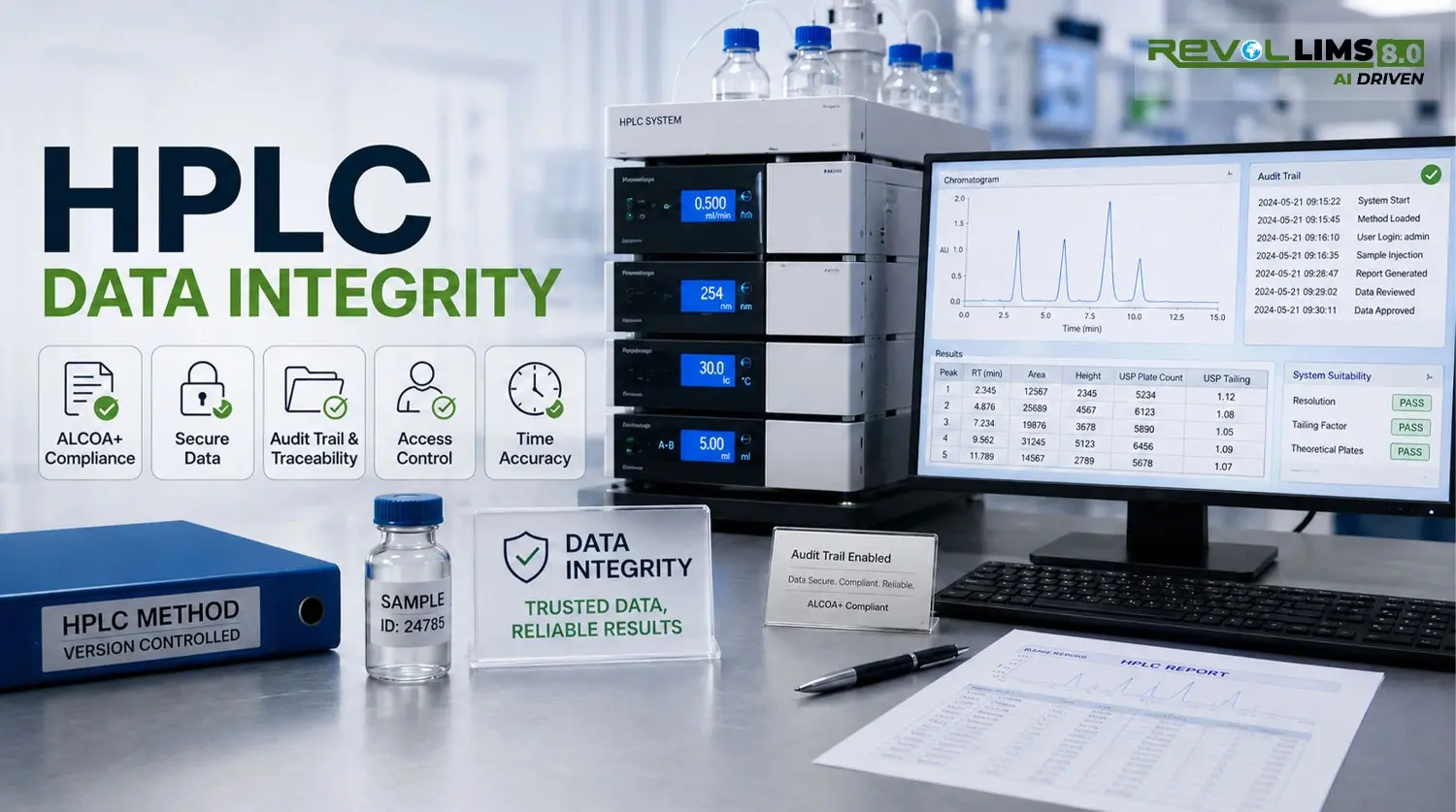
The reason regulators care is simple: LIMS results drive batch release, patient care and accreditation decisions. If a calculation is wrong or an audit trail has gaps, every result behind it becomes questionable, which is why validation is closely tied to data integrity and ALCOA+ expectations.
Does Your Lab Actually Need LIMS Validation?
In most regulated labs, yes. Elsewhere the answer is risk-based, and the rules your lab works under decide how much effort is justified.
| Lab type | Validation expectation | Typical driver |
|---|---|---|
| Pharmaceutical and GMP | Mandatory | 21 CFR Part 11, EU GMP Annex 11 |
| Clinical diagnostics | Expected | CLIA, CAP, ISO 15189 |
| Accredited testing and calibration | Required for accreditation | ISO/IEC 17025 information management requirements |
| Biobanks | Strongly expected | ISO 20387 traceability and documentation |
| Food, environmental, mining and others | Risk-based, often customer or accreditor driven | Customer audits, scheme rules |
Each row has its own context. Pharmaceutical labs face the strictest expectations, while clinical diagnostics labs work to the quality and competence requirements of the ISO 15189 standard. Accredited labs must show that their information management system is validated for functionality, as explained in this guide to ISO/IEC 17025 accreditation and in the ISO/IEC 17025 standard itself. Biobanks face similar documentation pressure, covered in this look at biobank LIMS and ISO 20387 compliance and in the international biobanking standard.
What Are IQ, OQ and PQ?
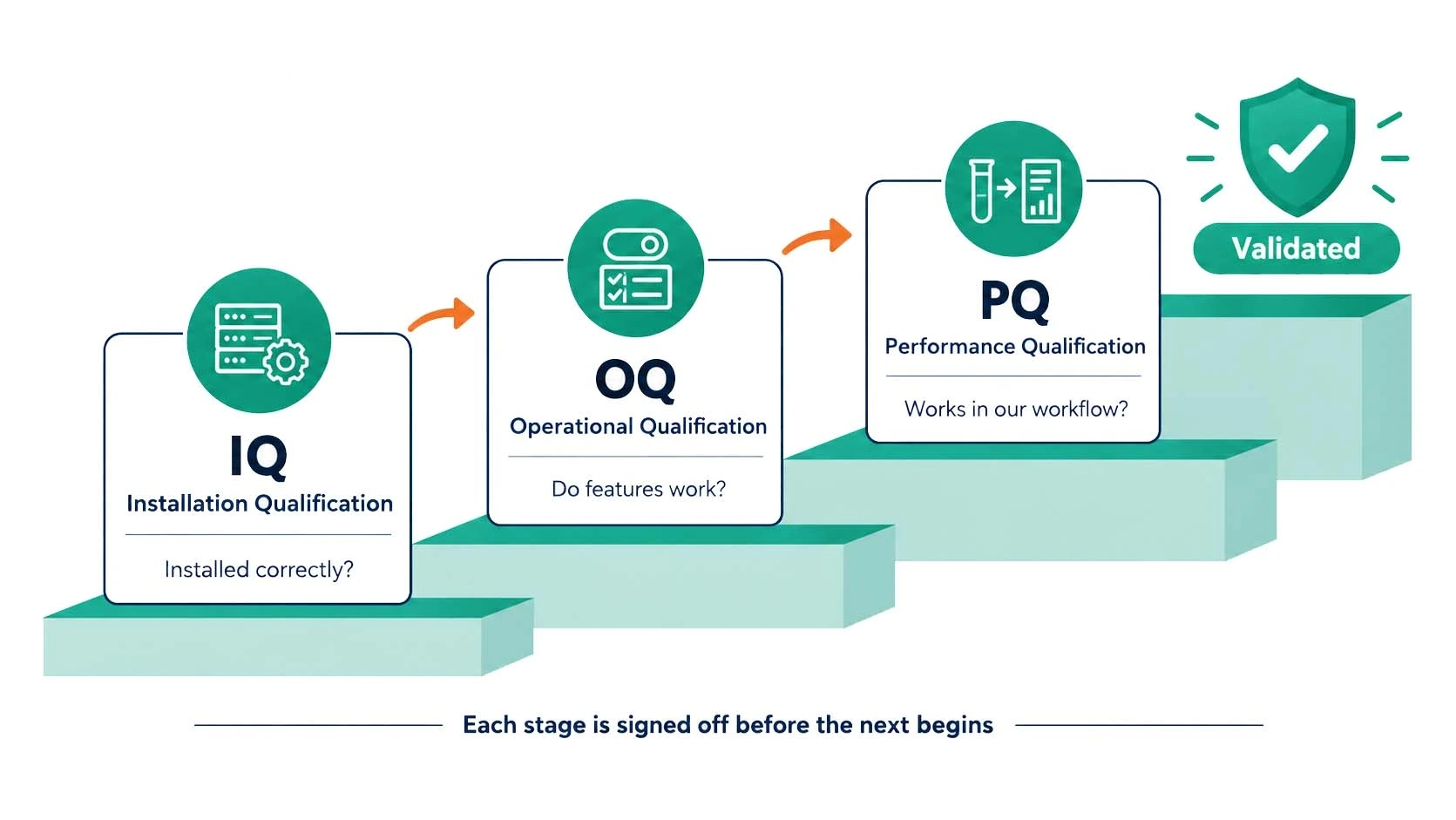
IQ, OQ and PQ are the three qualification stages inside a validation project: Installation, Operational and Performance Qualification. They always run in that order, and each must pass, with signed records, before the next one begins.
| Stage | Full name | Question it answers | Example test |
|---|---|---|---|
| IQ | Installation Qualification | Is the system installed and configured as specified? | Confirm software version, server and database settings, and user roles |
| OQ | Operational Qualification | Does each function work as designed? | Check that edits appear in the audit trail, that an unauthorised user is blocked, and that an out-of-specification result raises a flag |
| PQ | Performance Qualification | Does it hold up in our real workflow? | Run a sample from receipt to final report using your own methods and trained users |
Any failed test is logged as a deviation, investigated and resolved before the stage is signed off.
How Does the LIMS Validation Process Work?
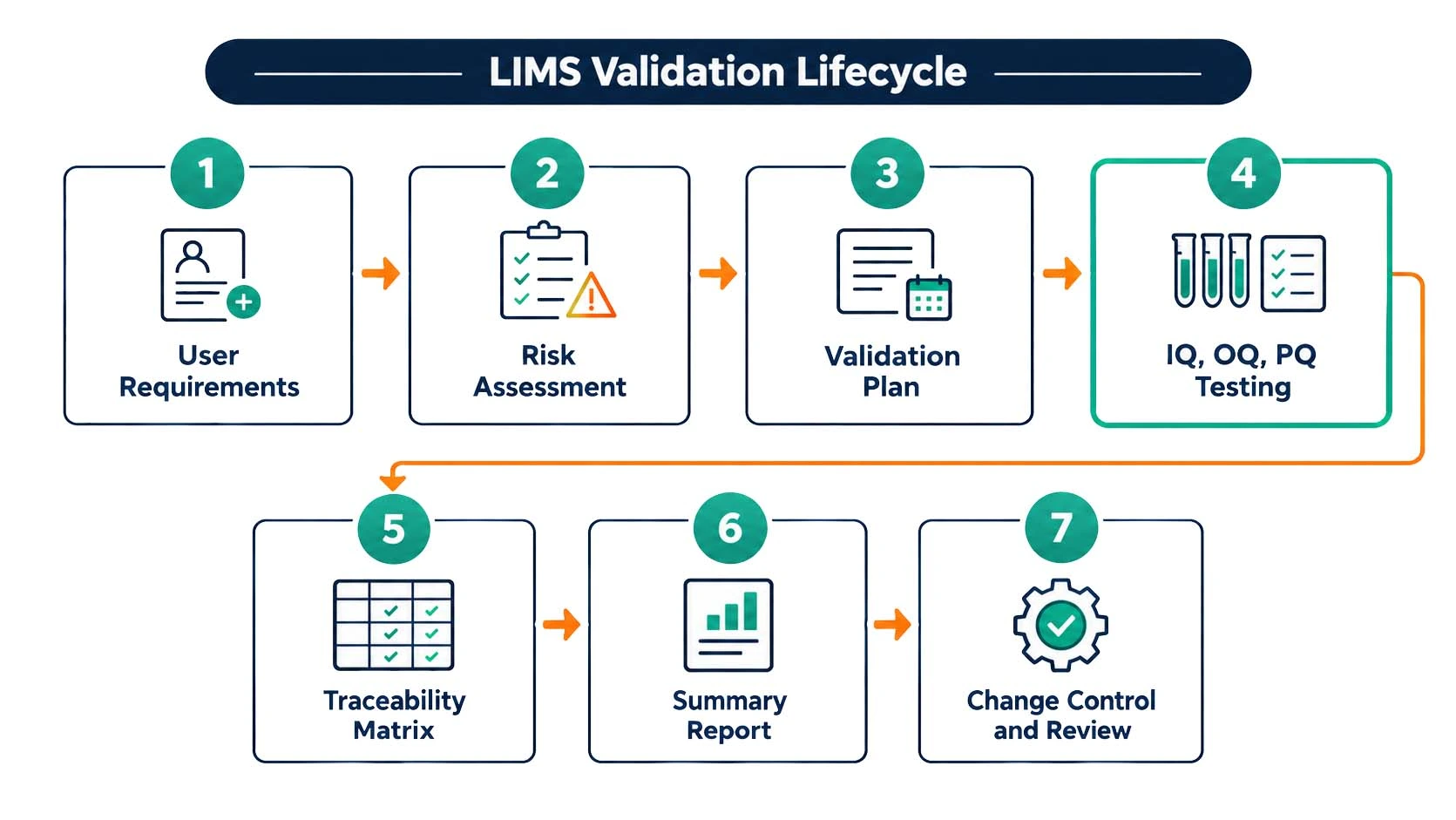
LIMS validation follows a seven-step lifecycle:
- User requirement specification (URS): what the lab needs the system to do.
- Risk assessment: which functions could affect data integrity, product quality or patient safety.
- Validation plan: scope, roles, deliverables and acceptance criteria.
- IQ, OQ and PQ execution: the three stages above, with evidence captured.
- Traceability matrix: a table linking every requirement to the test that proves it.
- Validation summary report: the formal conclusion that the system is fit for use.
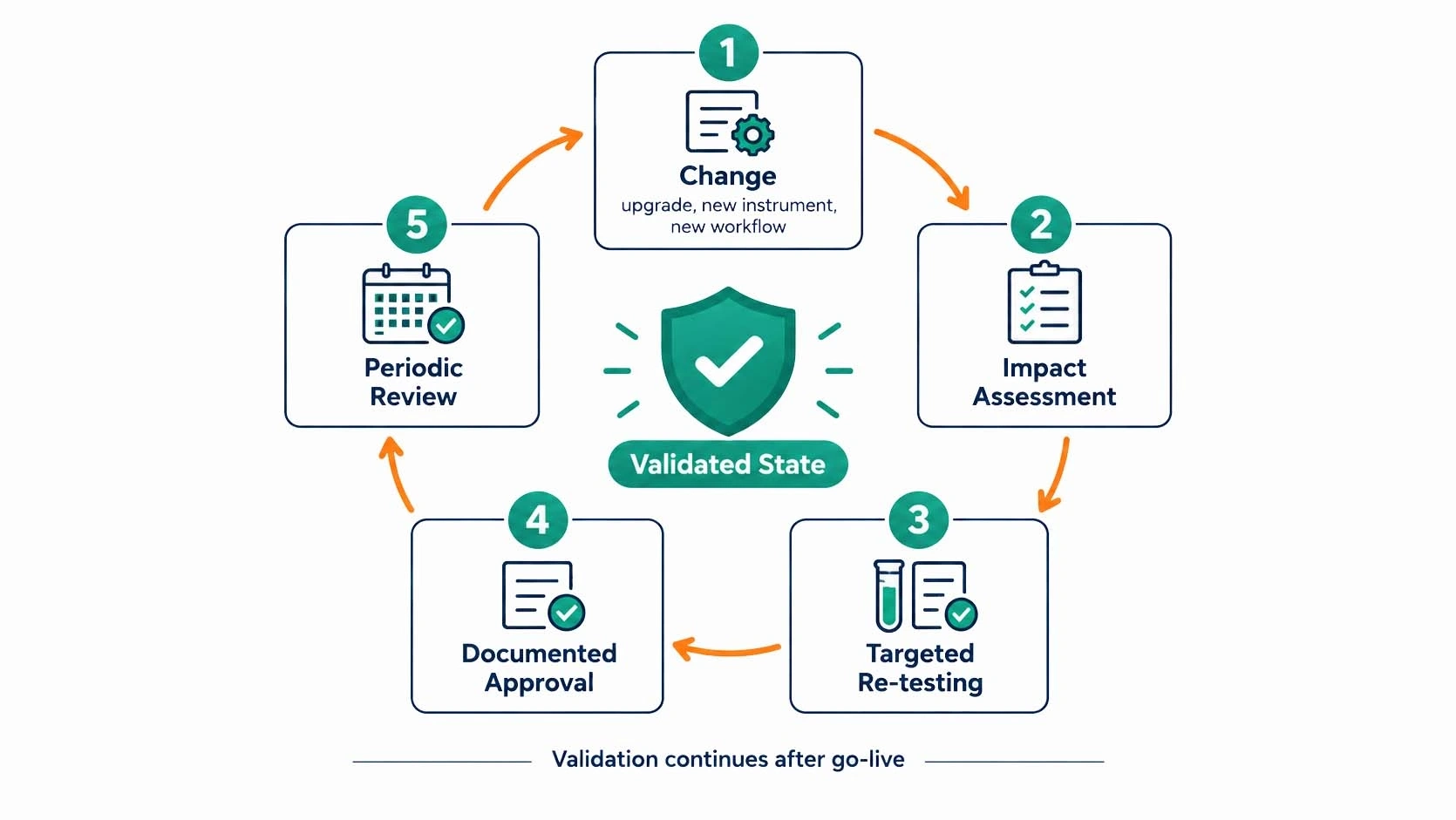
- Change control and periodic review: how the validated state is protected after go-live.
The ISPE GAMP 5 guide, whose second edition appeared in 2022, builds validation around a risk-based approach, which shapes steps 2 and 4. Test hardest where an error would matter most, such as result calculations, specification limits and approval workflows, and keep cosmetic settings light.
What Regulatory Updates Should Labs Watch?
In Europe, Annex 11 on computerised systems has been in force since 2011. A draft revision, released for stakeholder consultation in 2025 alongside a new Annex 22 on artificial intelligence, places more weight on lifecycle management, supplier oversight, audit trails, electronic signatures and security. Check the European Commission's GMP pages for the current status before relying on any draft wording.
In the United States, the FDA's Part 11 guidance on electronic records and signatures remains the central reference, and an FDA audit checklist helps you see where your records stand before an inspector does.
What Are the Most Common LIMS Validation Mistakes?
- Relying only on the vendor's standard test package and skipping the lab's own configuration
- Writing requirements after the system is chosen, leaving nothing to trace tests back to
- Testing every function with equal effort instead of focusing on high-risk ones
- Forgetting interfaces to instruments and other business systems
- Leaving spreadsheets or paper workarounds outside the validated system
- Keeping thin records: unsigned, undated or without evidence attached
Which LIMS Features Make Validation Easier?
Validation is faster and easier to defend when the system already contains the controls auditors look for:
- Secure audit trails: time-stamped, attributable records of every change
- Electronic signatures: linked to the user, the action and the record
- Role-based access control: permissions enforced by the system, not by habit
- Version-controlled configuration: changes tracked and approved before release
- Validation documentation support: test scripts and evidence packs that reduce lab effort
- Logged instrument integration: data transfers recorded rather than retyped
See these capabilities in the LIMS key features overview, and use this guide to choosing a LIMS for compliance when comparing vendors.
Frequently Asked Questions
Is LIMS validation mandatory?
Legally, it depends on your sector, but in practice most regulated or accredited labs are expected to show it. Pharmaceutical work carries the strictest rules. Elsewhere, accreditation bodies and customer audits usually set the bar. If neither applies, a lighter, risk-based validation file is still a wise precaution.
Who should be involved in LIMS validation?
A typical team includes a system owner from the lab, a quality assurance reviewer who approves the plan and final report, IT staff for installation and security, and the vendor for documentation and technical support. Trained end users take part in PQ testing. Naming each sign-off role in the validation plan prevents gaps and delays.
How long does LIMS validation take?
There is no fixed duration. Scope, the number of workflows, instrument interfaces and the documentation already available from the vendor all matter. A narrow, low-risk implementation can be validated far faster than a multi-site rollout. Planning requirements and the risk assessment early is the most reliable way to avoid delays.
Does a cloud or SaaS LIMS need validation?
Yes. A cloud vendor can supply qualification documents for its platform, but the lab remains responsible for showing the system works for its own configuration and intended use. Keep your own records of that testing, and ask how the vendor communicates product updates.
When does a LIMS need re-validation?
Whenever a change could affect functions you have already validated: software upgrades, new instrument interfaces, altered calculations or specifications, new workflows or a move to different hosting. A documented impact assessment decides how much re-testing is required. Not every change needs a full repeat, only the affected areas.
Conclusion
Validation is not paperwork for its own sake. It is how a lab proves that its results can be trusted, and that proof is far cheaper to build into a project from the start than to reconstruct before an audit.
Want to see how a validation-ready LIMS handles your own workflow? Request a demo and test it against your real requirements.
Author: Revol Team · marketing@revollims.com · www.revollims.com




 (1) (1).webp)