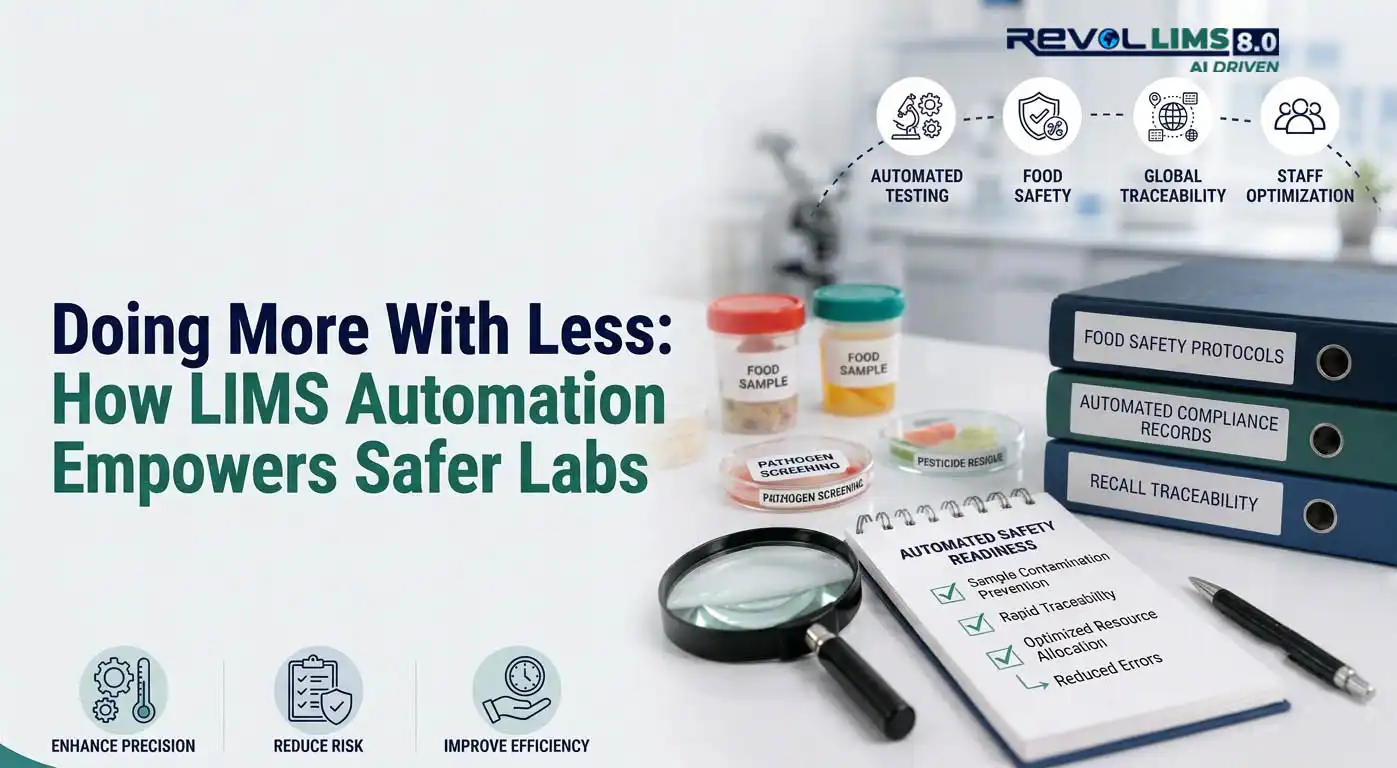
The Lean Lab Dilemma: More Samples, Fewer Hands
Food or beverage labs are being asked to do more every year, with the same team and the same budget. Sample volumes are rising. Test data is more complex. Regulators and customers expect faster, more complete records.
This is the lean lab dilemma. Here is what it looks like:
- More data: more products, more suppliers, and more tests per batch
- Tighter timelines: product release decisions depend on lab results
- Higher scrutiny: auditors, retailers, and regulators want proof, not promises
- Flat resources: hiring skilled analysts is slow and costly
Many labs still manage all of this with paper logbooks, spreadsheets, and manual data entry. Every manual step is a chance for error. In food safety, one wrong or missed result can reach a consumer.
The goal is not to work harder. The goal is to do more with less, without cutting corners on safety. LIMS automation makes that possible.
In this guide, you will learn:
- What LIMS automation is and how it works
- The four safety capabilities that matter most
- How a LIMS supports FDA 21 CFR Part 11 , ISO/IEC 17025, and FSMA
- How to measure the return on investment , and how to choose the right system
Quick Answer: What Is LIMS Automation in Food Safety?
LIMS automation in food safety is the digital integration of lab workflows that removes manual data entry, tracks samples from raw ingredient to finished product, and flags quality deviations instantly, helping keep contaminated goods off the market.
What Is a LIMS, and Why Does It Matter for Food or Beverage Labs?
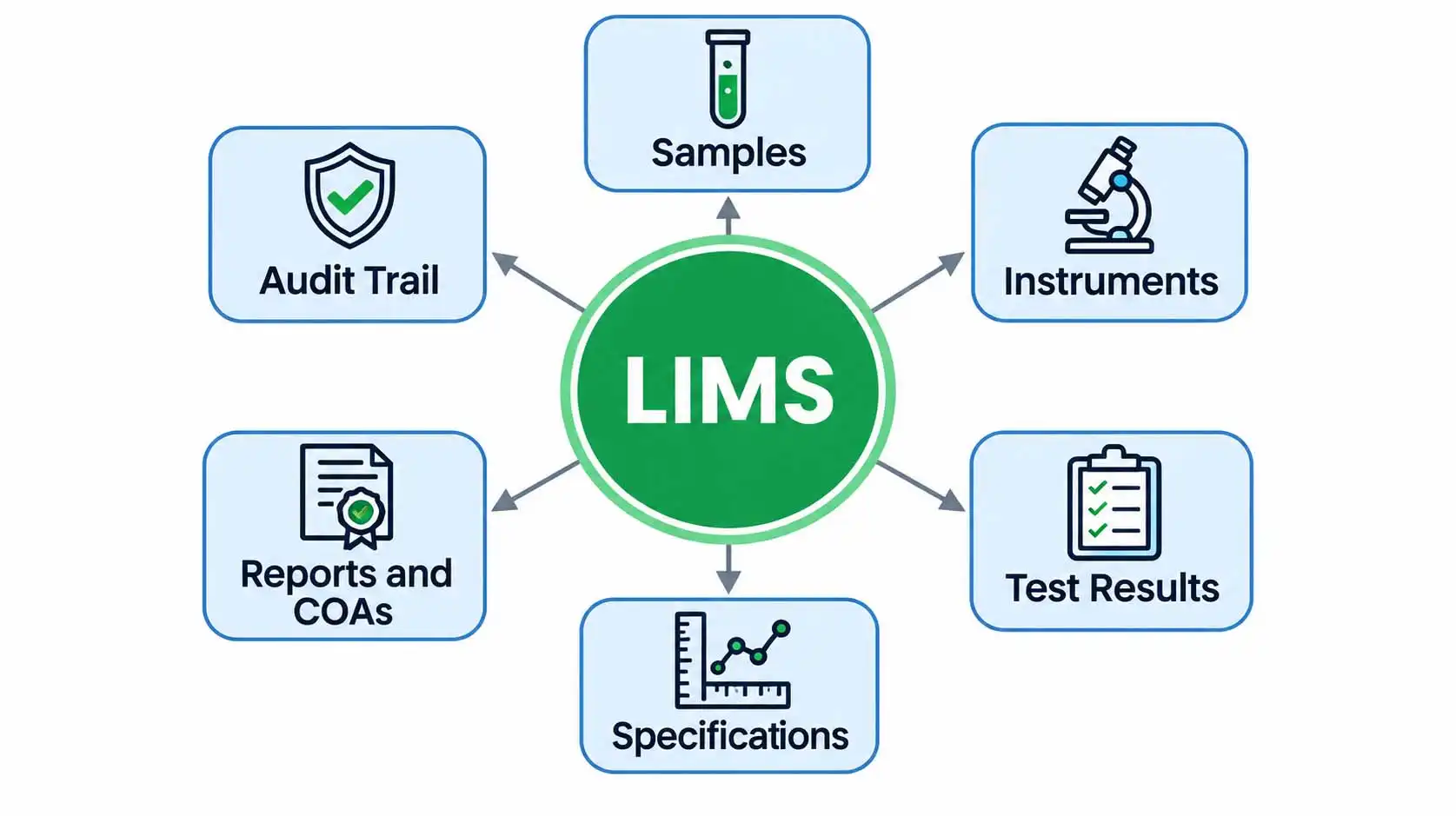
A Laboratory Information Management System (LIMS) is software that manages samples, tests, results, instruments, and reports in one place. Think of it as the central nervous system of your lab.
In a food and beverage setting, a LIMS typically handles:
- Sample login and unique ID labeling
- Test assignment and scheduling
- Specification limits for raw materials, in-process checks, and finished goods
- Results capture, review, and approval
- Reports and certificates of analysis (COAs)
- Audit trails, user permissions, and document control
The word automation is the key. A basic database stores information. An automated LIMS actively moves work forward. It assigns tests, pulls data from instruments, checks results against limits, sends alerts, and builds reports without someone retyping or chasing anything.
Why Manual Processes Fall Short
Spreadsheets and paper are familiar, and they work until they do not. Common weak spots include:
- Transcription errors. A misplaced decimal on a pathogen count can change a pass into a fail, or the other way around.
- Version confusion. Which spreadsheet holds the latest specification? Who changed it?
- Delayed detection. Problems show up at end-of-day or end-of-week review, not when they happen.
- Audit stress. Pulling records from binders, drives, and inboxes can take days.
- Weak data integrity. Paper and loose files make it hard to prove who did what, and when.
None of these are a sign of careless people. They are a sign of a system that asks people to do work that software does better.
Four Core LIMS Capabilities That Strengthen Lab Safety
Good LIMS software for food testing improves safety in many ways. Four capabilities stand out for food and beverage labs.
| Capability | What It Does | Safety Benefit |
|---|---|---|
| End-to-end traceability | Links every sample to its source ingredient, batch, and destination | Fast, targeted recalls and quick root-cause answers |
| Direct instrument integration | Sends results from the instrument straight into the LIMS | Removes transcription errors and lost printouts |
| Real-time OOS alerts | Notifies the right people the moment a limit is breached | Faster containment and decisions |
| Chain of custody and incubation logs | Timestamps every handoff, incubation step, and test stage | Reliable, defensible results that hold up in audits |
1. End-to-End Sample Traceability
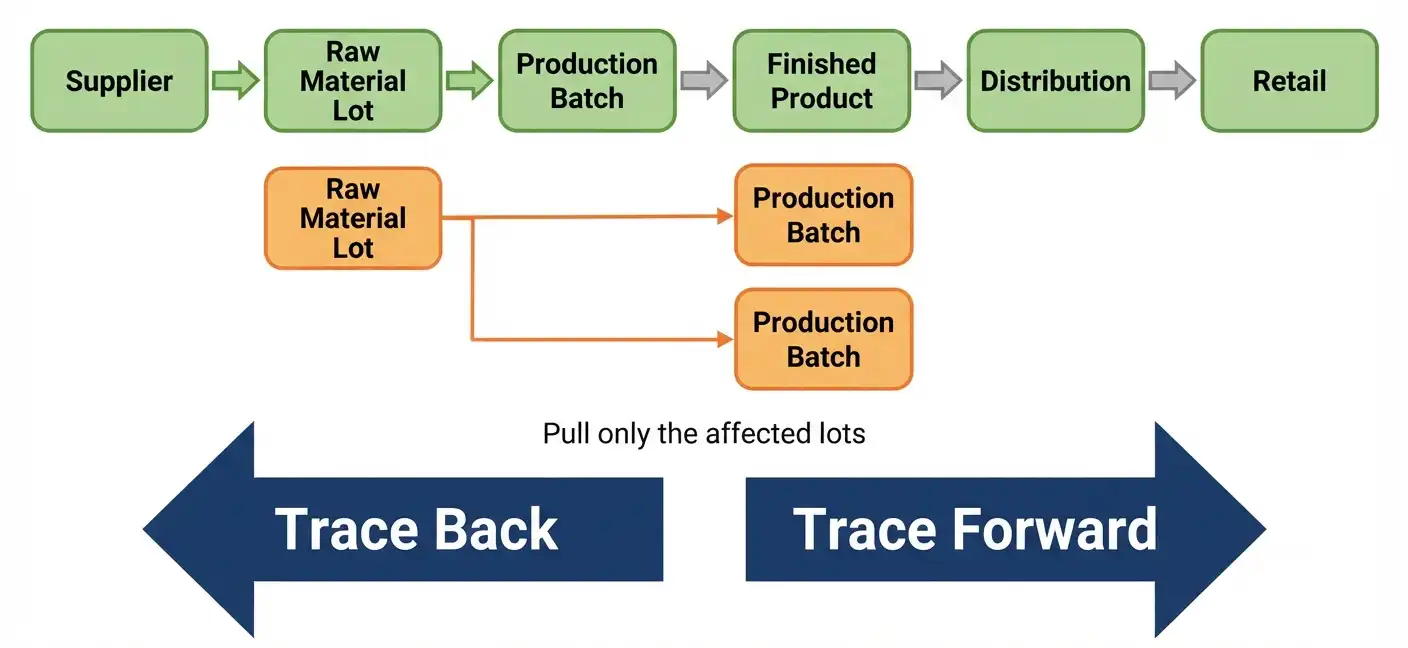
Traceability means you can follow a product from the supplier's truck to the retail shelf, and back again. A LIMS builds that chain automatically by linking each sample to a raw material lot, a production batch, a test record, and a finished-goods shipment.
When something goes wrong, you can answer the hard questions in minutes:
- Which batch is affected?
- Which ingredients and suppliers were involved?
- Which other products used the same ingredient lot?
- Where did the affected product ship?
That speed changes the nature of a recall. Instead of pulling everything produced that week, you can pull only the affected lots. Recalls become surgical instead of sweeping. That protects consumers first, and it also limits product loss, shipping costs, and brand damage.
Strong traceability also supports food traceability expectations under FSMA, which we cover below.
2. Direct Instrument Integration
Modern labs run on equipment: spectrometers, chromatography systems (HPLC, GC), pH meters, moisture analyzers, balances, PCR systems, and more. In many labs, someone still reads a number off a screen and types it into a sheet.
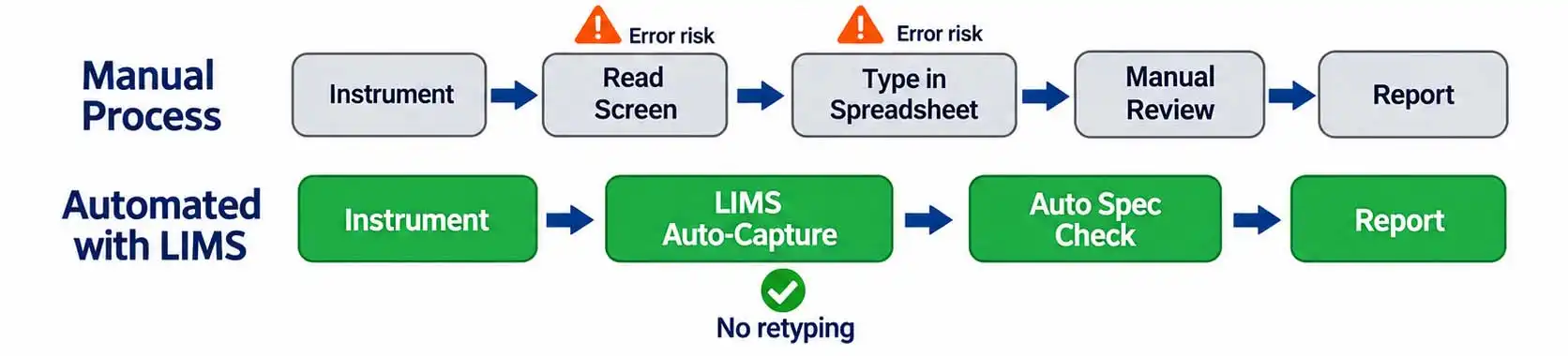
Direct instrument integration closes that gap. Results move from the instrument to the LIMS automatically, with the sample ID, method, analyst, and timestamp attached.
The benefits are practical:
- No retyping, so no typos or misplaced decimals
- No lost printouts or unreadable handwriting
- Raw data stays linked to the final result
- Analysts get time back for real scientific work
Manual transcription is one of the most common sources of lab data errors. It is also one of the easiest to remove.
3. Real-Time Out-of-Specification (OOS) Alerts
An out-of-specification (OOS) result is any result that falls outside the limits you have set for a product, whether that is a pathogen count, an allergen level, a chemical residue, or a nutritional value.
In a manual lab, an OOS result may sit in a notebook until someone reviews it. In an automated LIMS, the system checks each result against its specification the moment it arrives. If a limit is breached, it can:
- Flag the result on screen
- Notify QA managers by email, SMS, or dashboard
- Place the related batch on hold
- Start an investigation workflow with required steps and sign-offs
 Alerts.webp)
You no longer find the problem during end-of-day review. You find it while there is still time to act. In food safety, that gap between "result produced" and "result noticed" is where risk lives.
4. Chain of Custody and Incubation Logs
Some of the most important food tests are also the most time-sensitive. Microbial incubation, shelf-life studies, and stability programs all depend on exact timing and clean records.
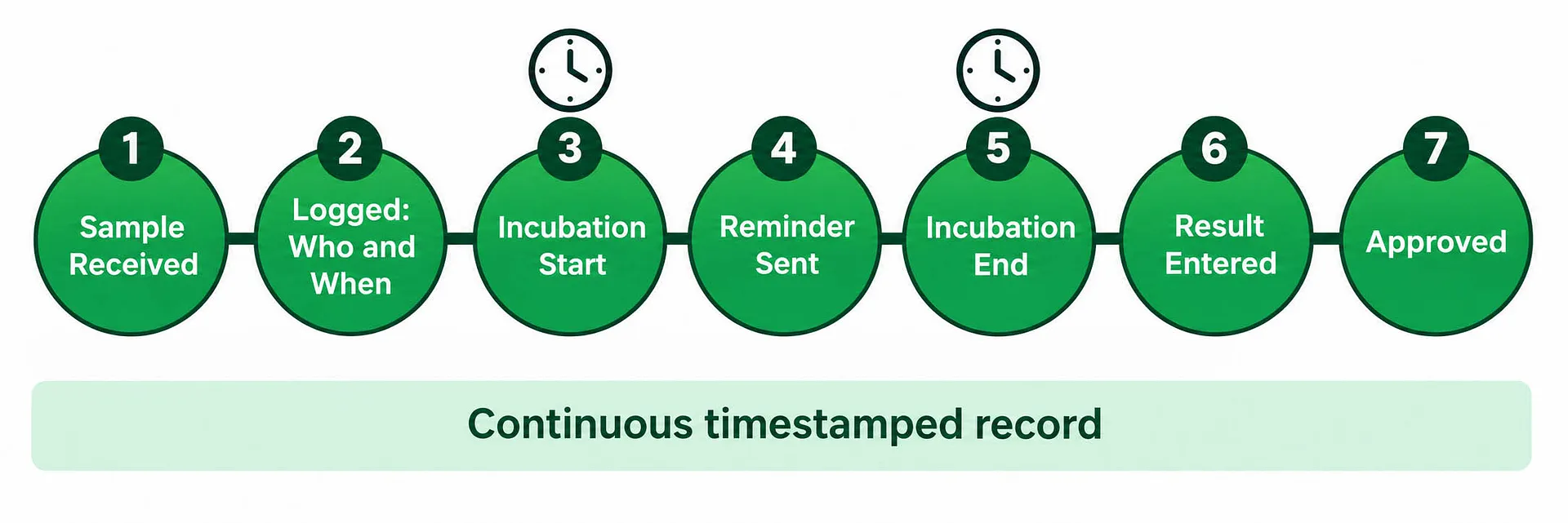
A LIMS supports this work by:
- Logging who handled each sample, and when
- Recording incubation start and end times and storage conditions
- Scheduling pull points for shelf-life and stability studies
- Reminding analysts when a test window is about to open or close
- Keeping a continuous, timestamped chain of custody
The result is a complete record that stands up in an audit. If anyone asks, "Was this sample held at the right temperature for the right time?" the answer is on screen.
Meeting Compliance Standards With LIMS Automation
Regulators and auditors want proof, not promises. A well-configured LIMS builds that proof into the daily routine instead of leaving it for a last-minute scramble.
| Standard | What It Covers | How a LIMS Helps |
|---|---|---|
| FDA 21 CFR Part 11 | Trustworthy electronic records and electronic signatures | Secure e-signatures, locked records, full audit trails |
| ISO/IEC 17025 | Lab competence, valid methods, reliable results | Calibration schedules, method control, analyst competency logs |
| FSMA (Food Safety Modernization Act) | Preventing hazards instead of reacting to them | Automated preventive-control records, monitoring, and traceability |
FDA 21 CFR Part 11: Electronic Records and Signatures
Part 11 sets the FDA's criteria for when electronic records and electronic signatures can be treated as trustworthy and equivalent to paper. A LIMS supports this with:
- Unique user logins and role-based access, so only authorized people can act
- Electronic signatures that are tied to one individual
- Secure, computer-generated audit trails that record who changed what, when, and why
- Record protection so data cannot be quietly edited or deleted
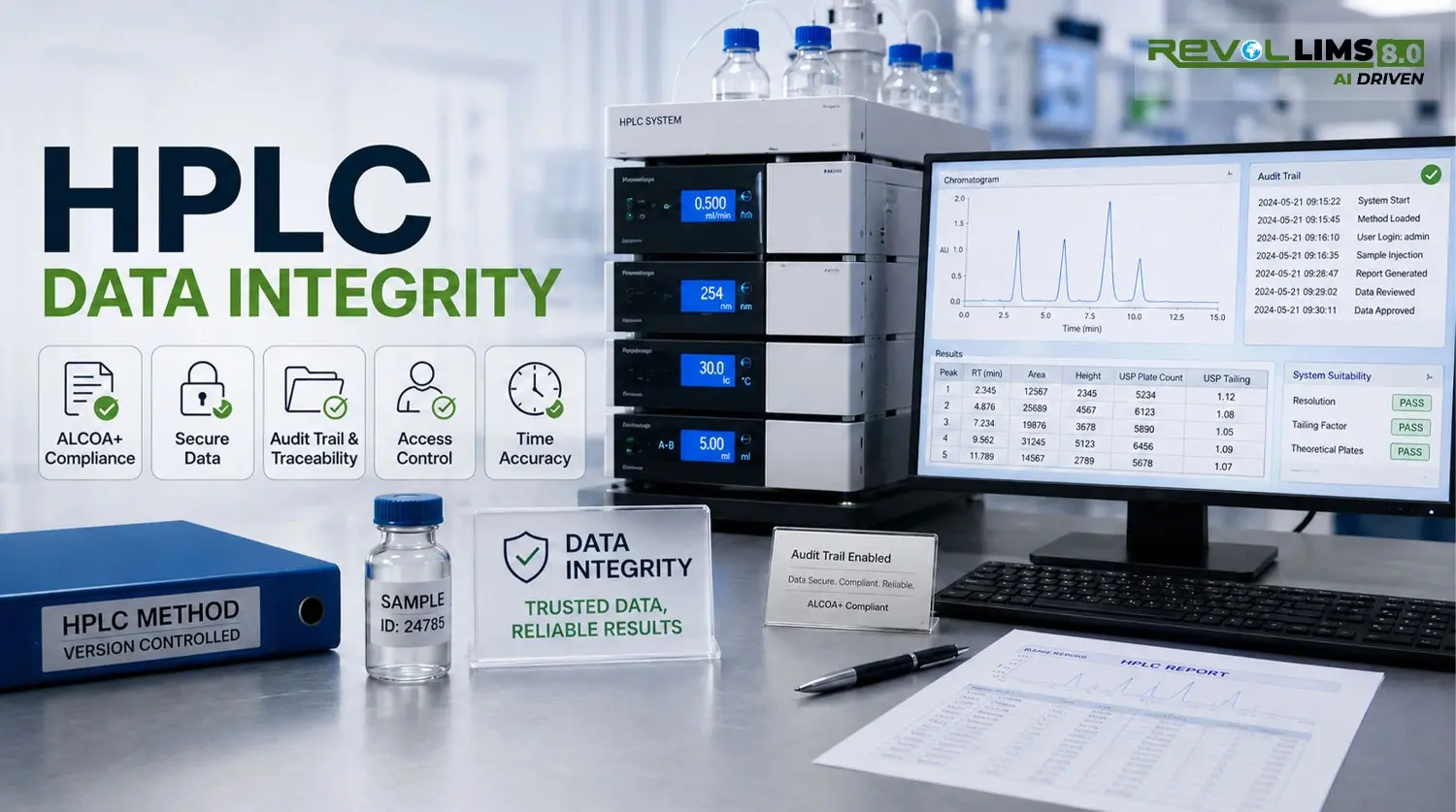
These features also support the widely used ALCOA+ data integrity principles: data should be attributable, legible, contemporaneous, original, and accurate, as well as complete, consistent, enduring, and available.
ISO/IEC 17025: Lab Competence and Valid Results
ISO/IEC 17025 is the international standard for testing and calibration laboratories. If your lab is accredited, or working toward it, you must show that your methods, equipment, and people are under control.
A LIMS helps you track and prove:
- Equipment calibration and maintenance dates, with alerts before they lapse
- Approved test methods and their current versions
- Analyst training and competency records
- Reference standards, reagents, and their expiry dates
- Measurement traceability and quality control results
Instead of searching for a calibration certificate during an assessment, you open a record.
FSMA: From Reacting to Preventing
The Food Safety Modernization Act (FSMA) shifted the U.S. food safety system from responding to contamination to preventing it. Facilities must identify hazards, set preventive controls, monitor them, and keep records to show it all works.
Lab data sits at the heart of that effort. A LIMS supports FSMA-related work by:
- Holding environmental monitoring and verification results in one place
- Trending data over time to spot drift before it becomes a failure
- Documenting corrective actions when a limit is exceeded
- Making records fast to retrieve when an inspector asks
- Supporting the traceability record-keeping that FSMA's food traceability requirements call for
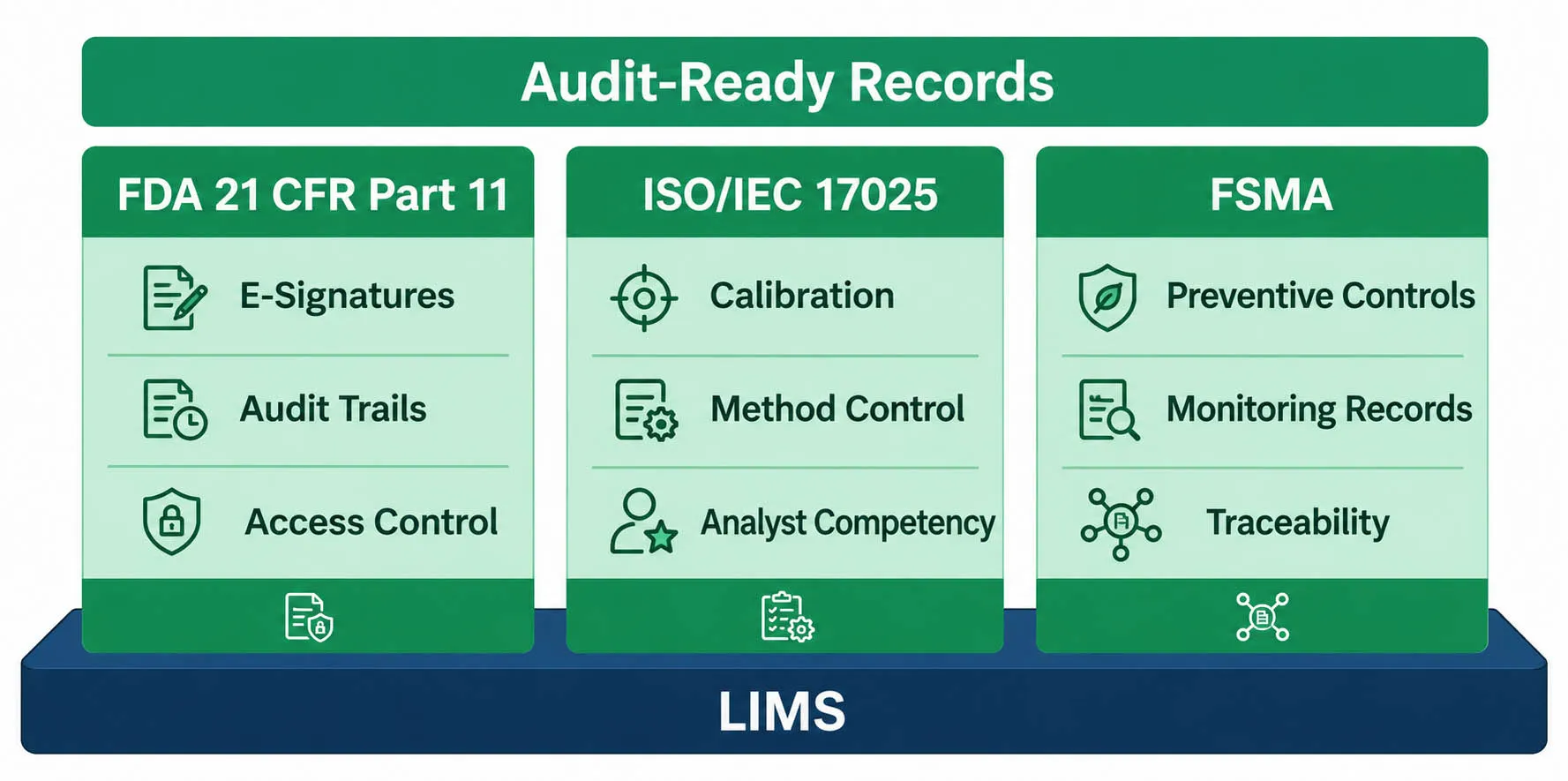
A LIMS supports compliance. It does not guarantee it. Validation, written procedures, training, and good lab practice still matter. Requirements and compliance dates change, so confirm current details with the FDA and your accreditation body for your specific products.
Many labs also use their LIMS to support broader quality frameworks such as HACCP, ISO 22000, and GFSI-benchmarked schemes like SQF, BRCGS, and FSSC 22000. The same traceability, audit trail, and record control features apply.
LIMS Automation in Action: Three Use Cases
The following scenarios are illustrative. They show how common lab problems look before and after automation.
Use Case 1: Dairy Plant Speeds Up Batch Release
The challenge: A dairy processor tests incoming milk, in-process samples, and finished products every day. Results were entered by hand, then reviewed on paper. Release decisions often waited on paperwork, not on the test itself.
The LIMS approach: Instruments sent results directly to the LIMS. Each result was checked against specification automatically. Passing batches were routed for fast approval, and only exceptions needed deeper review.
The outcome: Review time shifted from reading every number to reviewing exceptions. The result was faster, more consistent release decisions and a clean audit trail for every batch.
Use Case 2: Beverage Manufacturer Handles a Supplier Issue
The challenge: A beverage company found an off-spec result in an incoming ingredient. Without good traceability, the team would have needed to check several production runs by hand to see which finished products were affected.
The LIMS approach: Because every ingredient lot was linked to production batches and test records, the team ran a trace in minutes. It showed exactly which batches used the lot and which were still in the warehouse.
The outcome: A narrow hold instead of a broad one. Less product put at risk, less waste, and a clear record to share with the supplier and with customers.
Use Case 3: Ready-to-Eat Foods Lab Tightens Microbial Control
The challenge: A lab running environmental monitoring and pathogen testing relied on handwritten incubation logs. Missed read times and unclear handoffs created gaps that auditors questioned.
The LIMS approach: The LIMS logged incubation start and end times, reminded analysts when reads were due, and recorded every handoff. Positive results triggered immediate alerts and a structured investigation workflow.
The outcome: Fewer timing errors, faster response to positives, and records that were ready for audit on any day, not just the week before one.
The ROI of Doing More With Less
Safety and efficiency are often treated as trade-offs. With automation, they improve together. Here is where the return shows up.
Faster Turnaround Time (TAT)
Automated reporting removes manual compiling, formatting, and cross-checking. Many labs target report cycle time reductions of up to 40%. Your actual results will depend on your starting workflow, how many manual steps you remove, and how well the system is configured.
Why it matters: faster reports mean faster product release decisions, less time in holding, and fewer delays to customers.
Lower Administrative Overhead
Less time on paperwork means more time on science. Labs often see savings in areas such as:
- Manual data entry and double-checking
- Searching for records before audits
- Building COAs and routine reports by hand
- Training new staff on scattered, inconsistent processes
- Chasing sign-offs and reminders
Higher Throughput, Same Team
With routine tasks automated, a lean QC team can safely handle more samples without adding headcount. Analysts spend their hours on testing, review, and problem-solving instead of retyping and filing.
A Simple Way to Estimate Your Own ROI
Try this quick, back-of-the-envelope calculation. The numbers below are examples only. Swap in your own.
- Count the weekly hours your team spends on manual entry, report building, and record searching. Example: 5 people x 6 hours = 30 hours per week.
- Multiply by 50 working weeks. Example: 30 x 50 = 1,500 hours per year.
- Estimate the share automation could recover. Example: 50% = 750 hours.
- Multiply by your loaded hourly cost to get the annual value of time saved.
- Add the cost of avoided errors, retests, and recalls, then compare the total to the system cost.
Time savings are only part of the picture. One avoided broad recall can outweigh years of software cost.
| Before LIMS Automation | After LIMS Automation |
|---|---|
| Manual entry and double-checking | Automatic data capture from instruments |
| Paper logs and scattered spreadsheets | Centralized, searchable digital records |
| Days to compile audit data | Records retrieved in minutes |
| Issues found at end-of-day or end-of-week review | Issues flagged the moment they occur |
| Broad recalls because lot links are unclear | Targeted holds based on full traceability |
| Reports built by hand | Reports and COAs generated automatically |
How to Choose the Right LIMS for Your Food and Beverage Lab
Not every system fits every lab. When you compare options, use this checklist.
Questions to Ask Every Vendor
- Industry fit. Does the system include food and beverage workflows, such as specifications by product, microbial testing, and shelf-life studies?
- Instrument integration. Which of your instruments can connect directly? How is that done?
- Compliance features. Does it support audit trails, electronic signatures, and role-based access in line with 21 CFR Part 11 and ISO/IEC 17025 needs?
- Validation support. What documentation and testing support will you get?
- Ease of use. Can analysts learn it quickly? Can you change workflows without custom code?
- Integration with other systems. Can it connect to your ERP, QMS, or MES?
- Scalability. Will it grow with new products, new sites, or higher volumes?
- Deployment options. Cloud, on-premise, or hybrid? What do your IT and security teams need?
- Support and training. Who helps during rollout, and who helps after go-live?
Tips for a Smooth Rollout

- Start with a clear scope. Pick the highest-impact workflows first, such as sample login, results entry, and reporting.
- Involve your analysts early. The people who use it daily know where the pain is.
- Clean up your data. Review specifications, methods, and sample types before migration.
- Plan validation from day one. Do not leave it for the end.
- Train, then train again. Short, role-based sessions work better than one long one.
- Measure results. Track TAT, error rates, and audit prep time before and after.
Common Mistakes to Avoid
- Automating a broken process instead of fixing it first
- Skipping instrument integration and keeping manual entry "just for now"
- Treating the LIMS as an IT project instead of a quality project
- Underestimating training and change management
- Choosing on price alone
Frequently Asked Questions
What is a LIMS in a food and beverage lab?
A LIMS, or laboratory information management system, is software that manages samples, tests, results, instruments, and reports in one place. In a food and beverage lab, it tracks samples from raw materials through finished products and helps teams meet quality and safety requirements.
How does LIMS automation prevent data manipulation?
A LIMS uses several safeguards that work together:
- Audit trails record every action with the user, date, time, and reason.
- Role-based access controls who can view, edit, or approve data.
- Electronic signatures link approvals to specific individuals.
- Direct instrument integration keeps raw results from being retyped.
- Locked records prevent approved data from being quietly changed.
Changes are never silent. Any edit is visible, attributable, and traceable.
Can a LIMS manage shelf-life and stability testing?
Yes. A LIMS can schedule test pull points, track storage conditions, and log results over time. It sends reminders when tests are due and shows trends so you can see how product quality changes across its shelf life.
Does a LIMS make my lab compliant with 21 CFR Part 11?
Not by itself. A LIMS provides the technical controls, such as audit trails, electronic signatures, and access control. Your lab still needs validation, written procedures, trained staff, and proper configuration to show compliance.
How long does LIMS implementation take?
It depends on lab size, number of workflows, instruments to connect, and validation needs. Simple, focused rollouts can move quickly. Larger, multi-site projects take longer. A phased plan, starting with the highest-value workflows, usually works best.
Is a LIMS worth it for a small or mid-sized lab?
Often, yes. Smaller teams feel the cost of manual work the most, because each person carries more of the load. Cloud-based options can also lower upfront cost and IT effort. The best test is to estimate your own time savings, error reduction, and audit prep gains.
What is the difference between a LIMS and an ELN or QMS?
A LIMS focuses on sample and test management. An electronic lab notebook (ELN) captures experimental notes and research work. A quality management system (QMS) handles broader quality processes, such as document control and corrective actions. Many labs use them together, and some LIMS platforms include overlapping features.
Final Thoughts: Lean Does Not Have to Mean Risky
Food and beverage labs will keep facing more data, more scrutiny, and more pressure to deliver faster. Adding people is not always possible. Adding risk is never acceptable.
LIMS automation offers a better path. It removes manual steps where errors hide, flags problems the moment they appear, and builds the records that regulators and customers expect. It supports FDA 21 CFR Part 11 , ISO/IEC 17025, and FSMA-related work. And it gives lean QA/QC teams the room to handle more samples with confidence.
In short, it helps your lab protect consumers, pass audits with less stress, and get more done with the team you already have.
Ready to See What Automation Can Do for Your Lab?
Every lab is different, and the best way to understand the impact is to see it in your own workflows.
Book a personalized demo to see how LIMS automation can speed up reporting, tighten traceability, and strengthen safety in your food and beverage lab.
Not ready yet? Request a free lab workflow assessment, or download our LIMS buyer's checklist to start building your business case.
Ready to Strengthen Your Food Lab Safety?
Discover how LIMS automation improves efficiency and helps maintain food safety standards.
Book Your DemoAuthor: Revol Team

 (1) (1).webp)