LIMS for Refinery QC: Crude, Intermediate, and Finished-Product Testing
A modern refinery makes thousands of quality decisions every day. Each one depends on a laboratory result: whether a crude cargo matches its assay, whether a distillation cut can move to the hydrotreater, whether a diesel batch can be released to the terminal. When those results travel through spreadsheets, handwritten worksheets and disconnected instrument software, every decision inherits the delay and error risk of the slowest link.
A refinery LIMS (laboratory information management system) closes that gap. It connects sampling, ASTM test execution, specification checking, approval and reporting into one governed workflow that spans the crude yard, the process units and the product tanks.
Quick Answer: What Is a Refinery LIMS?
A refinery LIMS is a laboratory software platform that manages samples, test methods, instrument data, specifications and approvals across crude oil, intermediate streams and finished products. It enforces ASTM and ISO method requirements, flags out-of-specification results in real time, and keeps a complete, tamper-evident audit trail for regulatory and customer review.
Why Is Refinery Laboratory QC So Hard to Manage Manually?
Refinery laboratories combine high sample volumes, hazardous materials, tight turnaround windows and heavy regulatory exposure. Four bottlenecks appear repeatedly in plants that still rely on manual or semi-manual data handling:
- Turnaround pressure: process units cannot wait for a late result. A delayed intermediate-stream test can force a unit to run on stale data or hold material in a tank.
- Transcription risk: results retyped from a distillation apparatus, viscometer or analyzer into a report introduce errors that surface only at customer dispute or audit.
- Fragmented specifications: product grades, customer-specific limits and regional fuel rules live in different documents, so analysts apply the wrong limit or an outdated revision.
- Weak data integrity: shared logins, editable spreadsheets and unlogged result changes cannot withstand a ISO/IEC 17025 assessment or a custody transfer dispute.
Lab automation in oil and gas addresses these points structurally rather than by adding headcount. For a broader view of the software category, see our primer on what a LIMS is and how it works.
How Does a LIMS Interact with ASTM Standards?
Direct Answer
A LIMS does not replace ASTM standards; it encodes them, so every analyst and instrument follows the same method definition. ASTM method compliance becomes a system-enforced behavior instead of a training-dependent habit.
In practice, ASTM alignment inside a LIMS operates at four levels:
- Method definition: test components, units, significant figures, calculations and required equipment are configured once and version-controlled.
- Precision control: duplicate results are compared against method repeatability, and results outside the permitted difference are flagged for retest before they are released.
- Specification conformance: finished product specification ASTM limits, such as those in ASTM D975 for diesel and D4814 for gasoline, are stored per grade and applied automatically at result entry.
ISO/IEC 17025 sits above this layer. Clauses on method validation, result validity assurance, reporting and data and information management map to LIMS configuration.
Crude Oil Testing: Incoming Quality and Custody Transfer Validation
Crude receipt is where laboratory data carries direct financial weight. Density, water and sediment, salt and sulfur drive transfer value and downstream blending decisions. Errors here are expensive and contestable.
What Tests Matter for Crude Receipt?
Typical crude acceptance panels include density (ASTM D4052), water by distillation or Karl Fischer (ASTM D4006 or D4928), sediment, salt content, sulfur (ASTM D4294), and vapor pressure for volatile crudes. Assay-level work adds distillation yields and hydrocarbon characterization.
How Does a LIMS Support Custody Transfer Validation?
Custody transfer validation requires proof that the sample is representative, traceable and untouched between the transfer point and the result. A refinery LIMS supports that proof by:
- Registering each sample against a tank, pipeline, vessel or truck, with sampling method and time recorded at source.
- Maintaining an unbroken sample chain, comparable to the approach described in our guide to chain of custody in a LIMS.
- Linking density and water results to the volume correction calculations used to report net standard volume.
Crude oil testing compliance also depends on referencing the sampling practices that govern representativeness, such as ASTM D4057 for manual sampling and D4177 for automatic sampling. The LIMS records which practice was applied, so a dispute can be answered from the record rather than from memory.
Intermediate Stream QC: Keeping Process Units on Target
Intermediate streams (naphtha, kerosene, gas oil, vacuum gas oil, reformate, FCC and hydrocracker feeds and products) are where laboratory speed has the largest operational leverage. Intermediate stream QC determines whether a unit holds its operating window or drifts toward off-spec production.
What Makes Intermediate Stream QC Different?
Samples arrive on a fixed schedule and results feed operating decisions within hours. This is a scheduling and trend problem as much as an analytical one. Many of the same process-stream challenges appear in chemical and petrochemical laboratories.
- Sample point and schedule automation: recurring samples are generated automatically by unit, stream and frequency, and analysts receive worklists instead of paper requests.
- Trend and limit alerting: control limits tighter than the product specification warn operators before a stream reaches an out-of-specification condition.
- Closed-loop visibility: approved results are published to operations teams quickly enough to influence unit setpoints.
How Does Multi-Method Sequencing Work?
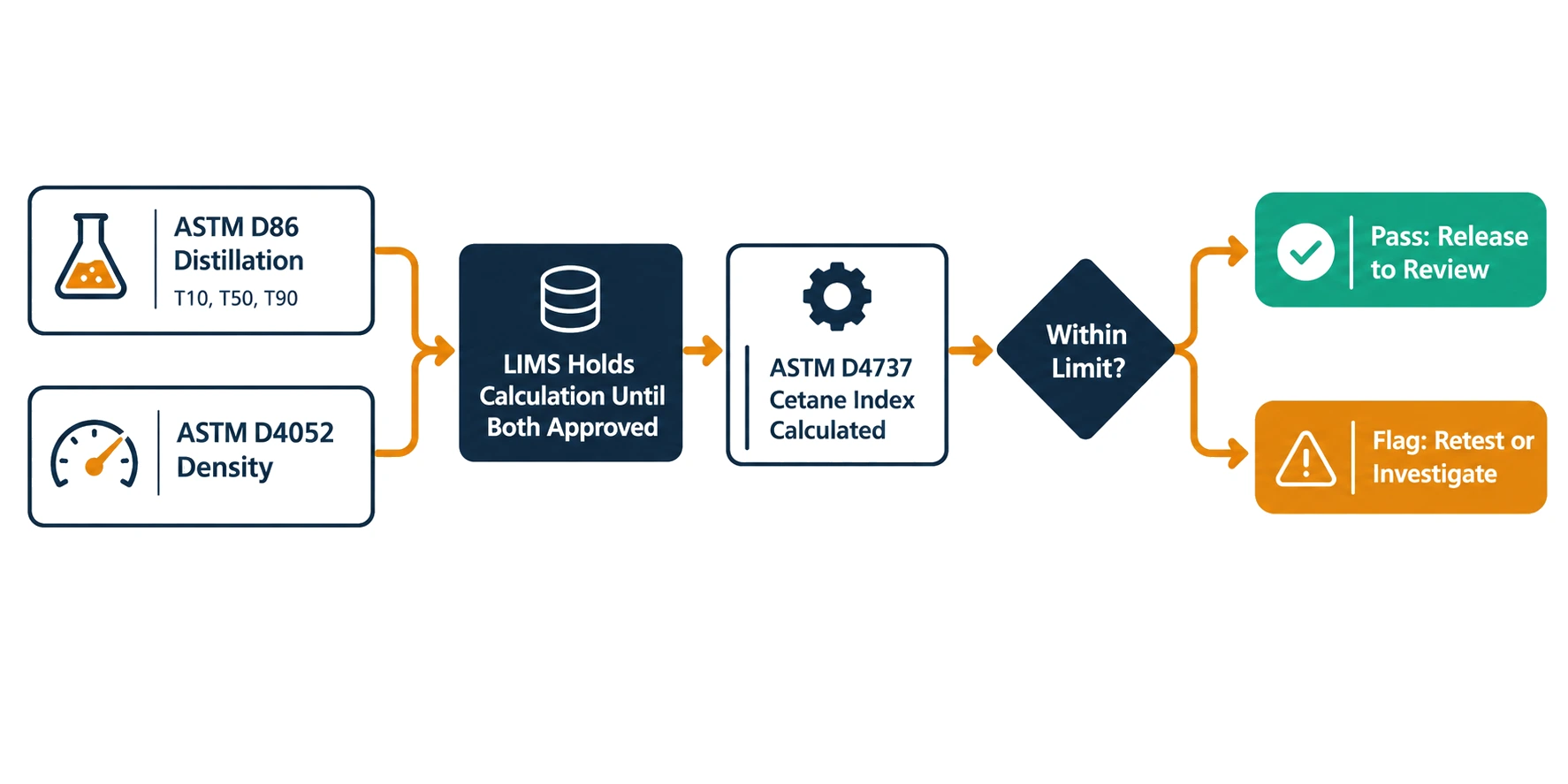
Multi-method sequencing means the LIMS orders and links related tests so results flow correctly between them. A diesel-range sample illustrates the point: the calculated cetane index (ASTM D4737) requires both density and distillation points from ASTM D86. The LIMS holds the calculation until both inputs are approved, then computes and checks the result automatically.
Common ASTM methods in refinery QC and the LIMS controls applied to each
| Test (ASTM) | Typical Stream | LIMS Control |
|---|---|---|
| D86: atmospheric distillation | Naphtha, kerosene, diesel | Barometric correction, IBP/T10/T50/T90/FBP limits, recovery and loss checks |
| D4052: density | Crude, gas oil, finished fuels | Temperature normalization, feeds dependent calculations |
| D445: kinematic viscosity | Gas oil, fuel oil, lubricant base stocks | Duplicate precision check, bath temperature record |
| D93: flash point | Diesel, fuel oil | Barometric correction, reproducibility flag |
| D6730: detailed hydrocarbon analysis | Gasoline blendstocks, reformate | Direct import from hydrocarbon analysis software, component grouping, automated calculations |
The same sequencing logic applies to other oil analysis programs, such as the dissolved-gas and dielectric testing covered in our guide to transformer oil testing at scale.
Finished-Product Testing: Specification Conformance and Release
Finished-product release is the last control point before material leaves the tank farm, and the point where an undetected error carries commercial and reputational cost.
How Is Finished Product Specification Conformance Verified?
The LIMS evaluates each approved result against the active specification for the product grade, customer and destination, then aggregates the evaluation into a batch-level decision. This replaces manual cross-referencing of results against limit tables.
- Grade-level and customer-level specifications, with revision history and effective dates.
- Automatic pass, fail and borderline flags, including conformance assessment that accounts for test method precision, consistent with ASTM D3244 and the interpretation principles of ISO 4259.
- Certificate of analysis generation drawn only from approved, locked results.
- Tank and batch genealogy so a quality query can be traced back to the blend components and their test records.
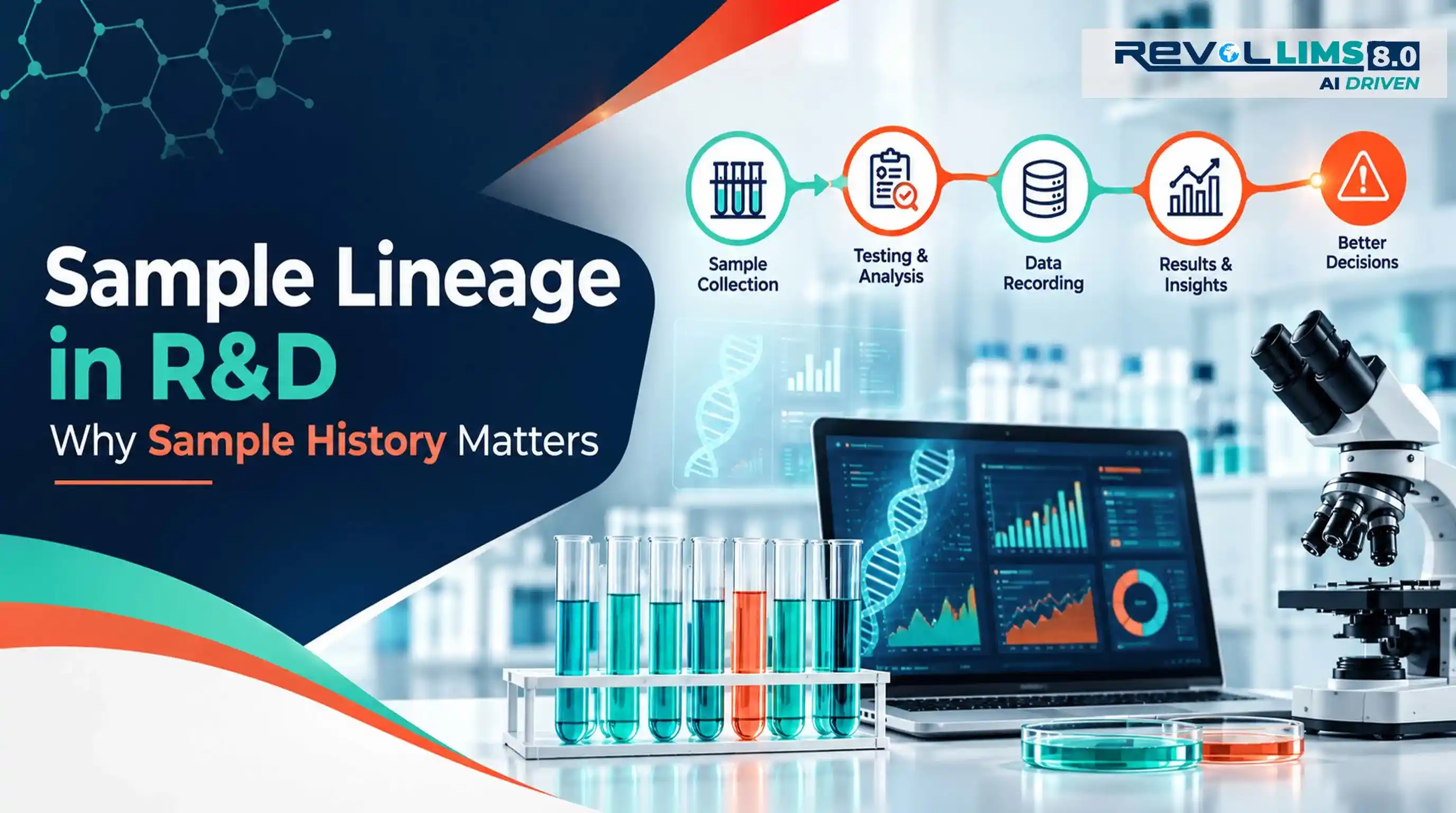
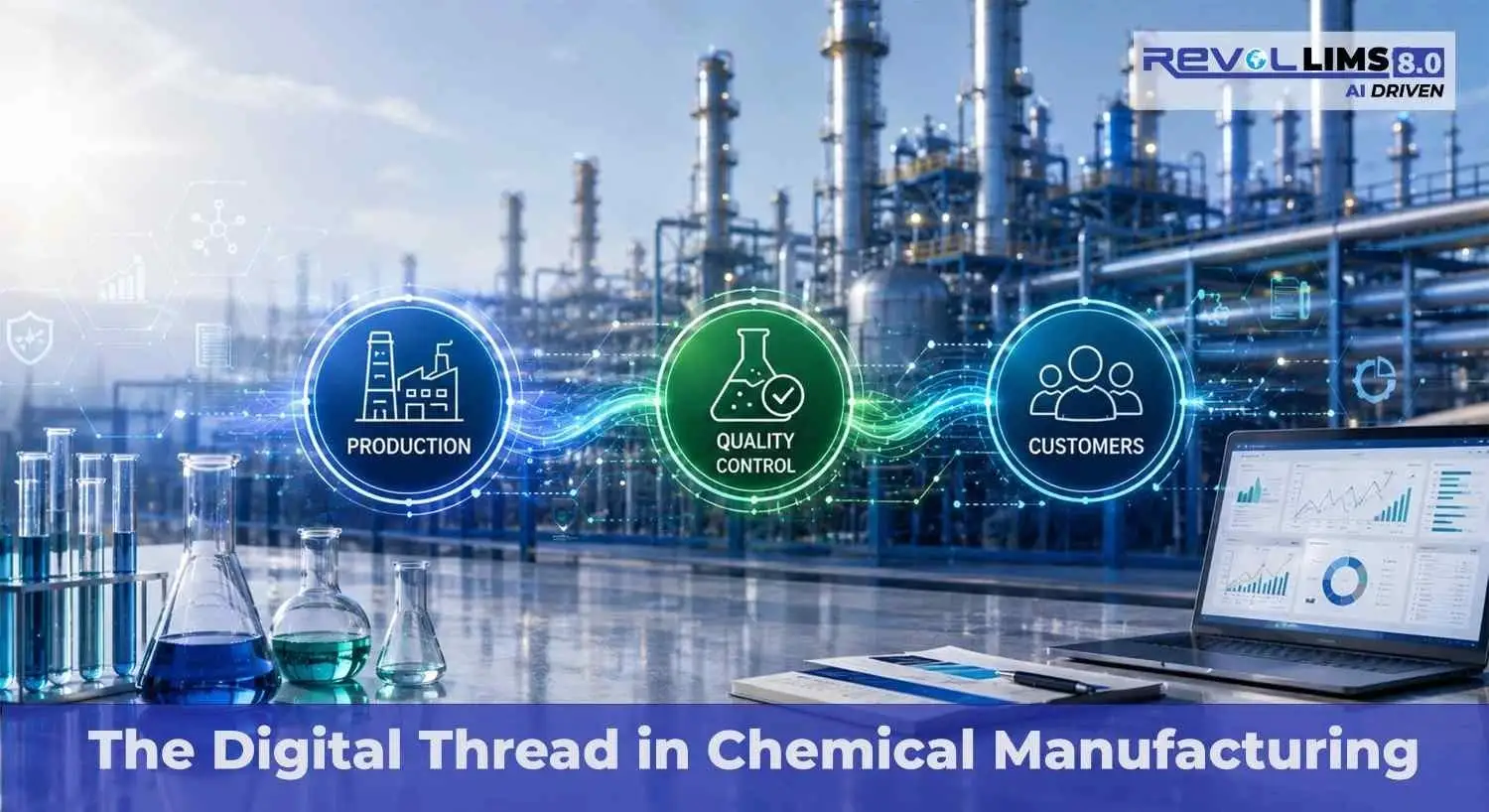
The same lineage logic is covered in depth in our article on sample lineage and why sample history matters, and the broader concept of unbroken data flow appears in the digital thread in chemical manufacturing.
What Regulatory Frameworks Does a Refinery LIMS Support?
Refinery laboratories answer to quality standards, environmental regulators and customers at the same time. A LIMS consolidates the evidence for all three.
Regulatory and quality frameworks relevant to refinery laboratories
| Framework | Refinery Relevance | LIMS Contribution |
|---|---|---|
| ISO/IEC 17025 | Competence of testing laboratories, result validity, data management | Method control, equipment and calibration records, audit trail, approval workflow |
| EPA 40 CFR Part 63, Subpart CC and Methods 325A/325B | Benzene fenceline monitoring at petroleum refineries | Sampler deployment records, 14-day sample cycles, laboratory result capture and report-ready data (see the EPA refinery fenceline monitoring overview) |
| EPA fuel quality regulations (40 CFR Part 80) | Gasoline sulfur and other fuel parameter limits | Batch-level sulfur tracking and averaging support, specification locking |
| ASTM product specifications | Grade definitions such as D975 and D4814 | Specification libraries with revision control |
Environmental testing programs share many of these controls, as shown in our overview of LIMS for water and environmental laboratories.
How Does a Refinery LIMS Integrate with SAP S/4HANA and Plant Systems?
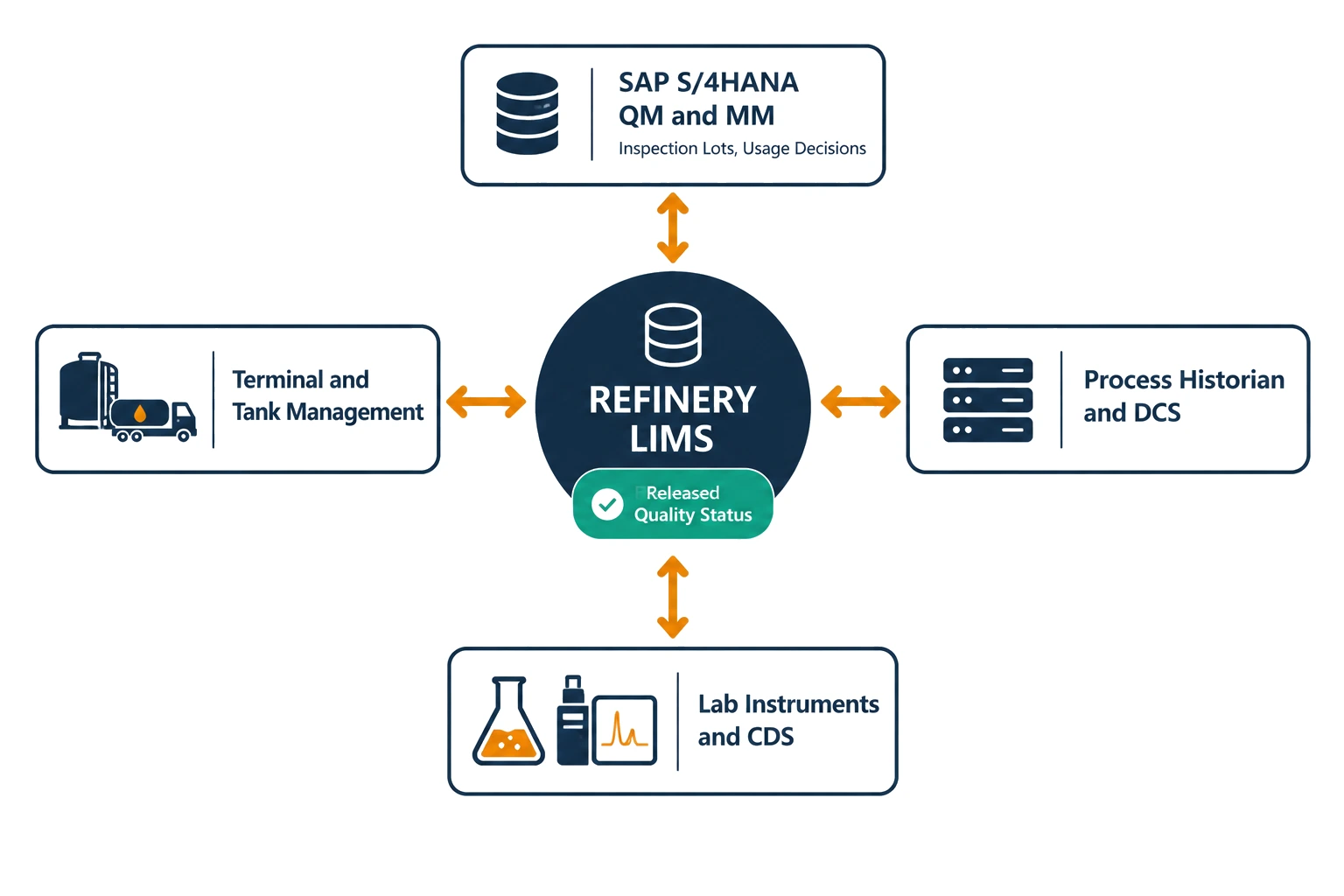
For IT procurement teams, integration depth often determines project value more than the laboratory feature list. A refinery LIMS typically exchanges data with four system classes:
- SAP S/4HANA (Quality Management and Materials Management): inspection lots and material batches flow into the LIMS as test requests; approved results and usage decisions flow back, so stock status and batch release follow laboratory approval without re-keying.
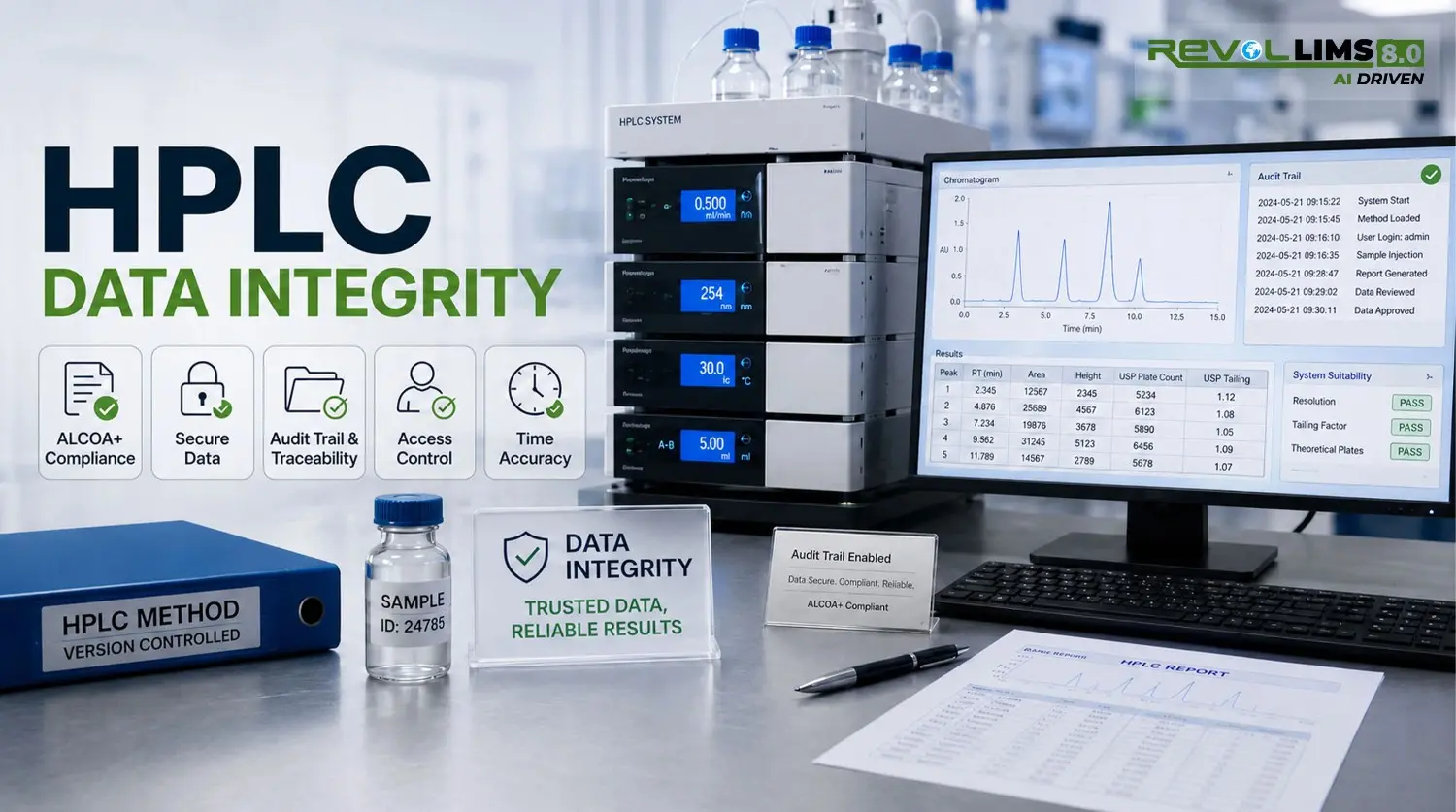
- Laboratory instruments and chromatography data systems: distillation apparatus, viscometers, density meters, analyzers and GC systems transfer results directly into the LIMS, which is the foundation of refinery laboratory data integrity.
- Process historians and distributed control systems: laboratory results appear alongside online analyzer data for correlation and inferential model calibration.
- Terminal and tank management systems: product movement is gated by released quality status.
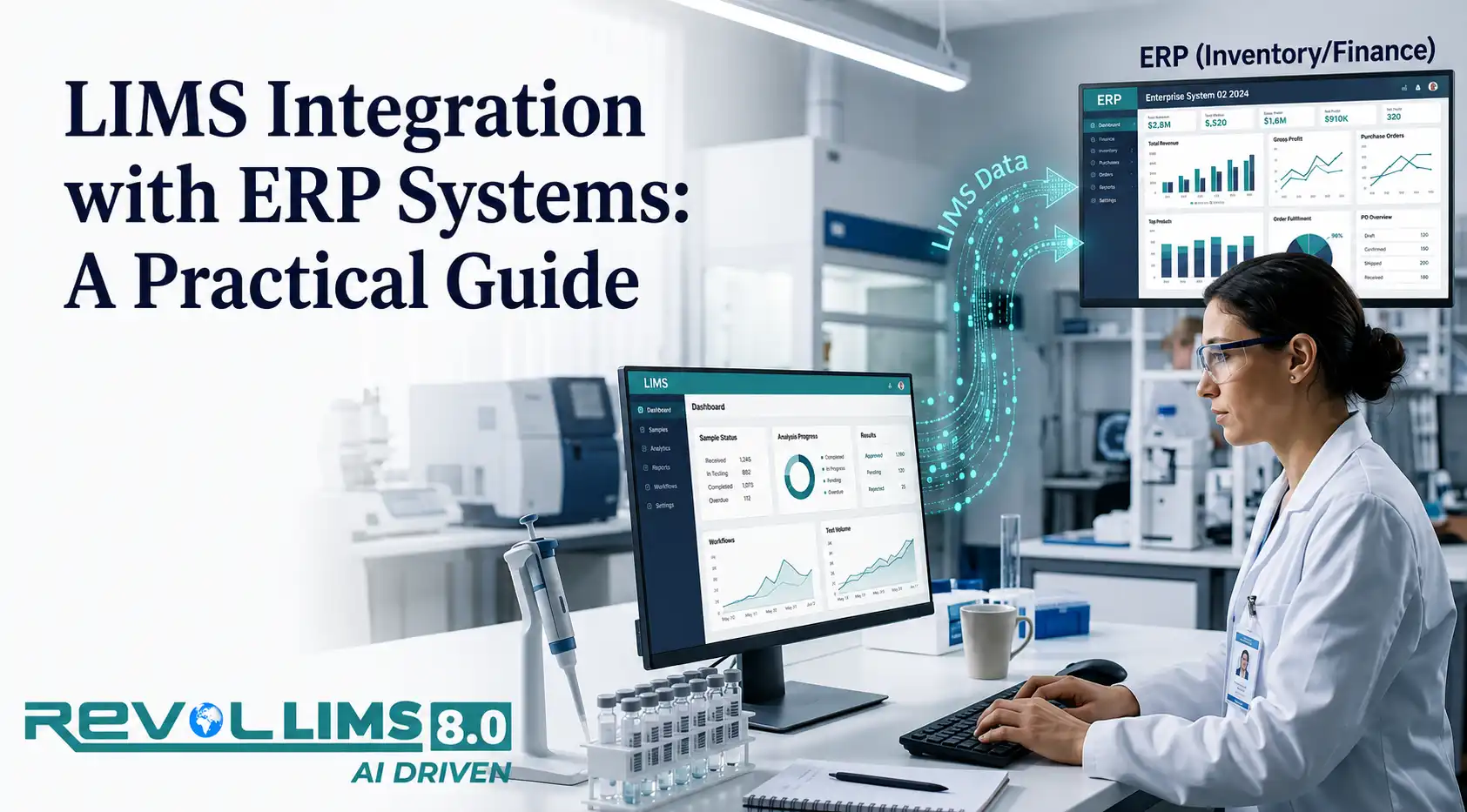
For a vendor-neutral walkthrough of order, invoice and inventory exchange between laboratory and enterprise systems, see our practical guide to LIMS integration with ERP systems.
Modern LIMS Key Features for Refinery Quality Control
When evaluating platforms, focus on capabilities that remove the specific bottlenecks above. Our overview of core LIMS features provides the general checklist; the refinery-specific priorities are:
- Refinery-structured sample management: a hierarchy of site, unit, stream and sample point, with scheduled and event-driven sampling.
- Configurable ASTM method library: calculations, precision limits and version control without custom code.
- Specification management: grade, customer and regional limits with automatic conformance evaluation.
- Instrument integration: direct result capture with no manual re-entry.
- Audit trail and electronic approvals: user-attributed, time-stamped records of every create, change and approval action.
- Statistical quality control: trending, control charts and laboratory proficiency monitoring.
- Enterprise integration: certified connectivity patterns for SAP S/4HANA, historians and terminal systems.
- Multi-site governance: shared method and specification masters across refineries with local flexibility.
- Dashboards and reporting: turnaround, backlog, out-of-specification rate and certificate-of-analysis delivery.
What Should Buyers Verify Before Selecting a Refinery LIMS?
Beyond the capabilities listed above, confirm these delivery and commercial points before shortlisting a vendor:
- Reference deployments: has the vendor delivered refinery or petrochemical laboratories, and can you speak with those users?
- Validation package: what documentation supports validation for intended use under ISO/IEC 17025?
- Data migration: how will historical results, specifications and method versions move from legacy systems?
- Upgrade path: do configured methods and specifications survive version upgrades without rework?
- Support model: is round-the-clock support available for a plant that runs continuously?
- Total cost: do license, implementation, training and support appear in a single quote?
Frequently Asked Questions
Is a LIMS required for ISO/IEC 17025 accreditation?
No. ISO/IEC 17025 does not mandate a LIMS. Where a laboratory uses an information management system, clause 7.11 requires it to be validated for its intended use and protected against unauthorized access, tampering and data loss. Refinery laboratories often adopt a LIMS because meeting those controls manually is difficult at refinery sample volumes.
How is a refinery LIMS different from the quality module in SAP S/4HANA?
SAP S/4HANA Quality Management governs enterprise-level inspection plans, lots and usage decisions. A LIMS manages what happens inside the laboratory: method execution, instrument data capture, precision checks and result approval. The two systems are complementary.
How does a LIMS handle ASTM method revisions?
Each method is version-controlled with an effective date. After the laboratory validates a revised standard, the new version is activated on a set date, while earlier results remain linked to the version used when they were produced.
What is the difference between a LIMS and a chromatography data system?
A chromatography data system acquires and processes chromatograph output, such as ASTM D6730 detailed hydrocarbon analysis runs. A LIMS manages the sample, workflow, specification and approval around that data. Refinery laboratories typically run both, with finalized results passing into the LIMS.
Conclusion
Laboratory results are the control signal that connects refinery operations, commercial transfers and regulatory reporting. Treating the LIMS as the governed path for that signal, rather than as a place to store records, is what separates defensible quality decisions from fragmented record keeping. Teams planning a project can start with the highest-friction workflow, typically crude receipt or a high-frequency intermediate stream, and expand from there.
See a Refinery QC Workflow in Action
Explore how a configurable LIMS handles crude, intermediate and finished-product testing for your refinery and oil and gas laboratory, from ASTM method control to SAP integration.
Book a DemoAuthor: Revol Team · marketing@revollims.com · www.revollims.com


 (1) (1).webp)