Implementing Industry 4.0: A Guide to Cement Lab Digitalization and LIMS Integration
Cement plants run around the clock, but many quality control laboratories still depend on spreadsheets, paper logs, and manual re-keying of results. Every handoff between an XRF spectrometer, a Blaine apparatus, a compression press, and the people who need those numbers adds delay and risk. When kiln chemistry can shift within hours, a four-hour reporting lag means off-spec material is already moving through the plant.
Cement lab digitalization closes that gap. By connecting instruments to a laboratory information management system (LIMS) and linking the LIMS to enterprise and plant systems, producers build an Industry 4.0 cement quality control model. This guide covers what that lab looks like, which workflows to digitalize first, and how LIMS integration turns lab results into plant actions.
TL;DR: What Is an Industry 4.0 Cement Lab?
An Industry 4.0 cement lab captures results directly from instruments into a LIMS, then shares them automatically with ERP, CMMS, and plant control systems. Failed batches are blocked, maintenance is triggered early, and raw mix feed is corrected in real time, without manual re-entry.
Key Takeaways
- Digitalize raw mix, fineness, and strength testing first
- The value comes from system connections, not from data storage alone
- Digital records support blended and low-carbon cement compliance
Section 1: Breaking the Silos of Industry 3.0
Industry 3.0 brought computers into the cement lab, but not connections. Analysts exported XRF results to Excel, typed Blaine values into a separate sheet, and emailed strength reports to the plant. Each file held its own copy of the truth, and none could trigger an action in another system.
Industry 4.0 replaces those islands with one connected flow. It is the same principle behind the digital thread in process manufacturing: data is created once and trusted everywhere. A result now travels like this, with no one touching it:
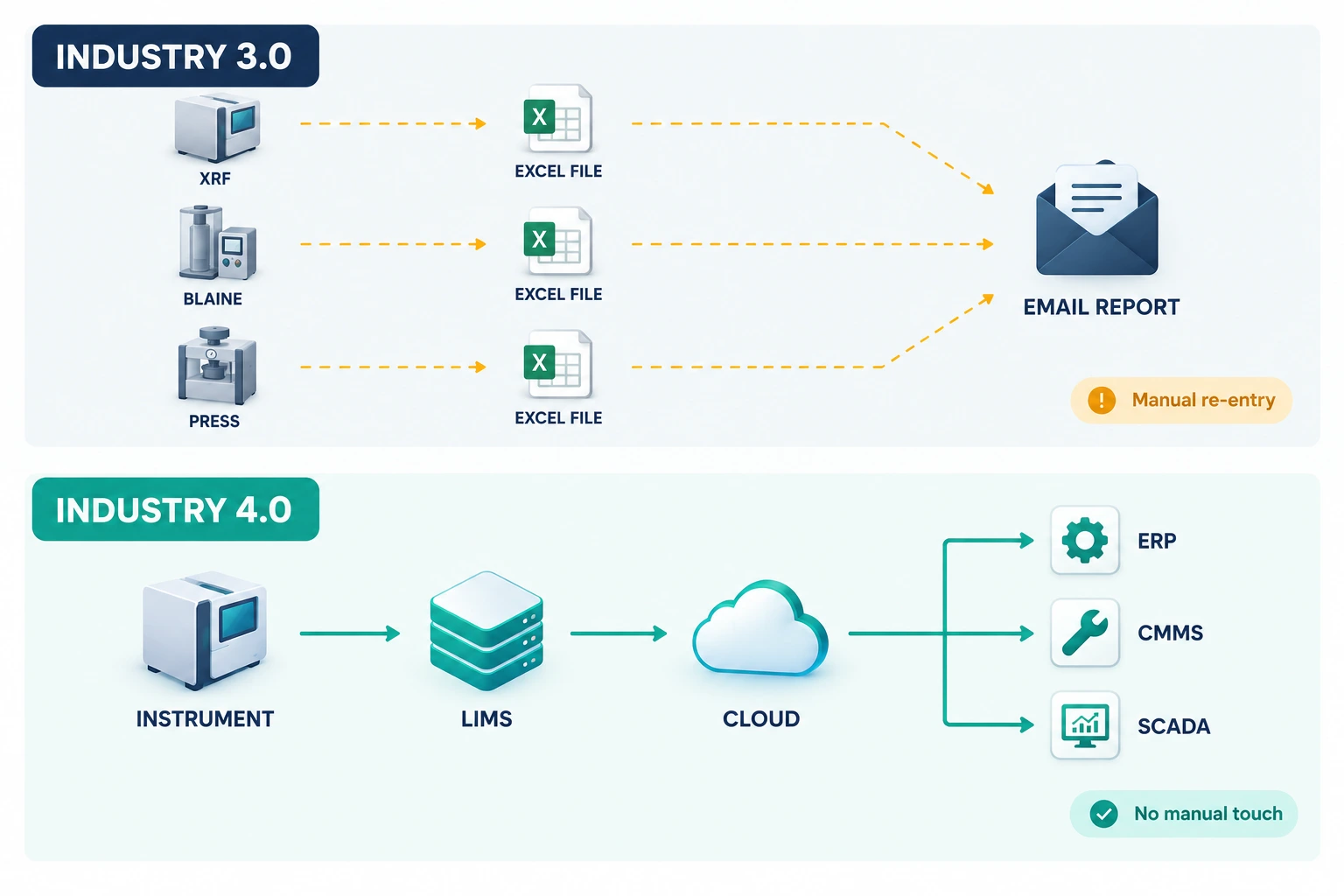
- Instrument: The XRF, XRD, Blaine apparatus, or compression press completes a measurement.
- Direct capture: Results move into the LIMS through an instrument interface, tagged with sample ID, method, and operator.
- Validation: The LIMS checks results against specification limits and calculates moduli and averages automatically.
- Cloud or server storage: Approved data is stored centrally and is visible to authorized users.
- Action: Connected plant systems receive the result and respond to pre-set rules.
Section 2: Automated ASTM Workflow Control
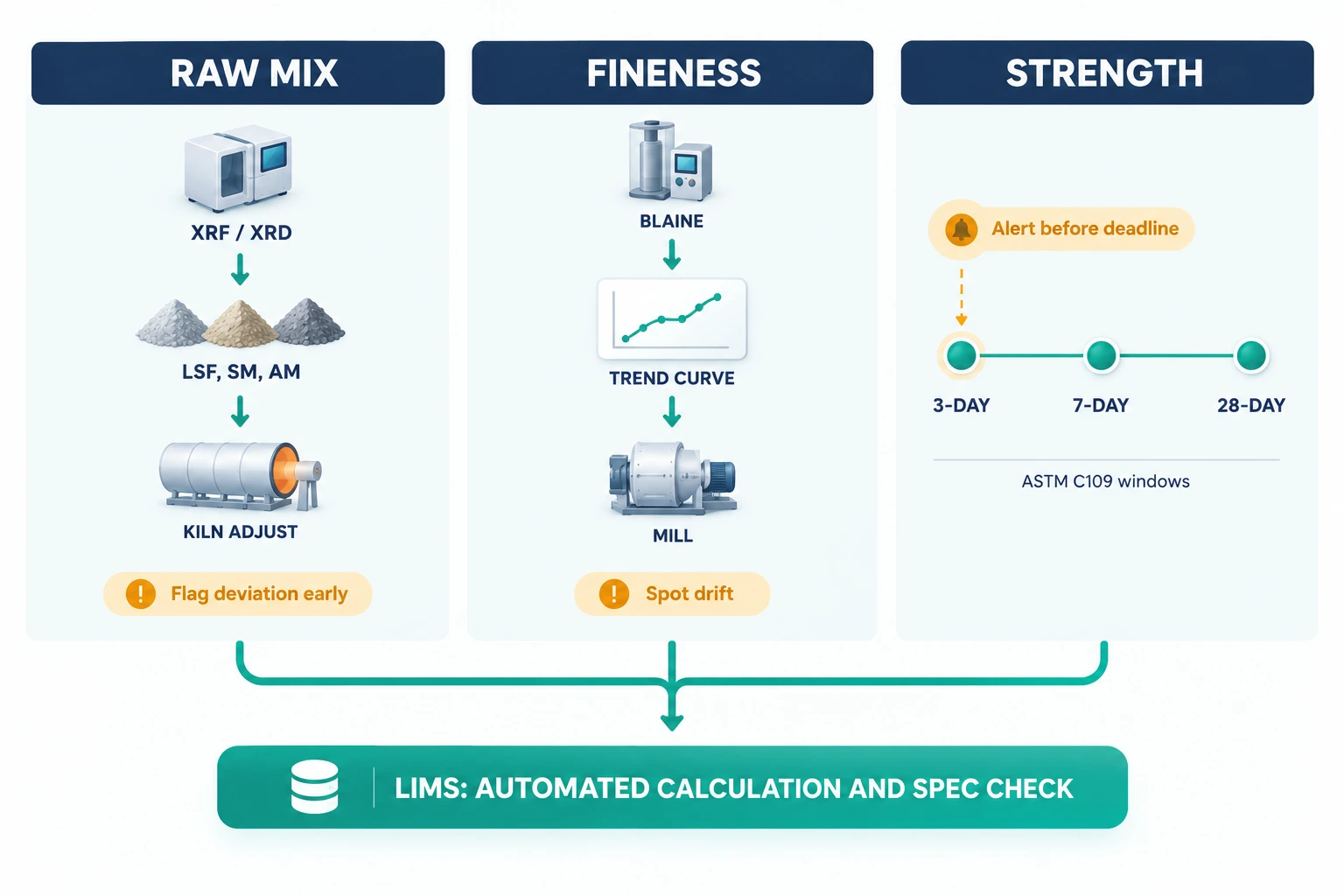
Three testing workflows cause the most bottlenecks when handled manually, which makes them the best starting points for a cement LIMS rollout.
Raw Mix Optimization
XRF and XRD results for raw meal and clinker feed the LIMS directly. The system calculates lime saturation factor, silica modulus, and alumina modulus, and flags deviations while the kiln can still be corrected. Chemical analysis follows ASTM C114 or the equivalent EN method.
Fineness and Grinding
Blaine air-permeability results (ASTM C204 or EN 196-6) are logged per mill and per sample, so fineness shows up as a trend curve instead of scattered rows in a sheet. Drift in a cement mill becomes visible before it affects strength.
Strength Milestones
Compressive strength tests at 3, 7, and 28 days must be broken inside strict time windows. Under ASTM C109, the 3-day tolerance is only one hour. The LIMS creates each test task at mixing, alerts the analyst ahead of the deadline, and records the actual break time.
Section 3: The LIMS + ERP + CMMS Integration Matrix
A LIMS that only stores results is a better filing cabinet. The real value appears when it exchanges data with the systems that run the plant.
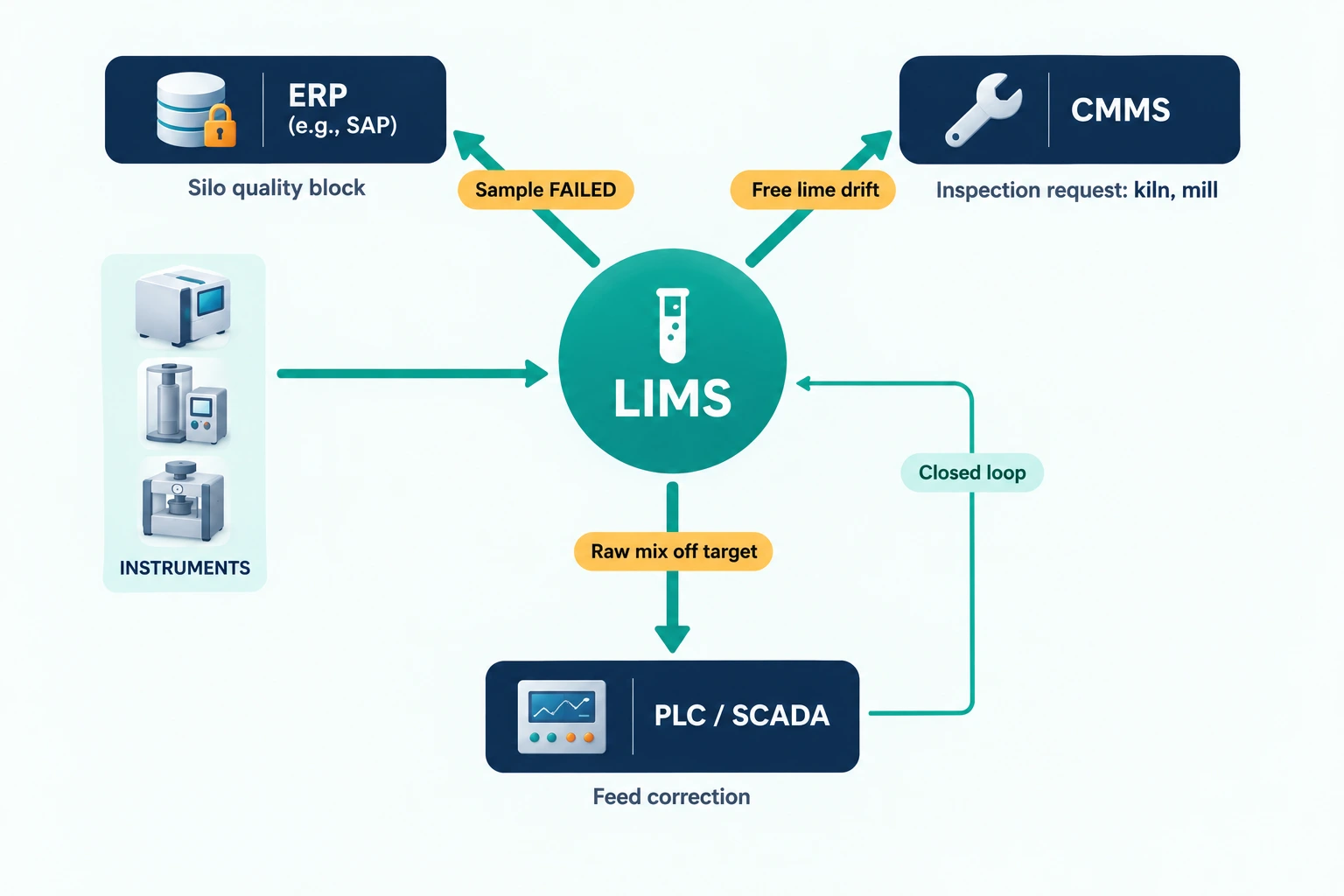
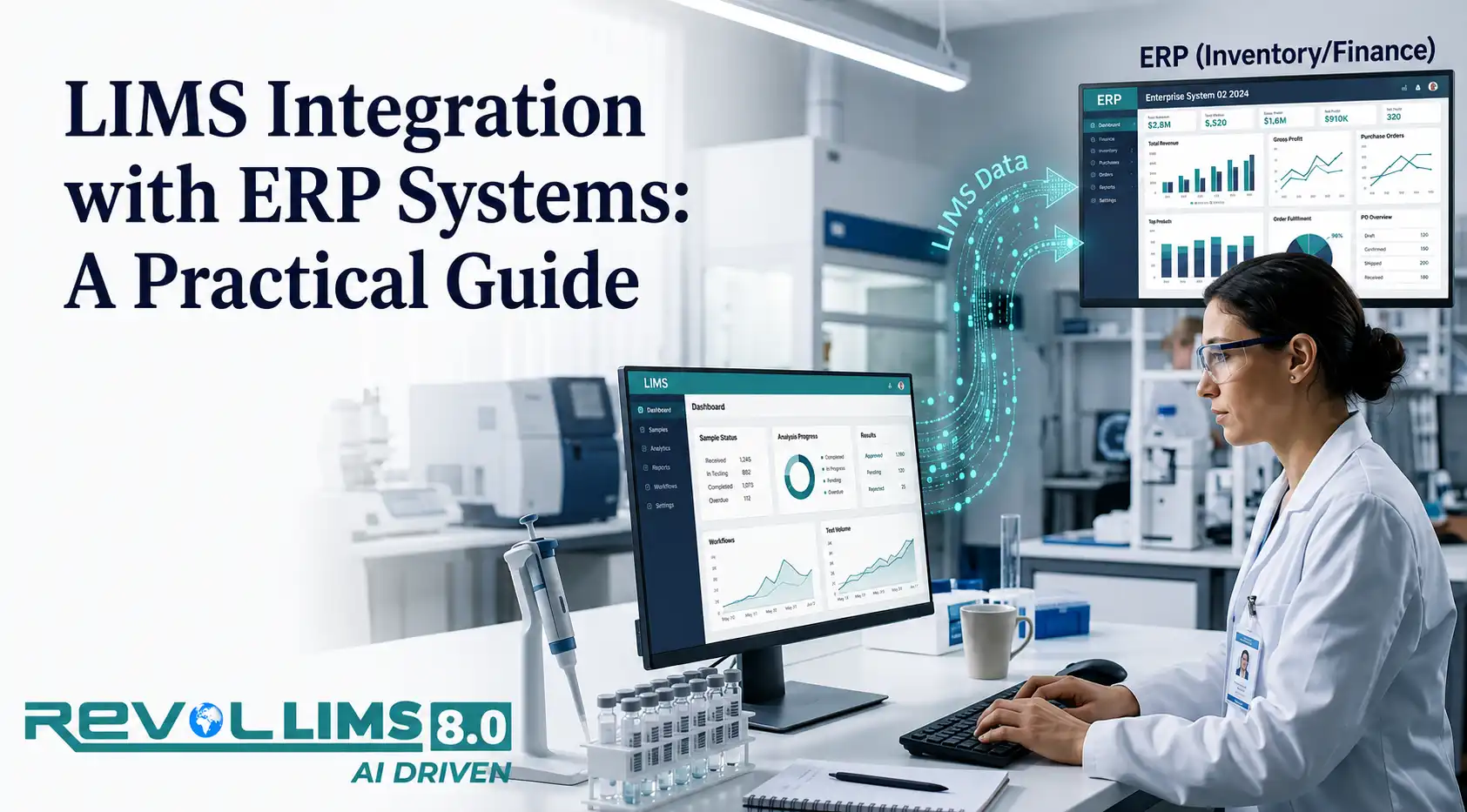
- LIMS to ERP (for example, SAP): Stopping Bad Batches at the Silo
When a cement sample fails specification, the LIMS sends a "Failed" status to the ERP. The ERP places a quality block on the associated silo or batch, so dispatch cannot create a delivery against it. Shipment of off-spec cement is prevented by system logic instead of a phone call to the shipping desk. - LIMS to CMMS: Maintenance Before Breakdown
Quality data is an early warning for equipment condition. If free lime in clinker trends upward, the LIMS raises an inspection request in the CMMS for the kiln burner or cooler. A fineness shift can do the same for a mill. The same asset and maintenance scheduling logic also keeps lab instruments calibrated. - LIMS to PLC/SCADA: Closed-Loop Feedback
Approved raw meal chemistry can be passed to plant automation as a correction signal for raw material feed ratios. Instead of an operator reading a printout and adjusting by judgement, the control system receives validated values and applies or proposes the change within defined limits.
The Digitalization Matrix: Disconnected Lab vs. Industry 4.0 Lab
| Capability | The Disconnected Cement Lab | The Industry 4.0 Lab |
|---|---|---|
| Data capture | Manual transcription from instruments and paper logs | Direct instrument capture into the LIMS |
| Calculations | Manual math in spreadsheets | Automatic, validated calculations |
| Response time | Up to 4 hours from result to plant action | Real-time alerts to the right team |
| Cross-system action | Calls, emails, and handwritten notes | Automatic triggers in ERP, CMMS, and PLC/SCADA |
| Strength test timing | Calendar reminders; windows can be missed | Auto-generated tasks with deadline alerts |
| Compliance records | Assembled by hand before an audit | Instant compliance packages |
Section 4: Meeting Green Cement and Low-Carbon Quality Standards
Decarbonization is changing what a cement lab has to control. Blended cements (ASTM C595, EN 197-1 composite types), supplementary cementitious materials, and calcined clay blends lower the clinker factor, but they also widen chemical and physical variability. Calcined clays, covered by pozzolan requirements such as ASTM C618, differ by source and calcination conditions, so each lot needs close characterization.
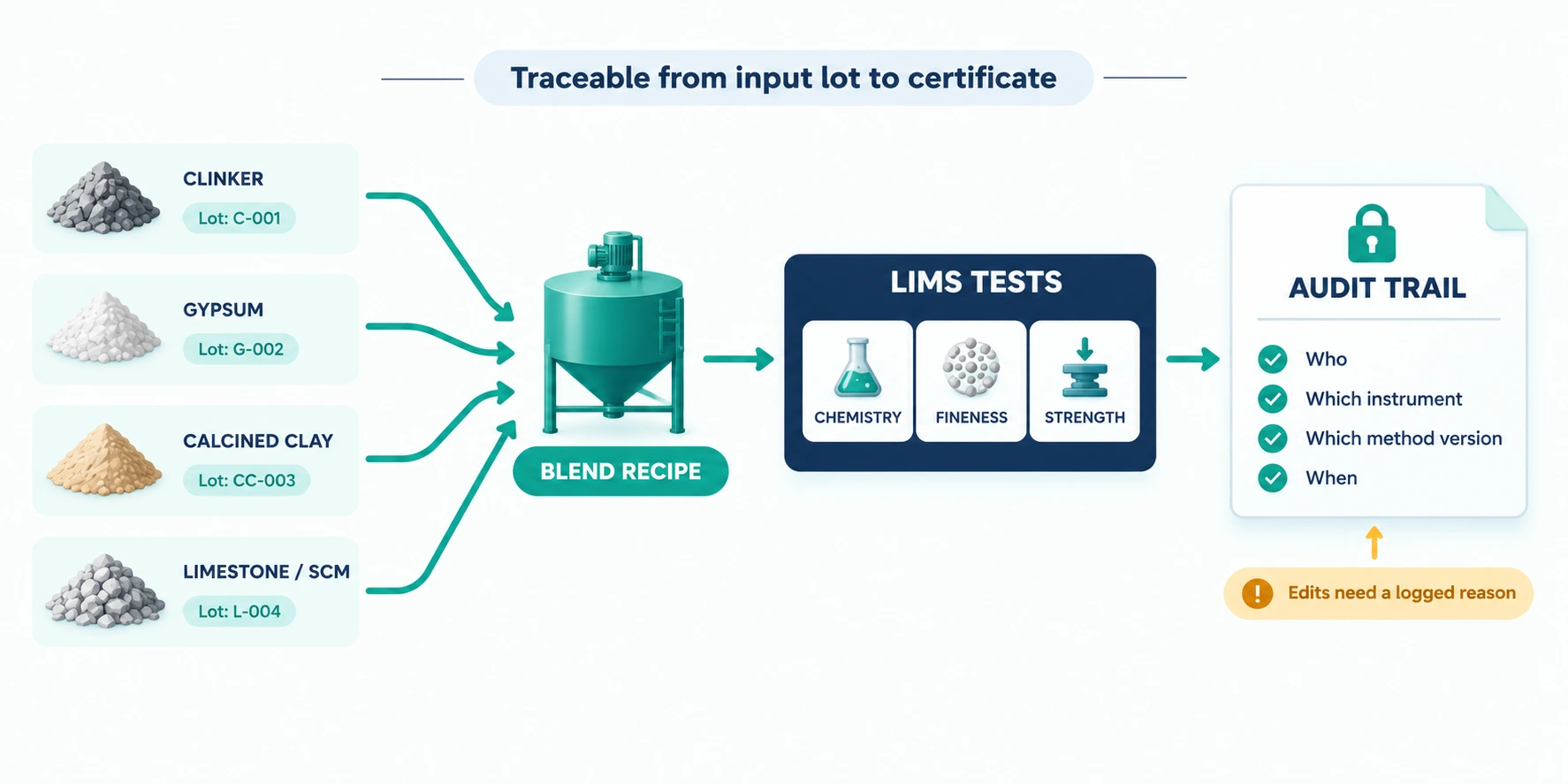
- Recipe-level traceability: Every blend links to its clinker, gypsum, and SCM lots, so performance traces back to inputs.
- Blend-specific trending: Strength development and fineness are charted per cement type, not averaged together.
- Clinker factor reporting: Lab data supports the figures that sustainability teams now request.
- Controlled method changes: New tests and specifications are added through a change workflow, not by rebuilding spreadsheets.
The other pressure is auditability. A LIMS records who tested what, with which instrument, under which method version, and when. Any edit requires a logged reason, which creates an audit trail aligned with the competence and traceability expectations of ISO/IEC 17025 and with ASTM and EN reporting needs. For more on how traceable history builds confidence in results, see why sample history matters.
Frequently Asked Questions
Is a LIMS the same as SCADA or an ERP?
No. SCADA controls and monitors plant equipment, and an ERP manages business processes such as inventory and dispatch. A LIMS manages laboratory samples, tests, and results. It does not replace either system. It supplies them with validated quality data.
Which cement lab instruments can connect to a LIMS?
Common examples are XRF and XRD analyzers, Blaine apparatus, particle size analyzers, laboratory balances, and compression testing machines. Connection methods vary by instrument and may use serial ports, file export, or database interfaces, so an instrument inventory is a useful first step.
Can a LIMS support low-carbon and blended cements?
Yes. A configurable LIMS applies the correct specification to each cement type and links every blend to its input lots. That helps labs manage the added variability of calcined clays and other low-carbon constituents.
Conclusion
Industry 4.0 in the cement lab is not about replacing analysts. It is about removing the delays that stand between a test result and a plant decision. As blended and low-carbon cements raise the quality bar, labs that connect their instruments, systems, and records will respond faster and with fewer errors than labs that rely on manual handoffs.
Ready to Connect Your Cement Lab?
See how an integrated LIMS can capture instrument data, control test schedules, and link quality results to plant systems.
Book a LIMS DemoAuthor: Revol Team · marketing@revollims.com · www.revollims.com










 (1) (1).webp)