Transformer Oil Testing at Scale: Why Large Utility Labs in the GCC Need More Than a LIMS Module
Key Takeaways
- Fleet-scale oil testing is a data problem, not just a lab task.
- A standalone testing module can't link results to asset history or auto-flag faults.
- A modern LIMS adds asset-linked samples, automated DGA interpretation, and fleet dashboards.
- GCC climate conditions usually call for tighter monitoring than the IEC/IEEE baseline.
1. Introduction
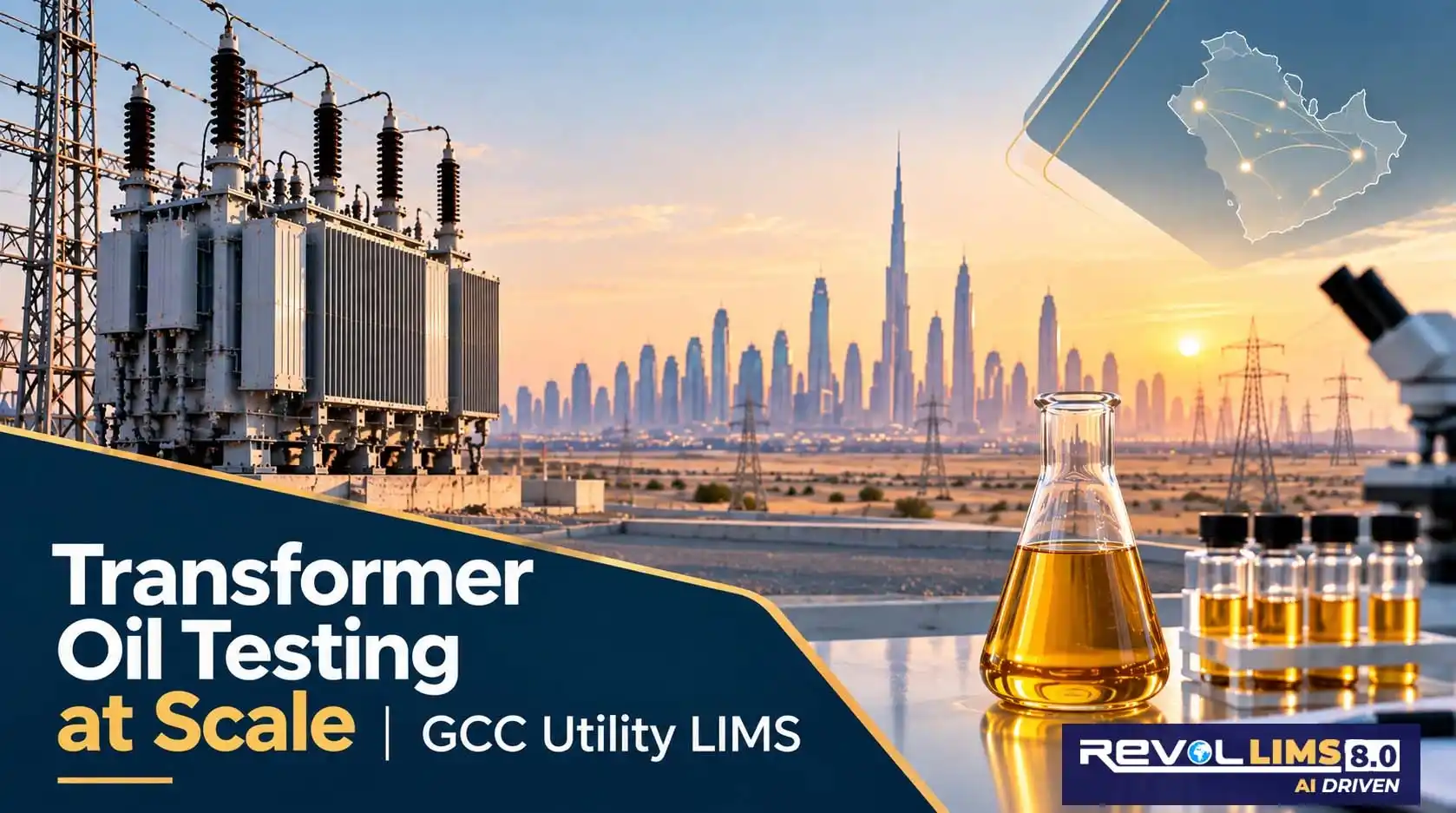
Power utilities across the GCC are expanding transmission and distribution capacity fast, and every new substation adds oil-filled transformers that need a recurring testing program. For a handful of assets that's simple — sample, test, file the report. For a lab running a regional or national fleet, it becomes a data problem: thousands of samples a year, each tied to its own asset, voltage class, and interpretation rule. Many labs try to solve this by bolting a testing module onto their existing software — it logs samples fine, but it generally can't link a result to asset history, apply engineer-grade interpretation, or flag a developing fault before it causes an outage. This guide covers what fleet-scale transformer oil testing involves, where a single-purpose module hits its limit, and the features a modern laboratory information management system needs to close that gap for GCC utility labs.
2. What Transformer Oil Testing at Scale Actually Involves
Transformer oil testing at scale means running a defined panel of tests against every in-service transformer on a recurring schedule set by voltage class, asset criticality, and oil condition history — not a one-off diagnostic check.
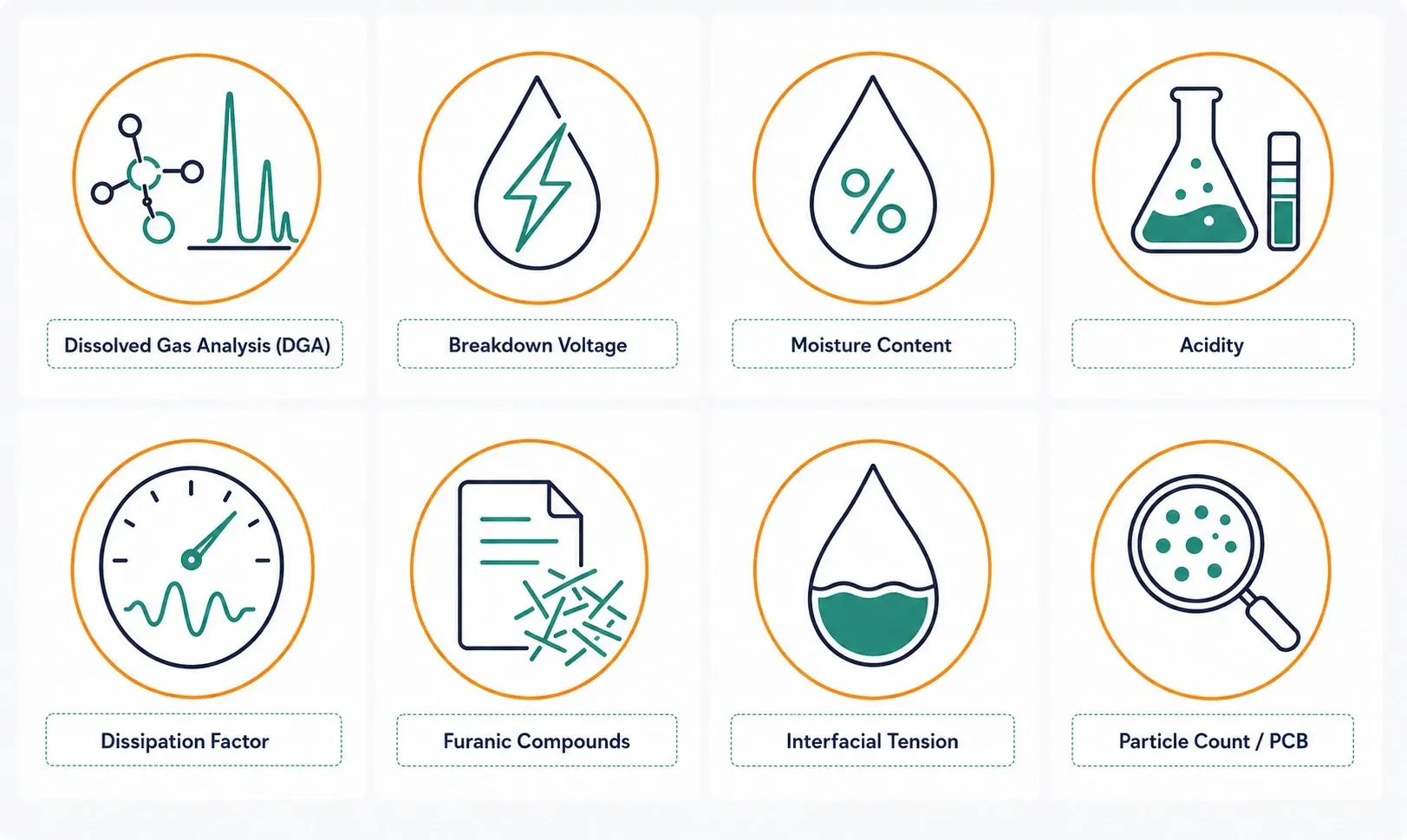
A typical utility testing program includes several distinct test types, each generating its own kind of result:
- Dissolved Gas Analysis (DGA) — gas chromatography measurement of hydrogen, methane, ethylene, acetylene, and other fault-indicator gases dissolved in the oil.
- Breakdown Voltage (BDV) — the oil's dielectric strength under an applied AC voltage, sensitive to moisture and particulate contamination.
- Moisture Content — usually measured by Karl Fischer titration, since water is one of the fastest ways insulation quality degrades.
- Acidity / Total Acid Number — an indicator of oxidation and long-term oil ageing.
- Dissipation Factor (Tan Delta) and Resistivity — dielectric loss and current-resistance measurements that flag contamination and ageing before it shows up in BDV.
- Furanic Compounds — a proxy for the condition of the paper insulation itself, not just the oil.
- Interfacial Tension and Colour — supporting indicators of contamination and oxidation.
- Particle Count and PCB Screening — checks for mechanical wear debris and, on older oil stock, polychlorinated biphenyl contamination.
Testing frequency is not uniform across a fleet. Guidance in IEC 60422 and IEEE C57.104 ties sampling intervals to transformer criticality and voltage class — new oil is tested before energisation, critical high-voltage transformers usually undergo DGA at least annually, and any abnormal result triggers a shorter re-test interval to track how fast a fault is developing. A utility running this correctly is managing dozens of different schedules simultaneously, each one dependent on the transformer's own history rather than a single fixed calendar date.
3. Where a Single LIMS Module Runs Out of Road
A basic testing module can log a sample and record a result, but it generally cannot connect that result to the transformer's full history, apply standards-based fault interpretation automatically, or flag a developing problem across a fleet of hundreds of assets — which is where testing programs at GCC utility scale actually break down.
The limitations tend to show up in the same few places:
- No persistent asset link. A module built around samples, not assets, makes it hard to pull a single transformer's complete testing history — across years and multiple oil changes — from one screen.
- Manual interpretation. Raw gas concentrations mean little without applying IEC 60599 ratio methods or the Duval Triangle. Without that logic built in, an engineer has to manually cross-reference every DGA result against the standard.
- Disconnected instruments. Gas chromatographs, Karl Fischer titrators, and BDV testers each produce results in their own format. A module without instrument connectivity means someone is retyping numbers from an instrument printout into the system.
- No fleet-wide view. A utility running testing across multiple substations and regions needs to see trend lines across the whole fleet — not just individual sample records — to spot which class of transformer is ageing faster than expected.
- Weak escalation logic. An abnormal gas ratio or a BDV result below action limits needs to trigger an investigation automatically. In a module built only for logging results, that escalation depends on someone reviewing every report by eye.
- No link to the asset register. Testing data that lives apart from the utility's EAM, GIS, or SCADA systems means maintenance planning and lab data are reconciled manually, usually well after the fact.
None of these gaps are visible in a small testing program. They become the defining constraint once a lab is running a testing calendar against hundreds of transformers rather than a handful.
4. Modern LIMS Key Features for Transformer Oil Testing Programs
A modern LIMS closes the fleet-scale gap by linking every sample to a permanent asset record, applying standards-based interpretation automatically, and surfacing trends and exceptions across the whole transformer population — not just the individual test result. The features below usually span several LIMS modules working together rather than a single testing screen.
Core Fleet-Scale Testing Features
- Asset-Linked Sample Registration — every sample is tied to a permanent transformer asset ID, carrying forward voltage class, location, and full historical results rather than starting a new, disconnected record each time.
- Automated DGA Interpretation — gas ratio methods and Duval Triangle logic aligned to IEC 60599 run automatically on every result set, rather than depending on manual cross-referencing.
- Multi-Instrument Connectivity — gas chromatographs, Karl Fischer titrators, and BDV testers feed results directly into the sample record, removing transcription steps between the instrument and the governed result.
- Configurable Test Panels by Voltage Class — sampling frequency and required test panels are governed automatically according to asset criticality, rather than tracked on a separate spreadsheet.
- Exception and Escalation Workflow — an abnormal gas ratio or an out-of-limit BDV result automatically opens an investigation and shortens the next test interval, instead of waiting for a manual review to catch it.
- Fleet-Wide Trend Dashboards — engineers see gassing trends, ageing patterns, and pending re-tests across the entire transformer population from one live view, not one sample at a time.
- EAM, SCADA, and GIS Integration — oil condition data connects to the utility's existing asset management and grid systems, so maintenance planning and lab results stay aligned automatically.
- Mobile Field Sampling — field technicians register and label samples against the correct asset ID at the point of collection, reducing mismatched or misidentified samples before they ever reach the lab.
- Role-Based Review and E-Signature — a qualified reviewer signs off on interpretation and release, with the review itself captured in a full audit trail.
- Automated Regulatory and Management Reporting — fleet condition summaries and compliance reports generate directly from governed results, rather than being assembled manually for each reporting cycle.
No single feature on its own solves the fleet-scale problem — it's the combination, running inside one governed system, that keeps testing coordination flat even as the transformer count keeps growing.
5. How the Testing Workflow Runs Across a Fleet
Across a fleet, one testing workflow has to run in parallel over hundreds of independent testing calendars — moving from sample collection to interpretation to consolidated reporting without a person manually coordinating each step.
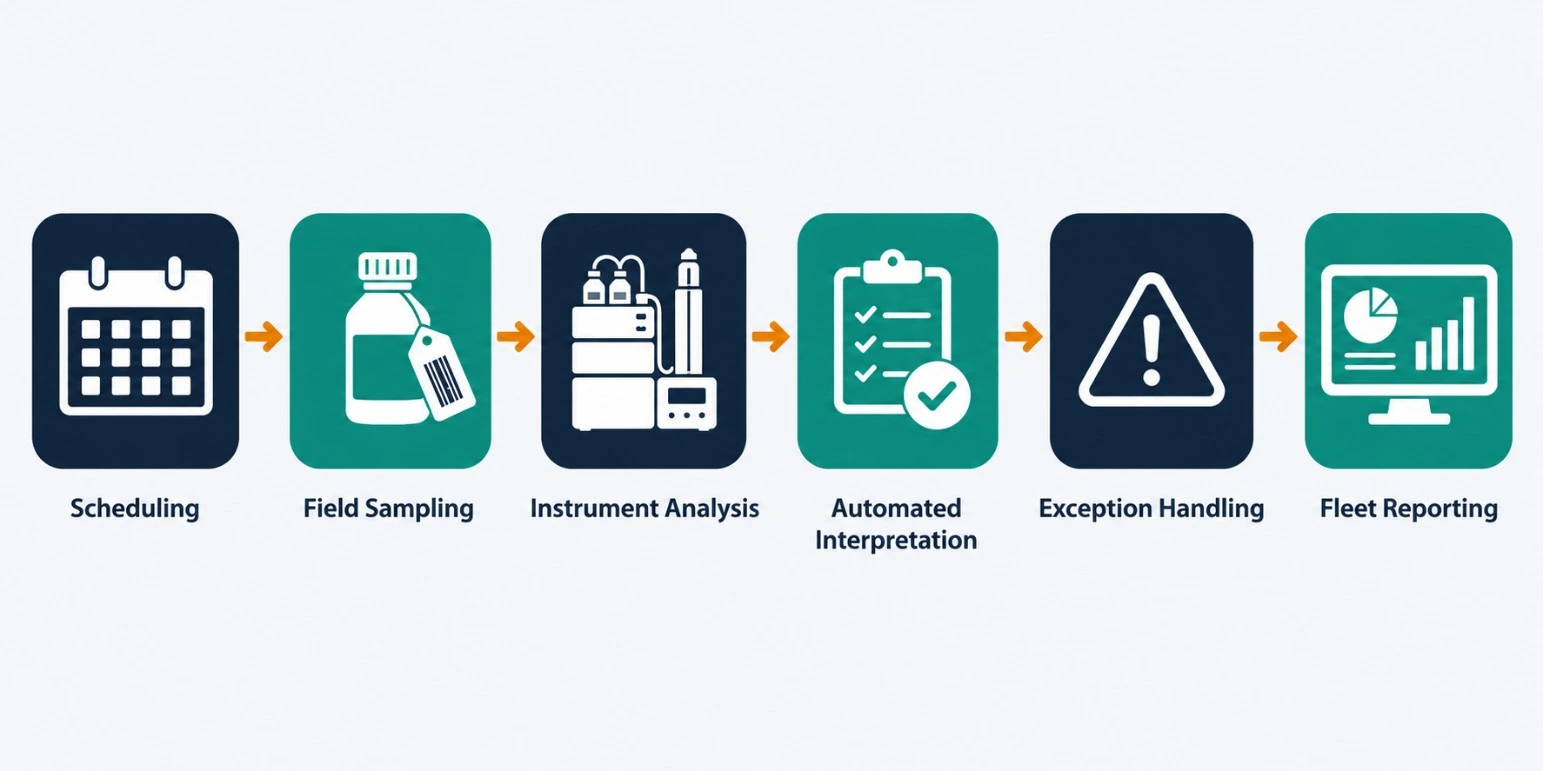
| Stage | What Happens | What Has to Carry Forward |
|---|---|---|
| 1. Scheduling | Each transformer's next test date is generated automatically from its voltage class, criticality, and last result | Asset ID, test panel, due date |
| 2. Field Sampling | Technician registers the sample against the correct asset in the field | Sample ID linked to asset ID |
| 3. Instrument Analysis | GC, Karl Fischer, and BDV results feed directly into the sample record | Raw results linked to sample and asset |
| 4. Automated Interpretation | Gas ratios and BDV limits are checked against IEC/IEEE reference values automatically | Fault classification, pass/fail status |
| 5. Exception Handling | Abnormal results open an investigation and shorten the re-test interval | Investigation record, revised schedule |
| 6. Fleet Reporting | Condition summaries roll up across substations and regions for engineering and management review | Trend history, full traceability back to raw data |
The value of this workflow is not just fewer manual steps — though eliminating instrument transcription and manual interpretation generally removes significant turnaround time from every test cycle. The larger value is that any transformer's full oil condition history, and any anomaly in it, can be queried in seconds rather than reconstructed from separate spreadsheets and instrument printouts after the fact.
6. Standards and Regulatory Alignment
Transformer oil testing programs in the GCC are built around a small set of internationally recognised standards, and a modern LIMS is what keeps day-to-day testing consistent with them at fleet scale.
IEC 60422
Supervision and maintenance guidance for mineral insulating oils in electrical equipment — the reference most utilities use to set test frequency and action limits by asset criticality.
IEC 60599
Guidance on interpreting dissolved and free gas analysis results to diagnose the condition of oil-filled equipment in service.
IEEE C57.104
Guide for interpreting gases generated in mineral oil-immersed transformers, including key-gas, ratio, and Duval Triangle methods.
ASTM D3612
Test method for the extraction and gas chromatography analysis of gases dissolved in electrical insulating oil.
7. Frequently Asked Questions
Why isn't a standard LIMS testing module enough for utility-scale transformer oil testing?
A basic testing module can log samples and record results, but it usually lacks a persistent link to each transformer's full history, automated standards-based interpretation, and fleet-wide trend visibility — all of which become essential once a lab is managing hundreds of assets rather than a handful.
What is the difference between a testing module and a full LIMS for this use case?
A testing module is typically one screen for sample and result entry. A full LIMS connects that data to the asset register, applies interpretation logic automatically, manages exception workflows, and reports across the whole fleet — functioning as the connective layer rather than an isolated data-entry tool.
How does a LIMS apply DGA interpretation automatically?
By encoding the gas ratio methods and Duval Triangle logic referenced in IEC 60599 and IEEE C57.104 directly into the system, so every DGA result is checked against those reference values as soon as it is captured, rather than requiring manual cross-referencing.
Does a LIMS replace the utility's existing EAM or SCADA systems?
No. A modern LIMS is usually integrated with existing EAM, GIS, and SCADA systems rather than replacing them, acting as the source of governed oil condition data that feeds into broader asset management decisions.
Why do GCC utility labs need tighter monitoring than the IEC/IEEE baseline suggests?
Coastal humidity and high ambient temperatures across much of the region accelerate moisture ingress and oxidative ageing in transformer oil, which typically pushes utility labs toward shorter test intervals than the standard baseline recommends for equivalent voltage classes.
8. Key Takeaway
Large utility labs in the GCC rarely lose control of a transformer oil testing program because of one major failure. It happens gradually — a sample logged without a clean link to its asset, a gas ratio interpreted by eye instead of by rule, a fleet-wide trend that stays invisible until a transformer that was gassing for months finally trips. Each of these is small on its own, and each one becomes harder to manage as the number of transformers on the books grows.
That is one of the more measurable LIMS benefits for utility labs — the difference between a lab that can answer a fleet condition question in seconds and one that needs days to reconstruct the same picture from separate spreadsheets and instrument printouts.
See How a Connected LIMS Handles Fleet-Scale Oil Testing
Explore how asset-linked samples, automated DGA interpretation, and fleet dashboards help GCC utility labs scale transformer oil testing without losing traceability.
Request a Live DemoCONTINUE READING
Author: Revol Team · marketing@revollims.com · www.revollims.com





 (1) (1).webp)