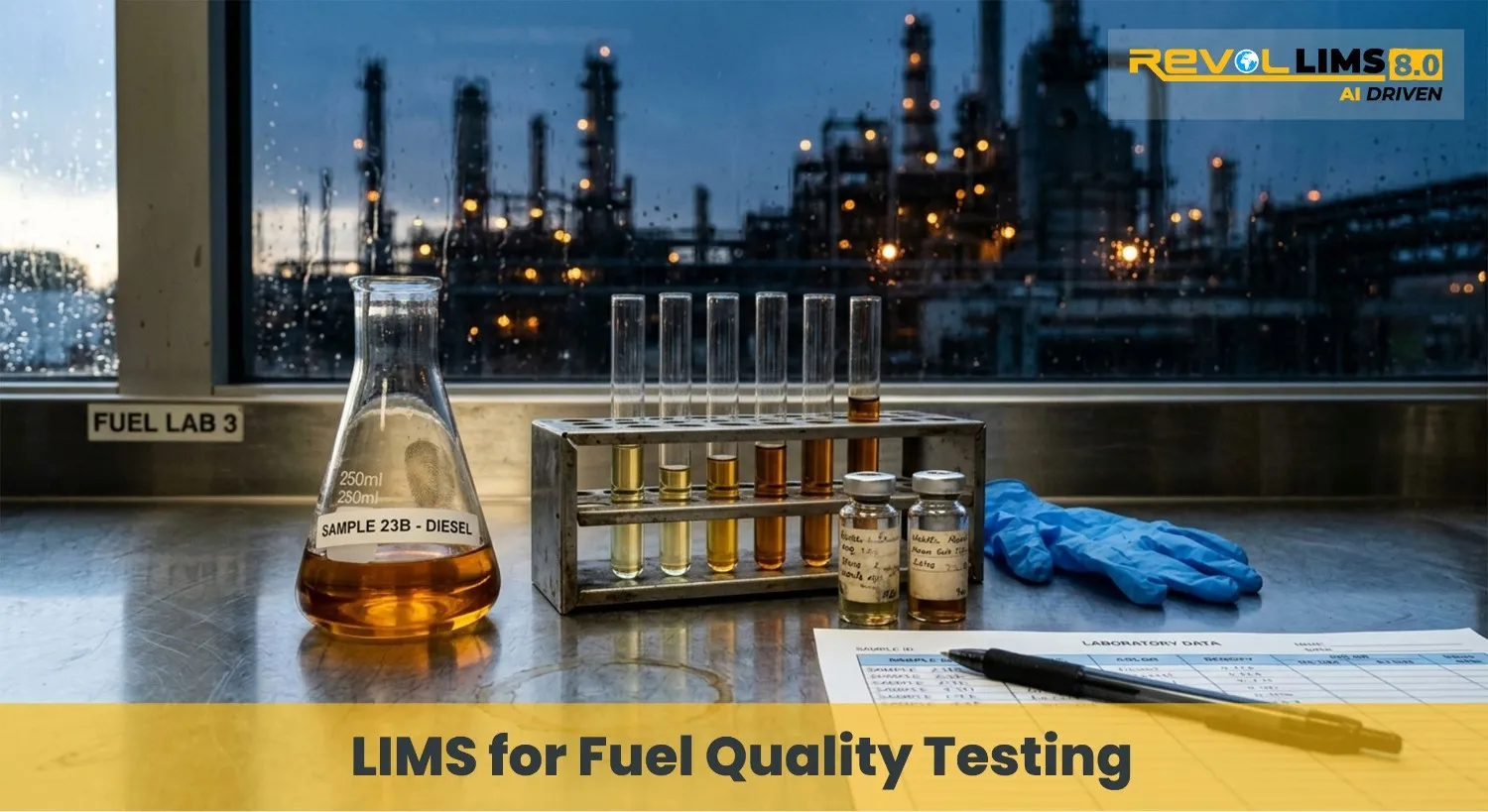
LIMS for Fuel Quality Testing: Ensuring In-Spec Deliveries Across Power Generation Assets
When a combustion turbine trips at 2 a.m., the investigation rarely turns up a single dramatic failure. It turns up a pattern. A diesel batch accepted on the supplier's certificate of quality without independent verification. A flash point result that gained a decimal place somewhere between the viscometer display and the spreadsheet. A water content reading that passed through two custody handoffs without anyone contesting it. The turbine was not failed by one bad decision. It was failed by a workflow that had no mechanism to catch a series of small ones.
Fuel quality testing laboratories in power generation sit at the intersection of asset reliability and regulatory accountability. The specifications they verify - flash point, viscosity, sulphur content, water and sediment, cetane number, cold filter plugging point - are not bureaucratic checklists. They are the operating envelope of the machines those fuels feed. For QA and QC managers, the challenge is enforcing those specifications consistently across every delivery, every analyst, and every custody handoff - with an audit trail that holds up under external scrutiny. For operations managers, the stakes are more direct: an off-spec batch that clears intake without detection does not announce itself until an unplanned shutdown forces the question. Most fuel quality teams describe the problem the same way: the instruments are fine, the analysts are competent, and the process still has gaps - because the coordination model connecting intake to laboratory to disposition to storage was never designed to scale.
This blog examines where those gaps appear, what a purpose-configured fuel quality LIMS does at each one, and which questions cut through vendor demos fastest. The comparison table in Section 4 is worth reviewing before any evaluation conversation.
73%
of unplanned power outages trace to fuel quality or supply chain failures
2–5×
turbine repair cost when contaminated fuel passes intake vs. rejection at delivery
48%
of fuel audit findings cite incomplete chain-of-custody documentation
dual compliance framework governing petroleum method traceability and laboratory competence in power generation fuel testing
1. Why Fuel Quality Testing Is Operationally Non-Negotiable
A gas turbine, diesel standby generator, or heavy fuel oil boiler has a defined operating envelope. Fuel specifications - measured in flash point, viscosity, water and sediment content, sulphur level, cetane number, and gross heating value - define that envelope's boundaries. Operate inside them and the asset runs as engineered. Drift outside and the consequences arrive on a sliding scale: fouling and accelerated wear in the best case, emergency shutdown and equipment damage in the worst.
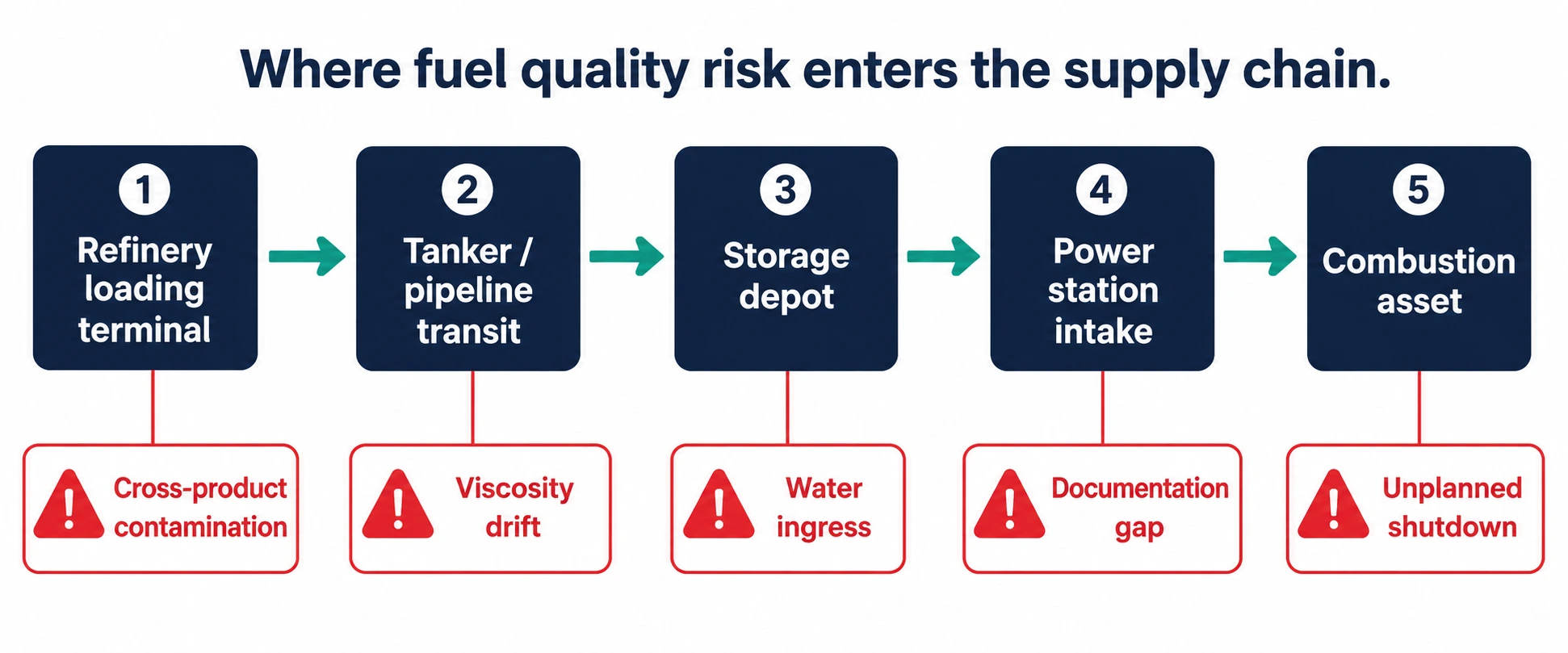
The difficulty is not that these parameters are unknown or hard to measure. Most power generation laboratories have the instruments and the methods. The difficulty is that between a refinery loading terminal, a tanker voyage, a storage depot, and the power station intake, the fuel passes through multiple handoff points. At each one, quality may change, documentation may fragment, and responsibility for verification can be genuinely ambiguous.
A diesel batch certified at the refinery may have picked up contamination in transit through a cross-product pipeline. A heavy fuel oil shipment may meet the viscosity specification but carry a sulphur level that violates the site's emissions permit. And a water content reading that nobody contested at three custody handoffs will not announce itself until the damage is visible in the fuel system.
The cost of a preventable fuel quality error is always higher than the cost of preventing it. A purpose-configured fuel quality LIMS makes prevention structural - not dependent on individual diligence at each handoff.
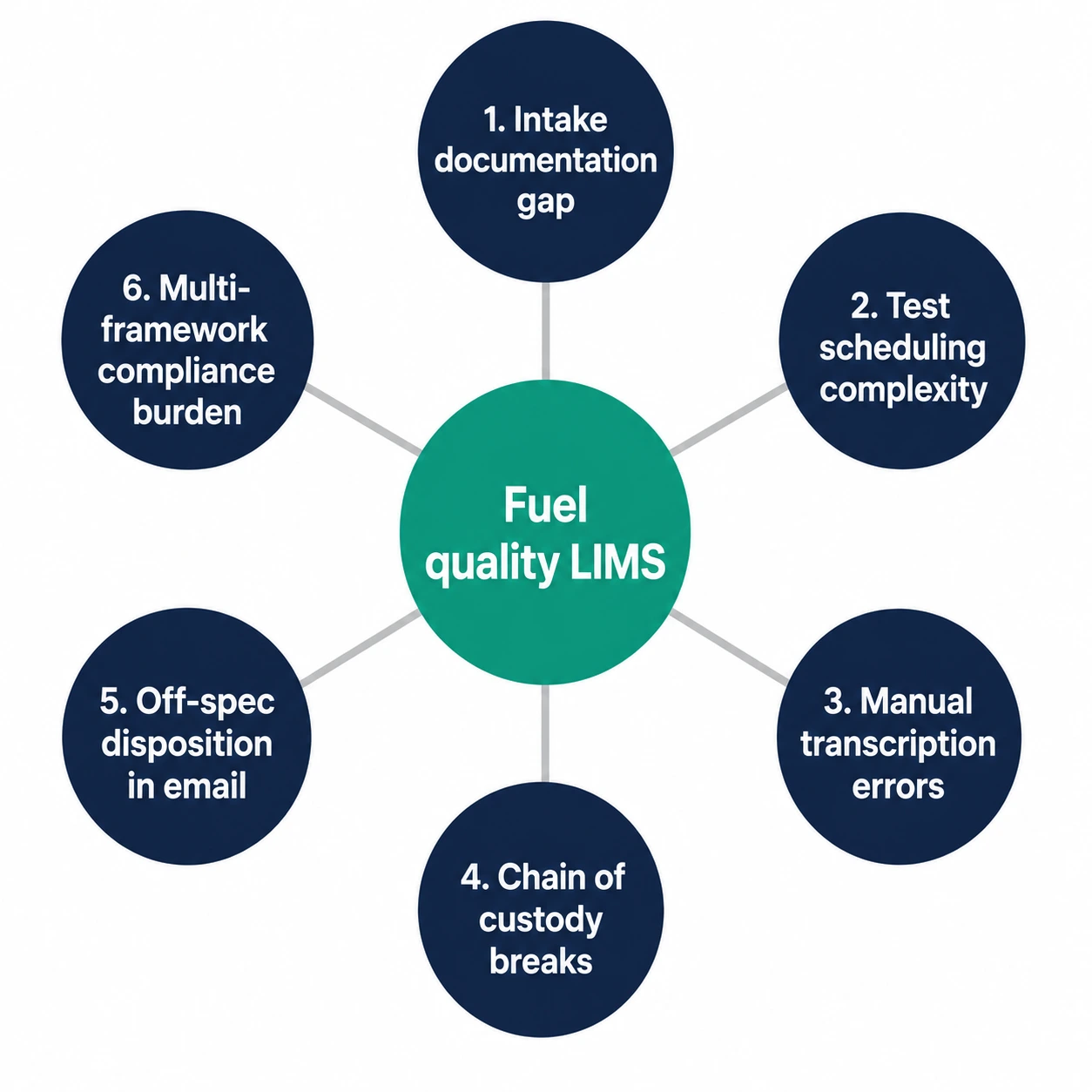
A fuel quality LIMS configured for energy operations integrates delivery intake management, multi-parameter test scheduling, instrument data capture, chain of custody tracking, out-of-spec disposition workflows, and compliance reporting into a single auditable environment. Every reading traces to a calibrated instrument. Every deviation triggers a hold before a disposition decision is made. Every delivery decision is on record before the fuel enters the asset. That is what the six sections below describe in practice.
2. The Six Critical Challenges a Fuel Quality LIMS Directly Addresses
Challenge 01
Delivery Intake Documentation Sits in a Different System from the Laboratory Results
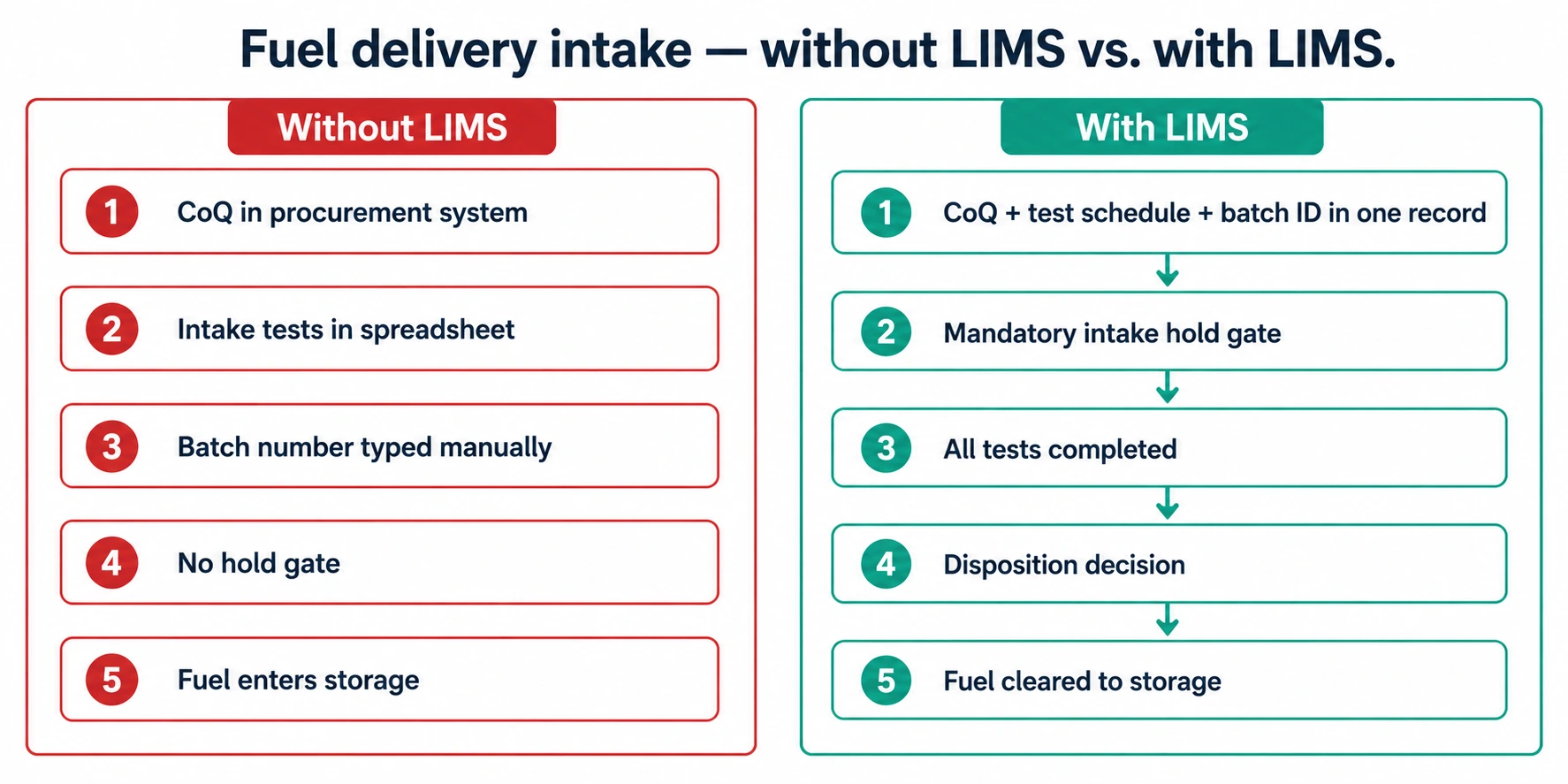
Most power generation facilities log a fuel delivery through at least two separate systems: a procurement or ERP platform that holds the supplier's Certificate of Quality, and a laboratory system that holds the independent intake test results. These records are connected - if at all - by a batch number that someone types into both systems correctly. When a fuel quality incident occurs and the investigation team needs to correlate what the supplier declared against what the laboratory actually measured, that correlation is reconstructed manually - sometimes days after the fact, sometimes under regulatory or insurance timeline pressure.
The problem compounds at multi-site operations. A quality issue affecting one supplier's output across three different sites may not surface as a pattern until each site has independently encountered it. For operations managers, the downstream effect is asset downtime that traces back to an intake decision made without complete information - weeks or months earlier.
- Delivery registration happens in the LIMS at intake - batch number, supplier, delivery date, volume, declared specification, transport documentation, and the supplier CoQ are linked in a single record alongside every test result generated for that batch.
- Intake hold logic is structural: no fuel moves to active storage until all mandatory intake tests are assigned, completed, and reviewed. The hold is not a notification - it is a gate.
- Cross-site supplier quality trends aggregate across all locations automatically. A pattern that would take weeks to notice across separate site systems becomes visible in days.
Challenge 02
Scheduling Six or More Test Methods Per Sample Relies on Coordination That Does Not Scale
A single diesel intake sample may require flash point by ASTM D93, water and sediment by ASTM D1796, sulphur content by ASTM D5453, cetane index by ASTM D976, kinematic viscosity at 40°C by ASTM D445, and cold filter plugging point by EN 116. That is six methods, potentially on four different instruments, with different analyst certification requirements and different turnaround times. Now run three simultaneous deliveries through that same workflow, add a heavy fuel oil batch requiring ISO 8217 parameters, and try to manage it via email and a whiteboard. Something will be missed. The coordination model places the cognitive burden of test panel management on individual people rather than embedding it in the workflow itself.
- Fuel-type test panels are configured once - diesel intake, Jet A-1, heavy fuel oil, generator diesel - and automatically generate the correct method set when a sample is registered.
- Analyst and instrument assignment follows real-time workload and certification status. If a method requires a specific certification, only qualified analysts appear in the assignment queue.
- Turnaround time monitoring flags overdue tests before they delay a hold decision
- Method version control is enforced at assignment - when ASTM or ISO methods are revised, the update applies centrally.
Challenge 03
Manual Transcription Between Instruments and Records Introduces Errors That Cut Both Ways
A viscometer outputs a result. Without direct instrument integration, that value travels from the display to a paper worksheet, to a spreadsheet, to a report - three transcription steps per result, each one an opportunity for a digit to move. An error that makes a passing result look like a failure triggers a wrongful rejection. An error that makes a failing result look like a pass moves the fuel into storage and eventually into the combustion system. In a laboratory processing multiple deliveries daily, transcription errors are a predictable output of any process that depends on human accuracy at every result, every shift.
- Bidirectional instrument integration captures results directly from analysers into the sample record - no intermediate step.
- Raw instrument output is archived alongside the calculated result for audit and dispute use.
- Results outside specification limits or the instrument's calibrated range are flagged automatically at capture.
- Calibration status is linked to every result - a test run on an instrument with a lapsed calibration is flagged before the result reaches the approval queue.
Challenge 04
Fuel Movements Between Tanks and Sites Have No Continuous Custody Record
Laboratory clearance is not the end of the fuel quality story. Between a cleared batch and combustion, fuel may move from intake tank to day tank, be blended with previously certified stock, or be transferred to a satellite generator site. Each movement is a potential quality event. In most operations those movements are logged - if at all - in an operations system entirely disconnected from the laboratory record that cleared the batch. When an auditor asks for the complete history of a batch from intake to consumption, assembling that record means pulling from multiple systems manually.
- Every storage movement requires an authenticated LIMS action - undocumented movement is structurally prevented, not dependent on staff remembering to log it.
- Inter-tank transfers trigger a quality checkpoint; if the receiving tank's last verification is outside the acceptable window, the LIMS flags it.
- Complete chain of custody reports for any batch are generated on demand, formatted for regulatory submission or insurance investigation.
Challenge 05
Out-of-Spec Disposition Decisions Live in Email Threads, Not in the Batch Record
When a delivery fails a specification parameter, the decision to accept under waiver, reject, or hold pending retest is often the right one. The problem is where it lives. An email thread is not a quality record. When an equipment failure occurs six months later and an investigation team wants to know what was known about the batch at acceptance, the answer should be in the quality system - with a named approver, a documented technical rationale, and a linked corrective action. In most operations, it is not.
- Any batch with a failing result is automatically quarantined - release requires a documented, approved disposition decision recorded in the LIMS.
- Conditional acceptance workflow captures the authorising role, technical rationale, risk assessment reference, and engineering restrictions on use - all linked to the batch record and immutable.
- Supplier dispute workflow auto-assembles the complete package: CoQ, LIMS result, raw instrument output, calibration certificate, and method version reference - ready to send without a manual step.
Challenge 06
Compliance Evidence for Four Different Frameworks Comes from Four Different Places
Power generation laboratories typically operate under overlapping compliance obligations simultaneously. ISO/IEC 17025 governs laboratory accreditation. National petroleum product standards set the specification parameters. Emissions permits impose sulphur limits that may be tighter than the general product standard. Supply contracts with grid operators embed their own fuel quality requirements and reporting schedules. The underlying test data is largely the same across all of them. The evidence packages are structured differently - and without a system that generates framework-specific reports from the same records, compiling compliance evidence means manually reformatting data multiple times under deadline pressure.
- Report templates are configured per compliance obligation - ISO 17025 traceability reports, ASTM method compliance summaries, sulphur regulatory returns, contract specification performance reports - all from the same underlying records.
- ISO 17025 traceability reports link every result to its method version, analyst record, instrument, calibration certificate, and reference standard lot number. The complete evidence chain is a single output.
- Sulphur compliance is tracked per site against that site's applicable limit, not a global threshold. Cross-site summaries aggregate performance for emissions permit evidence across the whole operation.
- Audit-ready batch records are generated on demand. Assessors get what they need; laboratory staff do not spend a working day reconstructing records from multiple systems.
Each of the six challenges above reflects a gap that a generic LIMS cannot close without significant custom configuration - and usually not without manual supplements even then. The next section covers how a purpose-configured fuel quality LIMS handles the compliance frameworks that govern what those test results must prove.
3. ASTM / ISO 17025 Compliance - Built In, Not Bolted On
The compliance landscape for power generation fuel testing sits at the junction of two frameworks. ISO/IEC 17025:2017 governs laboratory competence and measurement traceability - not which parameters to test, but how every result must be traceable to a calibrated standard, produced by a qualified analyst, using a controlled and documented method. ASTM International and ISO product standards - ASTM D975 for diesel, ASTM D1655 for aviation turbine fuel, ISO 8217 for marine and heavy fuel oils - define what is being measured and the precise procedure for measuring it.
The distinction that matters in practice is between recording compliance evidence after the fact and enforcing compliance requirements at each step in the workflow. A LIMS that logs what happened is a documentation system. A LIMS that prevents a non-compliant action from proceeding without a documented exception is an operational compliance system. That difference becomes visible at assessment time - and in the six months between assessments.
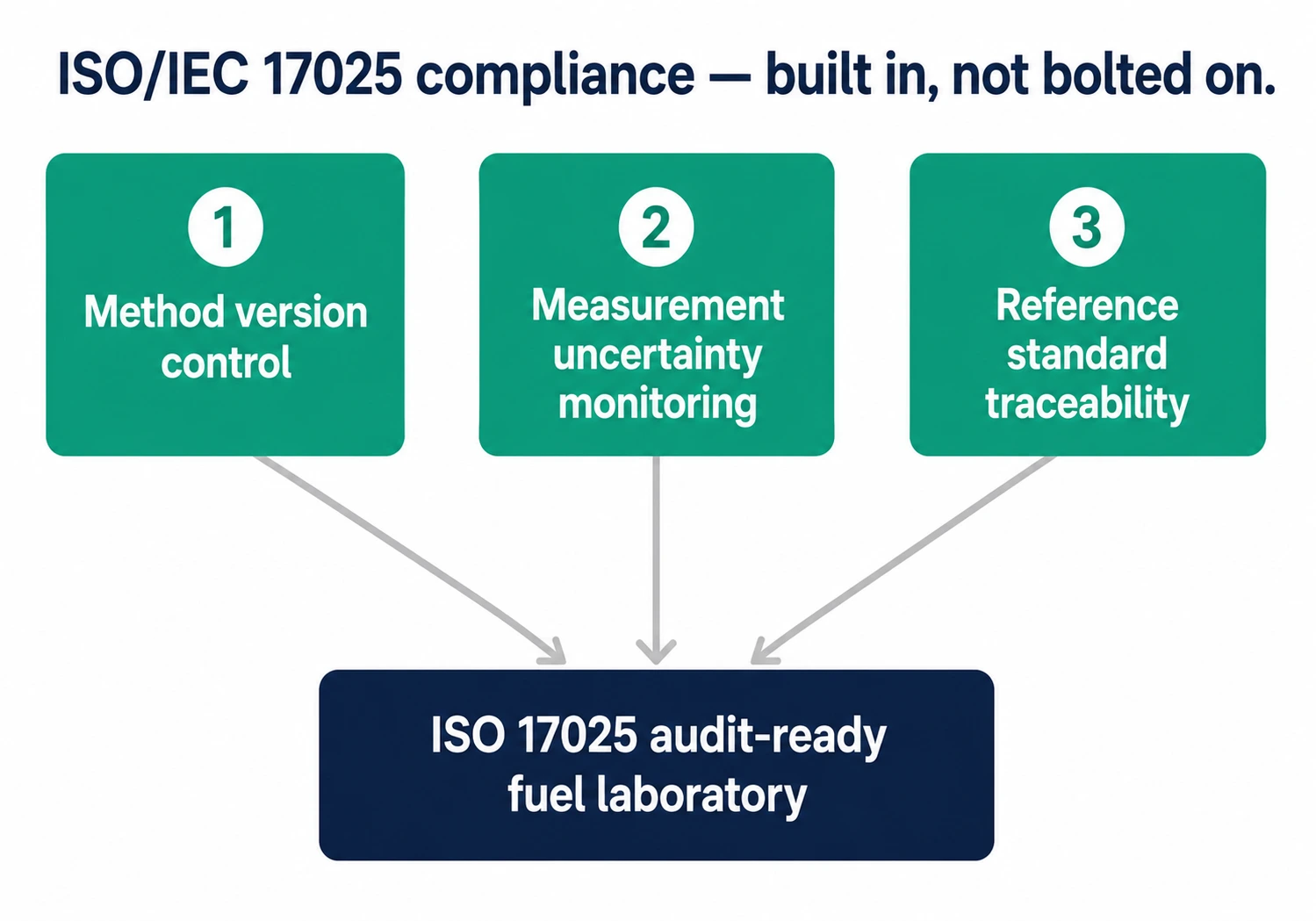
In practice, this means three things working together. First, method version control: every result is permanently tagged with the exact ASTM or ISO revision in use at the time of testing - analysts cannot work from a superseded version, and historical records are not retroactively retagged when a method is updated. Second, measurement uncertainty monitoring: the LIMS stores method-specific precision data and flags results where replicate measurements exceed the method's stated repeatability limit, catching instrument drift before it affects a delivery decision. Third, reference standard traceability: an expired calibration standard cannot be selected - the system confirms validity before an analyst can proceed, and records the lot number against every calibration event. For QA managers, these are not optional enhancements. They are the evidence chain that an ISO 17025 assessor will check first.
Method version control
Every result is permanently tagged with the exact ASTM or ISO revision in use at the time of testing. Analysts cannot work from a superseded version, and historical records are not retroactively retagged when a method is updated.
Measurement uncertainty monitoring
The LIMS stores method-specific precision data and flags results where replicate measurements exceed the method's stated repeatability limit - catching instrument drift before it affects a delivery decision.
Reference standard traceability
An expired calibration standard cannot be selected. The system confirms validity before an analyst can proceed and records the lot number against every calibration event.
For teams preparing for ISO/IEC 17025 assessment or reviewing current ASTM method requirements, the primary sources are the ASTM International standards portal, the ISO Online Browsing Platform, and ILAC guidance documents for accreditation bodies. National accreditation bodies - UKAS in the UK, A2LA and NVLAP in the US - publish additional sector-specific guidance for petroleum and energy testing laboratories.
The table in the next section maps these compliance requirements directly against what a generic LIMS delivers versus what an energy-configured system provides - useful to have open during any vendor conversation.
4. Generic vs. Energy-Configured LIMS - A Direct Comparison
The table below covers seven workflow areas where the gap between a general-purpose LIMS and an energy-configured system is most consequential. It is worth having this in front of you before talking to any vendor.
| Workflow Area | Generic LIMS | Energy-Configured LIMS |
|---|---|---|
| Delivery Intake | Sample registered. CoQ filed in procurement. No linked record. | Full delivery record - CoQ, intake hold logic, and all test results linked in one place. |
| Test Scheduling | Analyst selects methods manually. Scheduling via email. Panel errors common. | Fuel-type panels auto-generate the correct method set. Assignment automated by certification and workload. |
| Instrument Integration | Manual transcription from instrument to worksheet to LIMS. Errors accumulate. | Bidirectional integration. Raw output archived. Calibration status linked to every result. |
| Chain of Custody | Intake record and result exist. Storage movements and site transfers undocumented. | Every custody event authenticated. Tank transfers trigger quality checkpoints. On-demand CoC reports. |
| Out-of-Spec Disposition | Decision via email. Retrospective documentation if any. No formal batch record link. | Automatic quarantine hold. Authorised disposition workflow. Dispute package auto-assembled. |
| Compliance Reporting | Manual extraction and reformatting across systems. Ad hoc under audit deadline. | Framework-specific templates. ISO 17025 evidence chain per result. On-demand audit-ready output. |
| ASTM / ISO 17025 Readiness | Partial. Method version, uncertainty, and reference standard traceability require manual supplements. | Native. Method version control, uncertainty flagging, and reference traceability built in from day one. |
No column in that table should surprise a fuel laboratory manager who has been through an ISO 17025 assessment or an insurance audit following an equipment failure. The gaps in the generic column are where findings accumulate.
5. What to Ask When Evaluating a Fuel Quality LIMS
Most vendors will show you the features that make their system look best. These questions target the areas where generic implementations most frequently fall short in fuel quality and energy contexts. They are designed to produce a specific demonstration, not a general answer.
Test the delivery hold enforcement
Ask the vendor to show what happens when a diesel intake sample returns an off-spec flash point result. The quarantine hold should apply automatically - without a supervisor remembering to action it - and the batch should be structurally prevented from moving to active storage until a documented disposition decision is recorded in the system. If the hold is a notification that requires a manual follow-up step to enforce, the system is tracking the problem, not preventing the next action from happening.
Ask specifically about instrument integration architecture
Ask how the LIMS captures results from each of your specific instruments - your flash point analyser model, your viscometer, your sulphur analyser. Understand whether integration is bidirectional (LIMS sends a test request; instrument returns the result directly) or one-directional (a result file must be manually triggered for import). In a high-volume fuel laboratory, the transcription risk difference between those two architectures compounds across every result, every shift.
One structural question worth asking directly
Can a fuel batch be physically moved from one storage tank to another without any LIMS action being required? If the answer is yes, chain of custody depends on staff discipline, not system architecture. That distinction is the one that matters when the chain of custody record is tested in an external audit or an insurance investigation - and it is the question most vendors are not expecting.
A purpose-configured fuel quality LIMS built for energy operations delivers native ASTM/ISO 17025 compliance workflows, multi-site chain of custody enforcement, bidirectional instrument integration, and automated delivery hold logic from day one.
6. Frequently Asked Questions
Q1. Can a general-purpose LIMS be configured to manage fuel quality testing?
Some enterprise platforms are flexible enough - but the gap is substantial. Delivery hold logic, fuel-type test panels, bidirectional petroleum analyser integration, and multi-site custody aggregation are all difficult to retrofit. Before accepting 'configurable' as an answer, ask the vendor to show you another power generation laboratory running the same configuration in live production - not a pilot, a working operation.
Q2. What is the difference between chain of custody tracking and chain of custody enforcement?
Tracking records custody events when staff log them. Enforcement makes it structurally impossible to move a fuel batch or sample without a recorded custody event completing first. For power generation operations under regulatory or insurance review, that difference is between a system that documents what people remember to record and a system whose custody records are complete by design. ISO 17025 requires the integrity of the custody record to be guaranteed - not merely that events be logged when someone thinks to log them.
Q3. How does a fuel quality LIMS handle a dispute when our results and the supplier's CoQ disagree?
The LIMS generates the complete dispute package directly from existing records: the supplier's CoQ (already indexed against the delivery record at intake), the LIMS result, the archived raw instrument output, the calibration certificate current at the time of testing, and the method version reference. That package exists and is complete whether the dispute is raised on the same day or six months later during an investigation. No manual assembly required.
Q4. How does a LIMS manage sulphur content compliance when our sites operate under different regulatory limits?
Specification libraries are configured per site and updated as regulatory limits change - without a system modification each time. When a sulphur result is generated, the LIMS compares it against the applicable limit for that specific site and fuel type, not a single global threshold. Cross-site compliance reports aggregate performance for emissions permit evidence across the whole operation in a single output.
Have questions about fuel quality LIMS implementation for your power generation lab?
Contact Our Team →Final Thoughts
Power generation assets carry an unusual kind of accountability. The fuel entering a gas turbine or diesel standby generator is not an interchangeable input - it is a precision material with documented tolerances, feeding an engineered system that was specified to operate on fuel that meets them. When those tolerances are exceeded, the consequences do not always announce themselves immediately. Fouling accumulates. Wear accelerates. The connection between a quality event at intake and a maintenance event six months later is visible only to an investigation team with access to a complete, continuous record.
That is what a purpose-configured fuel quality LIMS provides: a record that is complete by construction, traceable at every step, and accessible in its entirety when the question is asked - whether by an internal engineer reviewing a combustion anomaly, a regulatory assessor conducting a scheduled audit, or an underwriter reviewing an equipment failure claim. That is not a software feature. It is the operational standard that responsible fuel management requires, and it is the standard that power generation laboratories are increasingly expected to demonstrate rather than describe.
CONTINUE READING
- How to Prepare Your LIMS for an FDA Audit:
https://revollims.com/lims-fda-audit-checklist - Energy LIMS Feature Overview:
https://revollims.com/lims-software/oil-and-gas-lims
Author: Revol LIMS Team · marketing@revollims.com · www.revollims.com




 (1) (1).webp)