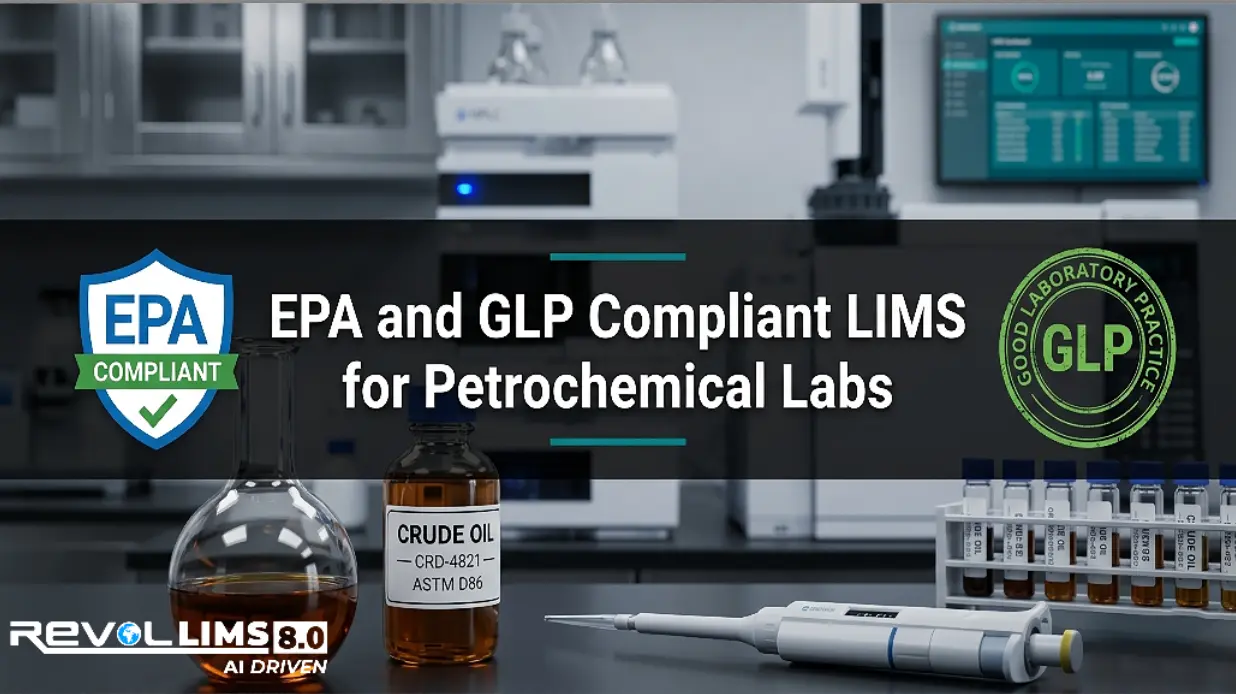
How LIMS Helps Petrochemical Achieve EPA and GLP Compliance
If you manage a petrochemical testing lab in the United States, you already know that regulatory compliance isn't a one-time checkbox. It's an everyday operational reality.
Between EPA reporting requirements, GLP standards, ISO 17025 accreditation, and method-specific demands from ASTM and OSHA, your lab is navigating one of the most complex compliance landscapes in the industry. And if you're still managing it all with spreadsheets, paper logs, and disconnected systems — the risk isn't just inefficiency. It's audit failure, data rejection, and potential enforcement action.
That's where Laboratory Information Management System (LIMS) software changes the game.
In this article, we'll break down exactly how LIMS helps petrochemical labs stay ahead of EPA and GLP requirements — not just during audits, but every single day.
The Compliance Challenge in Petrochemical Labs
Petrochemical and oil and gas laboratories operate under intense scrutiny. You're testing crude oil, refined products, process chemicals, wastewater effluents, and air emission samples — often simultaneously — under regulatory frameworks that demand complete traceability and data integrity at every step.
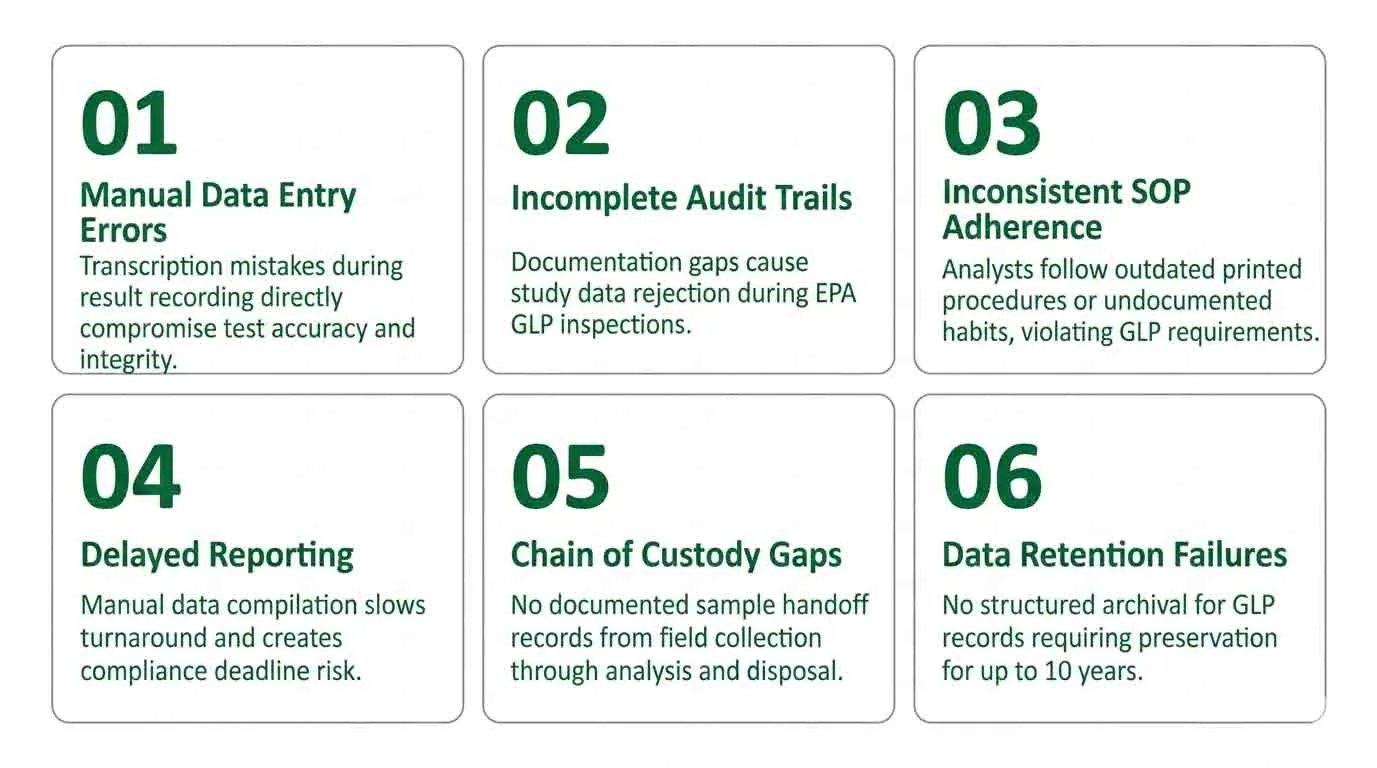
Here's what most lab managers deal with on a regular basis:
- Manual data entry errors that compromise test result accuracy
- Incomplete audit trails that fall apart during EPA inspections
- Inconsistent SOP adherence across shifts and analyst teams
- Delayed reporting that slows down both production and compliance sign-off
- Difficulty proving chain of custody for samples submitted to regulators
- Long data retention periods — up to 10 years for certain GLP studies — with no reliable archival system
These aren't minor operational hiccups. In a regulated environment, any one of them can result in a failed audit, a rejected study, or a costly regulatory action. And the bigger the lab, the harder these problems are to manage manually.
What Are EPA and GLP Compliance Requirements?
Before diving into how LIMS solves these problems, it's worth understanding what these frameworks actually require.
GLP (Good Laboratory Practice)
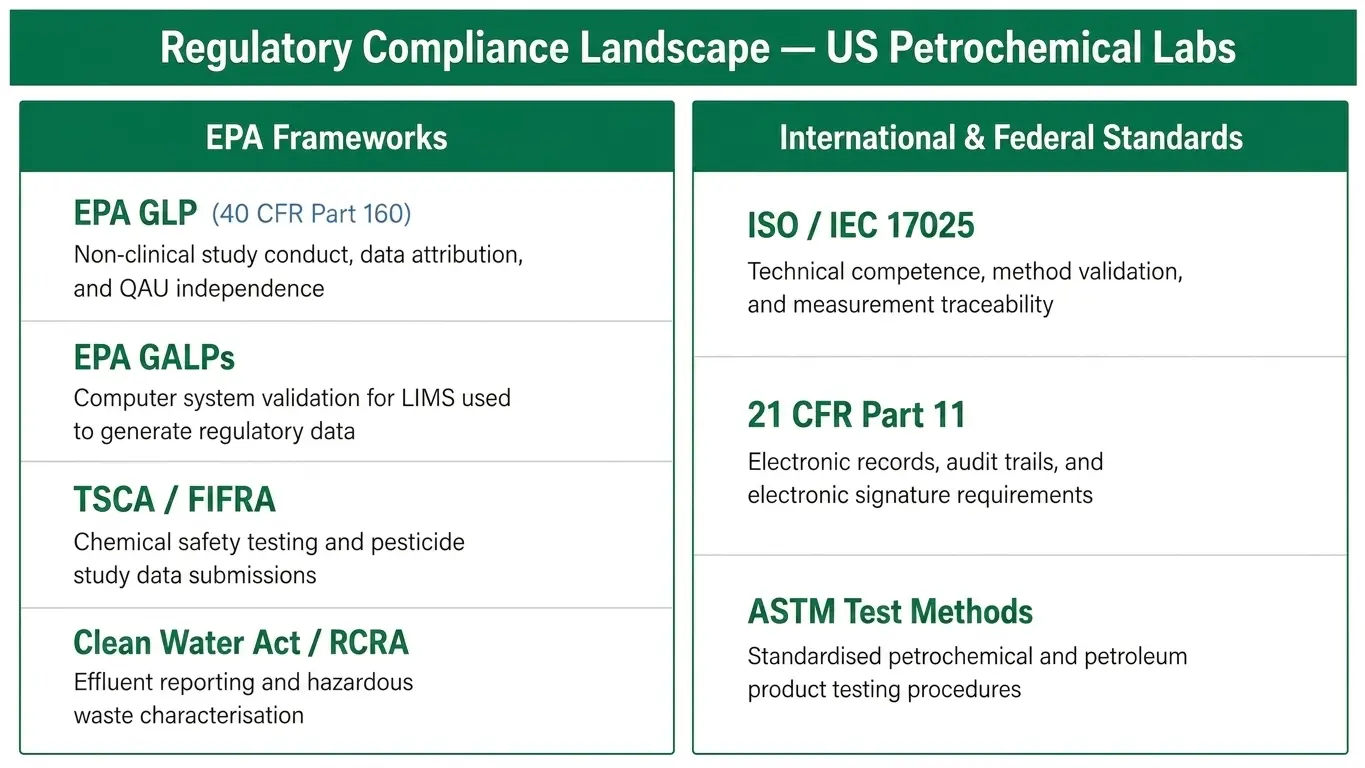
GLP is a set of principles designed to ensure the quality and integrity of non-clinical laboratory studies — particularly those submitted to regulatory agencies as the basis for safety decisions. In the United States, the EPA's GLP regulations under 40 CFR Part 160 apply to laboratories conducting chemical testing under TSCA (Toxic Substances Control Act) and FIFRA (Federal Insecticide, Fungicide and Rodenticide Act).
At its core, GLP demands:
- A designated Study Director responsible for overall study compliance
- An independent Quality Assurance Unit (QAU) that monitors each study separately from the team conducting it
- Standard Operating Procedures (SOPs) that are documented, version-controlled, and followed
- Complete raw data recording — accurately, promptly, and with individual attribution
- Traceability of corrections — any change must be documented with a reason, not simply overwritten
- Long-term data retention — records preserved and retrievable for years after study completion
EPA Compliance
EPA compliance for petrochemical labs extends beyond GLP. Depending on your operations, you may also need to comply with:
- EPA Method testing for air, water, and soil emissions
- Clean Water Act (CWA) effluent reporting requirements
- RCRA (Resource Conservation and Recovery Act) for hazardous waste characterization
- TSCA reporting for industrial chemical data
- Good Automated Laboratory Practices (GALPs) — EPA's specific guidance for computer systems and LIMS used to generate regulatory data
Meeting all of these simultaneously, consistently, and documentably — that's where paper-based systems simply can't keep up.
How LIMS Directly Supports EPA and GLP Compliance
1. Automated, Tamper-Proof Audit Trails
A modern LIMS enforces all of this automatically. Every sample login, result entry, approval, rejection, and correction is logged with a username, timestamp, and reason. If an analyst corrects a result at 2:17 PM on a Tuesday, that record exists permanently — alongside the original entry.
When an EPA inspector or external auditor requests documentation, you're not scrambling through binders or hunting through email threads. You pull the audit log directly from the system — complete, organized, and timestamped.
2. Complete Sample Traceability and Chain of Custody
In petrochemical labs, samples move through multiple hands and multiple stages — from field collection through receipt, preparation, analysis, and disposal. Each handoff is a potential compliance gap if it isn't documented.
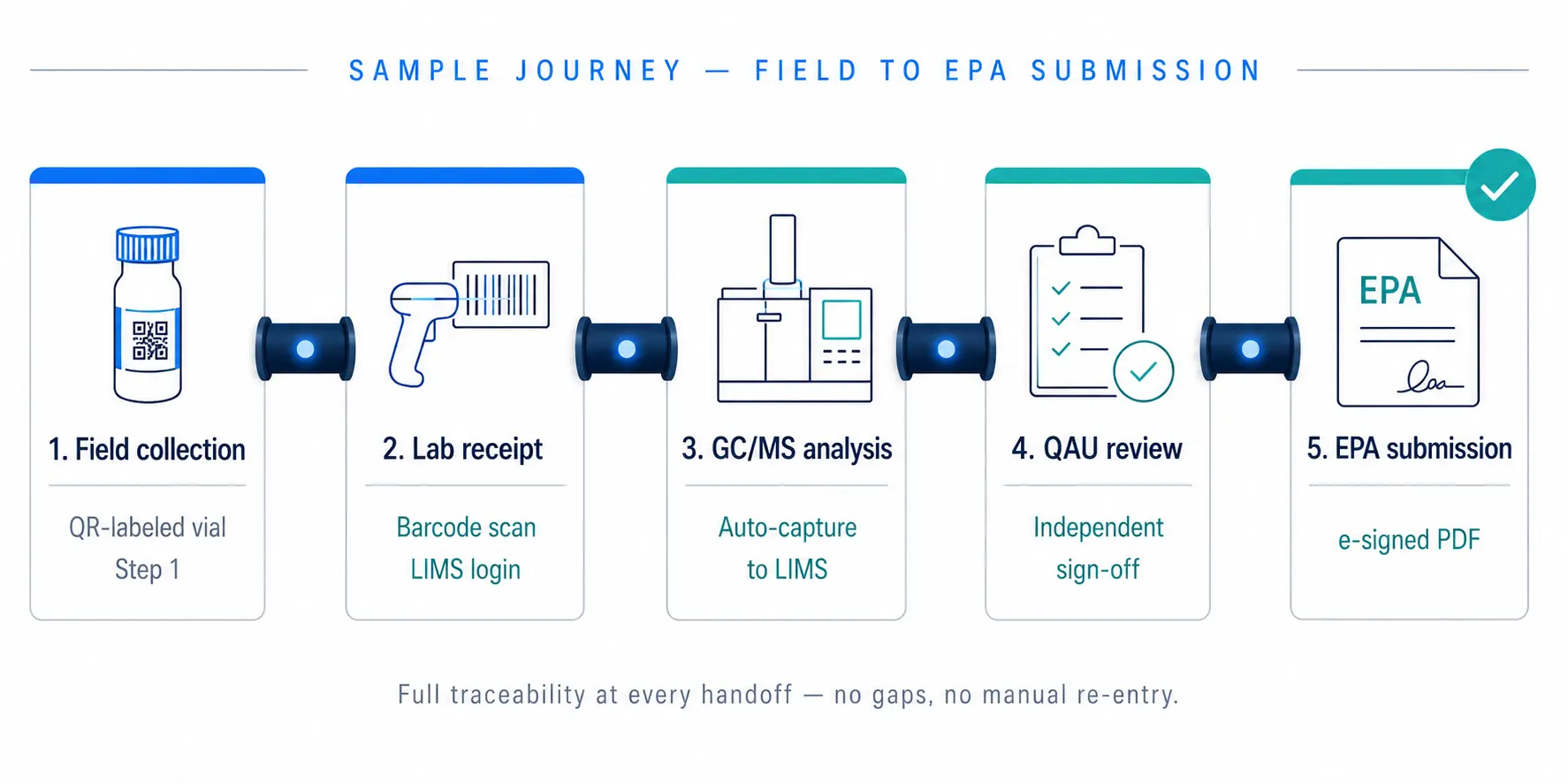
LIMS assigns a unique identifier to every sample from the moment it enters the system. Barcode or RFID-based tracking follows that sample through every stage of its lifecycle. Who collected it, when it was received, which analyst ran the test, which instrument was used, what the result was, and when it was reviewed — all of it is captured without manual effort.
For labs handling regulatory samples destined for EPA submission, this chain-of-custody documentation is non-negotiable. LIMS makes it automatic.
3. SOP Management and Enforcement
One of the most common GLP findings during EPA inspections is deviation from established SOPs — not because labs don't have procedures, but because analysts are working from memory, outdated printed copies, or informal habits that have drifted from the approved version.
LIMS centralizes SOP management within the same system where work is performed. Analysts access current, approved versions of test methods and procedures directly through their workflow. The system can require sign-off on SOPs before an analyst is permitted to run a test — creating documented evidence that the procedure was reviewed and followed.
Version control ensures that when an SOP is updated, older versions are archived (not deleted), and analysts automatically work from the current approved version.
4. Quality Assurance Unit (QAU) Independence
GLP is explicit: the QAU must operate independently from the team conducting the study. In practice, this means QA staff need visibility into study data, documentation, and findings — without having the ability to alter or interfere with the testing process itself.
LIMS supports this through role-based access controls. QA staff can view, review, annotate, and audit study records without touching analyst workflows. They can generate QA inspection reports, flag deviations, and track corrective actions — all within the same system — maintaining the independence that GLP requires.
5. Electronic Records and 21 CFR Part 11 Compliance
Many petrochemical labs that work with pharmaceutical or government clients — or submit data under federal programs — must also comply with 21 CFR Part 11 , the FDA's regulation governing electronic records and electronic signatures.
LIMS built for regulated industries includes electronic signature functionality that meets Part 11 requirements: unique user credentials, meaning-of-signature capture, and a non-repudiable link between the signature and the record. This eliminates wet-ink signatures on paper while satisfying both FDA and EPA requirements for electronic data submission.
6. Instrument Integration and Automated Data Capture
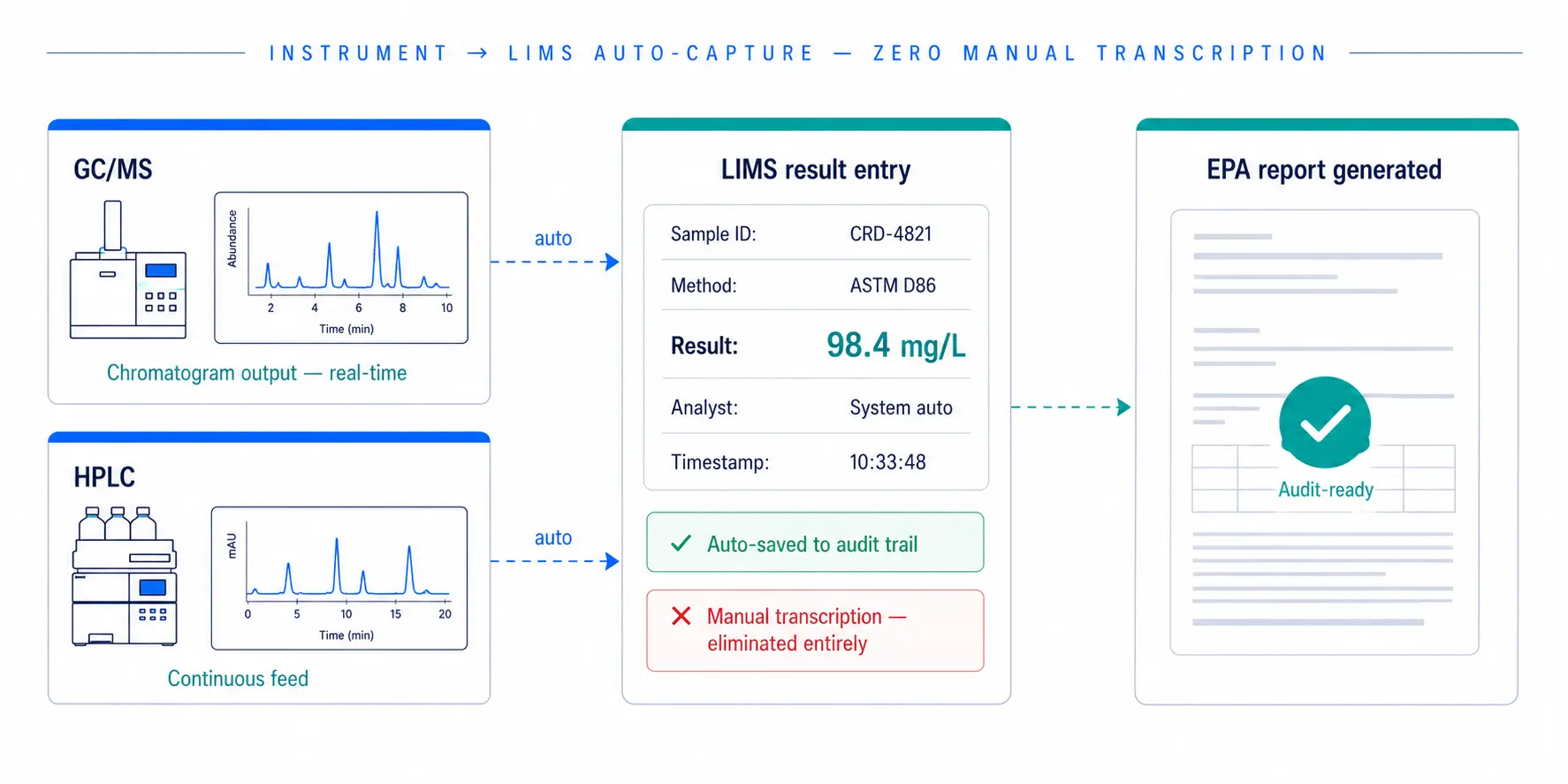
Manual transcription of instrument results into paper logbooks or spreadsheets is one of the highest-risk points for data integrity failures in any lab. An analyst copying a GC result by hand can introduce a transcription error. A cut-and-paste from a software export can lose metadata. Either way, you've broken the link between raw instrument data and your official result.
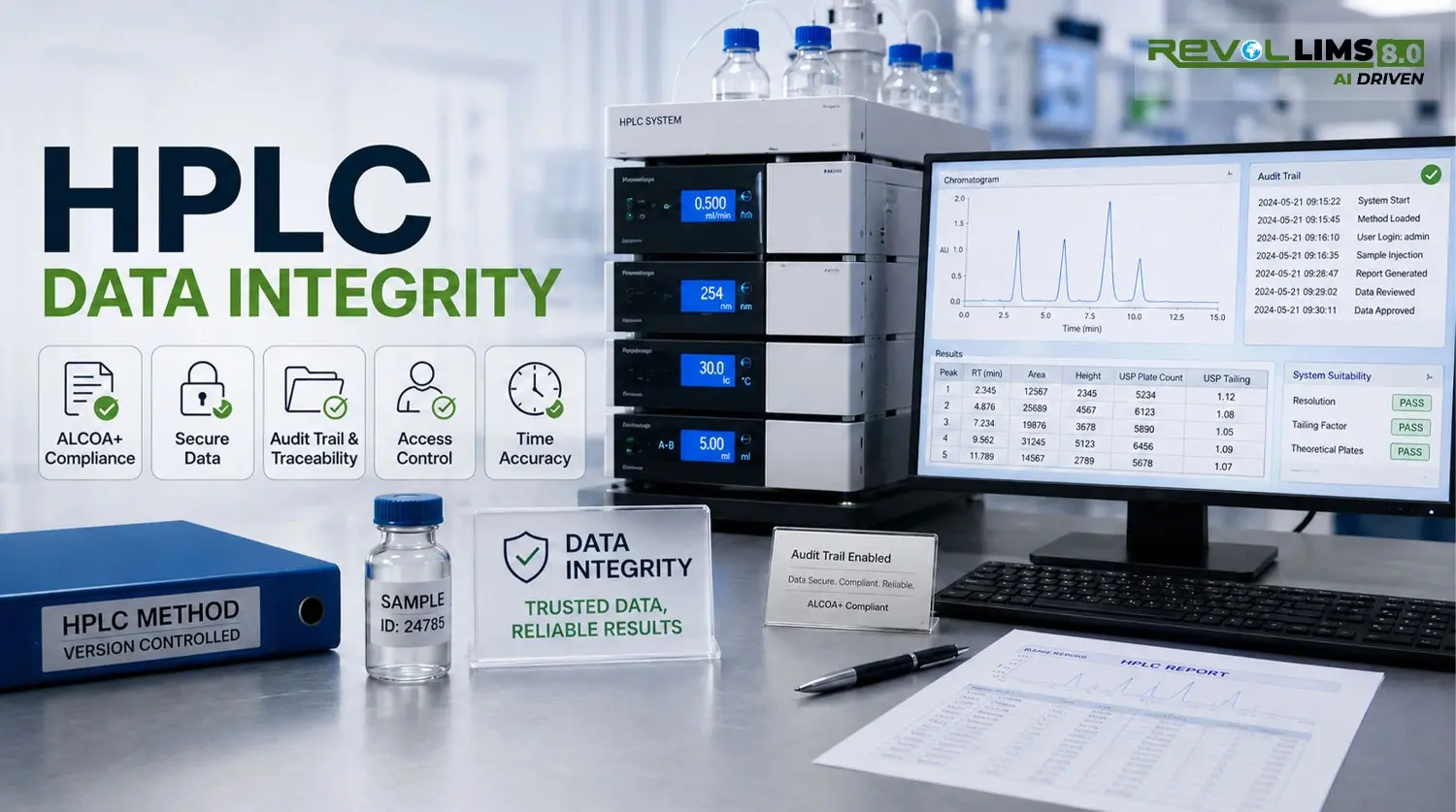
LIMS eliminates this risk by connecting directly to analytical instruments — GC/MS, HPLC, FTIR, titrators, viscometers, and others — and capturing results automatically at the point of measurement. The data flows from the instrument to the LIMS record without human transcription, preserving the integrity of raw data exactly as GLP requires.
7. Long-Term Data Retention and Archival
GLP data retention requirements are demanding. Study records must be preserved for a minimum of several years — and for certain raw data tied to ongoing regulatory decisions, that period can extend to a decade or more. The data must be stored in a format that remains retrievable and verifiable for the entire retention period.
LIMS handles this with structured archival — data is retained in a searchable, structured database rather than physical binders or ad-hoc file folders. Access controls ensure that archived records can be retrieved but not altered. Retention schedules can be configured to align with your specific regulatory obligations, ensuring nothing is deleted prematurely — and nothing relevant is buried when you need it.
8. Regulatory Reporting and Certificate of Analysis Generation
Whether you're submitting data to the EPA, generating test reports for clients, or producing Certificates of Analysis (CoAs) for refined product shipments, LIMS automates the reporting process. Reports are generated from verified, approved data with standardized templates — reducing the risk of formatting errors or data pulled from the wrong source.
For labs subject to EPA GALP requirements, the ability to trace every data point in a regulatory report back to its original instrument reading — through a documented chain of review and approval — is exactly what the framework demands. LIMS provides that traceability by design.
LIMS Compliance Coverage: At a Glance
| Regulatory Framework | What It Requires | How LIMS Addresses It |
|---|---|---|
| EPA GLP (40 CFR 160) | Data attribution, QAU independence, SOP adherence, raw data integrity | Audit trails, role-based access, SOP enforcement, instrument integration |
| EPA TSCA / FIFRA | Study data quality for chemical and pesticide submissions | Complete study documentation, long-term archival |
| EPA GALPs | Computer system validation for LIMS used in regulatory data | System validation documentation, access controls, data integrity features |
| ISO/IEC 17025 | Technical competence, method validation, measurement traceability | Method management, calibration tracking, proficiency testing records |
| 21 CFR Part 11 | Electronic records, electronic signatures | Compliant e-signature workflows, tamper-evident audit logs |
| ASTM Test Methods | Standardized petrochemical testing procedures | Pre-configured ASTM method templates |
| OSHA / RCRA | Hazardous material handling, waste characterization records | Sample labeling, storage tracking, hazardous material documentation |
What Happens Without LIMS: Real Risks for PetrochemicalLabs
It's worth being direct about what's at stake when compliance is managed manually.
During an EPA GLP inspection, investigators will request study documentation, raw data, QAU inspection records, SOP revision histories, equipment calibration logs, and corrective action records. If any of these are incomplete, inconsistent, or unlocatable — your study data can be invalidated. That means re-running studies, regulatory delays, and in serious cases, enforcement action under TSCA or FIFRA.
During an ISO 17025 accreditation audit, assessors will look at the same documentation — plus method validation records, proficiency test results, and uncertainty calculations. Gaps in traceability or inconsistencies between what your SOPs say and what your records show are findings that can put accreditation at risk.
The cost of a failed audit — in time, resources, remediation, and reputational damage — almost always exceeds the cost of implementing a LIMS in the first place.
Getting LIMS Right in a Petrochemical Environment
Not every LIMS is built for the demands of oil and gas or petrochemical testing. When evaluating a solution, look for:
- Pre-configured ASTM and EPA test method libraries — so you're not building from scratch
- Proven ISO 17025 and 21 CFR Part 11 compliance — with validation documentation provided
- Instrument integration with the specific equipment your lab uses (GC, HPLC, FTIR, titrators, viscometers)
- Flexible deployment — cloud-based for accessibility, or on-premise for data control, depending on your security requirements
- Multi-site support if your lab operations span multiple facilities or field locations
- Dedicated implementation support — not just software, but a team that understands petrochemical workflows
The right LIMS isn't just a data management tool. It becomes the operational backbone of your compliance program.
Frequently Asked Questions
Q: Is LIMS required for EPA GLP compliance in petrochemical labs?
LIMS is not explicitly mandated by name in EPA GLP regulations (40 CFR Part 160). However, the requirements for data attribution, audit trails, SOP management, and long-term archival are extremely difficult to meet reliably without an automated system. Labs that use LIMS are significantly better positioned during EPA inspections and data audits.
Q: What is the difference between GLP and EPA GALP requirements?
GLP (Good Laboratory Practice) governs the conduct and documentation of non-clinical safety studies submitted to the EPA. GALPs (Good Automated Laboratory Practices) are the EPA's additional guidance specifically for computer systems — including LIMS — used to generate, process, or store regulatory data. GALP compliance requires that your LIMS itself be validated, access-controlled, and capable of producing complete audit trails.
Q: Can LIMS help petrochemical labs meet both EPA and ISO 17025 requirements simultaneously?
Yes. Modern LIMS platforms are designed to support multiple compliance frameworks within a single system. EPA data integrity requirements, ISO 17025 technical requirements, and 21 CFR Part 11 electronic records requirements overlap significantly — a well-configured LIMS addresses all of them through its core features.
Q: How long does it take to implement LIMS in a petrochemical lab?
Implementation timelines vary by lab size and complexity, but leading platforms designed for regulated industries can go live in 8 to 12 weeks. Phased implementations are also common — starting with sample management and audit trail functionality, then expanding to instrument integration and full reporting automation.
Q: What should petrochemical labs look for when choosing a LIMS for EPA compliance?
Prioritize platforms with pre-configured EPA and ASTM test method support, built-in 21 CFR Part 11 electronic signature compliance, complete audit trail functionality, validated system documentation, and demonstrated experience in petrochemical or oil and gas laboratory environments.
Conclusion
Compliance in a petrochemical lab is not a problem you can solve with better spreadsheets or more diligent manual record-keeping. The regulatory expectations set by the EPA — across GLP, TSCA, FIFRA, and GALP frameworks — require systematic, automated, and fully traceable data management that paper-based processes simply cannot deliver at scale.
LIMS gives petrochemical labs the infrastructure to meet those expectations consistently — not just when an audit is coming, but as a natural byproduct of how the lab operates every day. Audit trails, chain of custody, SOP enforcement, instrument integration, data retention, and regulatory reporting all become built-in, not bolt-on.
If your lab is working toward EPA audit readiness, ISO 17025 accreditation, or simply trying to eliminate the compliance gaps that come with manual data management — LIMS is the most direct path to getting there.
Looking to learn more about how LIMS supports compliance in oil and gas and petrochemical laboratories? Explore Revol LIMS — purpose-built for the demands of petroleum and chemical testing environments.

 (1) (1).webp)