A quality manager at a mid-sized specialty chemicals company walks into a leadership meeting with a budget request for "laboratory management software." Six months, two vendor demos, and one very expensive consulting engagement later, the company has deployed an Electronic Lab Notebook — and the QC lab is still tracking 200 samples a week in a shared spreadsheet.
Nobody made a bad decision intentionally. The ELN genuinely impressed during the demo. It looked modern, intuitive, and covered enough bases to seem like a complete solution. What the demo did not reveal — and what the vendor had no incentive to clarify — was that the ELN was the right tool for the R&D team upstairs and the entirely wrong tool for the testing environment downstairs.
This guide exists because that story is not unique. It plays out in chemical plants, Petrochemical refineries, environmental testing services, and contract laboratories every year. The LIMS vs ELN decision is one ofthe most consequential technology choices a laboratory can make, and it is consistently made on incomplete information.
We will change that here:
Quick Answer: LIMS vs ELN
A LIMS (Laboratory Information Management System) manages samples, testing workflows, quality control, compliance, and operational data in a laboratory. It answers the question: What happened to this sample, and did it pass?
An ELN (Electronic Lab Notebook) captures experimental documentation, scientific knowledge, and research records. It answers the question: What did we try, observe, and learn?
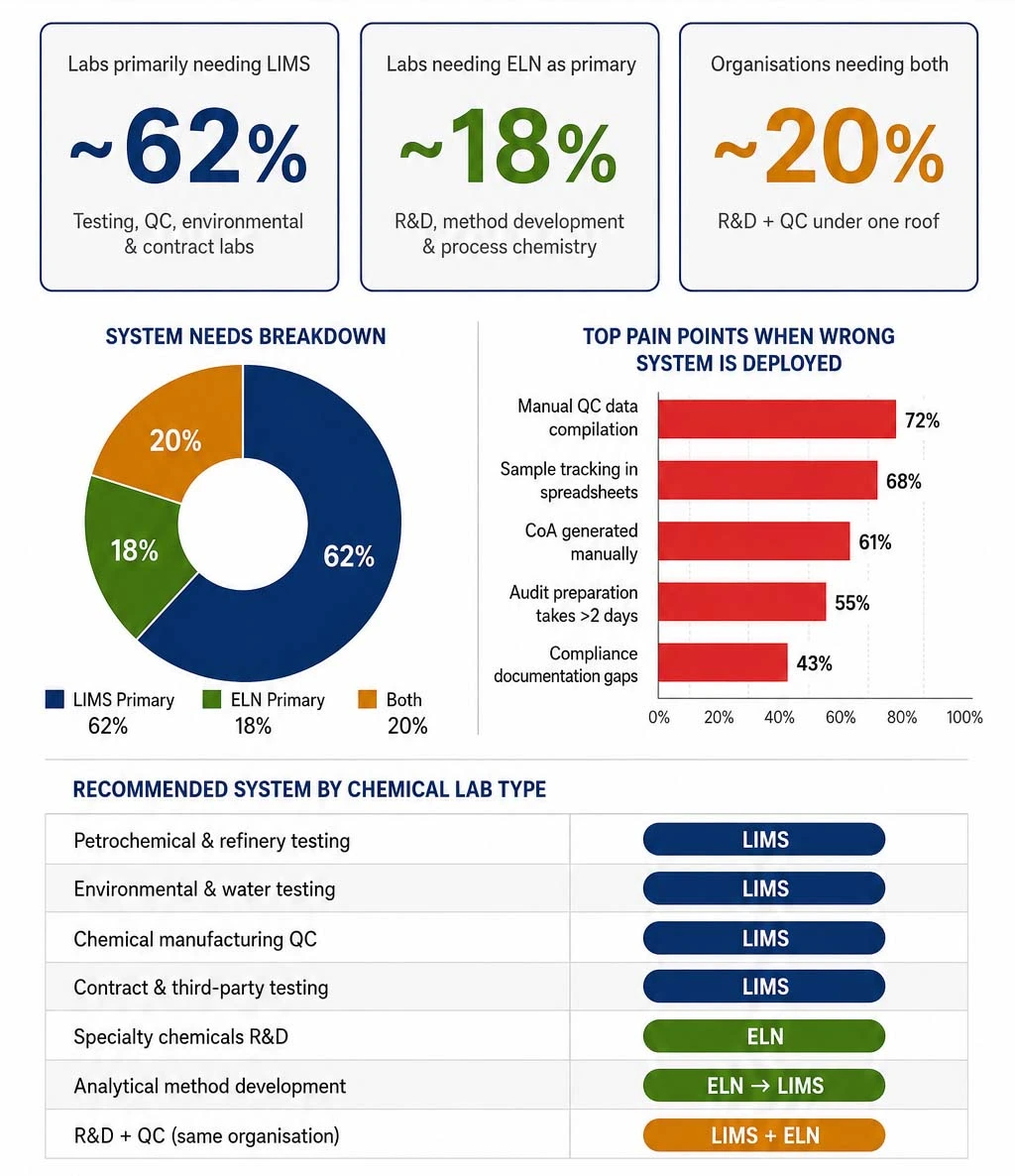
Most chemical testing, QC, environmental, and petrochemical laboratories need a LIMS. R&D and method development teams benefit most from an ELN. Organizations doing both need both — integrated.
What This Article Covers
- Why the LIMS vs ELN decision is harder than it should be — and who benefits from that confusion
- A plain-language breakdown ofwhat LIMS and ELN each actually do
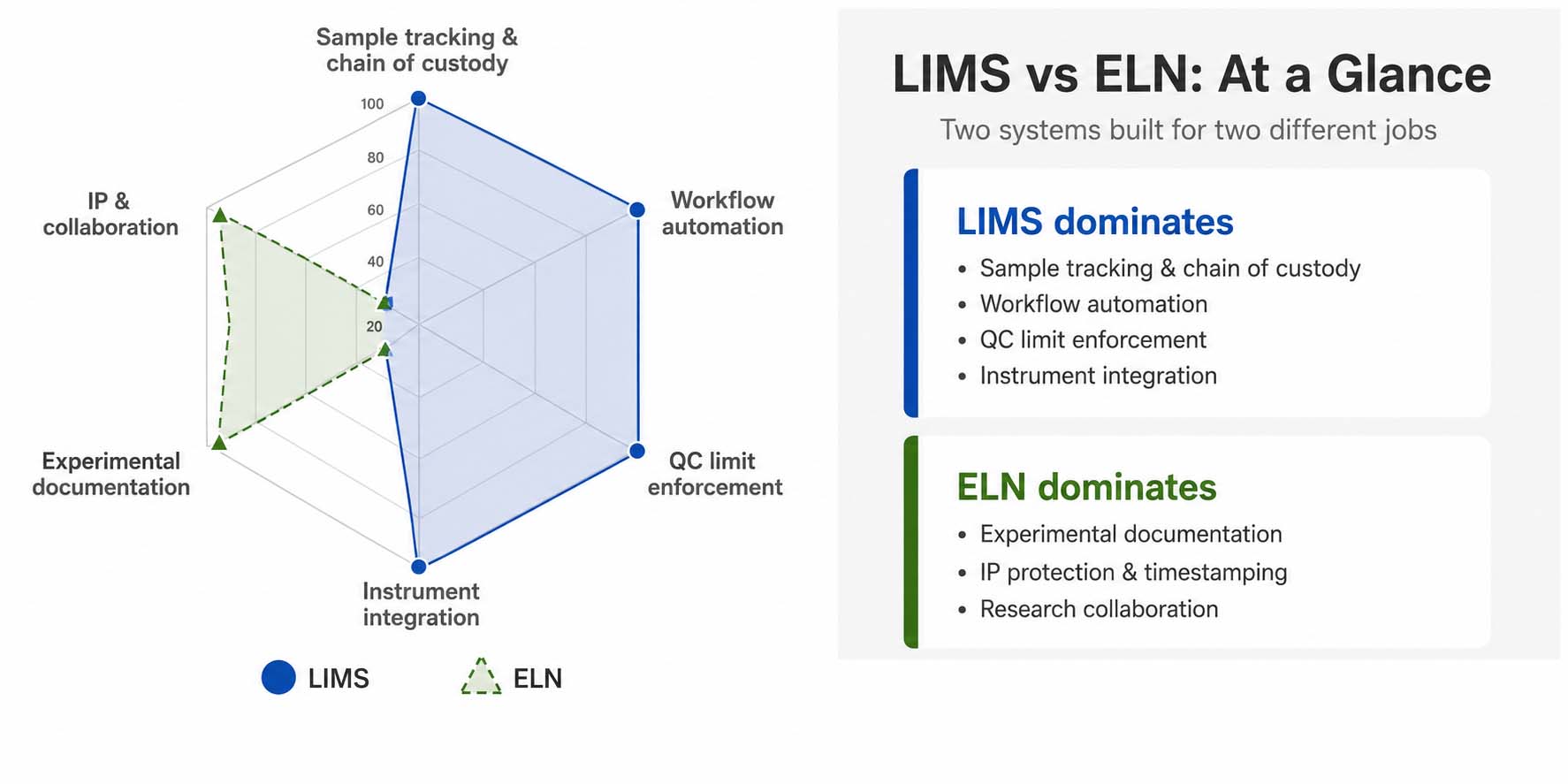
- The functional differences that matter most for chemical laboratories
- A side-by-side comparison table
- Real-world examples from petrochemical, environmental, specialty chemicals, and manufacturing labs
- The integration question: when one system is genuinely not enough
- The real cost ofchoosing the wrong system
- A five-question checklist to reach your decision in under ten minutes
- FAQ section
Why This Decision Is Harder Than It Should Be
The laboratory software market has a terminology problem. Vendors have diluted the definitions of LIMS and ELN to the point where each product claims to do what the other does. LIMS vendors have added notebook-style documentation features. ELN vendors have added basic sample tracking. The marketing language has converged even where the underlying capabilities have not.
For a laboratory manager evaluating systems for the first time, this creates genuine confusion. The product categories start to look interchangeable, and the decision becomes driven by surface-level factors — interface aesthetics, implementation cost, or which vendor responded faster — rather than by operational fit.
The result is a predictable set of failures. Testing labs that deploy ELNs find themselves without the workflow automation, QC management, and compliance infrastructure they actually needed. R&D labs that deploy LIMS find the system too rigid and structured for exploratory experimental work. Neither outcome is a vendor failure in any meaningful sense. It is a requirements mismatch that better information at the evaluation stage would have prevented.
What a LIMS Actually Does — Beyond the Marketing
A LIMS is an operational system. Its design purpose is to manage the movement of samples through a laboratory and control the processes applied to them. Every feature in a well-built LIMS exists to serve that central function.
In a chemical laboratory context, this translates into six operational capabilities that define the platform:
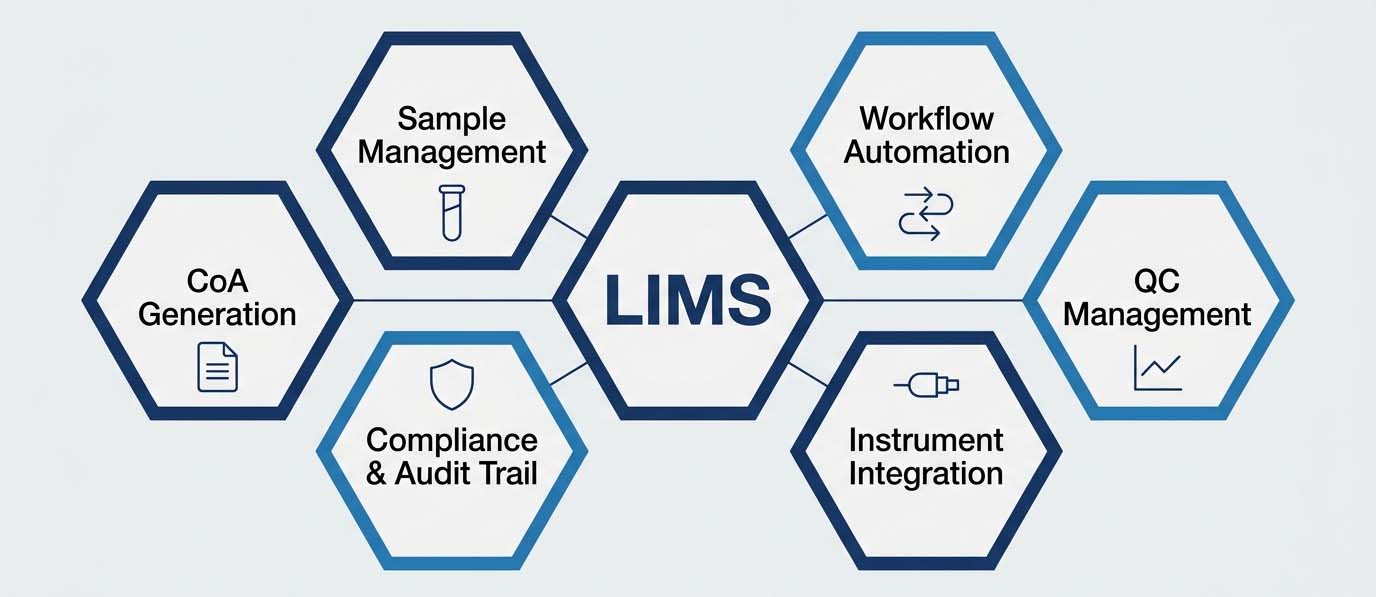
1. Sample Management and Chain of Custody Every sample that enters the laboratory receives a unique identifier — typically a barcode or RFID label — at the point oflogin. From that moment, every handoff, storage event, preparation step, and test assignment is recorded automatically. When a petrochemical quality lab receives a crude oil fraction from the refinery, the LIMS creates a traceable, auditable record before a single test is run.
2. Workflow Automation and Test Routing LIMS routes work automatically based on the sample type, the tests requested, and the instruments available. When a manufacturing QC lab receives a batch release sample, the system assigns the correct tests to the correct analysts, flags calibration windows for instruments, and escalates unapproved results — without anyone making those decisions manually.
3. Quality Control Management Built-in QC tools — control charts, out-of-specification alerts, duplicate sample scheduling, and QC limit enforcement — run continuously alongside routine testing. The system does not wait for an analyst to notice a trend. It flags it, records it, and initiates the configured response.
4. Instrument Integration and Data Capture Direct connections to analytical instruments — GC/MS, HPLC, ICP-OES, FTIR, titrators, viscometers — allow results to flow from the instrument directly into the LIMS test record. This eliminates manual transcription, which is where a disproportionate share oflaboratory data integrity failures originate.
5. Regulatory Compliance Infrastructure Audit trails, electronic signatures, role-based access controls, and long-term data retention are not add-on features in a properly built LIMS. They are architectural properties ofthe system. This is what makes LIMS the appropriate platform for laboratories operating under ISO 17025, GLP, GMP, or 21 CFR Part 11.
6. Reporting and Certificate of Analysis Generation Client-facing reports and Certificates of Analysis are generated from verified, approved data using standardized templates. The output is traceable from the final report back to the original instrument reading — through every step of review and approval.
What LIMS is not: LIMS is not designed for open-ended experimental work. It assumes that the tests to be run are defined, the methods are established, and the workflow is repeatable. That assumption is correct for 80% ofwork in a testing laboratory. It is incorrect for most work in an R&D laboratory.
What an ELN Actually Does — Beyond the Marketing
An ELN is a knowledge system. Its design purpose is to capture the scientific process — the observations, hypotheses, decisions, and interpretations that a researcher or scientist needs to document while conducting experimental work.
In a chemical laboratory context, ELN capability centers on five functions:
1. Structured Experimental Documentation Researchers record what they did, what they observed, and what conclusions they drew — in a structured digital format that replaces the traditional paper laboratory notebook. For a process chemist developing a new solvent formulation, every experimental variant is documented in a searchable, permanent, timestamped record.
2. Protocol Templates and Interactive Procedures Standard experimental procedures can be loaded as interactive templates, guiding researchers through each step while capturing the data entered at each point. This is particularly valuable in method development, where a procedure evolves iteratively across multiple experimental runs.
3. Intellectual Property and Legal Documentation ELN entries are signed, timestamped, and witnessed — creating a legally defensible record of who invented what and when. For specialty chemicals companies with active R&D programs, this documentation is foundational to patent applications and IP protection.
4. Scientific Knowledge Retrieval Years of experimental records, characterization data, and research observations become searchable and retrievable — transforming institutional knowledge from something locked in individual notebooks into a shared, queryable asset.
5. Research Collaboration Scientists can share, review, annotate, and build on each other's notebook entries. In organizations with distributed R&D teams or external research collaborations, ELN creates a shared workspace that paper notebooks cannot replicate.
What ELN is not: ELN is not designed to process high volumes ofroutine samples through defined testing workflows. It has no native sample chain of custody, no QC limit enforcement, no instrument integration for automated data capture, and no Certificate of Analysis generation.Asking an ELN to run a testing laboratory is like asking a research journal to manage aproduction line.
LIMS vs ELN: The Complete Comparison
| Dimension | LIMS | ELN |
|---|---|---|
| Core Purpose | Operational sample and workflow management | Scientific documentation and knowledge capture |
| Primary Environment | Testing, QC, compliance, contract laboratories | Research, development, method development |
| Sample Tracking | Full lifecycle from receipt to disposal | Not a native feature |
| Chain of Custody | Automated, auditable, regulatory-grade | Not included |
| Workflow Automation | Extensive — routing, alerts, escalations | Minimal — procedure templates only |
| Instrument Integration | Direct — bidirectional data capture | Limited — file upload or manual entry |
| QC Management | Native — control charts, OOS alerts, QC scheduling | Not included |
| Regulatory Compliance (ISO 17025, GLP, 21 CFR Part 11) | Designed as a compliance platform | Some platforms offer 21 CFR Part 11 support |
| Certificate of Analysis | Automated, template-driven, traceable | Not a feature |
| Experimental Documentation | Structured, workflow-bound | Open, scientist-directed |
| IP Documentation (timestamped, signed) | Not primary | Core capability |
| Scientific Collaboration | Approval-based only | Active, annotation-based |
| Inventory and Reagent Management | Yes — with expiry alerts | Limited |
| Reporting (regulatory and client) | Automated, verified, multi-format | Narrative and export only |
| Volume Capacity | Designed for high-throughput environments | Designed for individual researcher use |
| Best Fit | Testing, QC, environmental, petrochemical, contract labs | R&D, method development, process chemistry |
Where LIMS Belongs in Chemical Laboratories
Petrochemical and Refinery Testing Laboratories
Refineries and petrochemical plants run testing continuously — on feedstocks, process streams, intermediates, and finished products. Distillation curves, sulfur content, flash point, viscosity,density, and octane ratings are tested against ASTM specifications across hundreds of samples per shift. No test can be missed. No result can be manually transcribed without introducing risk.
A LIMS in this environment is not a productivity tool — it is a safety and compliance infrastructure. The cost ofa batch release failure, a customer complaint on an off-spec product, or an EPA reporting violation far exceeds any implementation cost.
Environmental and Water Testing Services
A contract environmental laboratory handling soil, water, groundwater, and air samples for industrial and municipal clients is fundamentally a sample logistics operation. Multiple clients, multiple sample matrices, multiple regulatory methods, strict turnaround time commitments, and documented chain ofcustody for regulatory submissions — these are not documentation challenges. They are operational challenges that only a LIMS is built to handle.
Chemical Manufacturing Quality Control
Whether the product is industrial solvents, specialty coatings, adhesives, or agricultural chemicals, every manufacturing QC laboratory runs the same fundamental process: receive a batch sample, test it against specification, approve or reject it, document the decision. At scale — 30, 50, 100 batches per day — manual systems fail not through error, but through volume. LIMS is the only infrastructure that keeps pace.
Third-Party and Contract Chemical Testing
Contract testing laboratories in the chemical sector operate across dozens of clients, hundreds of test methods, and tight commercial turnaround commitments. Invoicing is tied to sample counts. Profitability is tied to throughput and turnaround efficiency. Without LIMS, these operations are managing their core business process in spreadsheets — a risk that compounds daily.
Where ELN Belongs in Chemical Laboratories
Specialty Chemical Research and Development
A specialty chemicals company developing a new surfactant formulation, a high-performance coating, or a novel catalyst system needs to document the iterative experimental process — failed syntheses, modified conditions, unexpected observations, and characterization results — in a structured, searchable record. This is genuinely what ELN is built for.
The R&D scientist is not processing samples against defined specifications. They are generating knowledge, and the system they use should be built to capture it.
Analytical Method Development
When a laboratory is developing or validating a new analytical method — for instance, an LC-MS/MS method for trace contaminants in a specialty chemical — the work is exploratory. Conditions change between runs. Results prompt new experiments. Observations are as important as numbers. An ELN accommodates this process naturally.
Once that method is validated and moves into routine use, it transitions to the LIMS environment — where it becomes a defined, controlled test protocol applied to production samples.
Chemical Process Development and Scale-Up
In pilot plant environments, where process chemists are scaling synthesis routes from bench to pilot scale, the documentation needs are narrative — reaction conditions, mass balances, operator observations, deviations from expected behavior. ELN handles this. LIMS does not.
When Your Laboratory Needs Both — and How Integration Works
The integration scenario is genuine and common in the chemical industry. A company with both a research division and a quality testing function does not have an either/or decision in front of them. They have two distinct operational environments, each requiring the right tool.
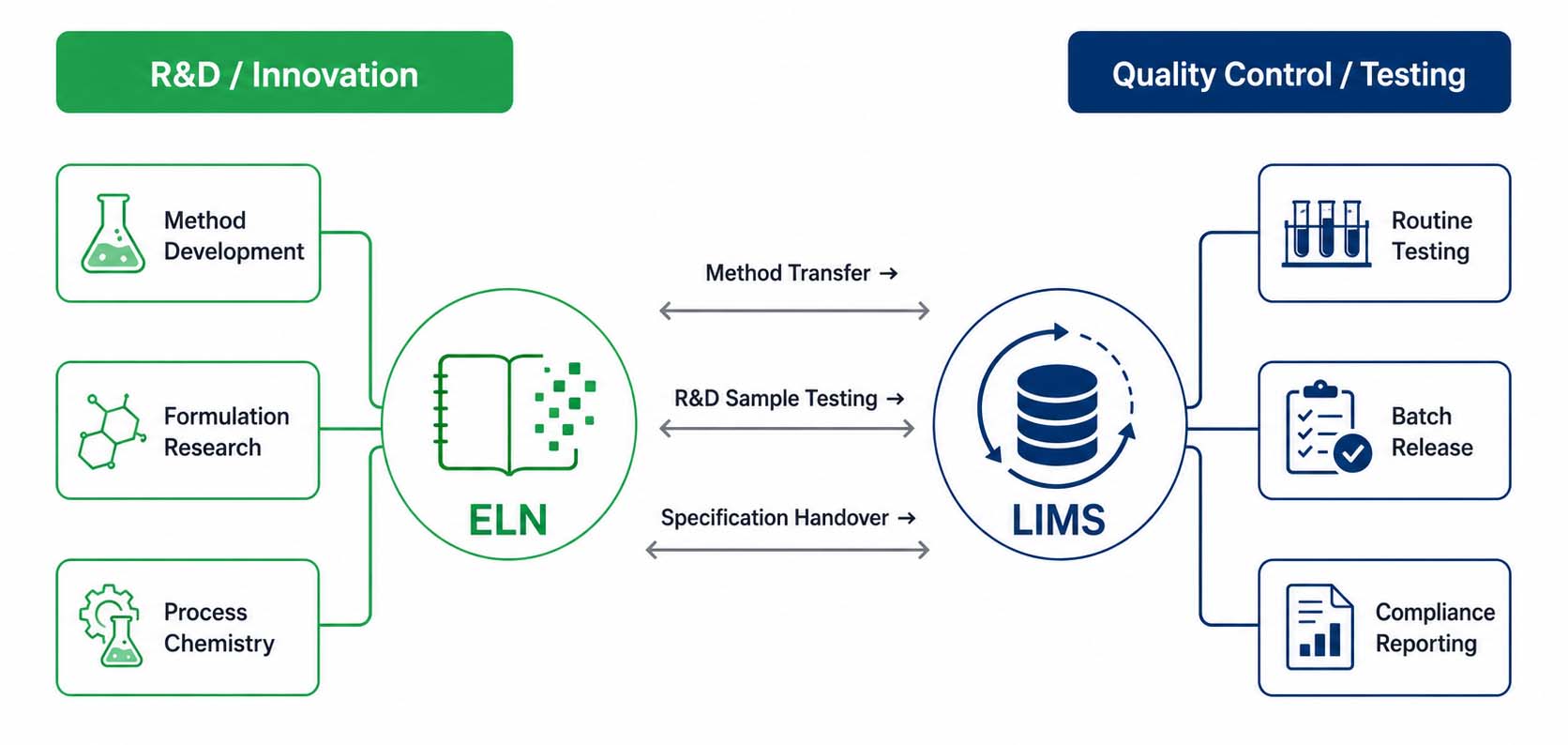
The specific workflows that benefit most from LIMS-ELN integration include:
Method transfer: A method developed and validated in the ELN needs to move into the LIMS as a defined test protocol when routine testing begins. Integration eliminates the manual re-entry step and maintains the validation documentation chain.
R&D sample testing: When R&D synthesizes a new compound and sends it to the QC laboratory for characterization, the LIMS manages the sample intake, testing, and result output — while the ELN captures the R&D team's interpretation of those results in the context of their experimental record.
Specification development: New product specifications developed in R&D need to flow into the LIMS as QC acceptance criteria. Integration makes this a controlled, documented transfer rather than an informal handoff.
When evaluating platforms for an integrated environment, the critical technical requirement is bidirectional API support. Systems that cannot exchange structured data without custom development create integration debt — maintenance burdens that grow as both systems evolve.
The Real Cost of Choosing the Wrong System
The financial impact of a LIMS-ELN mismatch is rarely visible in a budget line. It accumulates in operational friction.
A testing laboratory running on an ELN instead of a LIMS typically absorbs several hidden costs simultaneously: analysts manually tracking sample locations in parallel spreadsheets, QC supervisors manually compiling control data from notebook entries that were never designed for trending, compliance teams manually reconstructing audit trails from scattered records before each accreditation assessment. Each of these costs is individually small. Collectively, across a year, they exceed the cost of the system that would have prevented them.
A research team constrained to a LIMS instead of an ELN faces a different problem: the system's structured workflow demands work against the iterative, judgment-driven nature of research. Scientists work around the system. Records accumulate in personal files, printed pages, and informal notes. The institutional knowledge problem the ELN was meant to solve remains unsolved.
Neither of these is a technology failure. They are requirement mismatches — expensive ones, with compounding consequences.
Your Five-Question Decision Checklist
Before choosing a system, answer these five questions based on your laboratory's actual daily operations — not its aspirations.
- Question 1: What percentage of your daily work involves testing samples against defined methods or specifications? If the answer is above 50%, LIMS is your primary platform requirement.
- Question 2: Does your laboratory hold, pursue, or plan to pursue ISO 17025 accreditation, GLP compliance, or any regulatory certification? If yes, LIMS is a compliance requirement — not an operational preference.
- Question 3: How many discrete samples does your laboratory process per week? Laboratories processing more than 100 samples per week in a testing environment need LIMS workflow automation to maintain accuracy and turnaround commitments.
- Question 4: Does your lab generate Certificates of Analysis, issue reports to clients, or submit data to regulatory agencies? These outputs require the traceable, approval-controlled reporting workflows that are native to LIMS.
- Question 5: Does your lab conduct original research, develop new methods, or document experimental processes where the outcome is not predefined? If yes, and this represents a significant portion of your operation, ELN serves this function. If it's a small part of an otherwise testing-focused environment, a LIMS with structured worksheets may be sufficient.
Conclusion: The Right System Is the One That Matches Your Work
The LIMS vs ELN question has a clear answer — but only after you are honest about what your laboratory actually does every day.
For the overwhelming majority of chemical testing, quality control, environmental, Petrochemical, and manufacturing laboratories, LIMS is the correct primary platform. It manages samples, automates workflows, enforces quality standards, and builds the compliance infrastructure that those operations genuinely require. An ELN does not replace these capabilities, regardless of how its marketing positions it.
For R&D and method development environments, ELN is the appropriate tool — capturing the exploratory, knowledge-generating work that LIMS structured workflows are not built for.
For organizations with both, integration is the answer — and getting the integration architecture right from the start is as important as choosing the individual platforms.
The most expensive laboratory software decision is not the one that costs the most. It is the one that was made for the wrong reasons, deployed in the wrong environment, and discovered to be the wrong tool only after months of operational friction.
Start with your operations. Map your actual workflows. Count your weekly sample volumes. Review your compliance obligations. Let those facts drive the technology decision — and the right answer will be obvious.
Frequently Asked Questions: LIMS vs ELN
Q1: What is the difference between LIMS and ELN?
A: A LIMS (Laboratory Information Management System) is an operational platform that manages samples, testing workflows, quality control processes, instrument data, compliance documentation, and client reporting. An ELN (Electronic Lab Notebook) is a documentation platform that captures experimental records, research observations, and scientific knowledge. LIMS manages what happens to a sample. ELN captures what a scientist learned. These are different functions served by different systems.
Q2: Which is better for a chemical laboratory — LIMS or ELN?
A: For most chemical laboratories, LIMS is the better choice. Chemical testing, quality control, petrochemical, environmental, and manufacturing laboratories primarily test samples against defined specifications — an operational function that LIMS is purpose-built for. ELN is better suited to chemical R&D, method development, and process chemistry environments where the work is exploratory and experimental documentation is the core output.
Q3: Can an ELN be used instead of LIMS in a testing laboratory?
A: No. An ELN cannot substitute for a LIMS in a testing laboratory. Testing laboratories require sample chain of custody, automated workflow routing, quality control limit enforcement, instrument data integration, and Certificate of Analysis generation — none of which are native ELN capabilities. Using an ELN in a testing environment forces analysts to manage these functions manually, typically in parallel spreadsheets, which introduces data integrity risk and operational inefficiency.
Q4: What does LIMS stand for and what does it do?
A: LIMS stands for Laboratory Information Management System. It manages the complete lifecycle of laboratory samples — from receipt and login through testing, quality review, result approval, and final reporting. In a chemical laboratory, LIMS tracks chain of custody, automates test routing, enforces QC specifications, integrates with analytical instruments, and generates Certificates of Analysis. It is the operational backbone of testing, quality control, and compliance-driven laboratories.
Q5: What does ELN stand for and what does it do?
A: ELN stands for Electronic Lab Notebook. It replaces the traditional paper laboratory notebook with a structured digital system for recording experimental work — including procedures, observations, calculations, analytical data, and scientific interpretations. ELN is used primarily in research and development, method development, and process chemistry environments where capturing the experimental process and building searchable scientific knowledge are the primary goals.
Q6: Do Petrochemical laboratories need LIMS or ELN?
A: Petrochemical testing laboratories need LIMS. These environments test crude oil, process streams, refined products, and wastewater effluents under ASTM and EPA methods, require full sample traceability, must produce documented CoAs, and operate under regulatory compliance frameworks including ISO 17025 and GLP. LIMS provides the sample management, workflow automation, and compliance infrastructure these operations require. ELN is not appropriate as a primary system for petrochemical testing.
Q7: What is laboratory digital transformation in the context of LIMS and ELN?
A: Laboratory digital transformation refers to replacing manual, paper-based laboratory processes with integrated digital systems that ensure data integrity, operational efficiency, and regulatory compliance. For most chemical laboratories, LIMS is the foundational platform of this transformation — automating sample management, QC workflows, and compliance reporting. ELN becomes part of the digital transformation strategy specifically for R&D functions, where experimental documentation needs to be captured in structured, searchable, and auditable digital formats.
Q8: When does a laboratory need both LIMS and ELN?
A: A laboratory needs both LIMS and ELN when it operates distinct testing and research functions simultaneously. A specialty chemicals company with a QC testing laboratory and a product development R&D team is a typical example. The QC lab needs LIMS for sample management, quality control, and compliance. The R&D team needs ELN for experimental documentation and knowledge capture. Integration between the two systems — via APIs — allows methods developed in ELN to be transferred as test protocols in LIMS, and allows LIMS result data to be referenced within ELN experimental records.
Q9: Is LIMS required for ISO 17025 accreditation?
A: ISO 17025 does not mandate LIMS by name, but its requirements for method management, calibration tracking, measurement traceability, QC management, and documentation control are extremely difficult to meet reliably without an automated system. Laboratories pursuing or maintaining ISO 17025 accreditation consistently implement LIMS as the most reliable and auditable mechanism for meeting these requirements. LIMS also simplifies the evidence collection process during accreditation assessments significantly.
Q10: What are the limitations of using an ELN for quality control in a chemical lab?
A: Using an ELN for quality control in a chemical laboratory creates several critical limitations: no automated sample chain of custody, no QC limit enforcement or out-of-specification alerting, no direct instrument data integration, no automated Certificate of Analysis generation, and no compliance infrastructure for ISO 17025 or GLP. QC managers working in ELN-based environments typically compensate with parallel manual processes — tracking samples in spreadsheets, compiling QC data manually, and building CoAs in word processors — which defeats the purpose of laboratory digitalization.
Q11: How long does it take to implement a LIMS in a chemical laboratory?
A: LIMS implementation timelines depend on lab size, complexity, and the number of instruments to be integrated. For a mid-size chemical testing or QC laboratory, implementation typically takes 8 to 14 weeks from project kick-off to go-live. Phased implementations are common — starting with sample management and audit trail functionality, then adding instrument integration, QC automation, and reporting in subsequent phases. Purpose-built platforms with pre-configured chemical industry test methods can significantly reduce setup time.
Q12: What features should a LIMS have for environmental testing laboratories?
A: An environmental testing LIMS should include multi-client sample management with client-specific test panel configuration, regulatory method libraries (EPA methods for water, soil, and air), chain of custody documentation for regulatory submissions, sample storage tracking with temperature monitoring, turnaround time management, QC sample scheduling and control charting, automated report generation in regulatory-required formats, and data export capabilities compatible with state and federal environmental reporting systems.

 (1) (1).webp)