What Modern Mining Laboratories Must Demand From Their LIMS: A Practical Evaluation Framework
Picture a scene that plays out every day across the resource sector. A large iron ore operation in Odisha, or perhaps a high-grade copper mine in Rajasthan, is hitting peak production season.
The site is producing 800 samples per day. The assay laboratory is running three shifts continuously to keep pace. The instruments on the bench are state-of-the-art, properly calibrated, and producing highly accurate, reliable analytical data.
Yet, the journey from that precise instrument output to a critical mine planning decision still involves six manual steps. Technicians are printing results, transcribing them into spreadsheets, compiling batch reports, formatting the layout, reviewing the data manually, and emailing the final sheet to the geological team.
This scenario highlights a fundamental truth about every metals and mining operation's laboratory data infrastructure — and specifically about the design and capability of its mining LIMS.
Because of this administrative friction, the data the mine planning team receives is four hours old by the time it reaches them. Grade control decisions—decisions dictating the blending of thousands of tonnes of material—are being made on yesterday's numbers.
"The irony is sharp: a billion-rupee mining operation with state-of-the-art extraction equipment is routinely managed by a laboratory data system designed in a different era."
This scenario highlights a fundamental truth. The quality of a mining laboratory's laboratory information management system is not merely a support function consideration. It is a core operational and commercial infrastructure decision.
The capabilities that a system possesses dictate data turnaround times, grade control accuracy, and regulatory compliance posture. Ultimately, laboratory data latency impacts the commercial value of every tonne of ore produced and shipped.
This framework outlines what the modern resource sector actually requires from its laboratory data infrastructure. It provides a practical, operationally grounded guide for any mining laboratory professional making decisions about their data systems today.
Quick Summary
This guide covers the 8 capability domains every mining LIMS must address: sample management and chain of custody, instrument integration, regulatory compliance (ISO 17025, IBM, DGMS), data integrity and security, analytics and SQC/SPC monitoring, workflow automation, cloud deployment flexibility, and AI-powered predictive analytics. Implementation for a mid-size mining laboratory typically takes 3 to 6 months. A LIMS is worthwhile even for laboratories processing as few as 200 samples per day.
What is a Mining LIMS?
A mining LIMS (Laboratory Information Management System) is a software platform that manages the complete sample lifecycle in a metals and mining laboratory — from field collection through preparation, multi-instrument analysis, QA/QC monitoring and regulatory reporting. A mining-specific LIMS differs from generic laboratory software in its ability to handle high-throughput sample volumes (500 to 2,000 samples per day), integrate with metallurgical instruments (XRF, ICP-OES, AAS, fire assay), maintain complete chain of custody for drill core and ore samples, and support compliance with mining-specific regulations including ISO 17025, IBM and DGMS requirements in India.
What This Framework Covers
- The Data Management Challenges Unique to Metals and Mining: Why generic software solutions routinely fail under the intense throughput of mining environments.
- The Eight Essential Capability Domains: The foundational technical requirements that every mining LIMS must address to be considered fit for purpose.
- Mapping Capabilities to Operational Outcomes: How specific data management features directly influence grade control, mill efficiency, and commercial shipping decisions.
- Regulatory and Compliance Minimums: The baseline standards required for ISO 17025, environmental reporting, and national mining regulations.
- Scalability and Deployment Reality: What true system flexibility means in the context of remote mine sites and complex corporate structures.
- The Impact of Emerging AI: How predictive analytics and artificial intelligence are redefining what mining laboratories should expect from their data systems.
1. Why Do Standard Laboratory Software Solutions Fail in Metals and Mining Environments?
Metals and mining laboratory data management is fundamentally different from other analytical industries. When a generic laboratory software solution—rather than a purpose-built LIMS for metals and mining—is deployed in a mining context, it almost consistently underperforms.
This underperformance usually stems from a failure to handle the sheer volume of continuous data.
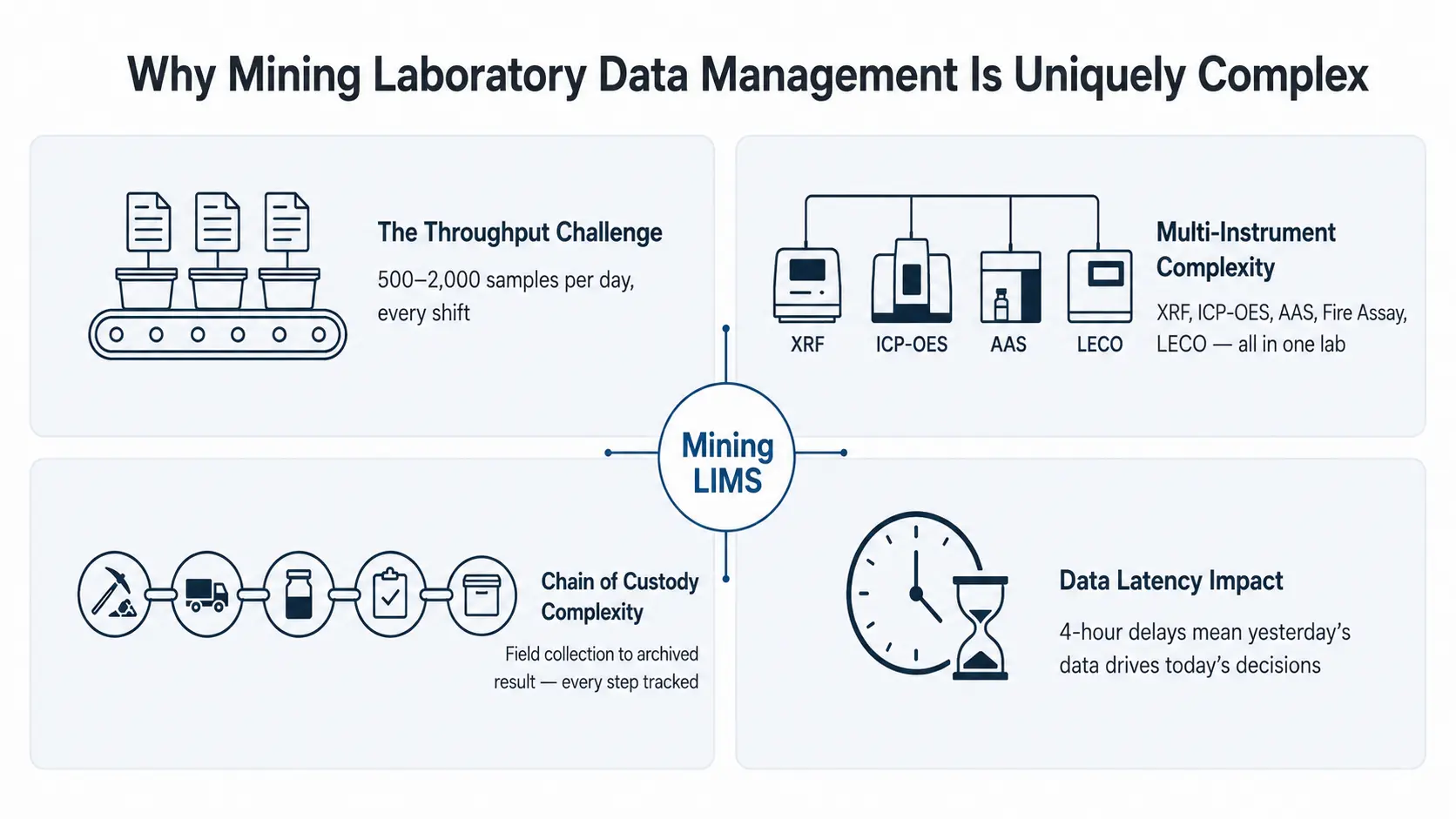
The throughput challenge in mining is relentless. Exploration drilling programmes might generate hundreds of samples per campaign, arriving in unpredictable surges. Meanwhile, production operations require continuous, unbroken assay programmes processing anywhere from 500 to 2000 samples per day.
Standard software systems designed for environmental or clinical testing often treat each sample as an isolated event requiring manual intervention. In a high-throughput mining laboratory, this creates administrative demands that rapidly overwhelm manual and semi-manual systems, leading to severe bottlenecks and a lack of proper grade control laboratory automation.
The multi-instrument complexity of a metallurgical laboratory further compounds this challenge. A standard metallurgical LIMS must rely on a diverse landscape of highly specific analytical hardware.
This includes XRF for rapid multi-element screening, ICP-OES for precise quantification of base metals, and AAS for specific element targeting. It also includes fire assay equipment for precious metals, LECO analyzers for carbon and sulphur, and increasingly, automated mineralogy systems.
Each of these instruments produces data in fundamentally different formats, operating through different interfaces. Managing this landscape requires a data system that can seamlessly interpret and normalise data from all of them simultaneously.
"Managing the modern instrument landscape requires a data system capable of speaking multiple machine languages simultaneously, without dropping a single decimal point of precision."
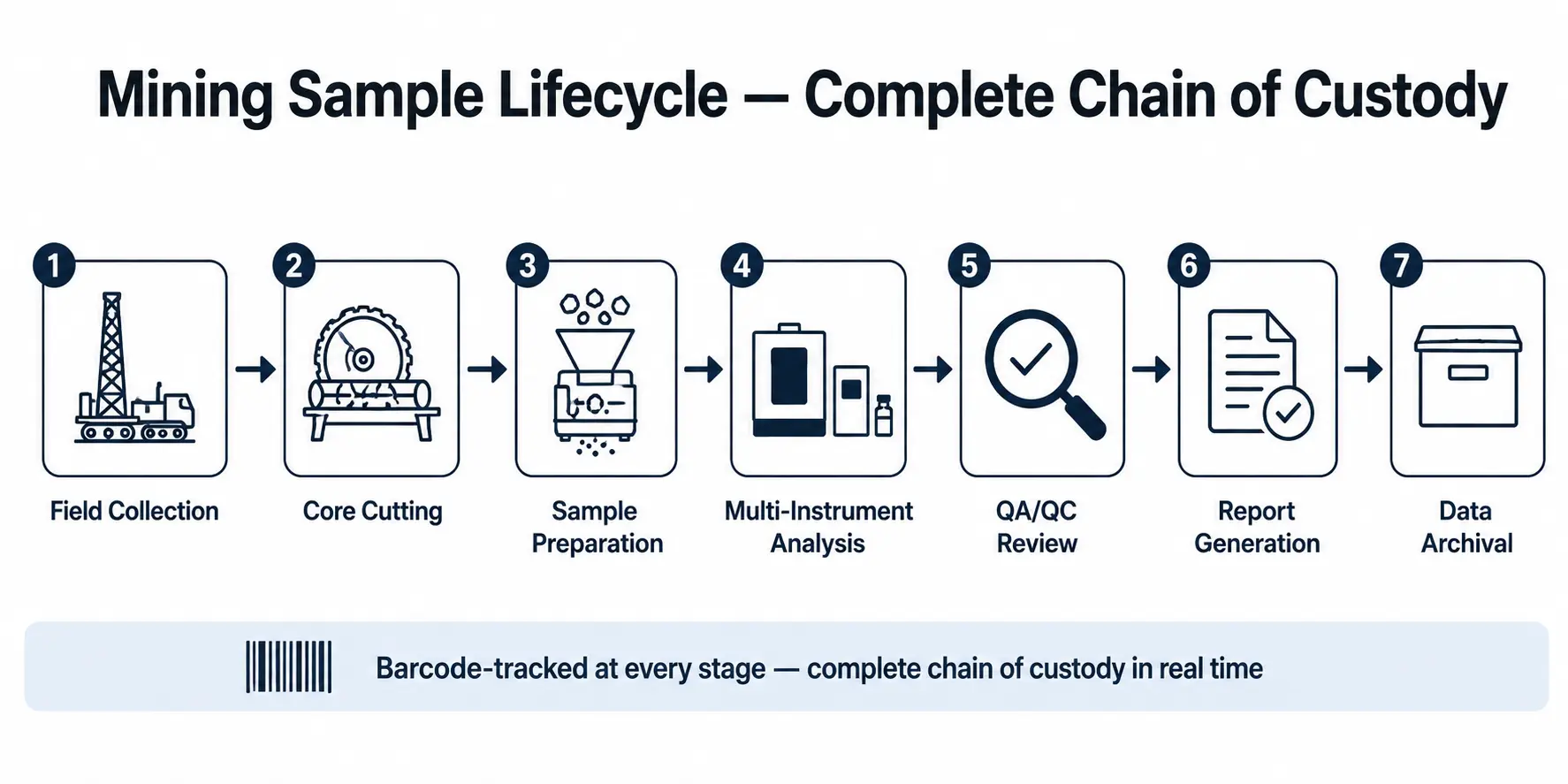
Furthermore, the chain of custody complexity in mining sample management is exceptionally rigorous. The journey from field collection through core cutting, crushing, pulverising, and splitting is long.
It involves multiple analytical stages, the rigorous insertion of QA/QC samples (blanks, duplicates, standards), thorough data review, and final reporting. This chain is longer than almost any other analytical industry. Any weakness in tracking this chain compromises the integrity of every result it touches.
Finally, we must consider the operational consequence of data latency. When laboratory data latency is measured in hours rather than minutes, the mine suffers.
Grade control decisions made on stale data result in immediate ore dilution, the misclassification of marginal material, and suboptimal mill feed grades. If a concentrator is fed the wrong blend because the assay laboratory was four hours behind on reporting, the metallurgical recovery drops, costing the operation millions in lost product.
2. What Sample Management Capabilities Must a Mining LIMS Provide?
When evaluating the key capabilities of a mining laboratory management system, real-time sample tracking is an absolute operational requirement. Every single sample must be instantly locatable within the system.
From the moment a barcode is scanned at the drill rig or the run-of-mine pad, to the final archived analytical result, an effective assay laboratory LIMS must maintain a complete, timestamped history.
This requires rigorous batch and lot tracking capabilities. A LIMS for metals and mining must provide the ability to link every final elemental result back to its origins.
Users must be able to trace a result back to a specific raw material or ore lot, a specific geospatial field location, a specific collection method, and a specific sample preparation procedure. If a grade anomaly is detected, the laboratory manager needs to instantly know which preparation technician handled the sample and which splitting protocol was used.
Because of the sheer volume of samples, automated data entry requirements are non-negotiable for any mining sample management software. Manual sample registration at mining laboratory throughput rates is structurally incompatible with data integrity.
Human operators cannot type hundreds of sample IDs per shift without eventually making a transcription error. Automated sample login through barcode or QR code workflows provides a necessary defence against these errors.
The operational outcome of these capabilities is profound visibility. A mining laboratory with real-time chain of custody visibility can answer any question about any sample at any point in its lifecycle in seconds. This capability protects the integrity of daily operational decisions and secures trust in commercial shipping relationships.
3. How Should a Mining LIMS Handle Instrument Integration and Data Capture?
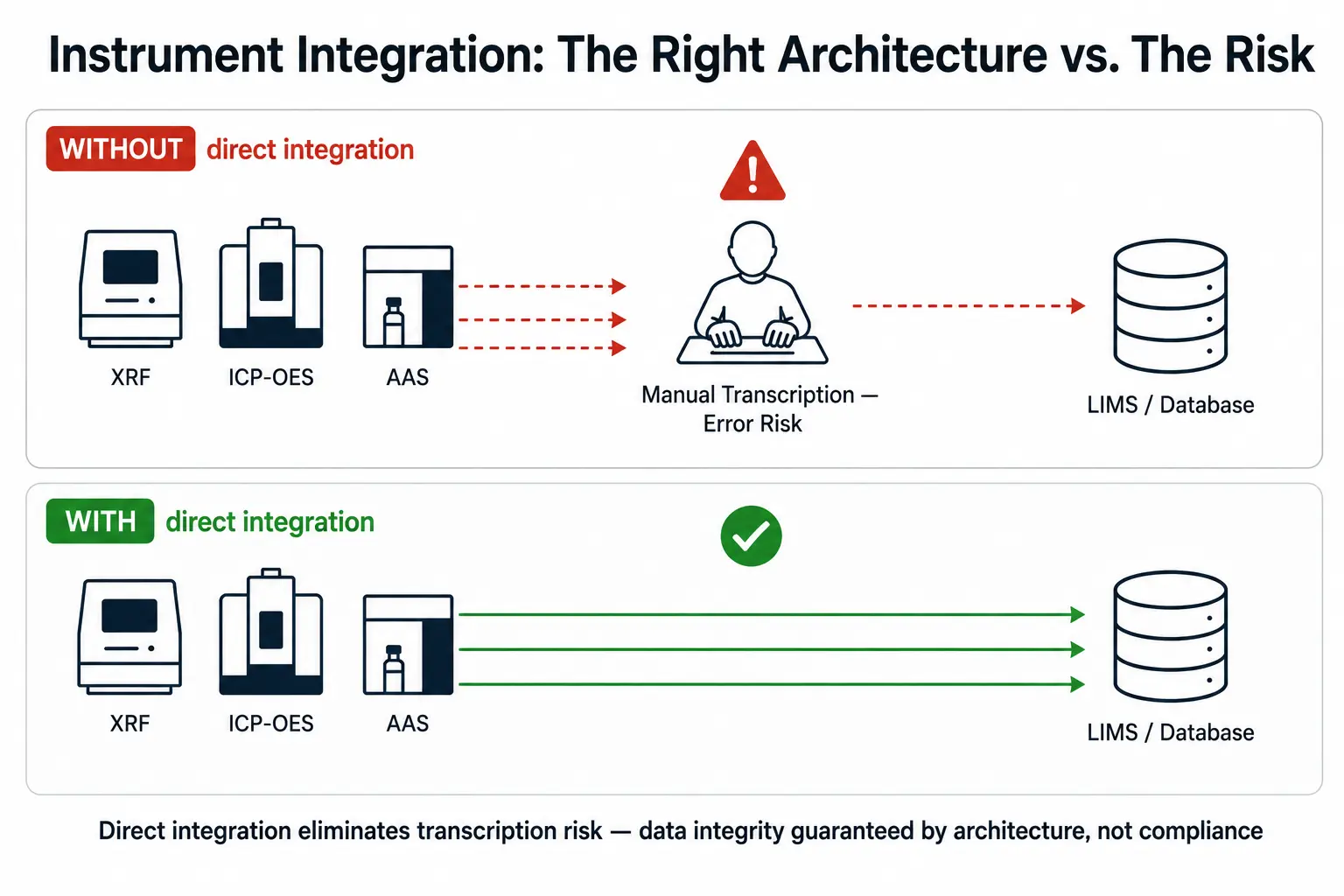
Direct instrument integration is frequently pitched as a convenience feature. In a high-throughput mining laboratory context, however, it is a strict data integrity requirement.
Every single manual data transfer between an instrument's local software and the central database is a transcription risk. At mining laboratory throughput rates, even a mathematically microscopic transcription error rate will generate a commercially significant number of grade errors per shift.
Genuine instrument integration means establishing bidirectional communication between the LIMS and the instrument software.
It requires the automatic transfer of results without human intervention, automatic sample identification linkage, and automatic QC flag generation when results fall outside predefined acceptance criteria. The system should tell the instrument what to test, and the instrument should feed the data back seamlessly.
"Direct instrument integration is not a convenience. It is the architectural firewall that protects your assay data from human error."
However, the instrument landscape challenge makes this difficult. A mining laboratory's integration requirements span multiple manufacturer platforms and communication protocols.
Facilities often operate instruments at vastly different points in their operational lifecycles. A highly advanced modern ICP-MS might sit on the same bench as a reliable but legacy titrator that lacks standard digital interfaces. The data system must be capable of accommodating this mixed-era reality seamlessly.
When an instrument integration mining lab setup is executed correctly, the operational outcome is transformative. When instruments speak directly to the data system, the laboratory's data integrity is guaranteed by system architecture, rather than relying entirely on human compliance and fatigue management.
4. How Does a Mining LIMS Support ISO 17025 and Regulatory Compliance?
The regulatory frameworks governing mining laboratories are stringent, multi-layered, and increasingly aggressively enforced. Navigating them requires a proactive digital strategy.
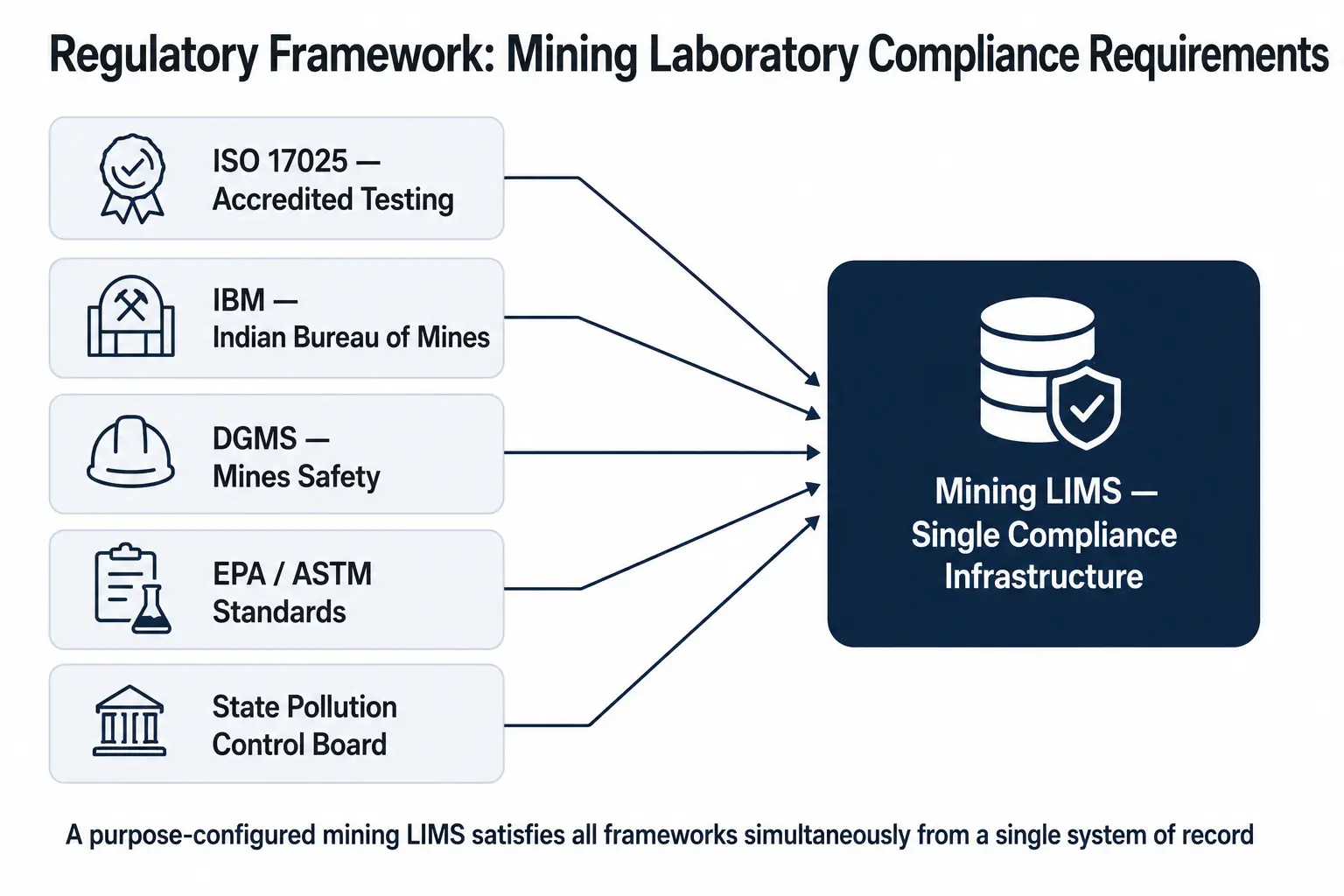
Laboratories must satisfy ISO 17025 for accredited testing, alongside EPA and ASTM standards for specific test methods. Furthermore, they must adhere to national mining regulatory requirements.
In the Indian operational context, this means satisfying the Indian Bureau of Mines (IBM), the Directorate General of Mines Safety (DGMS), and rigorous state pollution control board requirements. A mining LIMS ISO 17025 implementation must be flawless.
Genuine ISO 17025 readiness in a data system means far more than just secure document storage. It requires the active, continuous enforcement of a complete quality management architecture.
This includes embedded method management, where analysts are blocked from using expired SOPs. It requires proficiency testing records, continuous uncertainty of measurement tracking, and complete inter-laboratory comparison data management built directly into the database.
At a practical level, audit trail requirements mean every digital action must be tracked. Every modification to every record must be timestamped, attributed securely to a specific user, and rendered entirely immutable.
The complete history of every result—from initial capture through every dilution, recalculation, and approval—must be reviewable by any external auditor at any time without IT intervention.
Furthermore, automated reporting requirements are critical for compliance efficiency. The system must possess the ability to generate compliant reports for different regulatory bodies and commercial counterparties from the exact same underlying data set, without requiring manual reformatting in external software.
"In the current regulatory environment, the question is not whether your mining laboratory will be audited. The question is how fast your data system can prove your compliance when the auditor arrives."
5. What Data Integrity and Security Standards Must a Mining LIMS Meet?
For a mining operation, centralised data management is the foundation of operational truth, delivering key operational benefits across the site. It means capturing all quality data, from all instruments, at all laboratory locations into a single system of record.
This approach provides a single, unshakeable source of truth for every operational and commercial decision. Whether the mine manager, the process engineer, or the shipping logistics coordinator is looking at the data, they are looking at the exact same validated number.
Distributed data creates immediate commercial exposure. Having results trapped in instrument-specific software, grade control calculations living in standalone spreadsheets, and Certificates of Analysis (CoAs) buried in email threads is a severe risk.
It prevents rapid decision-making and makes historical data auditing nearly impossible. Centralised management eliminates this fragmented risk entirely.
We must also consider data encryption and transmission security requirements. In the mining sector, grade data and compositional data have direct, immediate commercial value.
If a competitor or a contractor gains unauthorized access to exploratory drill results or shipping lot assays, the commercial damage is severe. The data must be protected with enterprise-grade encryption both at rest and in transit.
Finally, role-based access control requirements are essential for internal security. Not everyone in a mining operation needs access to all laboratory data.
The ability to configure precise access permissions for different roles protects both data integrity and commercial confidentiality. The commercial value of ore is determined by a number in a laboratory report—that number must be protected with the same rigorous security as any physical asset on the mine site.
6. What Analytics and SQC/SPC Capabilities Does a Mining LIMS Require?
In a mining grade control context, real-time data analysis is the difference between proactive management and reactive damage control.
Real-time analysis requires the ability to view current analytical performance, current QC batch status, and current grade distributions simultaneously. Crucially, this must happen in real time, without waiting for end-of-shift compiled reports to tell you what happened eight hours ago.
Trend analysis requirements take this a step further. A capable system must detect subtle patterns in analytical data over time.
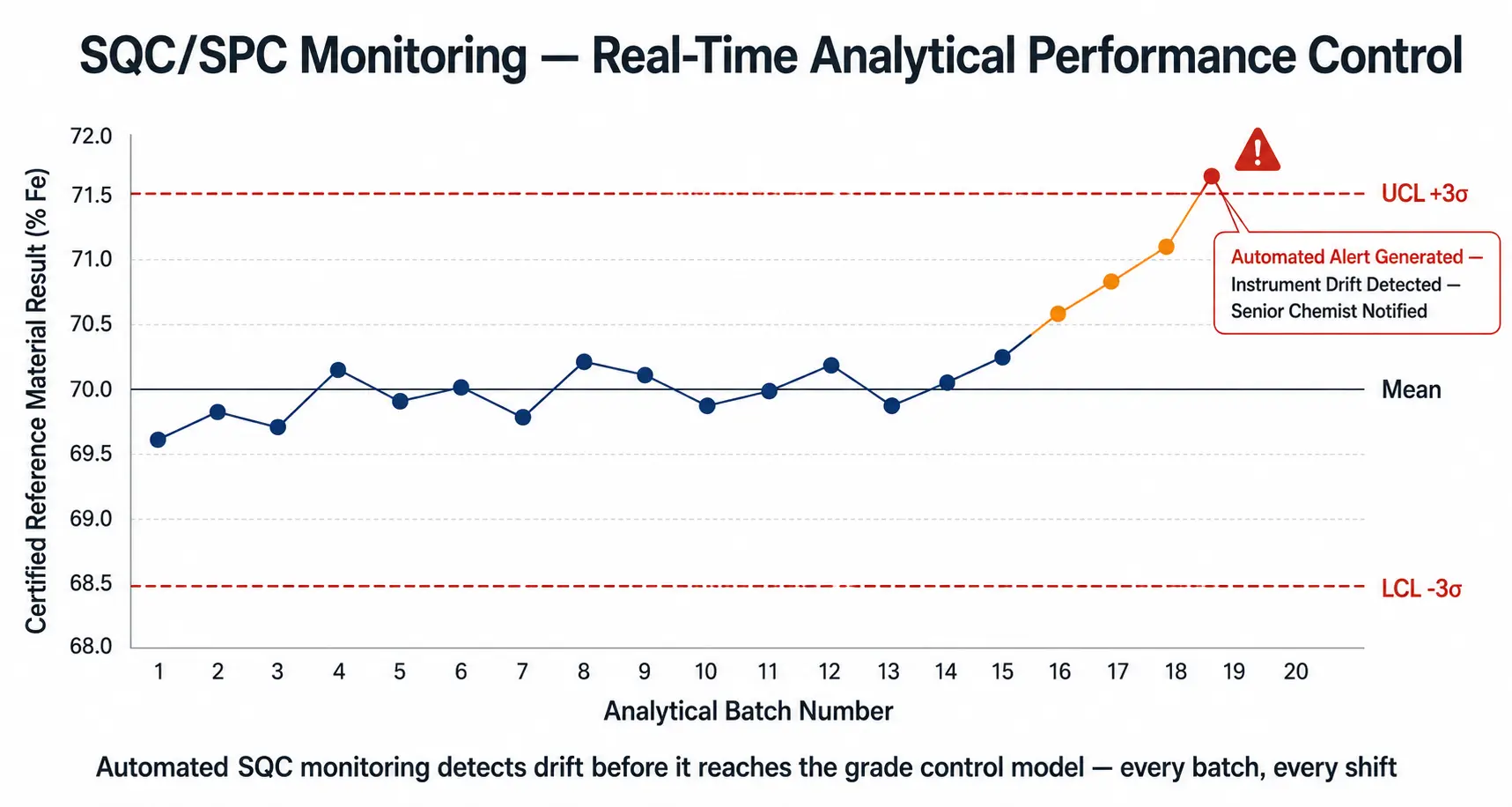
It must flag developing instrument drift, reagent lot variation, sample preparation inconsistencies, or genuine geological grade variation. It needs to highlight these trends before they mathematically compound into grade errors in the mine planning model.
SQC and SPC monitoring requirements are the heartbeat of an analytical laboratory. Statistical Quality Control (SQC) and Statistical Process Control (SPC) must be continuous and automated.
An SQC SPC mining laboratory system must monitor analytical data using accepted precision and accuracy metrics. It must automatically flag results that fall outside statistically derived control limits. It should generate Thompson-Howarth precision plots, Shewhart control charts, and other standard mining laboratory quality visualisations directly from the live data.
Additionally, customisable reporting requirements ensure that the right data reaches the right person in the right format.
The system must configure report formats for different audiences. Mine planning teams need geospatial assay data; metallurgical engineers need recovery metrics; environmental compliance officers need effluent limits; and external commercial counterparties need formalized CoAs. Each receives what they need automatically.
A mining laboratory that can see its own performance in real time, and respond to developing quality issues before they affect grade control decisions, operates at a fundamentally higher level of efficiency.
7. How Does Workflow Automation Improve Mining Laboratory Turnaround Time?
In a laboratory processing hundreds of metallurgical samples per shift, manual workflow management is not merely inefficient. It is the primary source of turnaround time delays that cascade through the entire mining operation.
Automated workflow management is the solution. This involves the automatic assignment of incoming samples to the correct analytical workflow based purely on the sample type, the project code, and the predefined testing requirements.
This level of grade control laboratory automation eliminates the need for manual routing decisions by laboratory supervisory staff, freeing them to focus on complex data validation rather than administrative traffic control.
Equally important are scheduling and resource management requirements. A laboratory manager must be able to see, at any given moment, the current workload queued on each specific instrument.
They need visibility into the current status of each analyst's sample queue and the mathematically projected completion time for every pending analysis. This enables proactive resource allocation and allows the laboratory to make realistic, binding turnaround time commitments to the mine planning team.
We must also consider automated anomaly detection. The data system must be trusted to flag results that fall outside expected historical or geological ranges automatically.
It should route these specific anomalous results for secondary review by a senior chemist before they ever enter the grade control model. Doing this without requiring manual line-by-line result screening at high sample volumes is critical for operational speed.
"If your senior chemists are spending their shifts manually hunting for anomalous data in spreadsheets, your software is failing your operation."
8. What Deployment and Cloud Access Options Does a Mining LIMS Need?
Deployment flexibility matters in the mining industry far more than in centralised urban industries. Mining footprints are geographically vast and operationally complex.
A single mining operation may have laboratory facilities at multiple physical site locations, a central metallurgical testing laboratory in a nearby city, satellite field laboratories at exploration camps, and a corporate quality assurance function in a different country. All of these stakeholders require access to the exact same data in real time.
Remote access requirements are therefore paramount. Mine planning teams, operations directors, and corporate quality functions must be able to access validated laboratory data from any location.
They cannot be technologically dependent on being physically present inside the laboratory walls. A cloud based LIMS mining operations deployment securely bridges this geographic divide.
However, cloud versus on-premise considerations must be evaluated specifically for the mining context.
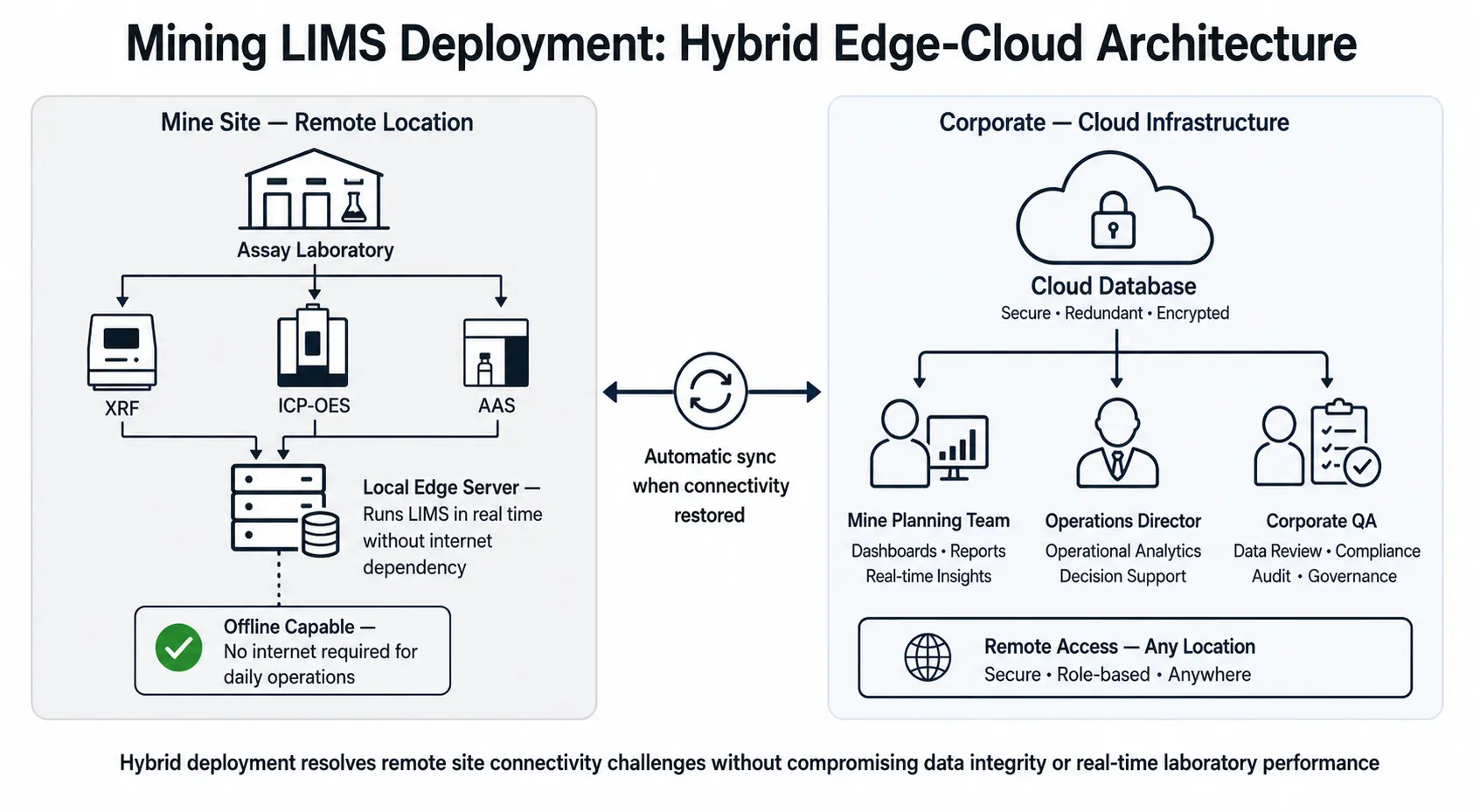
Operations must balance the often severe connectivity challenges of remote mine site locations against the data sovereignty considerations of highly sensitive mining operational data. Furthermore, the business continuity requirements of a system that mine planning depends on continuously must dictate the architecture.
Finally, data backup and disaster recovery requirements cannot be overstated. Laboratory data represents years, sometimes decades, of expensive geological and metallurgical intelligence that simply cannot be recreated.
The loss of that data to a system failure, a server room fire, or a broader site incident is a permanent, catastrophic operational loss. A mining laboratory's data system must be deployable in the configuration that fits the operation's infrastructure reality—whether cloud, on-premise, or a hybrid of both—without compromising security.
9. How Is AI Changing Mining Laboratory Data Management?
Artificial intelligence and predictive analytics are no longer future aspirations in laboratory informatics; they are active capabilities fundamentally changing how high-performing laboratories operate today.
Predictive analytics in mining laboratory quality management offers a massive operational advantage.
Well-designed systems use historical analytical performance data to predict future instrument drift.
They identify developing quality issues before they breach control limits and affect final results. They can forecast laboratory throughput constraints based on incoming sample volumes, identifying bottlenecks in the grade control workflow days before they occur.
Automated anomaly detection in a modern AI context goes beyond simple high/low limits.
It involves intelligently identifying complex multivariate patterns that suggest systematic analytical issues, differentiating them from genuine geological grade variations in the ore body. This prevents the laboratory from rejecting valid data while catching subtle, insidious calibration errors.
Furthermore, natural language data interaction is democratising data access.
The ability for laboratory managers and operations directors to query laboratory data through conversational interfaces (e.g., "Show me the lead variance in the concentrator feed over the last 48 hours") removes the need for complex SQL database query skills. This makes laboratory intelligence instantly accessible to all operational decision-makers.
Finally, AI enables profound SQC and SPC automation. Continuous statistical monitoring of analytical performance runs constantly in the background.
The system automatically generates alerts when control charts indicate developing non-random issues, doing so without requiring a dedicated quality statistician to review every chart manually. Mining laboratories that adopt these tools gain a measurable operational and commercial advantage.
10. What Does LIMS Scalability Actually Mean for a Mining Operation?
In the software industry, scalability often just means the ability to add more users or store more megabytes of data. In the context of a mining laboratory, scalability means something much more complex and operationally critical.
Scalability for a mining operation is not merely the ability to handle more samples during a peak production push. It is the architectural ability to add completely new instruments to the laboratory bench and integrate them seamlessly.
It is the ability to introduce entirely new complex test methods and preparation protocols as the mineralogy of the ore body changes over the life of the mine. It means bringing new laboratory locations online without requiring a massive system replacement or a painful, year-long re-implementation.
Crucially, customisation requirements are vast. Every mining operation on earth has unique ore types, unique national or state regulatory requirements, and unique internal corporate quality protocols.
Commercial reporting formats vary wildly depending on the specific buyer of the concentrate or final metal. The data system must accommodate these highly specific needs through simple configuration interfaces.
If a laboratory manager must wait for the vendor to write custom code every time they need to change a report format or add a new QA/QC rule, the system is not truly scalable. A mining operation's laboratory data requirements evolve continuously as the extraction deepens and the geology shifts—the data system must evolve in lockstep.
11. How Do You Evaluate a LIMS for a Metals and Mining Laboratory?
When evaluating a mining laboratory management system, moving past vendor marketing and focusing on operational realities is vital. Capable systems reveal themselves under highly specific technical questioning.
Here is a practical evaluation framework for laboratory managers assessing a LIMS evaluation mining short-list:
- How does the system handle direct integration with our specific instrument mix, including our 15-year-old legacy hardware? (Look for proven libraries of instrument parsers, not promises to "build it later").
- Can the database architecture handle our peak sample volume without user interface lag or reporting delays? (Ask for reference sites processing similar volumes).
- How does the system maintain data availability and prevent data loss when site internet connectivity drops out for six hours? (Evaluate offline sync capabilities).
- What does the implementation process actually require from our metallurgical team, and how long does it realistically take?
| Feature Category | Capable-Sounding Generic LIMS | Genuine Mining-Specific LIMS |
|---|---|---|
| Sample Tracking | Basic status drop-downs (Received, Tested). | Full genealogical lot/batch parent-child relationships. |
| QC Automation | Manual entry of limits; static warnings. | Automated Thompson-Howarth plots; continuous SPC tracking. |
| Instrument Data | Relies on third-party middleware or flat CSV uploads. | Direct bidirectional API/serial integration natively. |
| Industry Logic | Built for water or clinical labs; requires heavy customization. | Understands fluxing, fusions, core splitting, and over-limit repeats. |
- How does the system handle the specific regulatory reporting requirements for our specific mining jurisdiction?
- What does the backend audit trail actually look like, and how easily can it be exported for a regulatory auditor?
- How are system updates managed, and will an update break our customized grade-control reporting formats?
- What does the true Total Cost of Ownership look like over a five-year period, factoring in implementation, training, support, and inevitable workflow changes?
Frequently Asked Questions
Our laboratory is relatively small processing around 200 samples per day — is a LIMS worth the investment at our scale or is it only for large operations?
A LIMS is a worthwhile investment at 200 samples per day. Data integrity and compliance requirements are identical to large operations regardless of throughput scale. Yes, it is still a critical investment. While throughput bottlenecks are less severe at 200 samples per day, the requirements for data integrity, regulatory compliance, and auditability remain identical to those of a massive operation. A single spreadsheet transcription error on a grade control sample costs the same regardless of your laboratory's size. Modern cloud-based LIMS options provide scalable pricing models, allowing smaller junior explorers or boutique assay labs to access enterprise-grade data integrity without enterprise-level capital expenditure.
We have instruments from multiple manufacturers some of which are quite old — how do modern LIMS systems handle instrument integration across mixed and legacy landscapes?
A capable mining LIMS integrates with legacy instruments through flexible data parsing engines that read RS-232 serial outputs, raw text files and CSV dumps without requiring instrument upgrades. A capable modern LIMS utilizes flexible data parsing engines. Rather than requiring modern API connections, these systems can ingest and interpret legacy serial data outputs (RS232), raw text files, or basic CSV dumps generated by older equipment. The LIMS essentially "listens" to the output folder of the older instrument, captures the data string the moment the run finishes, and mathematically maps it to the correct sample ID in the database. You do not need to upgrade your reliable older instruments just to achieve automated data capture.
Our mine site has unreliable internet connectivity — what are our realistic options for cloud-based LIMS deployment in this environment?
For mine sites with unreliable internet connectivity, a hybrid edge-cloud architecture is the most practical option. A local edge server handles real-time operations offline and syncs to the cloud when connectivity is restored. If your site experiences frequent internet dropouts, a pure public cloud deployment without edge computing capabilities will disrupt your operations. The realistic options are either a fully on-premise server deployment managed by your site IT team, or a hybrid edge-cloud architecture. In a hybrid setup, a local edge server on the mine site manages the real-time instrument integration and daily workflows without needing the internet. It then syncs the archived data to the corporate cloud automatically whenever the connection is restored, ensuring seamless continuity.
How long does it realistically take to implement a LIMS in a working mining laboratory without disrupting current operations?
A professional mining LIMS implementation takes three to six months for a mid-to-large operation. Claims of instant deployment in complex metallurgical environments should be treated with significant caution. A genuine, professionally managed implementation for a mid-to-large mining laboratory typically takes between three to six months. Claims of "plug and play" instant deployment in a complex metallurgical environment are generally inaccurate. The timeline involves mapping your specific workflows, configuring the required QC rules, building the instrument parsers, and rigorously parallel-testing the system against your current methods before a hard cutover. Disruption is minimized by running the new LIMS in the background while the old system continues until validation is complete.
We currently manage our QA/QC data manually in spreadsheets — what does the transition to automated QC management actually involve?
Transitioning from manual spreadsheet QC to automated LIMS-based QC management involves importing historical data to establish control baselines and then configuring statistical limits within the database. The transition involves shifting your standard deviations and control limits from static spreadsheet formulas into the LIMS database architecture. During implementation, your historical QC data is imported to establish the baselines. Moving forward, the automated assay reporting system will automatically calculate the precision and accuracy of every batch as data flows from the instruments. It involves training your team to respond to automated system alerts rather than spending their afternoons manually plotting data points on a graph.
What regulatory standards should a LIMS for mining be compliant with and how do we verify genuine compliance versus claimed compliance?
At minimum, a mining LIMS must support compliance with ISO/IEC 17025:2017. For Indian mining operations, it must additionally support IBM, DGMS and state pollution control board reporting requirements. At a minimum, the system must support your compliance with ISO/IEC 17025:2017. Depending on your location and scope, it may also need to support EPA, ASTM, and local mining board regulations (such as IBM/DGMS in India). To verify genuine compliance, ask the vendor to demonstrate exactly how the system handles a "non-conforming work" workflow, how it forces users to acknowledge expired instrument calibrations, and how it tracks the complete version history of a testing method. Genuine compliance is embedded in the software's logic, not just its document storage capabilities.
Key Takeaways
- A mining LIMS must handle 500 to 2,000 samples per day without performance degradation or UI lag
- Direct instrument integration eliminates manual transcription — the leading cause of grade errors in mining laboratory operations
- ISO 17025 readiness requires active enforcement of method management and calibration expiry controls, not just document storage
- A hybrid edge-cloud deployment architecture resolves connectivity challenges on remote mine sites without compromising data integrity
- AI-powered predictive analytics can identify instrument drift and throughput bottlenecks before they affect grade control results
- LIMS implementation takes 3 to 6 months for a mid-to-large operation — vendors claiming rapid deployment should be questioned closely
- A LIMS delivers full ROI at 200 samples per day — compliance and data integrity requirements do not scale down with throughput
- The total cost of a manual quality system includes grade variance exposure, data latency operational cost and regulatory compliance risk — not just software licence fees
Final Thoughts
The decision regarding which laboratory data management system to implement is one of the most consequential infrastructure decisions a mining operation will make.
The analytical number that ultimately comes out of a mining laboratory assay report dictates everything. It determines the commercial value of what was extracted from the earth, the metallurgical efficiency of what was processed in the plant, and the environmental and regulatory standing of the entire operation.
That number is only as reliable as the digital infrastructure that captures, manages, and reports it.
Mining operations that continue to treat their laboratory data infrastructure as an administrative overhead or a secondary support cost consistently underperform. They suffer from delayed decision-making, higher rates of ore dilution, and stressful, chaotic regulatory audits.
Conversely, operations that treat their laboratory data systems as the primary intelligence backbone of the mine gain a distinct, measurable competitive advantage. They move faster, they extract higher yields, and they operate with absolute commercial certainty.
Take the framework and the capability domains outlined in this guide, reach out to request a demonstration, and apply them rigorously to your current infrastructure. Evaluate your existing systems, challenge your potential vendors, and demand a data management system that works as hard as the laboratory professionals who use it.
Continue Reading
- How to Prepare Your LIMS for an FDA Audit: A Practical Checklist
- Signs Your Legacy LIMS Is Costing You More Than You Think
- Achieving ISO/IEC 17025 Compliance: How a Modern LIMS Simplifies Accreditation



 (1) (1).webp)