The Digital Thread in Chemical Manufacturing: Connecting Production, QC, and Customers
Key Takeaways
- A digital thread links raw material, production, QC, and customer documentation into one traceable record.
- Most plants have three disconnected records instead — production, lab, and a manually built CoA.
- A modern LIMS closes the gap via batch-to-sample linkage, ERP/MES integration, and automated CoA generation.
- This supports traceability required under ISO 9001, ISO/IEC 17025, and REACH.
1. What Is a Digital Thread in Chemical Manufacturing?
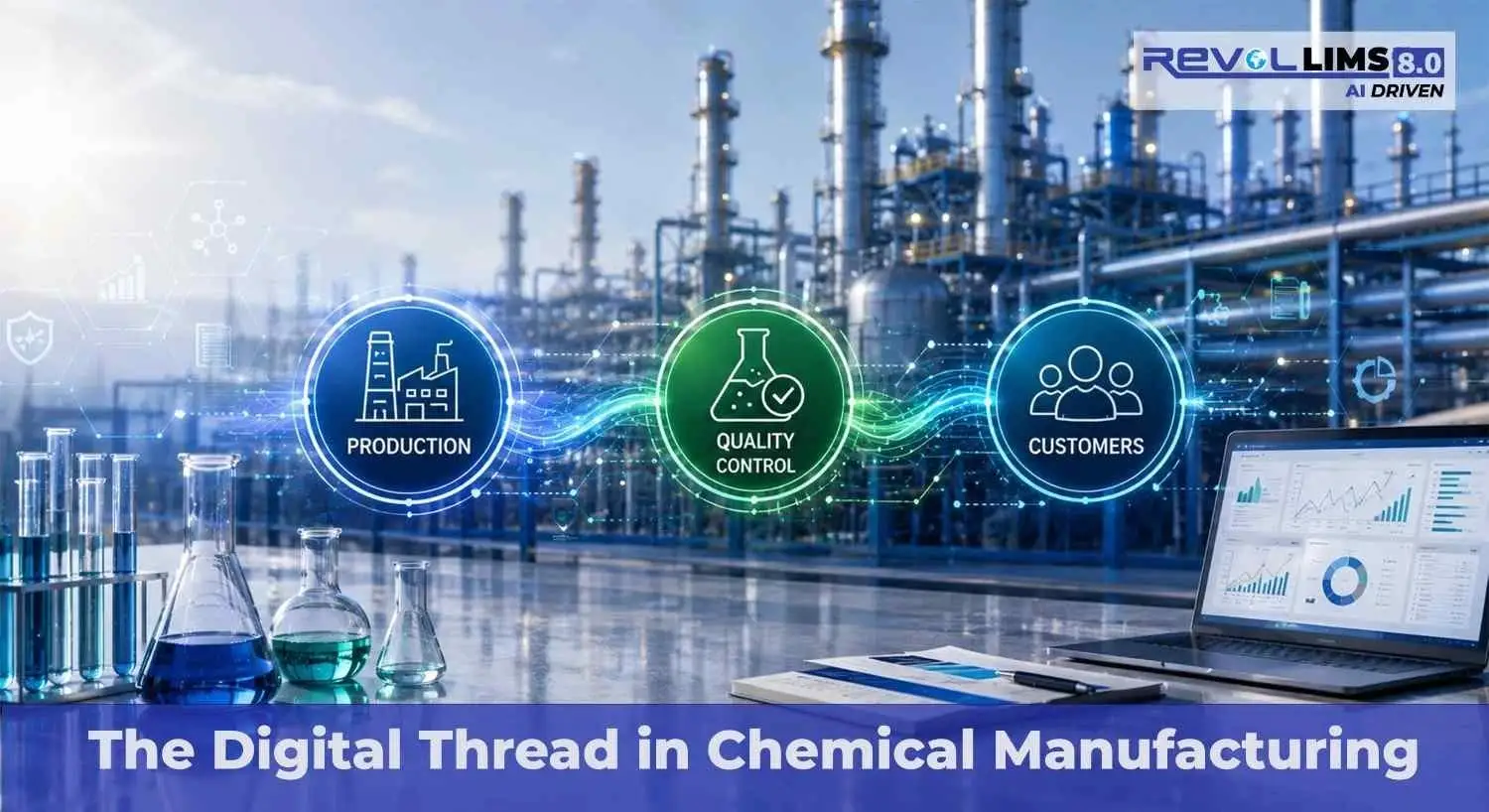
A digital thread is a continuous, system-enforced data record that connects a chemical product's entire lifecycle — raw material, production batch, QC result, and customer document — without manual re-entry at any stage. Instead of three separate records that someone has to reconcile after the fact, the thread means a single batch ID carries forward automatically: the raw material lots consumed, the process parameters recorded, the QC tests run against specification, and the final Certificate of Analysis (CoA) sent to the customer.
The concept borrows from product lifecycle management in discrete manufacturing, but in a chemical plant the thread has to connect three distinct systems that historically were never built to talk to each other: the production system (ERP or MES), the quality control system (LIMS), and the customer-facing document set (CoA, safety data sheet, batch certificate). The sections below look at where that connection typically breaks, and the specific LIMS modules that rebuild it.
2. Where the Thread Breaks: Production, QC, and Customer Silos
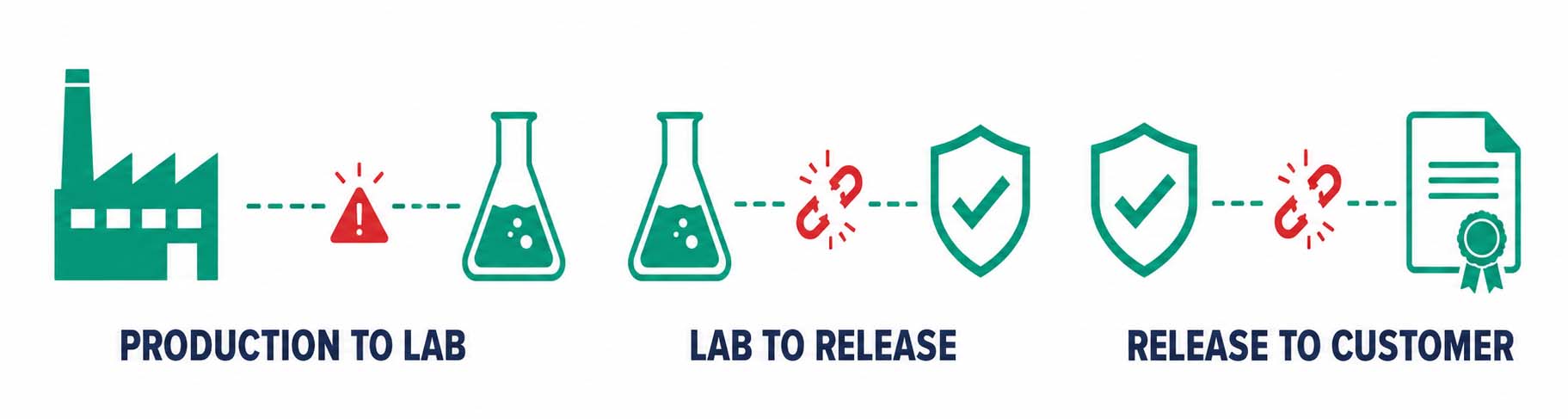
The digital thread breaks at three handoff points: production-to-lab, lab-to-release, and release-to-customer — each one traditionally bridged by a person re-typing data instead of a system passing it forward.
Production-to-Lab Handoff
A batch is produced in the plant and logged in the ERP or MES. A sample is then pulled and sent to QC — often referenced by a paper label or a spreadsheet row rather than a system-linked ID. If the batch number on the sample doesn't match the batch number in production records character-for-character, the link between what was made and what was tested is already broken.
Lab-to-Release Handoff
QC results are generated in the lab — sometimes in a LIMS, sometimes in disconnected instrument software or spreadsheets. A reviewer then has to manually compare results against the product specification and decide whether the batch passes. This comparison, done outside a system with enforced specification limits, is where out-of-specification results get missed or manually adjusted before release.
Release-to-Customer Handoff
Once a batch is approved, someone assembles a Certificate of Analysis by copying results from the lab record into a document template. This step — the one the customer actually sees — is usually the least governed part of the entire chain, run in Word or Excel with no audit trail connecting the CoA back to the original QC result set.
3. Modern LIMS Key Features That Build the Digital Thread
A modern LIMS builds the digital thread by linking batch, sample, result, and document records at the data level — so information created once in production flows automatically through QC and into the customer-facing document, instead of being re-entered at each stage. These features typically sit across a few core LIMS modules working together, rather than one standalone tool.
Core Digital-Thread Features in a Modern LIMS
- Batch-to-Sample Linkage — every sample registered in the LIMS is tied to a single production batch ID, carried through from raw material receipt to finished product, eliminating mismatched references.
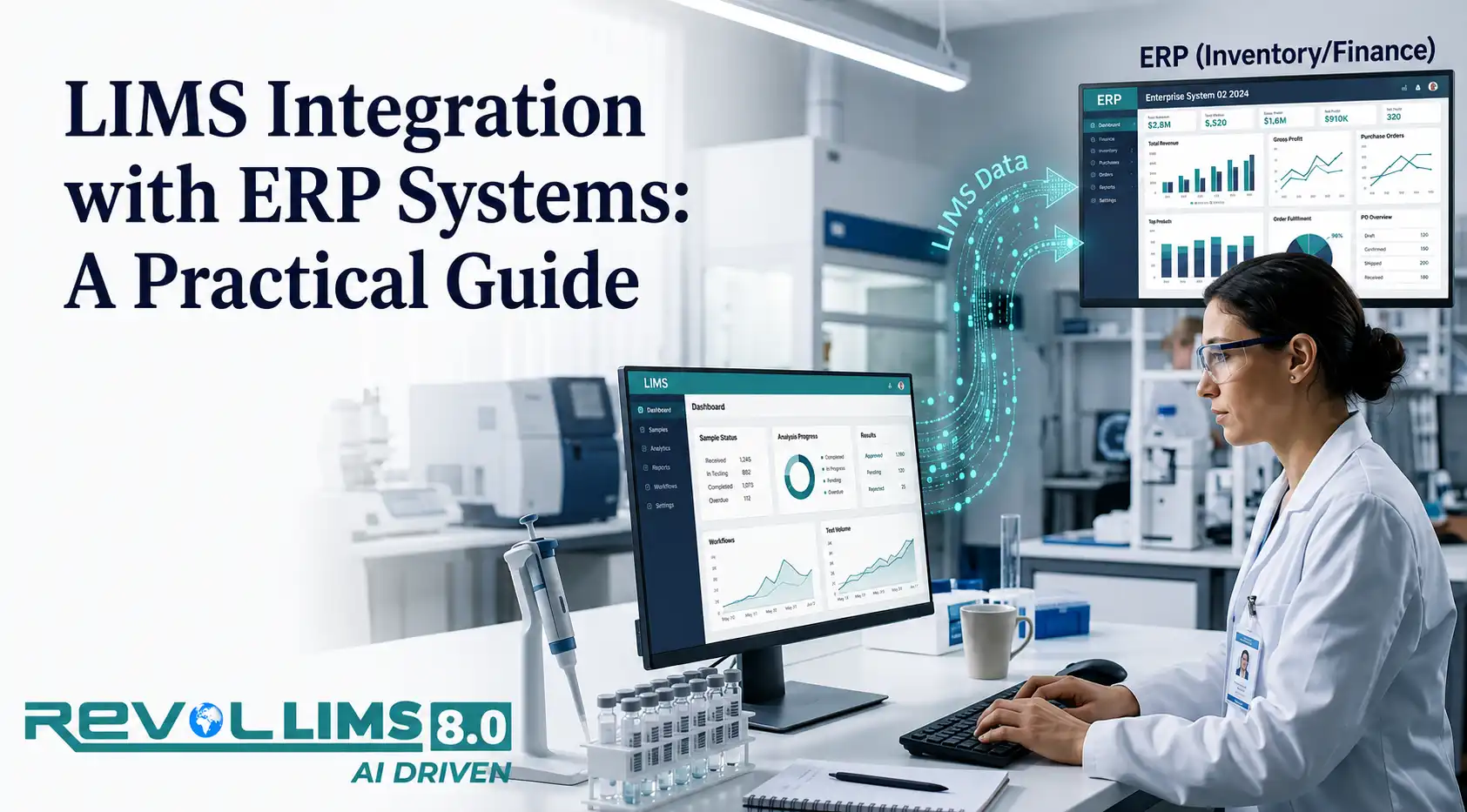
- ERP/MES Integration — production batch data (raw material lots, process parameters, run dates) flows into the LIMS automatically rather than being retyped by a lab technician.
- Specification-Based Auto-Release — results are checked against a governed product specification in real time; a batch cannot move to release status until every required test result meets specification.
- Automated Certificate of Analysis Generation — the CoA is generated directly from the approved result set, with no manual copy-paste step between the lab record and the customer document.
- Full Genealogy and Traceability — a single query traces a finished lot back through every intermediate batch, raw material lot, and QC test that contributed to it.
- Role-Based QA Review Gate — a designated reviewer must sign off before a batch or CoA is released, with the review itself captured in the audit trail.
- Instrument and CDS Connectivity — analytical instruments feed results directly into the sample record, removing transcription steps between raw data and the governed result.
- Customer-Facing Document Control — CoAs, batch certificates, and safety documentation are version-controlled and linked to the exact result set that generated them, so any document can be reproduced or audited on demand.
- Deviation and OOS Workflow — an out-of-specification result automatically opens an investigation record and blocks release until it is closed, rather than relying on someone remembering to flag it.
- Real-Time Dashboards Across Production and QC — plant and quality teams see batch status, pending tests, and release readiness from the same live view, instead of exchanging status updates by email.
Individually, each of these features solves a local problem. Connected together inside one system, they are what actually forms the thread — a batch record that stays intact and query-able from the raw material warehouse to the customer's inbox.
4. How the Digital Thread Flows: Production → QC → Customer
In a connected digital thread, a single batch ID moves through five stages without being re-typed at any point: raw material receipt, production, QC sampling, QA release, and customer documentation.
| Stage | What Happens | What Carries Forward |
|---|---|---|
| 1. Raw Material Receipt | Incoming lots are logged with supplier, lot number, and incoming QC status | Raw material lot IDs linked to every batch that consumes them |
| 2. Production | ERP/MES records the production run against a batch ID | Batch ID, process parameters, raw material consumption |
| 3. QC Sampling & Testing | Sample is auto-registered against the batch ID; results feed in from instruments | Test results linked to sample, sample linked to batch |
| 4. QA Review & Release | Results are checked against specification; reviewer applies e-signature | Pass/fail decision, reviewer identity, timestamp |
| 5. Customer Documentation | CoA and batch certificate are generated from the approved result set | Full chain from raw material to customer document, query-able in one record |
The value of this flow is not just speed — though eliminating manual re-entry between each stage typically removes days from batch release cycles. The larger value is that any single record, at any point later, can answer the question "what happened to this batch" without anyone reconstructing it from separate systems.
5. Regulatory and Quality-Standard Alignment
A connected digital thread directly supports the traceability, record-integrity, and documentation requirements found in ISO 9001, ISO/IEC 17025, and REACH — frameworks that most chemical manufacturers are already required to meet.
ISO 9001:2015
Quality management systems — Clause 8.5.2 requires organizations to identify outputs and maintain traceability where it is a requirement
ISO/IEC 17025
Testing & calibration laboratories — results must be attributable, method-validated, and traceable to the sample and instrument that produced them
REACH
EU chemical regulation — manufacturers and importers must substantiate substance composition and testing history on request
GHS
Globally Harmonized System — classification data must trace back to the specific test results that support it
6. Frequently Asked Questions
What is a digital thread in chemical manufacturing?
A digital thread is a continuous data record that connects a chemical product's raw materials, production batch, QC test results, and customer documentation into a single traceable chain, without manual re-entry at each handoff.
How is a digital thread different from a batch record?
A batch record typically covers production alone. A digital thread extends that record forward into QC testing and customer-facing documents like the Certificate of Analysis, and backward into raw material genealogy — connecting all three instead of treating them as separate documents.
What LIMS features are needed to build a digital thread?
The core features are batch-to-sample linkage, ERP/MES integration, specification-based auto-release, automated CoA generation, and full raw-material-to-finished-product genealogy — all operating inside one governed system rather than across disconnected tools.
Does building a digital thread require replacing existing ERP or MES systems?
No. A digital thread is typically built by integrating the LIMS with existing ERP/MES systems rather than replacing them — the LIMS acts as the connective layer between production data and QC/customer documentation.
Why does a broken digital thread create compliance risk?
Standards such as ISO 9001 and ISO/IEC 17025 require traceability from finished product back to raw materials and test data. When that link depends on manual reconciliation between separate systems, it becomes difficult to reproduce or defend during an audit.
7. Key Takeaway
Chemical manufacturers don't lose the digital thread because of one major failure — they lose it in dozens of small handoffs where a batch number gets retyped, a result gets copied into a spreadsheet, or a certificate gets assembled by hand. Each handoff is a point where the connection between what was made, what was tested, and what the customer received can quietly break.
A modern LIMS rebuilds that connection by linking batch, sample, result, and document at the data level, so the thread stays intact automatically rather than depending on someone reconstructing it after the fact. That is one of several measurable LIMS benefits — the practical difference between a plant that can answer a traceability question in seconds, and one that needs days to reconstruct the same answer.
See the Digital Thread in Action
Explore how a connected LIMS links production, QC, and customer documentation for chemical manufacturers.
Request a Live DemoCONTINUE READING
- Chemical and Petrochemical LIMS
- HPLC Data Integrity Challenges and How LIMS Solves Them
- How LIMS Helps Petrochemical Labs Achieve EPA and GLP Compliance
Author: Revol Team · marketing@revollims.com · www.revollims.com


 (1) (1).webp)