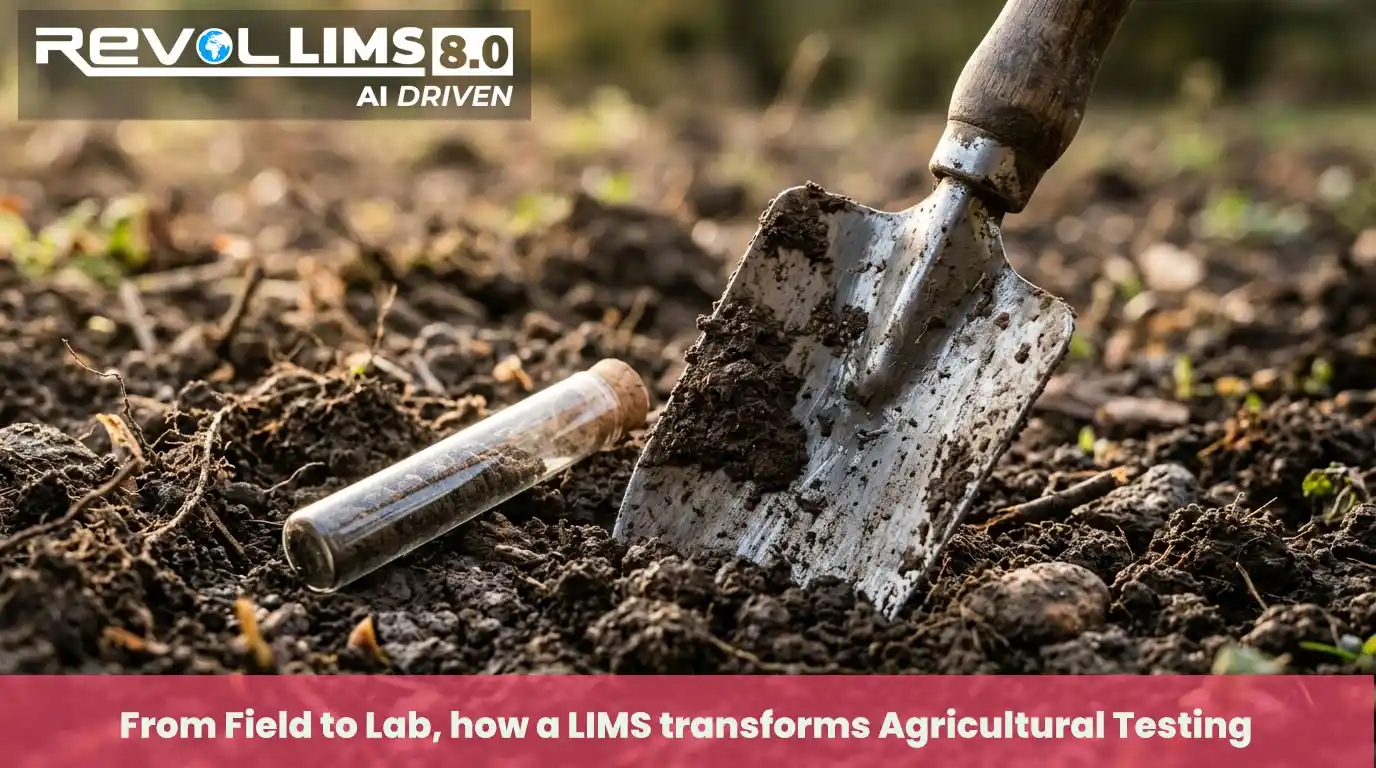
From Field to Lab, how a Laboratory Information Management System Transforms Agricultural Testing
The Broken Chain Between Field and Farm Report
Agriculture feeds the world — but the data infrastructure supporting it often doesn't keep pace. Between the moment a soil sample is collected from a paddy field and the moment a certified nutrient report reaches the farmer who needs it, there are more failure points than most laboratories care to admit.
Mislabelled samples. Chain-of-custody forms left in a vehicle. Results sitting in a shared spreadsheet for three days because the approving supervisor is on a field visit. By the time the data reaches a decision-maker, the planting window has already closed — and the entire testing exercise has delivered no agronomic value.
This is not an edge case. It is the operational baseline for a significant share of agricultural testing laboratories worldwide, particularly those still running on manual workflows built for smaller sample volumes and slower seasonal demands. The downstream cost is not merely operational — it is agronomic. Delayed or inaccurate results translate directly into suboptimal fertiliser decisions, undetected pesticide residues, failed export certification, and reduced farm profitability.
A Laboratory Information Management System purpose-built for agriculture fundamentally changes this equation. By digitising and automating the complete journey from field collection through laboratory analysis to certified report delivery, an agricultural LIMS closes the gap between raw sample and actionable insight — with full traceability, in a fraction of the time, and in compliance with ISO 17025:2017 and global food safety mandates.
When sample data flows seamlessly from the field to the lab to the farmer, every stakeholder wins — agronomists make faster decisions, laboratories run leaner operations, and farmers see measurable yield improvements.
This guide walks through that journey stage by stage: where traditional approaches break down, and what a well-implemented LIMS actually changes at each point.
Understanding the Agricultural Testing Lifecycle
Agricultural testing is not a single event. It is a multi-stage lifecycle spanning physical geography, multiple stakeholders, and diverse regulatory obligations. Each stage is distinct, yet deeply interdependent with the rest.
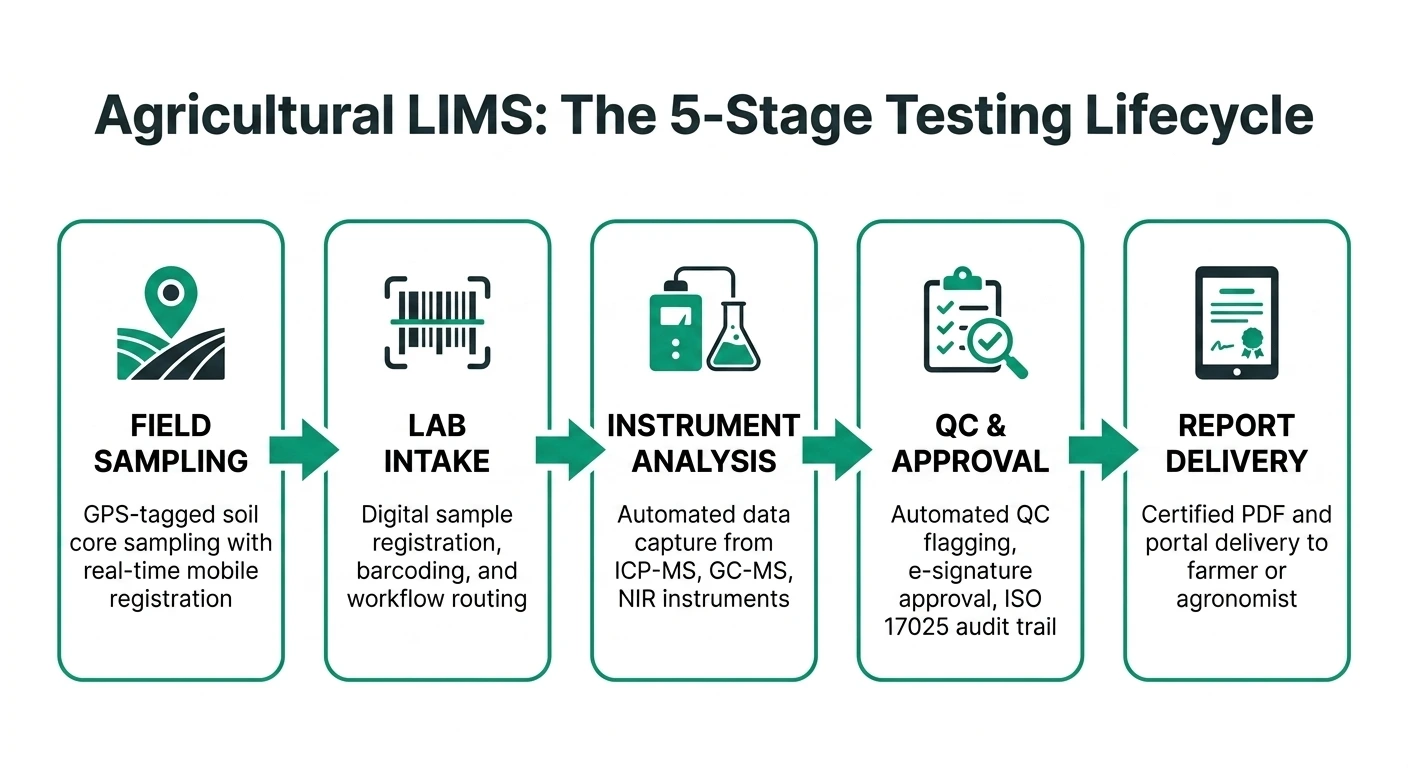
✔ Stage 1 — Field Sampling and Sample Registration
Everything begins in the field — and this is precisely where most laboratory problems are created, not in the lab itself. An agronomist, extension officer, or field technician collects samples: soil cores, irrigation water, leaf tissue, or harvested grain. Without a robust digital process at this point, samples arrive at the lab with handwritten labels that are smudged or ambiguous, no timestamped chain-of-custody record linking the collector to the container, and duplicate entries that slow down lab intake.
A modern agricultural LIMS addresses this before samples ever leave the field. Mobile collection applications on smartphones or ruggedised tablets allow technicians to register samples in real time — capturing GPS coordinates, field ID, crop type, sampling depth, and collector identity on the spot. Barcodes are generated instantly and printed via portable Bluetooth printers. When the sample arrives at the lab, it is already a fully registered entity in the system. No re-entry. No ambiguity.
✔ Stage 2 — Laboratory Intake, Sorting, and Scheduling
At the laboratory receiving dock, incoming samples must be sorted, prioritised, and routed to the correct analytical workstations. In manual environments, intake clerks manage this with paper job cards and whiteboard schedules — a system that works reasonably well at low volumes but tends to buckle under the seasonal surges that define agricultural testing. Peak planting or harvest windows can push sample volumes up by 200–300% in a matter of weeks.
With an agricultural LIMS, intake is automated. Scanning the barcode assigns the sample to a predefined workflow based on the test request, routes it to the appropriate analytical department, places it in a prioritised work queue, and assigns a storage location with the correct temperature condition immediately upon receipt.
✔ Stage 3 — Analytical Testing and Instrument Integration
This is the core laboratory phase: actual chemical, biological, or physical analysis of the sample. Agricultural testing spans an exceptionally wide range of methods — ICP-OES for macro and micronutrients, GC-MS for pesticide residue quantification, HPLC for mycotoxin detection, NIR for rapid grain quality screening, and microbiological plating for pathogen identification.
Without instrument integration, analysts manually transcribe instrument output into the tracking system — introducing transcription errors and adding considerable labour per batch. Direct integration eliminates this entirely: data flows automatically into the sample record, is validated against pre-configured acceptance criteria, and triggers alerts if a result is out of specification.
✔ Stage 4 — Data Review, QC, and Approval
Raw analytical results are not the same as certified results. Before a result can be reported to a client, it must pass a quality assurance review: checking calibration performance, reviewing blank and spike recovery data, confirming duplicate precision, and obtaining supervisor sign-off. In manual systems, this review process lives in paper folders and email chains that are slow to track and difficult to reconstruct for an audit.
A LIMS-based QC workflow automates generation of QC summary dashboards, flags out-of-specification controls automatically, and routes results through a configurable electronic approval workflow complete with electronic signatures compliant with FDA 21 CFR Part 11 and ISO 17025:2017 audit trail requirements.
✔ Stage 5 — Reporting and Delivery to the Client
The final stage is the most visible to the farmer, agronomist, or regulatory body receiving the results. Reports must be accurate, clearly formatted, and — increasingly — delivered digitally rather than by fax or post. More importantly, they must be actionable: the farmer needs to know not just what the nutrient levels are, but what to do about them before the next cropping decision.
An agricultural LIMS with configurable reporting templates can generate branded PDF certificates of analysis, append fertiliser or treatment recommendations based on result interpretation rules, send automated email or SMS notifications when reports are ready, and publish results to a client portal for self-service access.
The True Cost of Manual Processes in Agricultural Testing
Many agricultural testing laboratories — particularly those serving smallholder farming communities in developing markets — still rely heavily on paper sample registration, spreadsheet-based result tracking, Word document report templates, and email-based approval chains. The specific failure modes these systems produce are worth examining in detail, because understanding them is the starting point for understanding what a LIMS actually fixes.
The Sample Identity Problem
Agricultural field sampling happens under difficult conditions: monsoon rains, remote locations with intermittent connectivity, time pressure during harvest season. Handwritten labels deteriorate. Field codes are applied inconsistently by different collectors. By the time a sample reaches the lab, its provenance may be partially uncertain — and in a testing environment, partial certainty is no certainty at all.
A misidentified soil sample leads to a fertiliser recommendation applied to the wrong field. In a more serious case, an incorrectly labelled pesticide residue test can result in the approval of a non-compliant produce consignment — a food safety failure with direct legal and reputational consequences. Pre-analytical sample handling errors are widely cited in laboratory quality literature as the most common category of error in testing workflows, and agricultural labs operating in field conditions are particularly exposed.
The Data Silos Problem
A typical mid-size agricultural testing laboratory operates with a patchwork of disconnected systems: one platform for sample tracking, separate instrument software for analytical data, a spreadsheet for QC trending, a Word template for report generation, and email for client communication. Data must be manually re-entered between each system. Each re-entry is an opportunity for error, a source of delay, and an audit trail gap.
When a regulatory body or accreditation assessor requests a full audit trail for a particular test result, assembling it from disparate systems can take days. Under ISO 17025:2017, that audit trail must be demonstrably complete and tamper-evident. Manual systems cannot reliably provide this at scale.
The Throughput and Turnaround Problem
Agricultural seasons compress laboratory demand into narrow windows. A soil testing laboratory serving rice farmers may receive the majority of its annual sample volume in a six-week pre-planting period. Without automated scheduling and workflow management, laboratories struggle to scale throughput during these peaks. The result: turnaround times that stretch from a target of 3–5 days to actual performance of 10–14 days — by which point many farmers have already made their fertiliser purchasing decisions, and the test results are agronomically irrelevant for the current season.
Laboratories that implement purpose-built agricultural LIMS systems commonly report significant reductions in sample turnaround time during peak periods, driven by automated scheduling, parallel workflow management, and elimination of manual handoff delays.
The Reporting Inconsistency Problem
When reports are generated from manually populated Word templates, formatting inconsistencies, missing result fields, incorrect unit conversions, and outdated interpretation guidelines are common. For laboratories seeking export certification or NABL/ISO accreditation, inconsistent reports represent a direct compliance risk and erode credibility with agronomic clients who rely on those reports to advise farmers on high-value crop management decisions.
Core Capabilities of an Agricultural LIMS
A LIMS purpose-built for agricultural testing should address each stage of the lifecycle described above. The following capabilities represent the functional baseline any serious agricultural laboratory should expect from a modern system.
Mobile Field Sampling Module
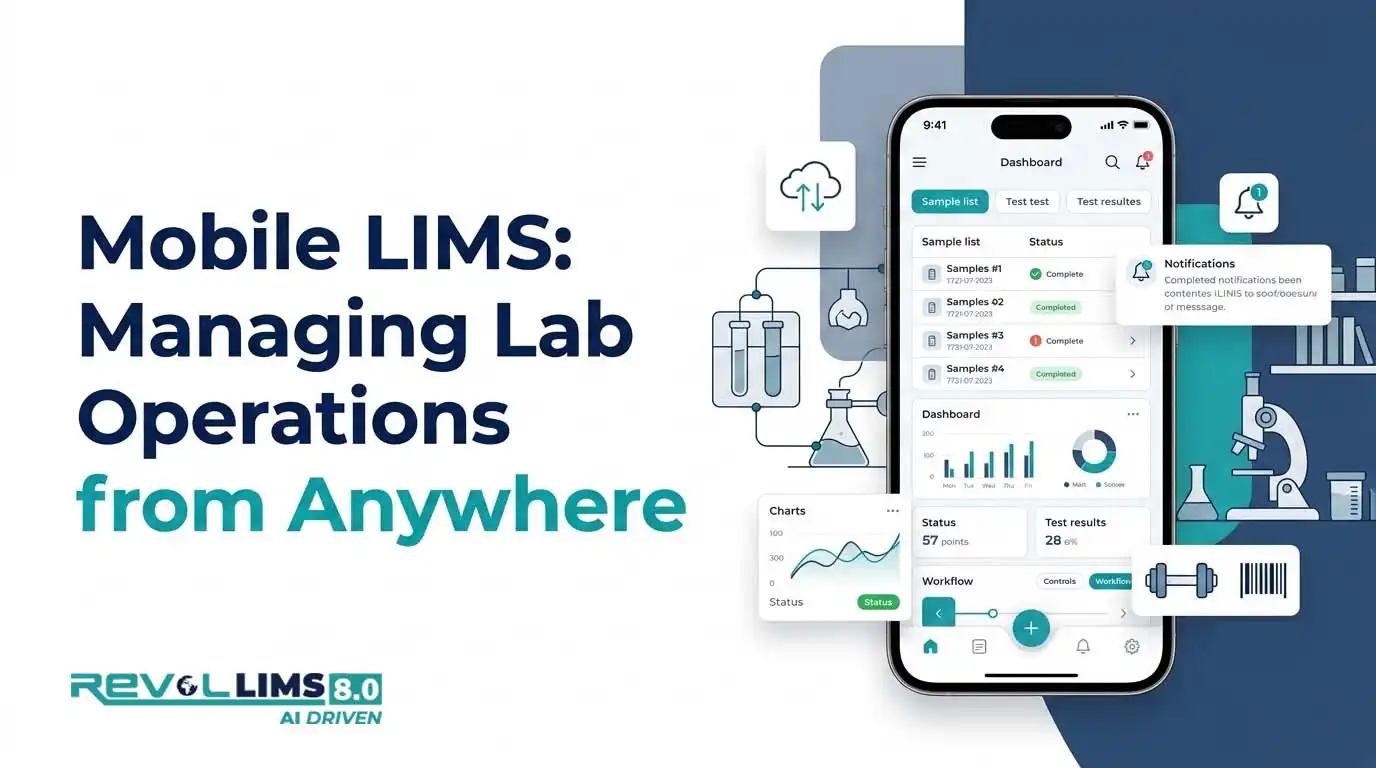
A well-designed agricultural LIMS extends the laboratory’s reach all the way to the field boundary. The mobile application — available on iOS and Android, optimised for low-bandwidth and offline operation — allows field technicians to register samples with GPS-tagged location data in real time, generate and print barcode or QR code labels via Bluetooth-connected portable printers, capture photographic evidence of the sampling site and sample condition, and log chain-of-custody information digitally with automatic timestamping and collector ID.
This eliminates the single largest source of pre-analytical error in agricultural testing. Every sample that reaches the lab arrives as a fully registered, fully documented entity — no ambiguity, no re-entry, no missing chain-of-custody records.
Configurable Agricultural Workflow Engine
No two agricultural testing laboratories have identical workflows. A government-run soil health card laboratory operates very differently from a private pesticide residue testing lab serving commodity exporters. A good LIMS offers no-code workflow configuration that allows laboratory managers to define custom sample types, test panels, and method libraries; set automated routing rules that assign samples based on test type, priority, and workload balancing; configure multi-stage approval workflows with e-signature requirements; and establish automatic escalation and notification rules for samples approaching turnaround SLA deadlines.
Instrument Integration and Automated Data Capture
Agricultural LIMS systems should integrate directly with the analytical instruments common in agricultural laboratories: ICP-OES and ICP-MS for elemental analysis, GC-MS and GC-FPD for pesticide residue testing, HPLC and UPLC for mycotoxin and herbicide quantification, NIR for rapid quality screening, and standard titrators and photometers for routine soil chemistry.
The practical impact for a lab running 500 soil samples per day is the elimination of several hours of manual data transcription daily, while simultaneously improving result accuracy and reducing transcription-introduced errors.
Quality Control and ISO 17025 Compliance Framework
Agricultural testing laboratories serving export markets, government schemes, or certification bodies must demonstrate ongoing compliance with ISO 17025:2017. This standard should be built into the LIMS’s core architecture, not added as an afterthought. Key features include automatic generation of QC charts (Shewhart control charts, R-charts) for each analytical method, real-time flagging of out-of-control QC events with mandatory corrective action documentation, calibration and equipment management tracking, complete tamper-evident audit trails for every result and review action, and method validation and measurement uncertainty documentation storage.
Automated Report Generation and Client Portal
A fully functional agricultural LIMS generates formatted, branded certificates of analysis directly from the system — no manual document population required. Agricultural report templates can include nutrient level results with target range comparisons and colour-coded sufficiency indicators, pesticide residue results with MRL compliance status against EU, US, or domestic standards, soil health interpretation notes and fertiliser recommendations automatically populated from result-based rule sets, and QR codes linking to the digital original for third-party verification.
Completed reports should be automatically emailed or made available through a client self-service portal, reducing inbound inquiry calls to the laboratory and improving the overall client experience.
Key Use Cases Across the Agriculture Testing Spectrum
Agricultural testing is not monolithic. The sector encompasses a wide variety of testing disciplines, each with distinct sample types, analytical methods, regulatory frameworks, and client expectations. A well-designed agricultural LIMS should serve all of them from a single platform.
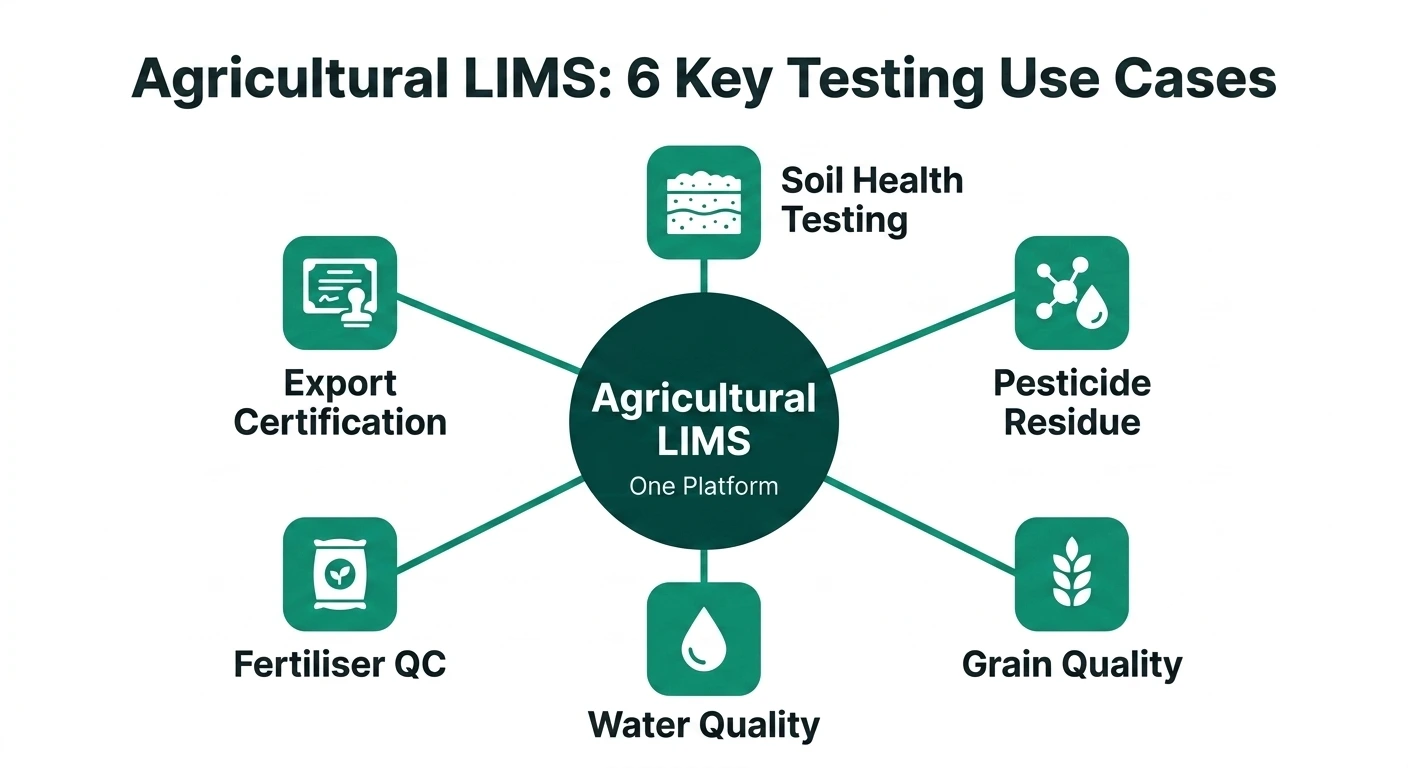
1. Soil Health and Fertility Testing
Soil testing is the foundation of precision agriculture. Laboratories processing soil health card samples, precision farming grid samples, or certification-programme samples need to handle high volumes with consistent methodology and rapid turnaround. Key system requirements include pre-configured test packages for macro and micronutrients (N, P, K, S, Zn, B, Fe, Mn, Cu), pH, EC, organic carbon, CEC, and texture/particle size workflows, GPS-linked sample maps for spatial result visualisation, and integration with national soil databases and advisory systems.
2. Pesticide Residue Monitoring
With growing export market requirements and consumer demand for residue-free produce, pesticide residue testing laboratories face intense scrutiny. Testing must cover hundreds of active ingredients across diverse matrices against constantly updating MRL databases.
A LIMS supporting pesticide residue work should provide multi-residue method management, automatic MRL compliance checking against configurable regulatory databases (EU Regulation 396/2005, FSSAI, Codex Alimentarius), automatic flagging of non-compliant results, and outbreak investigation tools for tracing non-compliant batches to source fields.
More than 1,400 pesticide active substances are currently regulated under EU MRL legislation alone (Source: EU Pesticides Database, European Commission). Manual compliance checking across this many active substances is not operationally feasible at laboratory scale.
3. Grain, Seed, and Commodity Quality Testing
Export grain quality testing requires rapid turnaround to support trading decisions. A LIMS for this use case should provide integration with NIR analysers for rapid grain quality screening, mycotoxin ELISA platform integration, automatic certificate of analysis generation in buyer-specified formats, and lot traceability linking harvest batches through storage and processing.
4. Irrigation and Agricultural Water Quality
Testing irrigation water for salinity, heavy metals, coliform bacteria, agricultural chemical contamination, and pH-nutrient antagonism helps farmers protect both their crops and soil health. A water testing LIMS module should support sampling point geolocation and seasonal trending, automatic comparison of results against WHO agricultural water guidelines and national standards, and risk-tiered reporting in clear green/amber/red advisory format. This use case is particularly relevant in GCC countries such as the UAE and Saudi Arabia, where irrigation water quality monitoring is a regulatory priority given water scarcity pressures on agricultural operations.
5. Fertiliser and Agrochemical Quality Control
Fertiliser quality testing — verifying declared nutrient content, detecting adulteration, and supporting regulatory compliance — is a critical function for manufacturers, importers, and state agriculture departments. LIMS support for fertiliser QC labs should include gravimetric and volumetric method templates, declaration vs. analysis comparison reports, and batch release workflows aligned to the Fertiliser Control Order (FCO) and equivalent national regulations.
6. Export Certification and Phytosanitary Compliance
Agricultural produce destined for export must meet the phytosanitary and quality requirements of destination markets. Testing laboratories supporting export certification need chain-of-custody documentation that is unimpeachable from farm gate to port. This requires end-to-end traceability, exportable audit trail reports in formats accepted by APEDA, FSSAI, and destination market authorities, and multi-laboratory coordination tools for samples requiring testing at multiple accredited facilities.
Navigating the Compliance Landscape in Agricultural Testing
Agricultural testing laboratories operate within a complex and evolving regulatory framework. Compliance is not optional — it is the commercial licence to operate. Understanding the landscape helps laboratories prioritise where a LIMS delivers the most immediate compliance value.
ISO 17025:2017 — The Foundation Standard
ISO 17025:2017 is the international standard for testing and calibration laboratory competence. For agricultural testing laboratories seeking NABL accreditation (India), UKAS (UK), A2LA (US), or equivalent recognition, ISO 17025 compliance is mandatory. The 2017 revision placed greater emphasis on risk-based thinking, measurement uncertainty, and the impartiality and integrity of laboratory operations — all areas where a LIMS provides documented, auditable evidence.
A LIMS built to ISO 17025:2017 requirements should include built-in support for method validation documentation, personnel competency records, equipment calibration management, reference material tracking, and control chart-based QC monitoring.
FSSAI and Food Safety Standards
In India, agricultural produce testing for compliance with Food Safety and Standards Authority of India (FSSAI) standards is increasingly mandatory for domestic market players as well as exporters. FSSAI-notified laboratories must maintain specific documentation, use approved methods, and participate in proficiency testing programmes. A LIMS should support FSSAI compliance through method library management aligned to the FSSAI Food Testing Manual, proficiency testing sample tracking, and automated report formats compatible with FSSAI submission requirements.
EU MRL Regulation (EC No 396/2005) and Global Pesticide Standards
For laboratories supporting export of agricultural produce to the European Union, compliance with EU Maximum Residue Level regulation is critical. The EU MRL database covers over 1,400 active substances across hundreds of crop-pesticide combinations. A LIMS should be configurable with the current EU MRL database — updatable as new regulations are published — and automatically compare every pesticide residue result against the applicable MRL for the commodity, flagging non-compliance for immediate client notification.
APEDA, Organic Certification, and Traceability Mandates
India’s APEDA mandates residue testing for a wide range of export commodities. Third-party organic certification bodies (NPOP, NOP, EU Organic Regulation) require documented evidence of testing and traceability from field to final product. A LIMS provides the complete audit trail infrastructure these certification processes require — from field sample registration through to certified report issue, with every action timestamped, attributed, and immutable.
| Compliance Standard | What a LIMS Should Support |
|---|---|
| ISO 17025:2017 | Full audit trail, method validation, equipment management, QC charting, e-signatures |
| FSSAI / NABL | Approved method library, proficiency testing tracking, NABL-format report templates |
| EU MRL Regulation | Configurable MRL database, automatic compliance checking, non-compliance alerts |
| APEDA / Export | Chain-of-custody from field to port, traceability reports, multi-laboratory coordination |
| Organic Certification | Field-to-lab sample lineage, certified result records, third-party auditor access portal |
| Codex Alimentarius | Multi-standard MRL comparison, international commodity trade report formats |
The AI Advantage: Intelligence in a Modern Agricultural LIMS
Laboratory informatics has entered a new era. AI and machine learning integration in LIMS platforms is no longer a roadmap item — it is increasingly standard in leading systems, and agricultural testing laboratories are among the most compelling beneficiaries. Here is what that looks like in practice.
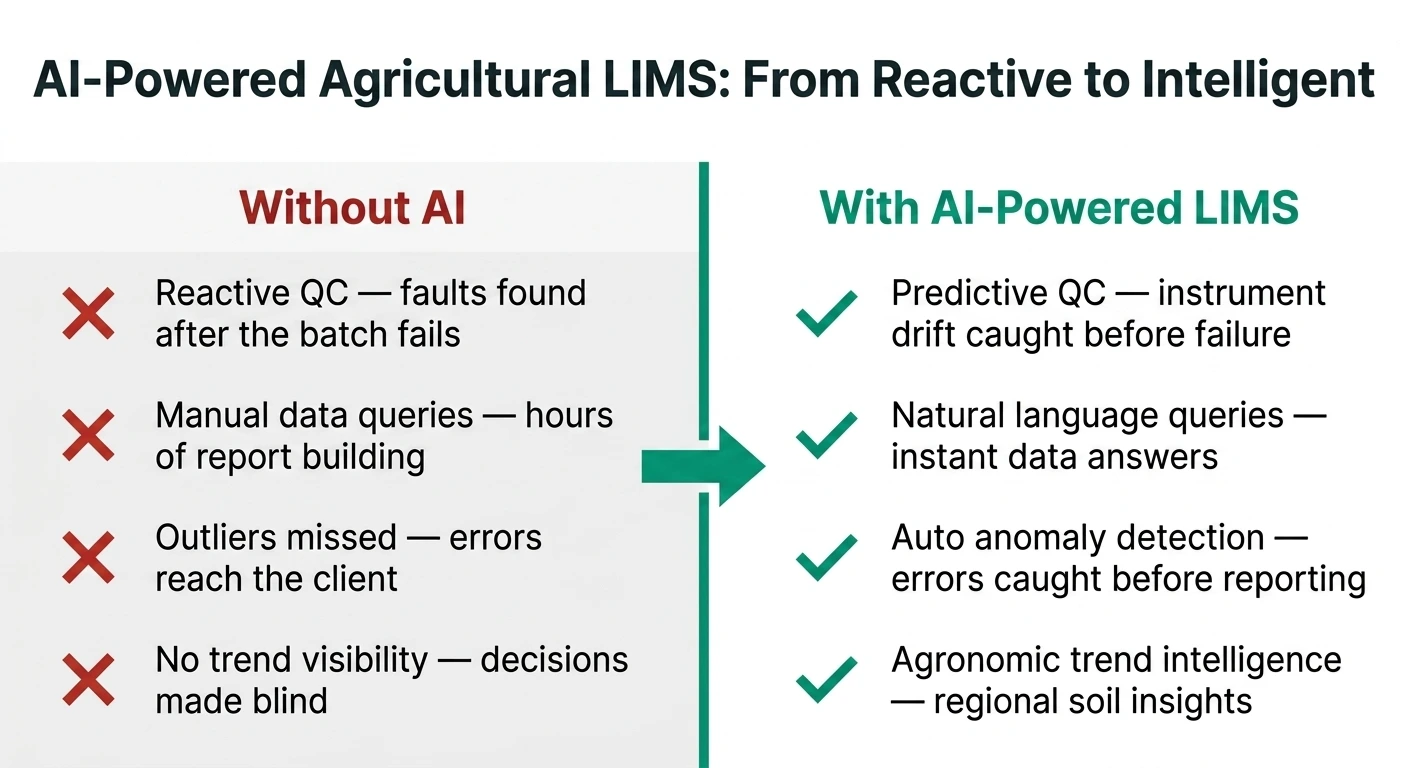
Predictive Quality Control
Traditional QC is reactive: a control fails, an analyst is notified, a batch is quarantined, and root cause investigation begins — after the damage is done. AI-powered predictive QC changes this by analysing historical control chart data, instrument performance trends, analyst behaviour patterns, and seasonal environmental variables to identify leading indicators of impending QC failure before it occurs.
For an agricultural testing laboratory running soil analysis batches of 200 samples per day, an undetected QC failure can invalidate an entire day’s work. Even a two-hour predictive warning that a particular instrument is trending toward out-of-control performance gives an analyst enough time to intervene, recalibrate, and prevent the batch failure entirely.
Natural Language Data Interaction
Some modern LIMS platforms now integrate AI-based query assistants that change how laboratory teams access their data. Instead of navigating complex report menus, a lab manager can type a plain-language query such as: “Show me all soil samples from a particular district collected in the last 30 days where potassium is below 120 kg/ha.” The system retrieves the data and presents it in a table, chart, or formatted report — instantly, without IT involvement.
For agricultural laboratory managers who need to answer agronomic trend questions quickly, this transforms the laboratory from a result-delivery service into a genuine agronomic intelligence resource.
Automated Anomaly Detection
Agricultural samples can exhibit extreme variability — the composition of a soil sample from a waterlogged field is fundamentally different from one taken 50 metres away in a well-drained upland area. This variability makes outlier detection both challenging and critical: a genuine result from an unusual sample must be distinguished from an error caused by a contaminated analytical blank or a mis-routed specimen.
AI-powered anomaly detection in a LIMS learns the expected distributions for each test parameter within defined geographic and agronomic zones, and flags results that deviate significantly from expectation for secondary analyst review — without automatically rejecting them. Scientific integrity is preserved while genuine errors are caught before they reach the client.
Trend Analysis and Agronomic Intelligence Reporting
Perhaps the most commercially transformative capability is the generation of spatial and temporal trend intelligence from cumulative laboratory data. A laboratory that has processed soil samples from a particular region over several years holds an extraordinarily valuable dataset — a longitudinal record of how soil health is changing, which deficiencies are emerging, which areas are at risk of salinisation, and how fertiliser programmes are performing across the landscape.
A LIMS analytics engine that allows laboratories to extract and visualise this intelligence — producing regional trend reports, early warning maps for deficiency hotspots, and longitudinal analysis for individual farm clients — creates a value-added service layer that differentiates the laboratory commercially, far beyond the commodity business of individual sample reports.
Laboratories that offer AI-powered agronomic trend intelligence to their clients report higher client retention rates, premium pricing power, and deeper integration into their client's farm management decision cycles.
Implementing an Agricultural LIMS: Practical Considerations and ROI
The decision to implement a LIMS is a significant investment — of capital, management attention, and operational change. For agricultural testing laboratories, it is increasingly not a question of whether, but when and how to make that investment effectively.
Deployment Options: Cloud and On-Premise
Agricultural testing laboratories range from large government reference laboratories in state capitals with reliable high-speed connectivity, to small district-level soil testing centres with intermittent internet access. A robust LIMS should support all deployment models:
- Cloud (SaaS): Fastest to deploy, lowest upfront cost, automatic updates — ideal for multi-site laboratories hosted on secure, ISO-certified data centres.
- On-Premise: Full data sovereignty, suitable for government laboratories with data localisation requirements or facilities with security constraints.
Implementation Timeline
A realistic LIMS implementation for a mid-size agricultural testing laboratory (10–30 users, 200–500 samples per day) typically follows a phased approach. The first two weeks cover system configuration: method library setup, test panel configuration, workflow definition, and report template design. Weeks three and four address data migration and instrument integration testing. Weeks five and six involve parallel running alongside the existing system to identify and resolve discrepancies. Full go-live with ongoing hypercare support typically begins around week seven.
The most important success factor in any LIMS implementation is change management — engaging laboratory staff in the configuration process, training analysts thoroughly, and communicating clearly about how the new system simplifies their daily work rather than adding to it.
Return on Investment: A Framework for Agriculture Labs
Labour efficiency: Automated data entry, instrument integration, and report generation can reduce non-analytical laboratory labour by 25–40%. For a laboratory spending ₹40 lakh per annum on administrative and data entry staff, this represents ₹10–16 lakh in recoverable efficiency annually.
Rework and re-test reduction: Pre-analytical errors, QC failures, and reporting mistakes that require re-testing can consume 5–15% of total analytical capacity. A LIMS that reduces rework by even half of this liberates significant capacity for revenue-generating work.
Turnaround time improvement: Faster turnaround enables higher throughput with the same capital equipment. It also opens premium service tiers — 48-hour or 24-hour rush services at higher price points — that manual laboratories cannot reliably offer.
Accreditation and contract access: NABL and ISO 17025:2017 accreditation unlocks access to government contracts, export certification business, and premium commercial clients that will not engage non-accredited laboratories. This is the single largest commercial multiplier for most agricultural testing laboratories.
Client retention and loyalty: Agricultural clients who receive fast, accurate, well-presented reports with agronomic interpretation are significantly more likely to return season after season and refer new clients to the laboratory.
How to Choose the Right Agricultural LIMS: A Buyer’s Framework
The agricultural LIMS market has matured considerably. There are now dozens of platforms available, ranging from generic laboratory management systems adapted for agriculture to purpose-built agri-sector solutions. Making the right choice requires a structured evaluation framework aligned to your laboratory’s specific testing disciplines, compliance obligations, scale, and growth trajectory.
✔ Step 1 — Define Your Testing Scope and Volume
Before evaluating any LIMS, map your current and anticipated testing portfolio precisely. Which sample matrices do you test — soil, water, plant tissue, grain, pesticide residue, fertiliser? What is your current daily sample volume, and what does peak season look like? Are you operating a single laboratory or multiple collection centres? Do you have field sampling operations that need mobile integration?
This scoping exercise will immediately filter out platforms designed for generic laboratory environments that cannot handle agricultural-specific workflows such as GPS-tagged field sampling, multi-residue pesticide panels, or seasonal volume spikes.
✔ Step 2 — Assess Compliance Obligations Now and in Three Years
Compliance requirements evolve. A laboratory currently serving only domestic agricultural clients may be targeting export market certification within two years. A soil testing lab serving a government scheme today may be seeking ISO 17025:2017 NABL accreditation next year. Choose a LIMS that meets your compliance obligations today and has the architecture to grow with you.
Key questions to ask any vendor: Is ISO 17025:2017 compliance built into the core system, or is it an add-on module? Can the system maintain configurable MRL databases for EU, Codex, and domestic pesticide regulations simultaneously? Does the electronic signature workflow meet 21 CFR Part 11 requirements? Can the audit trail be exported in a format accepted by NABL assessors and third-party certification bodies?
✔ Step 3 — Evaluate Instrument Integration Depth
Instrument integration is where many LIMS implementations either deliver or disappoint. A system that claims instrument connectivity but requires custom scripting for every new instrument model is a long-term IT liability. Look for a vendor-maintained instrument driver library that includes the specific makes and models in your laboratory, bidirectional communication where applicable, support for both serial and network-based communication protocols, and a clear roadmap for adding new instruments as your analytical capability expands.
✔ Step 4 — Scrutinise Configuration Flexibility vs. Customisation Cost
There is a critical distinction between a LIMS that is configurable and one that requires expensive custom development. No-code or low-code configuration — where laboratory managers can define new test types, modify workflows, update report templates, and adjust QC rules without writing code or engaging the vendor’s development team — dramatically reduces both implementation cost and total cost of ownership over the system’s lifetime.
✔ Step 5 — Evaluate Vendor Stability and Support Quality
A LIMS is a long-term infrastructure investment. Vendor stability matters. Look for a demonstrated multi-year track record with agricultural laboratory clients, evidence of active product development, responsive technical support with agricultural domain expertise, and clear contractual obligations around uptime, data backup, and support response times.
| Evaluation Criterion | What to Look For |
|---|---|
| Agricultural workflow specificity | Pre-built soil, water, pesticide, grain, fertiliser test panels — not generic templates |
| Mobile field sampling | Offline-capable iOS/Android app with GPS, barcode, photo capture |
| Instrument integration | Vendor-maintained driver library for your specific instrument models |
| ISO 17025 / NABL compliance | Built-in, not bolt-on: audit trail, method validation, QC charting, e-signature |
| Pesticide MRL compliance | Configurable, updatable MRL databases for multiple regulatory regimes |
| Report flexibility | No-code template editor; multi-language and multi-format output |
| Deployment options | Cloud, on-premise, and hybrid with offline mobile capability |
| No-code configuration | Lab managers can add tests, update workflows, without developer support |
| Vendor track record | Proven agricultural lab deployments, active compliance database updates |
| Support model | Domain-expert support, documented SLAs, post-implementation hypercare |
What Agricultural Labs Commonly Get Wrong
Several patterns of poor LIMS selection recur consistently across implementation experience. The most common is selecting a generic LIMS — one designed for pharmaceutical or industrial quality control — because it is well-known or has a lower upfront licence cost, then spending 12–18 months and substantial consulting fees trying to configure it for agricultural workflows it was never designed to support.
The second most common error is selecting based on the demo environment rather than production performance. A system can look excellent in a controlled demonstration with clean, pre-loaded data. The critical test is how it performs during peak agricultural season, with 400 soil samples arriving simultaneously, three analysts working the same batch, two instruments generating data concurrently, and a client calling for an urgent result on a specific sample. Ask vendors for references from agricultural laboratories operating at your scale and volume — and speak to those references directly before committing.
The right agricultural LIMS is not necessarily the most feature-rich or the most expensive. It is the one most deeply aligned to the specific workflows, compliance obligations, and growth trajectory of your laboratory — deployed by a vendor who understands agriculture, not just laboratory software.
The Future of Agricultural Testing: LIMS in the Precision Farming Revolution
Agricultural testing does not operate in isolation from the broader technological transformation of farming. Precision agriculture, remote sensing, IoT-connected soil probes, drone-based crop monitoring, and satellite-derived vegetation indices are generating more agronomic data than ever before. The challenge is no longer whether data is available — it is whether the right infrastructure exists to integrate, validate, and act on it.
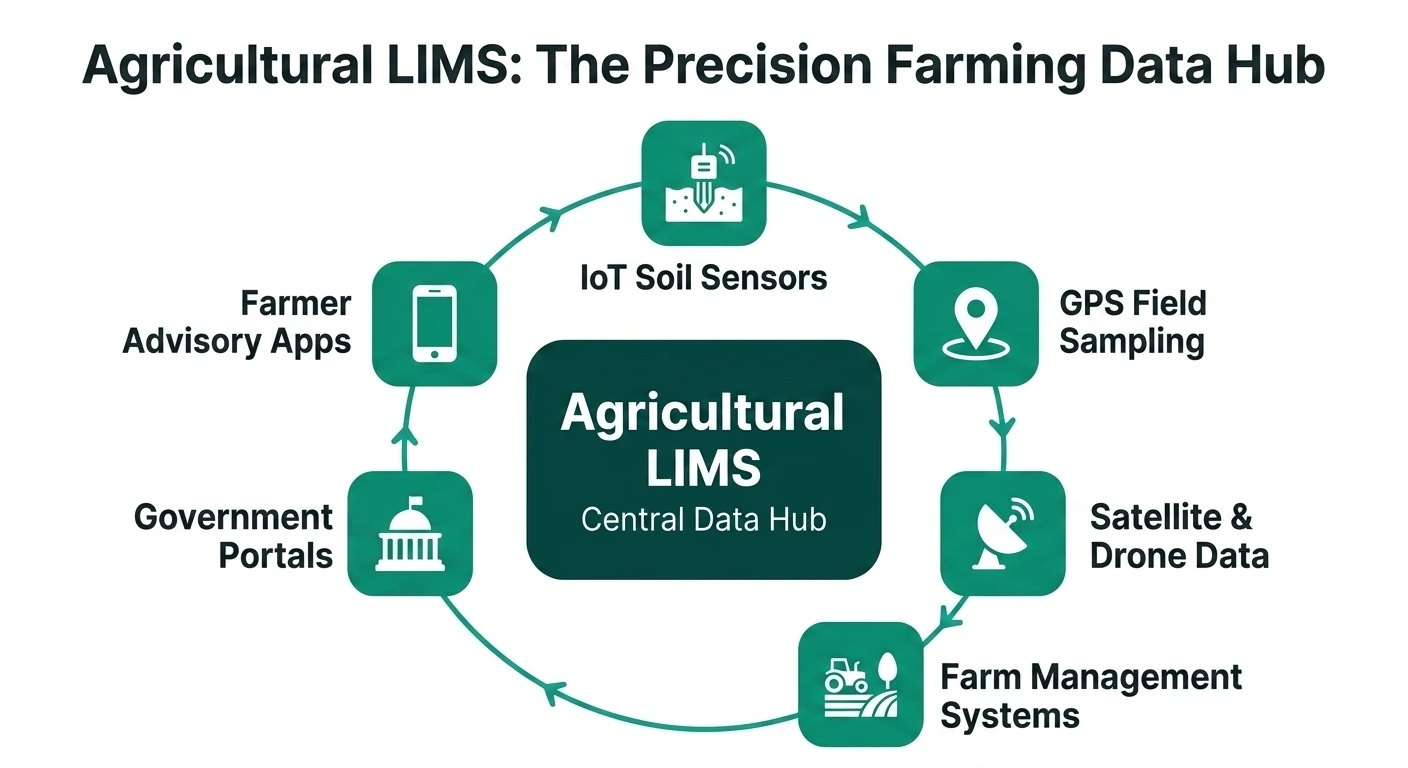
LIMS as the Central Agricultural Data Hub
The LIMS of the future — and increasingly of the present — is not just a sample tracking system. It is the authoritative data hub that connects field intelligence (GPS-tagged sampling, IoT sensor data, satellite imagery metadata) with laboratory analysis results, contextualises both against agronomic benchmarks and compliance standards, and delivers actionable insights to farmers, agronomists, and policymakers through digital interfaces.
An API-first LIMS architecture built for this connected future enables integration with precision farming platforms, farm management information systems (FMIS), government agricultural data portals, and commodity trading platforms. As these integrations deepen, the agricultural testing laboratory evolves from a commodity service provider into an indispensable node in the digital agriculture value chain.
IoT Integration and Real-Time Field Intelligence
The proliferation of low-cost IoT sensors in agricultural environments — soil moisture probes, weather stations, conductivity monitors, pH sensors — is generating continuous field data streams that have historically had no formal connection to laboratory testing. As LIMS platforms evolve to consume and contextualise IoT data streams alongside discrete laboratory results, the potential for dynamic, real-time soil and crop monitoring grows substantially.
Sustainability, Carbon, and ESG Reporting
Regulatory and commercial pressure on agricultural supply chains to demonstrate environmental sustainability credentials is intensifying globally. The EU Farm to Fork Strategy, India’s National Action Plan on Climate Change agricultural components, and ESG requirements from food company buyers are pushing agricultural testing laboratories toward expanded roles in monitoring soil carbon sequestration, water use efficiency indicators, and ecosystem health metrics.
Laboratories that can provide validated, LIMS-documented evidence of soil health improvement over time will find growing demand from corporate food buyers, ESG-reporting supply chain managers, and voluntary carbon market participants.
Smallholder Farmer Accessibility and Digital Inclusion
A critical challenge in agricultural testing in developing markets is making laboratory services accessible and actionable for smallholder farmers who may be semi-literate, lack digital devices, or operate in regional languages. The evolution of LIMS toward SMS-based result delivery, voice-enabled query interfaces, regional language report generation, and integration with rural community agricultural service centres represents both a social impact opportunity and a significant commercial market development frontier.
India’s Soil Health Card scheme has demonstrated at national scale that agricultural testing can reach even marginal farmers when the delivery infrastructure is designed for accessibility. The next generation of LIMS integration — connecting laboratory results directly to government extension officer apps, to Kisan Call Centre databases, and to digital payment-linked advisory platforms — will require exactly the kind of API flexibility and configurable report output that modern agricultural LIMS platforms are developing.
Frequently Asked Questions
What is an agricultural LIMS, and why do farming laboratories need one?
An agricultural LIMS is a software platform that digitises and automates the full lifecycle of agricultural sample testing — from field collection and laboratory intake through analytical testing, QC review, and report delivery. Agricultural laboratories need a LIMS to eliminate manual errors, accelerate turnaround times, maintain ISO 17025 compliance, and deliver higher-value services to farming and agribusiness clients. The core value proposition is simple: faster, more accurate, more traceable results — delivered at the scale that agricultural seasons demand.
Can one LIMS handle both soil testing and pesticide residue testing in the same laboratory?
Yes. A well-designed multi-disciplinary LIMS with configurable test panels, method libraries, and workflow templates can cover the full range of agricultural testing disciplines — soil health, water quality, pesticide residues, mycotoxins, fertiliser quality, grain and commodity testing, and microbiological safety — within a single unified platform. Multiple laboratory departments can operate their own workflows while sharing a centralised sample registration, client management, and reporting infrastructure.
Is ISO 17025:2017 compliance built into agricultural LIMS systems?
It depends on the system — and this distinction matters. ISO 17025:2017 compliance should be architected into the core of the LIMS, with built-in support for audit trail completeness, measurement uncertainty documentation, calibration and equipment management, method validation records, QC charting, and electronic signature workflows. When evaluating any LIMS, ask specifically whether compliance features are native to the platform or require additional modules that carry separate licensing costs.
How long does it take to implement an agricultural LIMS?
A typical mid-size agricultural testing laboratory (10–30 users, 200–500 samples per day) can expect to be fully operational on a LIMS within 6–8 weeks, including system configuration, data migration, instrument integration, staff training, and parallel running. The timeline varies depending on the complexity of the laboratory’s testing portfolio, the number of instruments requiring integration, and the volume of historical data to migrate. Change management — preparing staff for the transition — is consistently the most important factor in whether an implementation lands on time.
Does an agricultural LIMS work offline for field sampling in remote areas?
A well-designed mobile field collection application should support full offline operation. Field technicians should be able to register samples, capture GPS coordinates, attach photographs, and generate barcode labels in areas with no connectivity. All data should automatically synchronise to the central database when connectivity is restored, maintaining the unbroken chain of custody with no manual re-entry required. This is particularly important for laboratories operating in rural India, GCC agricultural zones, or any market where field connectivity is inconsistent.
What analytical instruments should an agricultural LIMS integrate with?
A comprehensive agricultural LIMS should integrate with ICP-OES and ICP-MS systems for elemental and heavy metal analysis, GC-MS and GC-FPD platforms for pesticide residue quantification, HPLC and UPLC systems for mycotoxin and herbicide analysis, NIR analysers for rapid grain quality screening, microplate readers for ELISA-based residue screening, and standard titration and photometric platforms for routine soil chemistry. Verify that the LIMS vendor maintains active driver support for the specific instrument makes and models in your laboratory before committing to a contract.
How does a LIMS help agricultural laboratories win government contracts?
Government agricultural testing contracts in India — under schemes such as the Soil Health Card programme, APEDA residue monitoring, or state government quality assurance mandates — typically require NABL accreditation, adherence to specific approved methods, documented chain of custody, and standardised reporting formats. A LIMS that provides the operational, compliance, and reporting infrastructure that NABL assessors and government scheme administrators require significantly reduces audit preparation burden and accelerates the accreditation process that unlocks access to high-volume public sector contracts.
Closing the Loop from Field to Farmer
The agricultural testing lifecycle is a chain — and like every chain, it is only as strong as its weakest link. For too many laboratories, the weakest links are the same ones: manual sample registration at field intake, disconnected analytical systems requiring re-entry, paper-based QC processes, and report delivery bottlenecks. Each weak link delays the farmer’s access to the insight they need, erodes the laboratory’s operational efficiency, and undermines the compliance foundation that underpins its commercial credibility.
A purpose-built agricultural LIMS does not merely patch these weak links — it replaces the entire chain with a single, integrated, intelligent digital infrastructure. From the moment a field technician logs a sample under a mango orchard in Maharashtra to the moment a certified soil health report is automatically delivered to an agronomist in Chennai, every step is documented, automated, compliant, and optimised.
The agricultural sector stands at a pivotal moment. The convergence of climate pressure, food security imperatives, export market quality demands, and precision farming technology is driving an urgent need for laboratory infrastructure that can keep pace. LIMS is not a back-office IT upgrade — it is a strategic capability that positions agricultural testing laboratories as indispensable partners in the future of food production.
The laboratory that builds the right digital foundation today is the one clients will rely on tomorrow.
Ready to Transform Your Agricultural Laboratory?
Revol LIMS 8.0 is purpose-built for the compliance demands, sample volumes, and workflow complexity of regulated agricultural testing laboratories. Get a personalised demo configured to your specific testing disciplines — soil, pesticide residue, water, grain, or export certification.
Request a Demo: www.revollims.com
Explore other verticals: Food & Beverage LIMS | Environmental & Water Testing LIMS
Author: Revol LIMS Team




 (1) (1).webp)