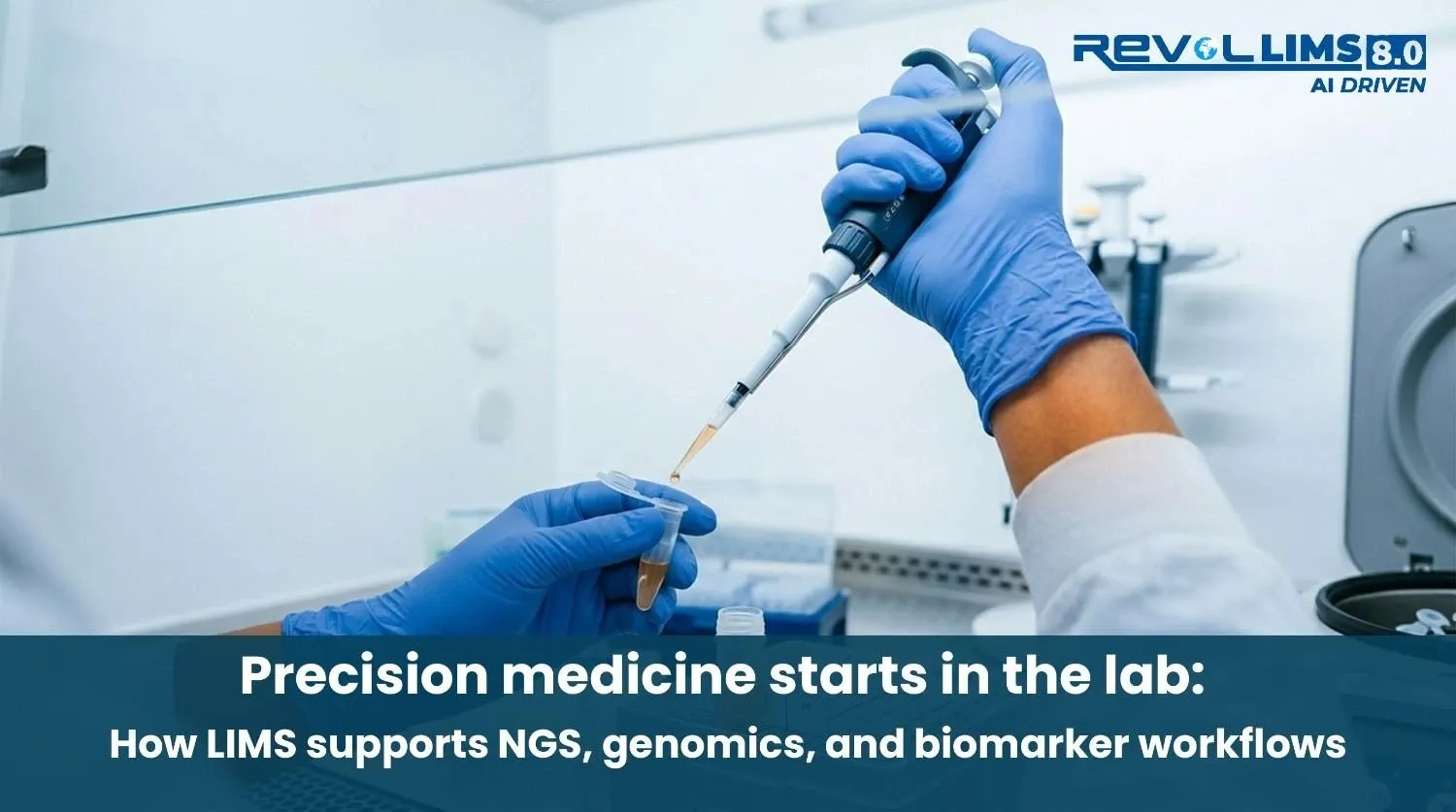
Precision medicine starts in the lab: how LIMS supports NGS, genomics, and biomarker workflows
Next-generation sequencing has moved from specialist equipment to everyday infrastructure in biotech labs. But sequencing faster is only half the equation. The data generated by NGS runs, multi-omics platforms, and biomarker assays is only as useful as the systems managing it. For most labs still relying on spreadsheets or generic LIMS, precision medicine remains a research ideal rather than an operational reality. A purpose-built Laboratory Information Management System changes that - turning raw genomic data into traceable, compliant, actionable insight.
NGS MARKET SIZE
$22.7B
Global NGS market projected by 2028 (Grand View Research)
PRECISION MEDICINE GROWTH
~12% CAGR
Global precision medicine market growth rate through 2030
AI PILOT FAILURE RATE
95%
AI initiatives that fail to scale - primary cause: poor data quality (Forbes/MIT)
LAB DIGITISATION
48%
Life sciences leaders prioritising digital transformation in 2026 (Deloitte)
Key takeaways
- NGS, genomics, and biomarker workflows generate data volumes that spreadsheets and generic LIMS cannot reliably handle.
- A purpose-built biotech LIMS ensures end-to-end traceability from sample intake to genomic report - critical for compliance.
- Key standards governing precision medicine labs include ISO 15189, 21 CFR Part 11, GLP (21 CFR Part 58), GMP, CLIA, CAP, ICH Q10, and ISO 17025.
- LIMS accelerates biomarker discovery by integrating instrument data, automating QC, and enabling multi-omics data correlation.
- AI-driven LIMS platforms eliminate the siloed data problem - the #1 reason biotech AI initiatives fail to scale.
What This Article Covers
- Why precision medicine creates a data management crisis
- Six genomic workflows where LIMS makes the critical difference
- The full compliance landscape for biotech precision medicine labs
- Generic LIMS vs. biotech-ready LIMS: a direct comparison
- How to evaluate a LIMS for NGS and biomarker workflows
- FAQs
1. Why precision medicine creates a data management crisis
A single whole-genome sequencing run produces between 50 and 200 gigabytes of raw data. Add in transcriptomics, proteomics, metabolomics, and liquid biopsy panels, and a single patient's molecular profile can span terabytes across disparate instruments, file formats, and databases. For labs running dozens of such profiles simultaneously, the data management challenge is not incremental - it is a defining challenge.
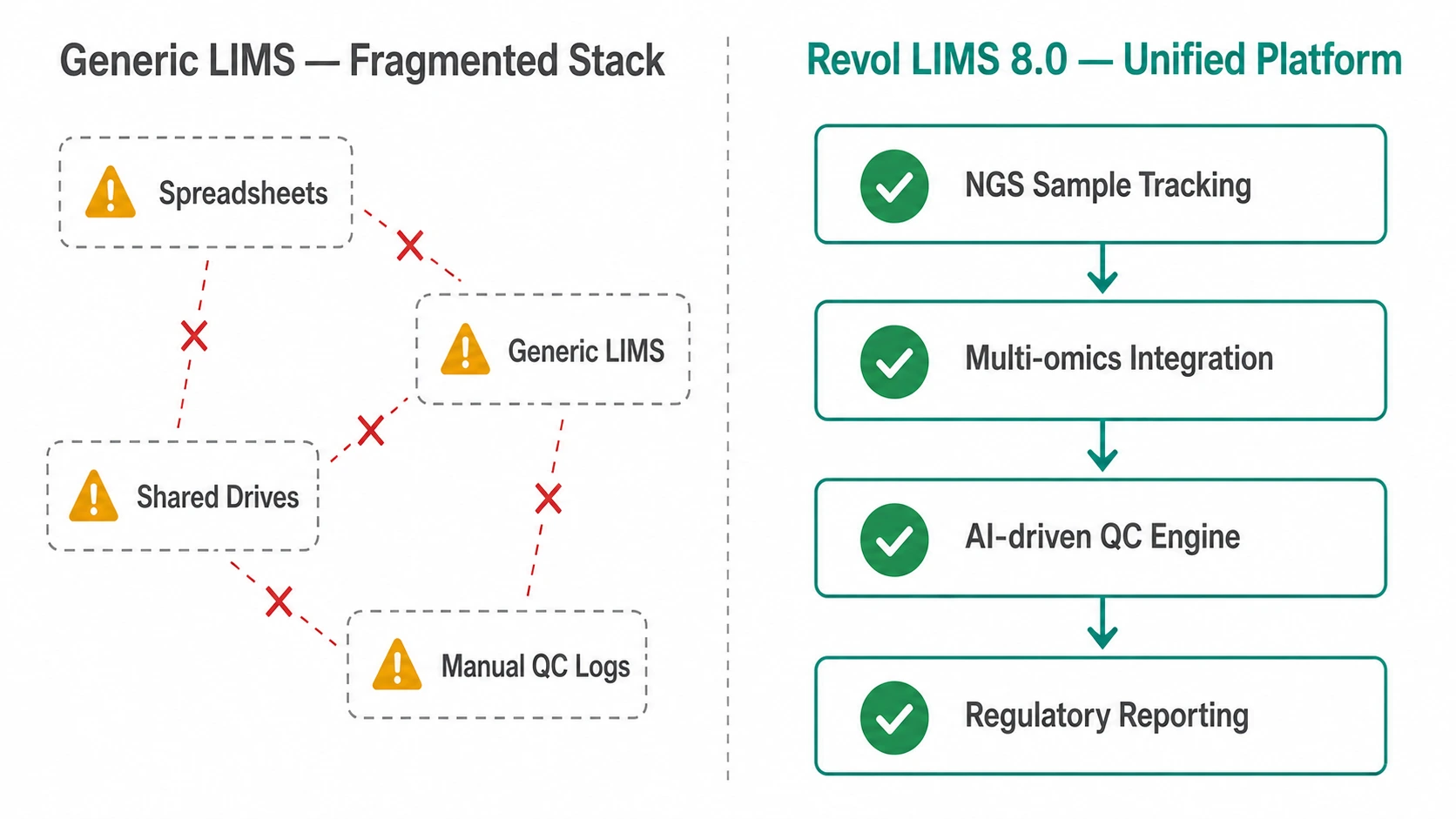
The problem is not the science. It is the infrastructure beneath it. Most biotech labs began their precision medicine journey by adapting tools designed for simpler workflows: spreadsheets for sample tracking, generic LIMS for QC logging, shared drives for sequencing outputs. These systems do not communicate. Data lives in silos. Errors introduced at sample collection propagate invisibly through every downstream step. By the time a variant call reaches a clinician or a regulatory submission, its provenance is unclear.
This is the data management crisis at the heart of precision medicine - and it is precisely why AI-driven initiatives keep stalling. According to research cited by Forbes and MIT, 95% of enterprise AI initiatives fail to scale beyond pilots, and the number one cause is poor data quality and fragmented infrastructure. You cannot build a predictive biomarker model on disconnected spreadsheets. You cannot meet 21 CFR Part 11 requirements with a shared folder. A biotech-grade LIMS is core requirement - it is the central system for precision medicine at scale.
2. Six genomic workflows where LIMS makes the critical difference
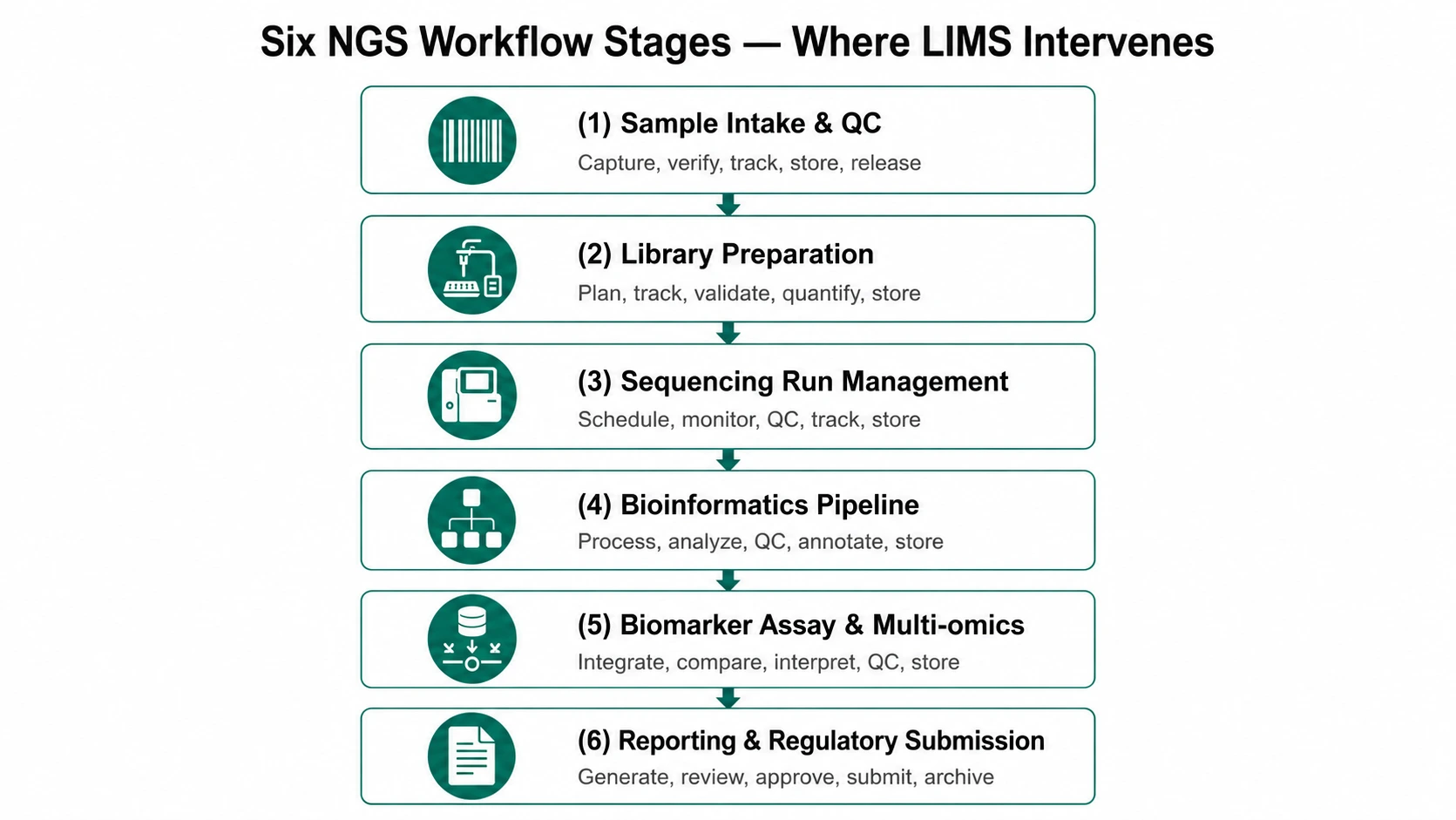
2.1 NGS sample intake and library preparation tracking
Every NGS workflow begins with a sample - and every sample carries the risk of mislabelling, degradation, or contamination before it even reaches the sequencer. A LIMS enforces pre-analytical quality checks at intake: DNA/RNA quantification thresholds, QC pass/fail criteria, and automated rejection flags for out-of-specification inputs. Library preparation steps - adapter ligation, PCR amplification, pooling - are logged in real time with reagent lot numbers, operator IDs, and timestamps. If a batch fails downstream, the root cause can be traced to a specific preparation step within seconds, not days.
2.2 Sequencing run management and instrument integration
Modern sequencers - Illumina NovaSeq, Oxford Nanopore, Ion Torrent - generate structured run metrics alongside raw FASTQ outputs. Without direct instrument integration, these metrics are manually transcribed or lost entirely. A biotech LIMS captures run metrics automatically: cluster density, Q30 scores, read depth, and error rates. QC thresholds can be configured to flag sub-standard runs before they consume analyst time. Run data is linked directly to the originating sample record, creating a complete, unbroken audit trail from wet lab to sequencing output.
2.3 Bioinformatics pipeline data management
Variant calling, alignment, annotation, and interpretation each involve multiple software tools, reference genome versions, and parameter sets. Any change in pipeline configuration - even a minor reference database update - can affect variant calls. A LIMS maintains version-controlled records of every pipeline component used for each analysis run, satisfying CAP and CLIA requirements for bioinformatics documentation. This also enables reproducibility: if a result is queried six months later, the exact analytical conditions can be reconstructed without ambiguity.
2.4 Biomarker assay workflow management
Biomarker workflows - whether immunoassays, ctDNA liquid biopsies, proteomics panels, or single-cell RNA sequencing - require structured result capture with predefined acceptance criteria. A LIMS enforces these criteria at the point of result entry, preventing out-of-range values from advancing without review. For companion diagnostic development, where biomarker assay performance must be validated to FDA and EMA standards, LIMS-generated validation records form the documentary backbone of regulatory submissions.
2.5 Multi-omics data correlation and cohort management
Precision medicine's true power emerges when genomic, transcriptomic, proteomic, and clinical data are correlated across patient cohorts. This requires a data model that links samples, assays, and results across modalities without losing provenance. A biotech LIMS with multi-omics support maintains these linkages natively: a single patient record connects germline sequencing, somatic panel results, expression profiling, and clinical metadata. Cohort queries - essential for biomarker discovery and clinical trial stratification - become a matter of seconds rather than days of manual data aggregation.
2.6 Reporting, interpretation, and regulatory submission readiness
The final output of a precision medicine workflow is not a data file - it is a clinical or regulatory report that must be accurate, interpretable, and defensible. A LIMS automates report generation from structured result data, applying laboratory-specific templates and interpretation logic. For FDA IND or NDA submissions, LIMS-generated study reports include the full analytical provenance required by ICH E6 and 21 CFR Part 11. Electronic signatures with audit timestamps eliminate the paper-based review bottlenecks that delay submissions.
3. The full compliance landscape for biotech precision medicine labs
Biotech precision medicine labs operate under one of the most demanding regulatory environments in science. Unlike a single-standard quality system, a genomics or biomarker lab must simultaneously satisfy frameworks spanning clinical accreditation, electronic data integrity, manufacturing quality, and clinical trial conduct. A LIMS is not merely a compliance tool - it is the platform through which all of these standards are enforced and documented.
| Standard | Scope | LIMS role |
|---|---|---|
| ISO 15189 | Medical & genomics labs - quality & competence | Audit trails, sample traceability, result validation |
| 21 CFR Part 11 | FDA electronic records & signatures | e-signatures, timestamped audit logs, access controls |
| GLP (21 CFR Part 58) | Non-clinical safety/research studies | Study protocol enforcement, raw data integrity |
| GMP (21 CFR Part 210/211) | Manufacturing & QC labs | Batch records, SOP enforcement, CoA generation |
| CLIA | Clinical lab testing standards (US) | Test result traceability, QC documentation |
| CAP Accreditation | Pathology & genomics lab quality | Proficiency testing records, competency tracking |
| ICH Q10 | Pharmaceutical quality system lifecycle | Change control, CAPA, continuous improvement logs |
| ISO 17025 | Testing & calibration lab competence | Method validation, instrument calibration records |
| ICH E6 (GCP) | Clinical trial conduct standards | Sample traceability across clinical phases |
| ISO 9001:2015 | General quality management system | Document control, process consistency |
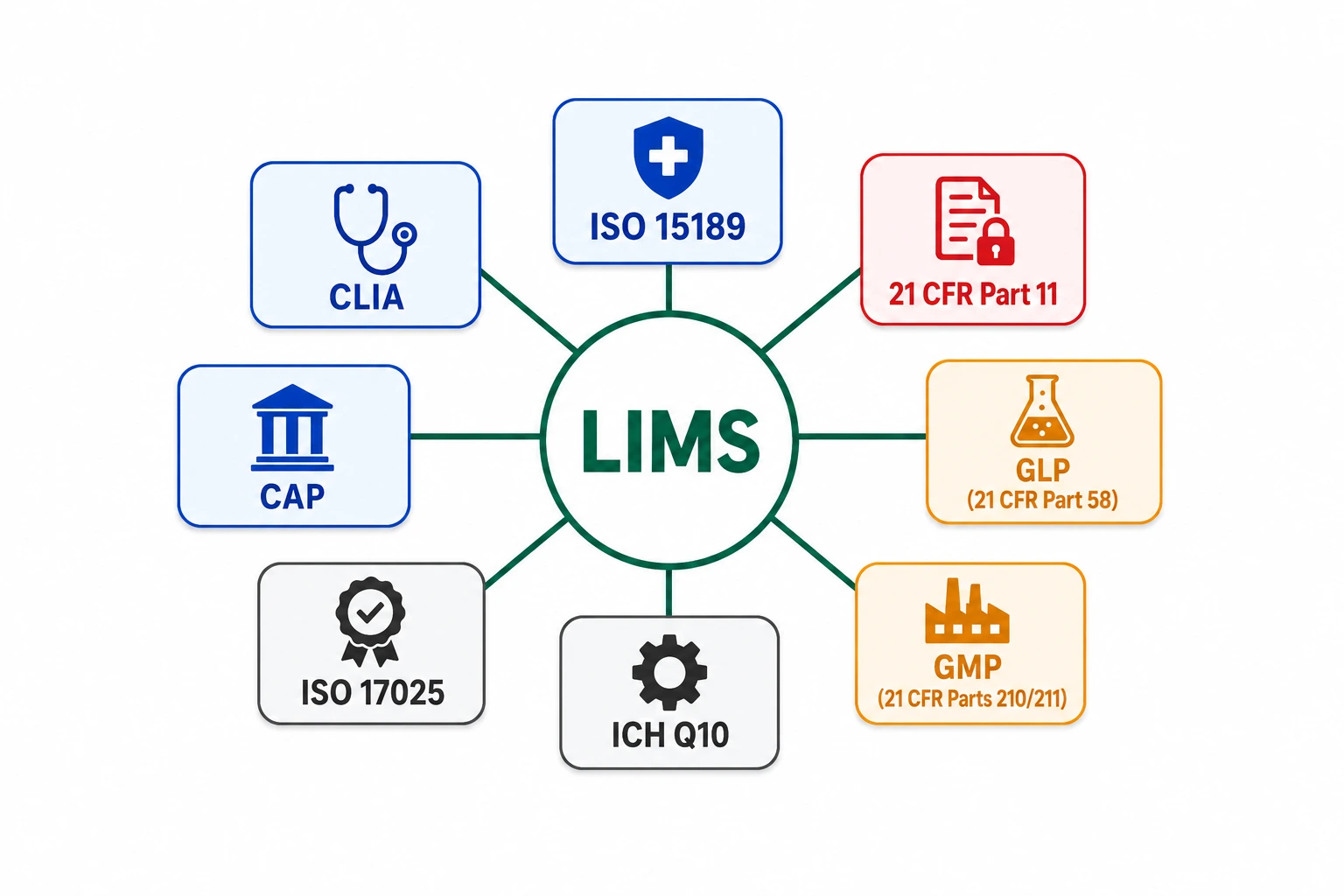
In practice, these standards overlap significantly. A lab running NGS-based companion diagnostics for a Phase III trial must satisfy GCP (ICH E6) for sample handling, 21 CFR Part 11 for electronic records, CAP/CLIA for assay quality, and ISO 15189 for overall laboratory competence - simultaneously, in the same workflow. A LIMS that addresses only one or two of these frameworks creates compliance gaps that surface painfully during audits.
4. Generic LIMS vs. biotech-ready LIMS: a direct comparison
The market contains dozens of LIMS products, but not all are built for the complexity of biotech precision medicine. General-purpose systems designed for clinical chemistry or environmental testing lack the data models, instrument integrations, and compliance depth that NGS and biomarker workflows demand. The table below illustrates the critical capability gaps.
| Capability | Generic LIMS | Purpose Built Biotech LIMS |
|---|---|---|
| NGS sample tracking | Manual / partial | End-to-end automated |
| Multi-omics data integration | Not supported | Native multi-omics module |
| Biomarker workflow management | Workaround needed | Built-in biomarker pipelines |
| 21 CFR Part 11 / GLP compliance | Add-on or manual | Out-of-the-box, validated |
| ISO 15189 / CAP / CLIA support | Limited | Full audit trail & e-signatures |
| Instrument auto-capture (NGS, MS) | Manual import | Direct instrument integration |
| AI-driven QC alerts | Not available | Integrated AI quality engine |
| Chain of custody (sample to report) | Fragmented | Complete, tamper-proof |
| Scalability (multi-site / cloud) | On-premise only | Cloud-native, multi-site ready |
The distinction is not cosmetic. A generic LIMS may satisfy basic sample tracking but will require extensive customisation - often costing more than a purpose-built solution - to handle NGS run management, multi-omics linkage, or automated CAP/CLIA documentation. Labs that attempt this path typically find themselves maintaining a brittle set of scripts and workarounds that breaks with every software update.
5. How to evaluate a LIMS for NGS and biomarker workflows
Selecting a biotech LIMS is a multi-stakeholder decision involving lab directors, bioinformaticians, quality assurance leads, and IT. The following criteria framework helps structure the evaluation:
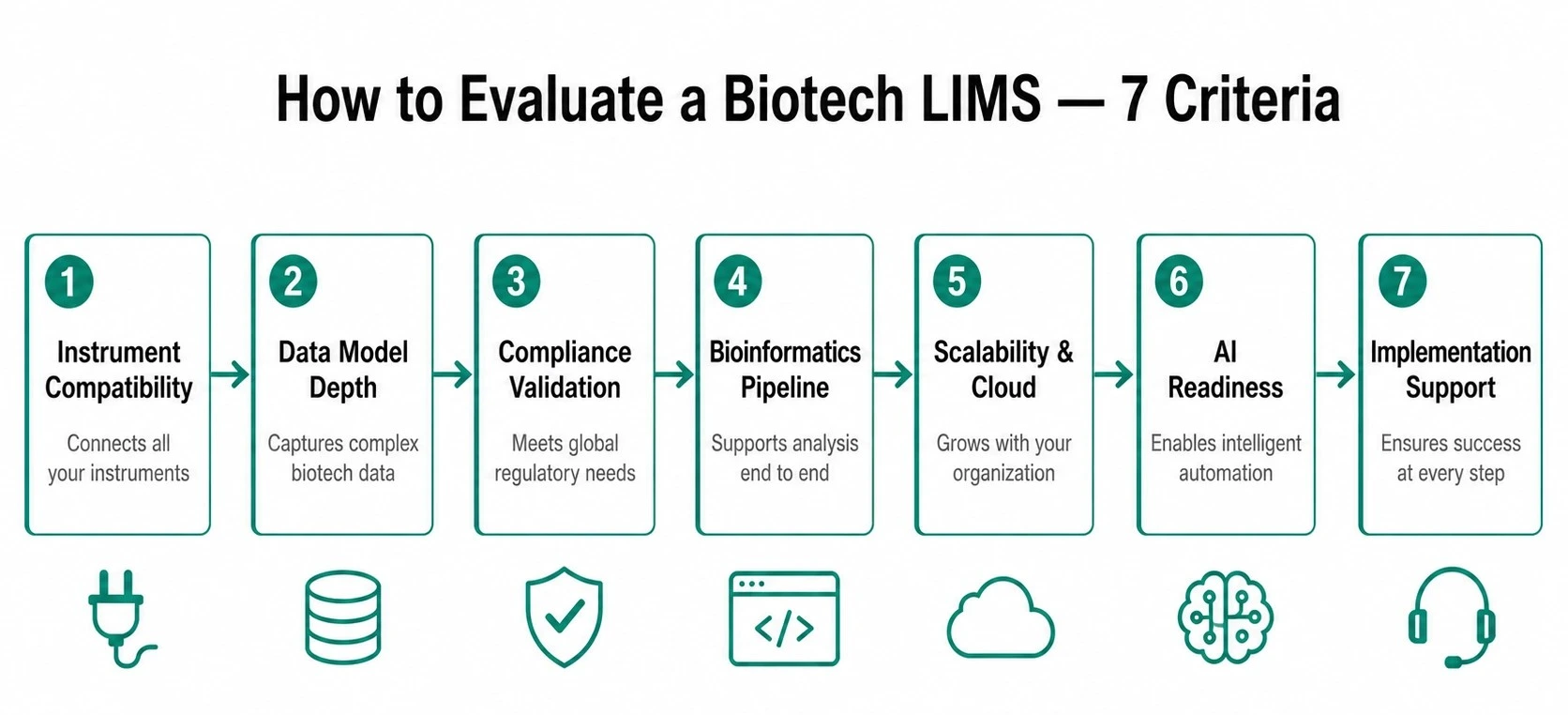
1. Instrument compatibility
Confirm direct integration with your sequencing platforms (Illumina, Nanopore, Ion Torrent) and analytical instruments (mass spectrometers, plate readers). Ask vendors for a tested integration list, not a promised roadmap.
2. Data model depth
Does the system support multi-omics linkage natively, or does it treat each assay type as an isolated module? The ability to link genomic, proteomic, and clinical data to a single patient or sample record is essential for precision medicine.
3. Compliance validation package
Request the vendor's validation documentation for 21 CFR Part 11, GLP, and ISO 15189. A genuinely compliant system ships with pre-built audit trail configurations, e-signature workflows, and validation protocols - not post-implementation add-ons.
4. Bioinformatics pipeline support
Evaluate whether the LIMS can log pipeline version, parameters, and reference data per analysis run. This is required for CAP/CLIA accreditation and critical for reproducibility in regulatory submissions.
5. Scalability and cloud architecture
Precision medicine data volumes grow faster than lab headcounts. Evaluate whether the system is cloud-native, supports multi-site deployments, and can scale storage and compute without custom engineering.
6. AI and analytics readiness
A modern biotech LIMS should expose structured, clean data to AI layers - whether the vendor's own analytics engine or your internal data science tools. Ask how data is exported and whether the schema supports downstream ML pipelines.
7. Implementation and support
vTime-to-go-live matters. Evaluate the vendor's implementation methodology, training programme, and post-go-live support responsiveness. A LIMS that takes 18 months to implement delays every downstream project it was meant to accelerate.
6. Frequently asked questions
What is the role of LIMS in precision medicine?
LIMS acts as the central system of a precision medicine lab - managing sample intake, tracking NGS runs, logging biomarker assay results, enforcing QC criteria, and generating regulatory-ready reports. Without a LIMS, these workflows rely on manual processes that introduce errors, lose provenance, and cannot scale.
Can a standard LIMS handle NGS workflows?
Standard or generic LIMS can handle basic sample tracking but typically lack the instrument integrations, multi-omics data models, and bioinformatics documentation features required for NGS workflows. Purpose-built biotech LIMS platforms address these gaps natively.
Which compliance standards apply to NGS-based biomarker labs?
NGS and biomarker labs typically need to satisfy ISO 15189 (lab competence), 21 CFR Part 11 (electronic records), CLIA and CAP (clinical lab quality), GLP for research studies, GMP if supporting manufacturing, and ICH E6 for clinical trial sample handling. A biotech LIMS should support all of these from a single platform.
How does LIMS support AI in biotech R&D?
AI models in biotech require clean, structured, well-provenance data. A LIMS provides exactly this - standardised data capture, validated QC, and complete sample history. Without this foundation, AI initiatives fail at the data quality stage. With it, the LIMS becomes the data layer that makes predictive analytics and biomarker discovery models viable.
What should I look for in a LIMS vendor for precision medicine?
Key criteria include: direct instrument integration with your NGS platforms, multi-omics data model support, pre-validated compliance documentation for 21 CFR Part 11 and ISO 15189, cloud scalability, and demonstrated deployments in biotech or genomics environments. Ask for reference customers running similar workflows.
How long does it take to implement a biotech LIMS?
Implementation timelines vary from three months for cloud-based systems with standard configurations to 12-18 months for complex multi-site deployments requiring significant customization.
CONTINUE READING
- Toxicology Lab Workflows: Why Generic LIMS Implementations Fail - https://revollims.com/toxicology-lims-implementation-failures
- Achieving ISO/IEC 17025 Compliance: How a Modern LIMS Simplifies Accreditation https://revollims.com/iso-17025-compliance-modern-lims
- Revol Biorepository LIMS Feature Overview - https://revollims.com/lims-software/biorepository-lims
Author: Revol LIMS Team



 (1) (1).webp)
.webp)