Enhances and Automates your Water and Environment Laboratory Data Management and Quality
Download free brochure
Transform Your Water & Environmental Laboratory with Enterprise-Grade LIMS.
Environmental Testing Labs Face Shrinking Holding Times, Expanding Regulatory Mandates, and Multi-Site Sample Complexity — All at Once.
Revol LIMS delivers automated chain-of-custody management, EDD-ready regulatory reporting, configurable method compliance for EPA, ISO, TNI, and WHO standards, and direct instrument integration — in one platform.
Solving the Unique Challenges of the Water & Environmental Industry
Water and environmental testing sits at the intersection of public health, ecological protection, and regulatory enforcement. Whether you run drinking water compliance testing, industrial effluent monitoring, or multi-site groundwater programmes, the analytical demands are distinct:
- Holding Time Criticality: Environmental samples degrade from the moment they are collected. A missed holding time is a failed result — and for regulated programmes, it is also a compliance violation with potential legal exposure.
- Regulatory Fragmentation: EPA methods, ISO 17025, NELAP/TNI accreditation, WHO drinking water guidelines, the EU Water Framework Directive, and country-specific environmental mandates create overlapping compliance requirements that change with every regulatory cycle.
- Multi-Site and Field Sample Complexity: Managing samples from hundreds of monitoring locations, across multiple field teams, with varied matrices — drinking water, wastewater, groundwater, soil, sediment, and air — demands a system built for the field as much as the bench.
Enterprise Features for Modern Environmental Laboratories
1. Automated Holding Time & Preservation Monitoring
In environmental testing, a missed holding time is a failed result — and in regulated programmes, it is a compliance violation. Revol LIMS tracks every sample's collection timestamp and applies configurable holding time rules per analyte and method, automatically alerting analysts and supervisors before any deadline is breached.
- Automated holding time countdown per analyte, method, and matrix
- Preservation requirement tracking (pH adjustment, chemical preservation, temperature, container type)
- Colour-coded sample status indicators: Within Window / At Risk / Expired
- Automated escalation alerts to supervisors before holding time expiry
- Full audit trail of sample receipt conditions and analyst acknowledgements
- Configurable grace period and flag thresholds per regulatory programme
2. EDD Generation & Regulatory Reporting
Preparing Electronic Data Deliverables (EDDs) manually is one of the most time-consuming and error-prone tasks in environmental lab operations. Revol LIMS eliminates manual report compilation with configurable EDD templates aligned to EPA WQX, STORET, state environmental agency formats, and international regulatory reporting standards.
- Configurable EDD templates for EPA, state, and international regulatory formats
- One-click submission-ready data export — no manual data compilation
- Automatic result qualifier assignment (U, J, B, E, UJ flags) based on configurable detection limits
- Method Detection Limit (MDL), Reporting Limit (RL), and Practical Quantitation Limit (PQL) tracking
- PFAS, VOC, SVOC, metals, nutrient, and microbiological reporting packages
- Data completeness and validation checks before submission export
3. Multi-Site Field Sample & Chain-of-Custody Management
Environmental projects span dozens of monitoring locations across vast geographies. Revol LIMS manages the complete chain of custody from the field sampling event to the final certified result — with mobile sample login, GPS-tagged records, and configurable custody transfer workflows.
- Field sample login via mobile device or tablet — no paper CoC required
- Configurable Chain-of-Custody forms and sample manifests
- GPS coordinates and location metadata attached to every sample record
- Sampling event and project-based sample organisation
- Third-party laboratory forwarding with automated custody transfer documentation
- Sub-sample and sub-aliquot tracking through preparation and analysis
4. Comprehensive Method Library & Automated QC Management
Environmental laboratories are mandated to run specific methods with defined QC requirements. Revol LIMS maintains a configurable method library aligned to the full spectrum of standard environmental test methods, with automated QC sample scheduling and real-time acceptance criteria enforcement.
- EPA 200-series (metals), 500-series (disinfection byproducts), 600-series (organics), 8000-series (RCRA/groundwater) method support
- Standard Methods for the Examination of Water and Wastewater (APHA/AWWA/WEF)
- ASTM, ISO, and EN environmental method alignment
- Automated QC sample scheduling: field blanks, method blanks, laboratory control samples (LCS), matrix spikes (MS/MSD), surrogates, and duplicates
- Real-time QC acceptance criteria enforcement with automatic fail flagging
- Continuing calibration verification (CCV) and calibration blank (CCB) tracking for instrument sequences
What's Holding Water & Environmental Labs Back
Across the water and environmental testing sector, laboratory teams face the same recurring operational and compliance challenges:

Holding Time Violations
High-volume, multi-matrix sample batches tracked manually on spreadsheets. Missed preservation or holding time deadlines go unnoticed until after the fact — resulting in failed analytical data, client disputes, and regulatory non-conformances.

Fragmented Chain-of-Custody Records
Paper-based or disconnected CoC records create traceability gaps between field collection, sample receipt, laboratory preparation, and final reporting. This is a recurring audit failure point for NELAP and ISO 17025 accredited laboratories.

EDD Preparation Bottlenecks
Laboratory staff spending days manually compiling regulatory Electronic Data Deliverables from instrument exports, spreadsheets, and disparate data sources — with high error rates, submission delays, and compliance exposure.

QC Data Management Failures
Manual QC sample scheduling and result tracking leads to QC batches running out of sequence, acceptance criteria failures going undetected, and analytical methods being executed non-compliantly — creating accreditation risk.

Multi-Matrix Workflow Conflicts
Drinking water, wastewater, soil, sediment, and air matrices have fundamentally different preservation, preparation, analytical, and reporting requirements. Forcing these through a single undifferentiated workflow creates dangerous cross-contamination of methods and QC criteria.

Regulatory Change Burden
As PFAS action limits, emerging contaminant guidelines, state permit thresholds, and accreditation requirements evolve, laboratories updating analytical parameters manually face constant compliance risk, costly re-validation effort, and version control failures.
Built for Global Environmental Compliance Standards
Water and environmental testing is regulated at federal, state, regional, and international levels simultaneously — each with distinct method requirements, QC mandates, and reporting formats. Revol LIMS is built on internationally recognised compliance frameworks, ensuring your laboratory remains audit-ready across every applicable standard.
| Standard / Regulation | How Revol LIMS Supports Compliance |
|---|---|
| ISO/IEC 17025:2017 | Accreditation-aligned workflows, method management, measurement uncertainty documentation, proficiency testing sample tracking, and document control for environmental testing laboratories seeking or maintaining ISO 17025 accreditation. |
| NELAP / TNI Standards | Configurable workflows aligned to The NELAC Institute (TNI) standards for environmental laboratory accreditation, including QC sample requirements per method, holding time documentation, and state-specific reporting specifications. |
| EPA Methods (40 CFR) | Built-in support for EPA 200-series (metals, ICP-MS), 500-series (disinfection byproducts), 600-series (organics), and 8000-series (RCRA methods) — with configurable QC acceptance criteria, detection limits, and method-specific holding times. |
| Standard Methods (APHA/AWWA/WEF) | Standard Methods for the Examination of Water and Wastewater aligned workflows, including SM 2320B (alkalinity), SM 4500 (nitrogen/phosphorus), SM 5210B (BOD), SM 9221 (coliform), and related analytical methods. |
| EPA WQX / STORET | Configurable Electronic Data Deliverable (EDD) templates for direct, submission-ready export to EPA Water Quality Exchange (WQX) and the STORET national water quality database. |
| EU Water Framework Directive (WFD) | Priority substance monitoring workflows, Environmental Quality Standard (EQS) action limit configuration, and multi-site monitoring programme management for laboratories operating within EU-regulated catchment areas. |
| PFAS Regulatory Requirements | Dedicated PFAS/PFOA/PFOS analytical workflows aligned to EPA Method 533, EPA 537.1, and ASTM D7979, with configurable reporting limits tracked against evolving national and state drinking water Maximum Contaminant Levels (MCLs). |
| CCME (Canada) | Canadian Council of Ministers of the Environment guideline alignment for water quality, soil, and sediment reporting — with configurable EDD exports for provincial environmental programme submissions. |
| WHO Drinking Water Guidelines | Action limit configuration aligned to WHO drinking water quality parameters for laboratories serving municipal utilities, international development programmes, and humanitarian operations. |
| 21 CFR Part 11 (where applicable) | For water and environmental organisations with FDA-adjacent operations or those requiring pharmaceutical-grade data integrity, Revol LIMS supports electronic records and electronic signature requirements. |
| Data Integrity (ALCOA+) | All analytical data in Revol LIMS is Attributable, Legible, Contemporaneous, Original, and Accurate — with a complete, tamper-evident electronic audit trail that satisfies regulatory inspectors and accreditation body auditors across all jurisdictions. |
Key Revol LIMS Capabilities for Water & Environmental Labs
Sample Management
Assigns unique IDs and barcodes to every sample and tracks its complete journey — from field collection through preparation, analysis, and storage — with full audit-ready traceability and automated holding time management.
- Unique ID and barcode assignment for every field and laboratory sample
- Holding time countdown with automated supervisor alerts
- Preservation requirement and sample condition tracking
- Multi-matrix support: drinking water, wastewater, groundwater, soil, sediment, air
- Field sample login via mobile device or tablet
- Project and sampling event-based sample organisation
- Sample storage location and temperature condition tracking
EDD & Regulatory Reporting
Generates submission-ready Electronic Data Deliverables for EPA, state, and international environmental regulators — automatically, without manual data compilation or spreadsheet manipulation.
- Configurable EDD templates for EPA WQX, STORET, and state/international formats
- Automatic result qualifier assignment (U, J, B, E, UJ flags)
- MDL, RL, and PQL tracking per method and analyte
- PFAS, VOC, SVOC, metals, nutrient, and microbiological reporting packages
- Data completeness and validation pre-checks
- Audit-ready report archive with electronic signature trail
QC & Method Compliance
Manages the full QC lifecycle — from method configuration through QC sample scheduling, acceptance criteria enforcement, and non-conformance investigation — ensuring every analytical batch meets regulatory and accreditation requirements.
- Configurable method library: EPA, Standard Methods, ISO, ASTM, EN
- Automated QC sample scheduling: blanks, LCS, MS/MSD, surrogates, duplicates
- Real-time QC acceptance criteria enforcement with automatic fail flagging
- CCV and CCB sequence tracking for instrument runs
- OOS/non-conformance investigation workflows
- Method Detection Limit (MDL) recalculation tools
Instrument Integration
Connects directly to the full range of environmental analytical instruments, transferring results automatically into Revol LIMS — eliminating manual transcription errors and ensuring complete data integrity from instrument to final report.
- ICP-MS, ICP-OES for metals and trace element analysis
- GC-MS, GC-MS/MS for VOCs, SVOCs, pesticides, and residual solvents
- Ion Chromatography (IC) for anions and cations
- TOC/TN analysers for organic carbon and total nitrogen
- Multi-parameter field meter and portable instrument data import
- Bi-directional data transfer — no manual result re-entry
Chain-of-Custody & Traceability
Maintains end-to-end chain-of-custody documentation from field sample collection to final certified report — providing legally defensible traceability for regulatory submissions, litigation support, and accreditation audits.
- End-to-end sample chain-of-custody from field event to issued report
- Configurable CoC forms and sample manifest generation
- Third-party laboratory forwarding with automated custody transfer records
- GPS coordinates and location metadata for field-collected samples
- Sub-sample and sub-aliquot tracking through all preparation stages
- Tamper-evident audit trail for accreditation and legal defensibility
AI & Analytics
Surfaces operational intelligence that prevents issues before they occur — from holding time predictions to QC trend degradation alerts and laboratory throughput analytics.
- Holding time breach prediction with early warning notifications
- QC trend analysis and batch acceptance rate dashboards
- Turnaround time analytics by project, analyst, matrix, and client
- Anomaly detection on analytical result trends
- Laboratory performance KPI and capacity dashboards
- Client delivery time tracking and service-level analytics
Achieve ISO/IEC 17025:2017 Accreditation with Confidence
For water and environmental testing laboratories, ISO/IEC 17025:2017 accreditation is not optional — it is the foundation of regulatory credibility and client trust. Whether your lab tests drinking water for municipal authorities, monitors industrial effluent for compliance, or analyses soil and air samples for environmental assessments, Revol LIMS comes with a built-in Quality Management System (QMS) designed to keep your lab compliant and inspection-ready at all times.
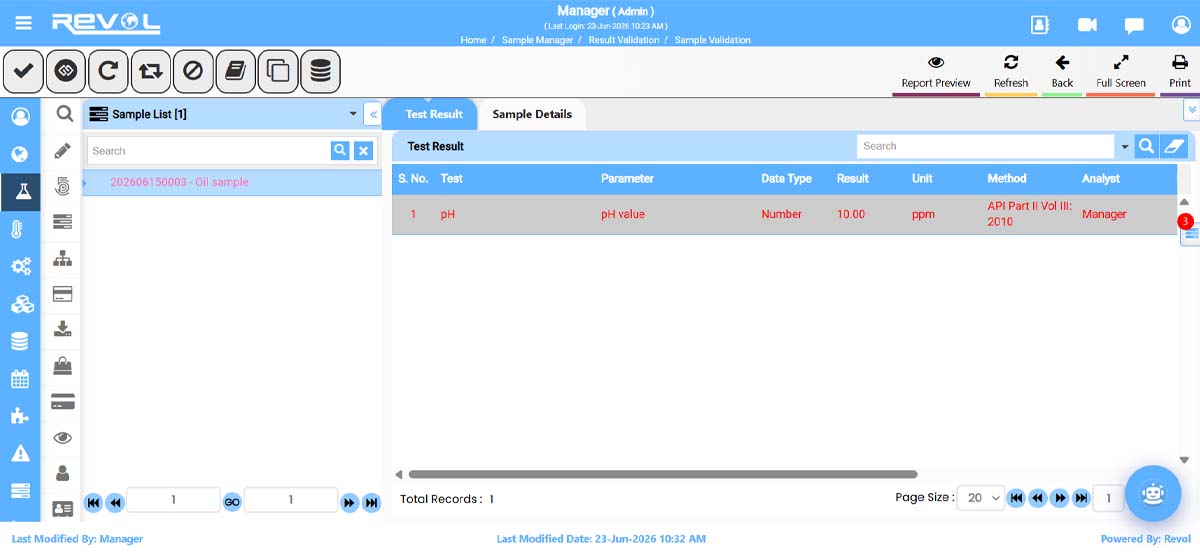
Quality Assurance (QA)
Route water and environmental test results — covering parameters such as heavy metals, BOD/COD, microbiological contaminants, and VOCs — through configurable multi-level QA approval workflows, ensuring every test report is reviewed and authorized before it is released to regulators or clients.
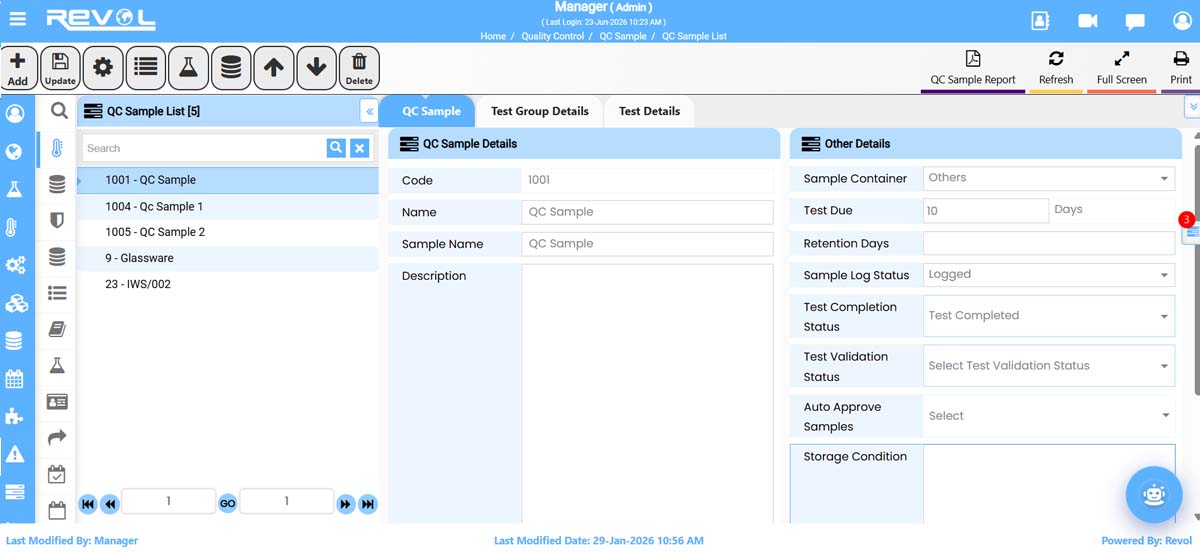
Quality Control (QC)
Embed method blanks, matrix spikes, duplicates, and certified reference materials directly into your test batches. Revol LIMS automatically flags out-of-specification QC results before a batch is approved, keeping your data defensible under EPA, NABL, or other regulatory scrutiny.
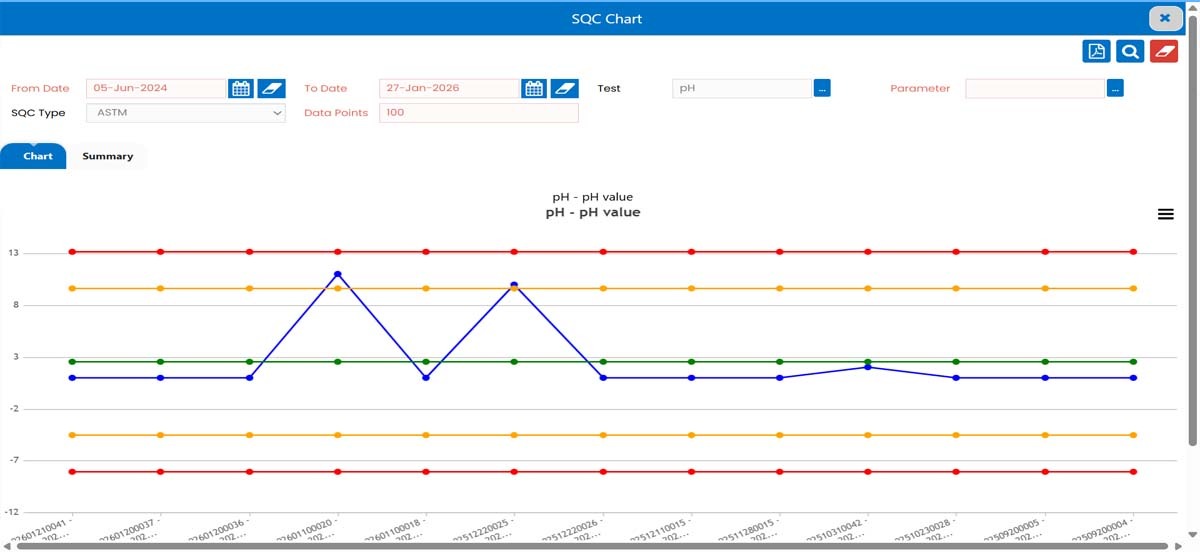
Trend Analysis
Track instrument performance, analyst variability, and QC outcomes across testing parameters and sample matrices over time. Built-in control charts and trend dashboards help water and environmental labs detect analytical drift early — well before it triggers a non-conformance during an accreditation audit.
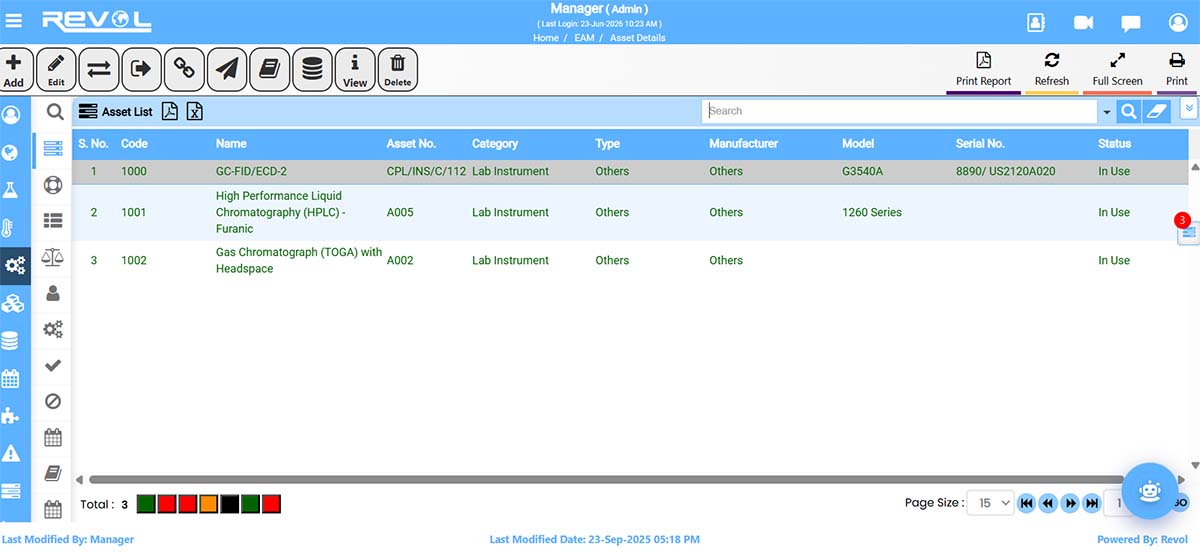
Instrument Calibration & Maintenance
Schedule, execute, and document calibration and preventive maintenance for your full instrument inventory — ICP-MS, ion chromatographs, spectrophotometers, pH meters, and more — with automated reminders and a complete maintenance history that satisfies ISO 17025 equipment management requirements.
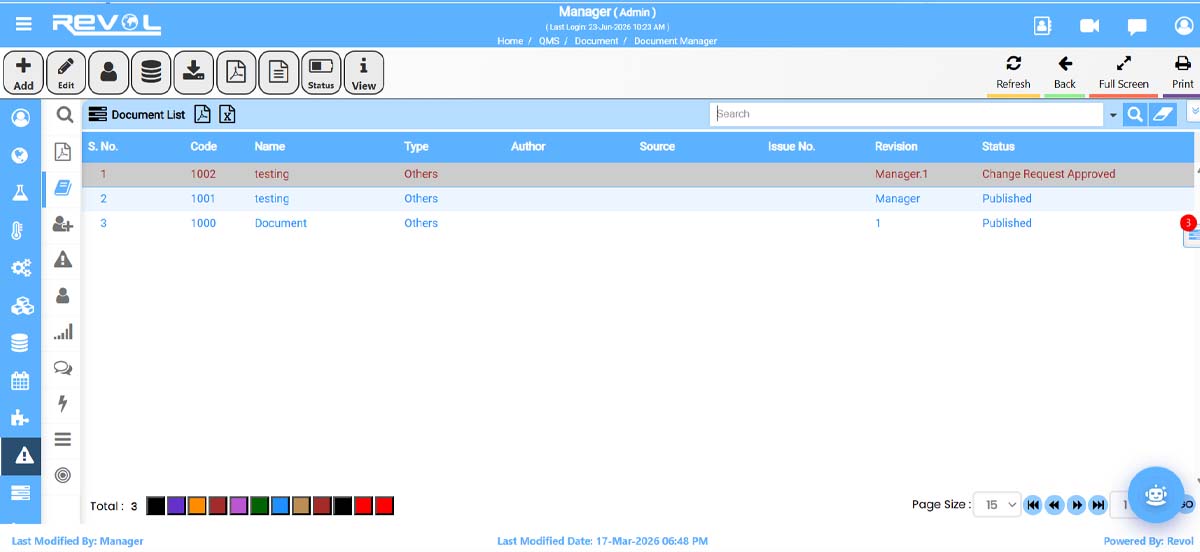
Document Management
Maintain version-controlled SOPs, test methods, and quality records with full revision history, electronic authorization, and controlled distribution. Revol LIMS ensures your lab's documentation is always current, accessible during audits, and compliant with ISO 17025 clause 8.4 on control of documents.
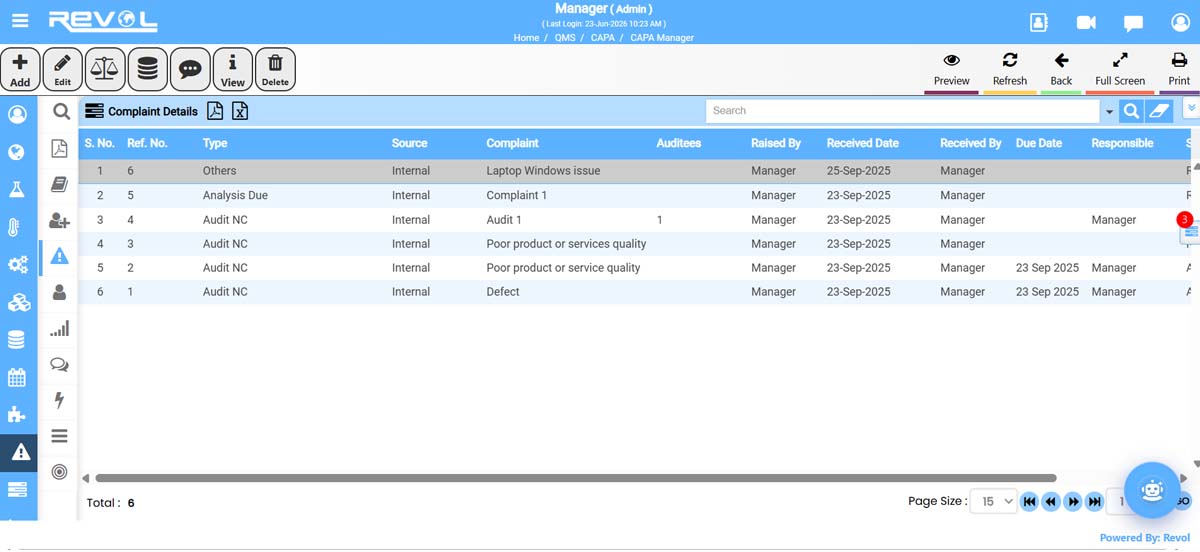
Non-Conformance and CAPA Management
Log non-conformances the moment they are identified — whether a QC failure, a sample integrity issue, or an instrument anomaly — and manage corrective and preventive actions through to verified closure within a single auditable record, fully satisfying ISO 17025 clause 8.7.
The Revol Difference: Why We Outpace Legacy Vendors
| Feature | Revol LIMS | Legacy Vendors |
|---|---|---|
| Holding Time Management | Automated — configurable countdown alerts per analyte and method. No sample invalidated by a missed deadline. | Manual tracking in spreadsheets; missed deadlines depend entirely on analyst memory and vigilance. |
| EDD Generation | Configurable Templates — EPA, state, and international EDD formats generated in one click, fully error-checked. | Requires custom report writing or manual CSV manipulation for each regulatory submission format. |
| QC Management | Automated Scheduling & Flagging — QC samples scheduled automatically; acceptance criteria failures flagged in real time. | QC tracking typically manual or semi-manual; criteria checked retrospectively, often after batch sign-off. |
| Multi-Site Management | Multi-Site Ready — manages samples from dozens of monitoring locations under a unified project structure. | Often single-site in architecture; multi-site operations require expensive add-ons or separate database instances. |
| Configuration | No-Code / Low-Code — update methods, action limits, and EDD templates in minutes without IT support. | Requires custom coding or expensive vendor consultations for every regulatory or method change. |
| Implementation Time | 3–4 Months: Rapid deployment via proven implementation methodology and domain expertise. | 9–12 Months: Protracted timelines with heavy custom configuration and onsite consulting requirements. |
Frequently Asked Questions
Can Revol LIMS track holding times and preservation requirements for environmental samples?
Yes. Revol LIMS applies configurable holding time rules to every sample at login, based on analyte, method, and matrix. The system provides automated countdown alerts to analysts and supervisors before a holding time expires — preventing sample invalidation and result rejections. Preservation requirements (chemical additions, temperature conditions, and container specifications) are tracked and documented as part of the chain-of-custody record, providing a complete audit trail for regulatory review.
Does Revol LIMS support Electronic Data Deliverable (EDD) generation for EPA and state regulatory submissions?
Yes. Revol LIMS includes configurable EDD templates aligned to EPA WQX, STORET, and state environmental agency formats. Result qualifiers (U, J, B, E, UJ flags) are assigned automatically based on configurable detection limit and reporting limit rules. Built-in data validation and completeness checks are performed before export, enabling submission-ready EDDs without manual data compilation or spreadsheet manipulation.
Which environmental test methods does Revol LIMS support?
Revol LIMS supports the full spectrum of standard environmental test methods, including EPA 200-series (metals and trace elements by ICP-MS/ICP-OES), EPA 500-series (disinfection byproducts), EPA 600-series (organics by GC-MS), EPA 8000-series (RCRA/groundwater methods), Standard Methods for the Examination of Water and Wastewater (APHA/AWWA/WEF), and ASTM and ISO environmental methods. Method-specific QC acceptance criteria, holding times, and regulatory reporting requirements are all configurable per method.
Can Revol LIMS handle samples from multiple monitoring locations and field sampling events?
Yes. Revol LIMS is built for multi-site environmental project management. Samples are organised by project, sampling event, and monitoring location — with GPS coordinates and location metadata attached to every sample record. Field sample login is supported via mobile device or tablet with configurable chain-of-custody forms. Third-party laboratory sample forwarding with automated custody transfer documentation is also fully supported.
Is Revol LIMS suitable for NELAP/TNI accredited environmental laboratories?
Yes. Revol LIMS supports the operational requirements of NELAP-accredited laboratories under TNI standards, including method management, automated QC sample scheduling and acceptance criteria enforcement, holding time tracking with documented alerts, equipment calibration and maintenance records, and complete tamper-evident electronic audit trails. Workflows are configurable to meet the specific accreditation requirements of individual state environmental programmes.
Does Revol LIMS support PFAS testing workflows?
Yes. Revol LIMS supports dedicated PFAS/PFOA/PFOS analytical workflows aligned to EPA Method 533, EPA Method 537.1, and related ASTM methods. Reporting limits are configurable in line with current national and state drinking water Maximum Contaminant Levels (MCLs), which continue to evolve rapidly. As regulatory action limits are updated, they can be revised centrally in Revol LIMS without disrupting ongoing analytical operations or requiring system reconfiguration.





Hear What Our Customers Want To Say
Why Revol LIMS Stands Out