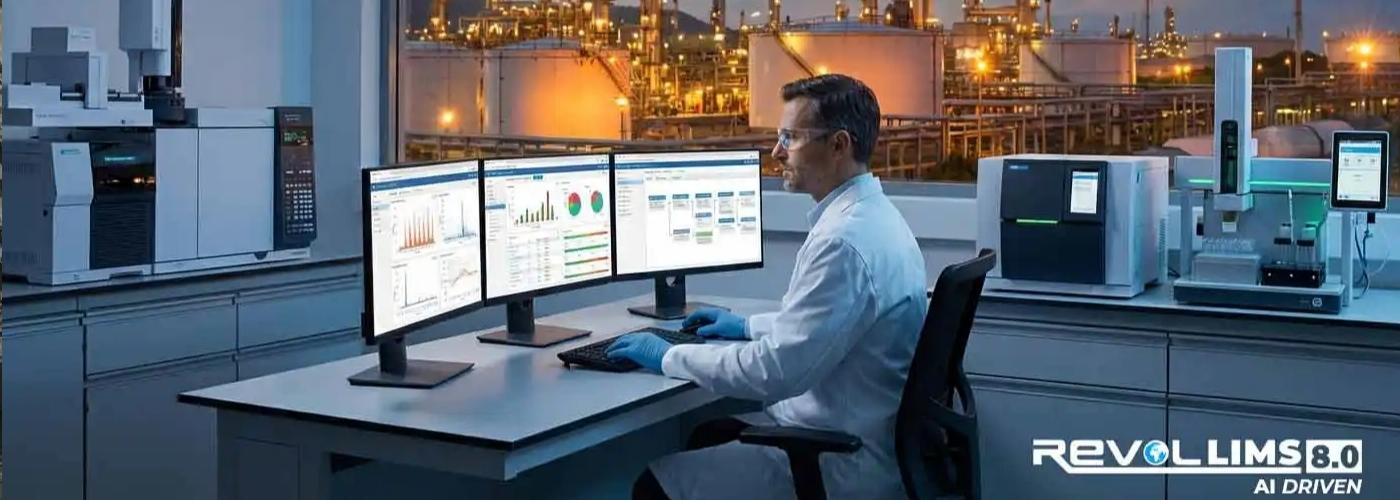
Deliver Precise, Traceable Quality Control Across Every Stage of Your Chemical or Petroleum Operation.
Download free brochure
Chemical and Petrochemical Laboratories Face Complex Multi-Stage Product Specifications, Demanding Regulatory Regimes, and Zero Tolerance for Release Errors — Simultaneously.
Revol LIMS delivers automated Certificate of Analysis generation, end-to-end batch traceability from raw material receipt to finished product release, real-time SPC/SQC process control, and built-in compliance across ISO 17025, ASTM, API, GLP, REACH, and EPA frameworks — in one platform.
Solving the Unique Challenges of the Chemical & Petrochemical Industry
Chemical and petrochemical laboratories operate under a combination of production pressures and quality obligations that few other industries match. Whether your lab serves a speciality chemicals manufacturer, a petroleum refinery, a polymer plant, or an agrochemical operation, three challenges define the environment:
Multi-Stage Batch & Product Traceability: From raw material receipt through intermediate processing to finished product release, every test result must be traceable to every batch and every production stage. A single traceability gap — in a recall, a customer dispute, or a regulatory inspection — creates liability exposure across the entire supply chain.
Customer-Specific CoA & Specification Management: A single chemical product may be sold to dozens of customers, each with their own specification limits, CoA format, unit expressions, and delivery protocol. Managing customer-specific specifications manually at scale fails every time a spec is updated, a new customer is onboarded, or a product grade is added.
In-Process Turnaround Pressure: In a refinery or chemical plant, QC lab results are a production-rate constraint. STAT results on process samples determine whether a reactor continues, a batch is held, or a pipeline is cleared. Delayed turnaround does not just inconvenience the lab — it holds up downstream operations and costs production hours.
Enterprise Features for Modern Chemical & Petrochemical Laboratories
1. Raw Material, In-Process & Finished Product Batch Traceability
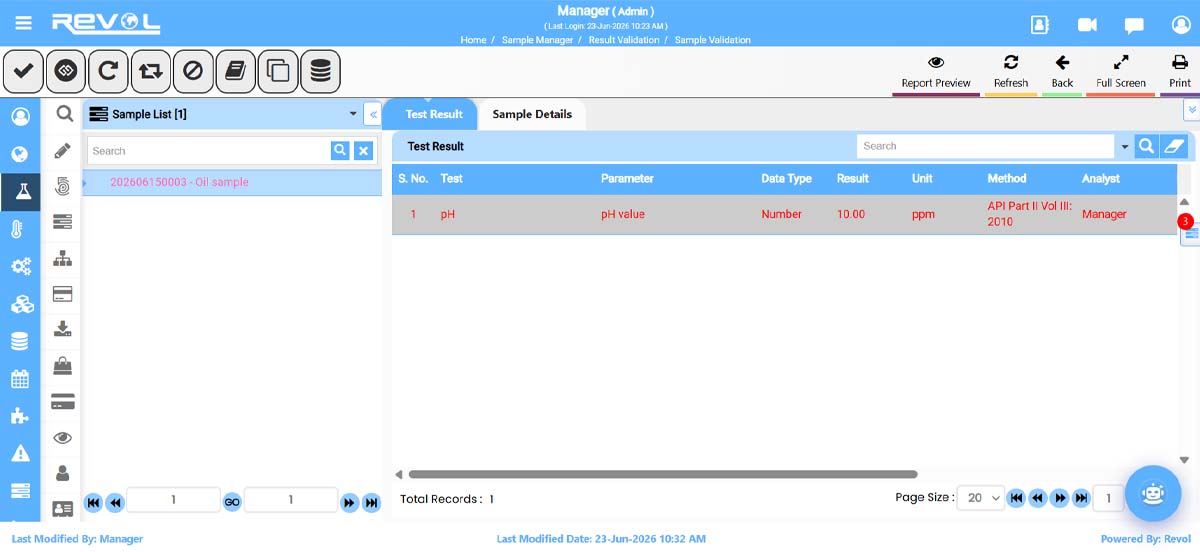
Revol LIMS maintains a complete, unbroken batch genealogy from the moment a raw material lot is received through every intermediate test stage to the finished product CoA — so any quality event can be traced forward and backwards across the supply chain in minutes.
Complete batch genealogy: raw material lot → production batch → finished product release.
Configurable specification limits per product grade, customer, application, and test method.
Multi-stage in-process test scheduling with configurable pass / hold/reject rules.
Lot-to-lot trend analysis for incoming raw material supplier quality monitoring.
Retroactive batch impact analysis: identify all finished products that used a given raw material lot.
2. Automated CoA Generation & Customer Specification Management
Certificates of Analysis are generated directly from verified instrument data the moment a batch is released — using configurable, customer-specific templates. No manual compilation, no transcription risk, no format discrepancies between what was tested and what was reported.
Configurable CoA templates per customer, product grade, application, and regulatory market
Automated CoA generation from verified analytical data — no manual assembly
Customer-specific specification limit sets and reporting unit expressions are maintained centrally
Multi-analyte, multi-method panel support per product specification
Digital CoA delivery with permanent, audit-trail archive
Specification change management: version control, approval workflow, and effective-date tracking
3. SPC/SQC Real-Time Process Control & OOS/OOT Management
In-process quality control is more than a compliance exercise in a chemical plant — it is a production optimisation tool. Revol LIMS integrates real-time SPC/SQC charting with automated OOS and OOT detection and configurable CAPA initiation, giving QC teams and production managers a shared view of process quality before it becomes a release problem.
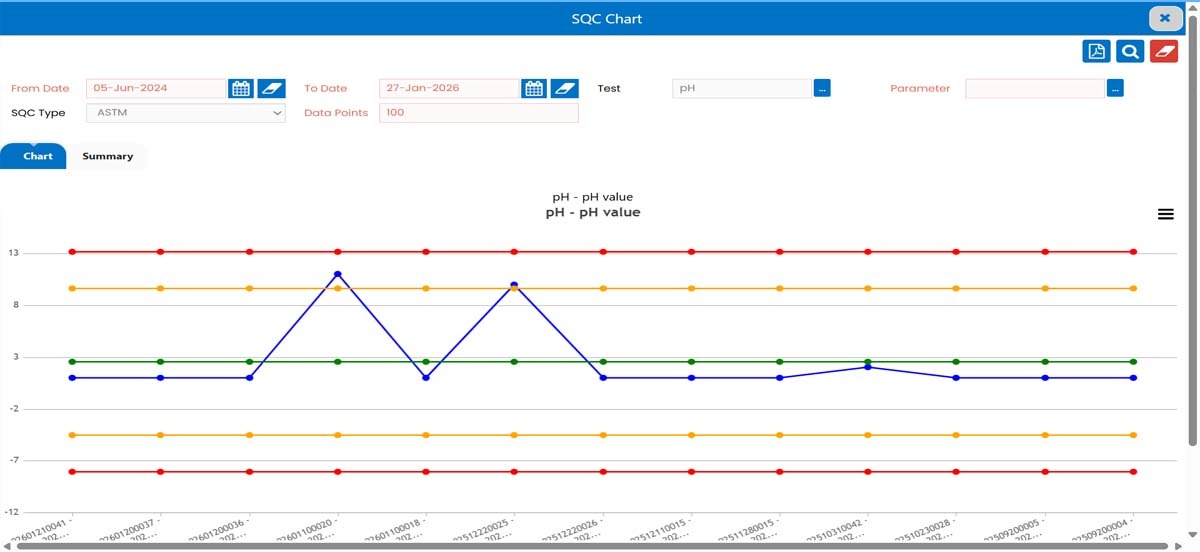
Real-time SPC/SQC control charts: X-bar, R, individual moving-range, CUSUM
Configurable control limits and warning limits per product, process line, and parameter
Automated OOS/OOT flag generation with mandatory CAPA investigation initiation
Trend analysis and process drift detection before specification limit breaches
Long-term process capability reporting: Cp, Cpk, Pp, Ppk by product and parameter
Multi-site process capability benchmarking across plant locations
Chemical and petrochemical laboratories carry compliance obligations that span product quality standards, environmental discharge regulations, worker safety frameworks, and international chemical substance regulations simultaneously. Revol LIMS consolidates all of these into a single, audit-ready platform.
ISO 17025 method management, measurement uncertainty, and proficiency testing tracking
REACH SVHC (Substance of Very High Concern) substance tracking and documentation
SARA Title III / TSCA chemical inventory and threshold-based reporting alerts
Safety Data Sheet (SDS/GHS) linkage to test methods, raw materials, and hazardous chemicals
Multi-regulatory report package generation per shipment, audit, or regulatory submission
What’s Holding Chemical & Petrochemical Labs Back
Across speciality chemical manufacturers, petroleum refineries, polymer plants, and agrochemical operations, laboratory teams face the same recurring operational and compliance bottlenecks:
Manual CoA Assembly Bottleneck
Compiling customer-specific Certificates of Analysis from instrument exports, spreadsheets, and shared drives consumes hours per batch. Each manual step introduces transcription risk, specification mismatch exposure, and delivery delay that scale destructively across high-volume product portfolios.
Batch Traceability Gaps
Inability to trace a finished product batch back through every intermediate production stage to the originating raw material lot makes recall investigations, customer quality disputes, and regulatory inspections time-consuming, expensive, and legally exposed.
Disconnected SPC/SQC Monitoring
Process quality control charts maintained in spreadsheets or standalone software miss early warning signals. By the time an out-of-control condition is visible to the QC team, off-spec product may already be in downstream processing, blending, or customer delivery pipelines.
Customer Specification Management Chaos
Managing dozens of customer-specific specification sets, reporting unit expressions, CoA formats, and delivery protocols in spreadsheets or shared folders fails every time a specification is updated, a new customer is onboarded, or a product grade changes — creating release errors and customer complaints.
Instrument Data Silos
GC-FID, GC-MS, ICP-OES, FTIR, Karl Fischer titrators, viscometers, and XRF systems producing results in isolation require manual re-entry into LIMS or spreadsheets. Every transcription step adds error, delay, and data integrity risk.
Environmental & REACH Compliance Burden
Managing environmental monitoring datasets, REACH substance registration updates, SARA reporting thresholds, and EPA method documentation across multiple lab locations manually creates version-control failures, missed deadlines, and inspection-readiness gaps.
Built for Global Chemical & Petrochemical Compliance Standards
Chemical and petrochemical testing laboratories carry compliance obligations spanning product quality accreditation, environmental regulation, international chemical substance law, and process safety management — often simultaneously across multiple geographic markets. Revol LIMS is built on internationally recognised compliance frameworks, ensuring your laboratory remains audit-ready at every level.
Standard / Regulation
How Revol LIMS Supports Compliance
ISO/IEC 17025:2017
Method management, measurement uncertainty documentation, equipment calibration records, proficiency testing tracking, and document control — aligned clause-by-clause to the accreditation standard for chemical and petrochemical testing laboratories.
ASTM International (D-Series, E-Series)
Configurable method library aligned to ASTM D-series petroleum testing methods (flash point, viscosity, density, distillation, sulphur content) and ASTM E-series analytical chemistry methods, with configurable precision, bias, and acceptance criteria per method.
API (American Petroleum Institute) Specifications
Configurable product specification libraries aligned to API product standards for petroleum products, lubricants, and refinery streams, with automated batch disposition against API-compliant specification limits.
ISO 9001:2015
Quality management system documentation, CAPA workflows, management review reporting data, non-conformance management, and customer complaint handling — fully traceable from test result to corrective action closure.
GLP (OECD / FDA 21 CFR Part 58)
Study management, raw data archiving, audit trail, and personnel qualifications documentation aligned to Good Laboratory Practice requirements for regulatory submission studies — covering agrochemical, industrial chemical, and speciality chemical registrations.
EPA Methods (40 CFR)
Environmental monitoring workflows for air emissions, industrial wastewater, cooling water, and soil testing aligned to EPA analytical methods, with regulatory reporting package generation for discharge permits and compliance reports.
OSHA Process Safety Management (PSM / 29 CFR 1910.119)
Hazardous chemical inventory management, process hazard analysis documentation linkage, and safety-critical test result tracking to support PSM compliance for highly hazardous chemical operations.
21 CFR Part 11 (where applicable)
For chemical laboratories supporting FDA-regulated pharmaceutical intermediate testing, API quality control, or agrochemical regulatory submissions, fully compliant electronic records and signatures with immutable audit trails.
ALCOA+ Data Integrity
All analytical data in Revol LIMS is Attributable, Legible, Contemporaneous, Original, and Accurate — with tamper-evident electronic audit trails satisfying regulatory inspectors and accreditation auditors across every jurisdiction and regulatory framework.
Key Revol LIMS Capabilities for Chemical & Petrochemical Labs
Sample & Batch Management
Tracks every raw material lot, in-process intermediate, and finished product batch with full genealogy — from incoming receipt through multi-stage testing to final release or rejection — with automated batch disposition and retroactive impact analysis.
Unique sample ID and barcode assignment at receipt
Batch genealogy: raw material lot → production batch → finished product CoA
Configurable multi-stage in-process test scheduling
Automated batch disposition: Release / Quarantine / Hold / Reject
Lot-to-lot supplier quality trend analysis
Retroactive recall impact tracing across the production history
CoA & Customer Specification Management
Generates Certificates of Analysis automatically from verified data using configurable, customer-specific templates — and maintains all customer specification sets, reporting unit expressions, and CoA formats in one centrally managed library.
Customer-specific CoA templates: format, units, analyte selection, report language
Automated CoA generation directly from released test data — no manual compilation
Central customer specification library with version control and approval workflow
Specification change effective-date tracking and notification
Multi-analyte, multi-method panel support per product and customer
Digital delivery archive with permanent audit trail
SPC/SQC Process Control
Provides real-time statistical process control visibility for in-process quality parameters, with automated OOS/OOT detection and CAPA initiation — giving QC and production teams a shared, proactive view of process quality.
Real-time control charts: X-bar, R, individual moving-range, CUSUM, EWMA
Configurable control and warning limits per product, process line, and parameter
Automated OOS/OOT detection with mandatory CAPA workflow initiation
Process drift trend detection and early warning alerting
Long-term process capability: Cp, Cpk, Pp, Ppk reporting
Multi-site process performance benchmarking dashboards
Instrument Integration
Connects directly to the full range of chemical and petroleum analytical instruments — transferring results automatically into Revol LIMS and eliminating manual transcription at every step.
XRF, ion chromatography, UV-Vis spectrophotometers, automated titrators
Environmental Monitoring & REACH
Manages environmental monitoring programmes and chemical substance compliance documentation alongside product quality testing — in the same platform, with the same audit trail.
Stack emissions, effluent, cooling water, and soil sampling workflows
EPA method-aligned analytical workflows and reporting packages
REACH SVHC substance register and restriction monitoring
SARA 312/313 threshold tracking and automated reporting alerts
SDS/GHS linkage to test methods and chemical inventory records
Surfaces operational intelligence that prevents quality and compliance issues before they affect production or customers — from process capability trends to supplier quality scorecards and turnaround dashboards.
Process capability (Cp, Cpk) trend monitoring and degradation alerts
Supplier raw material quality scorecards and trend analysis
Turnaround time analytics by sample type, test method, and production line
OOS/OOT rate dashboards by product, analyst, and instrument
Customer CoA delivery time tracking and on-time performance reporting
Predictive anomaly detection on in-process quality parameter trends
Achieve ISO/IEC 17025:2017 Accreditation with Confidence
For chemical and petrochemical testing laboratories, ISO/IEC 17025:2017 accreditation is the mark of technical competence and analytical integrity. Whether your lab characterises crude oil and refined petroleum products, tests industrial chemicals against ASTM or IP method specifications, or validates process samples for quality control, accreditation bodies demand rigorous data integrity, end-to-end traceability, and fully documented quality management processes. Revol LIMS comes with a built-in Quality Management System (QMS) designed to help chemical and petrochemical labs satisfy ISO 17025 requirements and remain inspection-ready at all times.
Quality Assurance (QA)
Configure multi-level QA approval workflows for fuel, lubricant, and process chemical test results — covering parameters such as flash point, viscosity, sulfur content, and distillation characteristics — ensuring every test report is reviewed, authorized, and aligned with ASTM, IP, or ISO method requirements before it is released to clients or regulators.
Quality Control (QC)
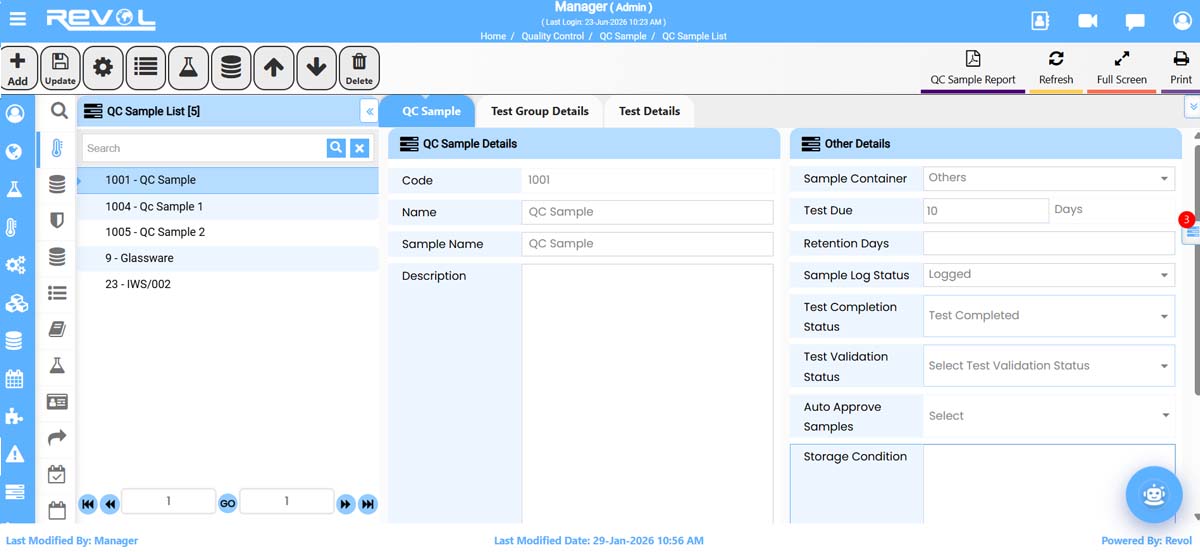
Embed QC checks — reference standards, method blanks, and replicate analyses — directly into your test batches for petroleum products and industrial chemicals. Revol LIMS automatically flags out-of-specification results and holds batches pending review, keeping your data defensible under ISO 17025 and customer specification requirements.
Trend Analysis
Monitor instrument performance, analyst consistency, and QC outcomes across product grades and test methods over time. Built-in control charts and trend dashboards help chemical and petrochemical labs detect analytical drift before it leads to product misclassification or a non-conformance finding during an accreditation audit.
Instrument Calibration & Maintenance
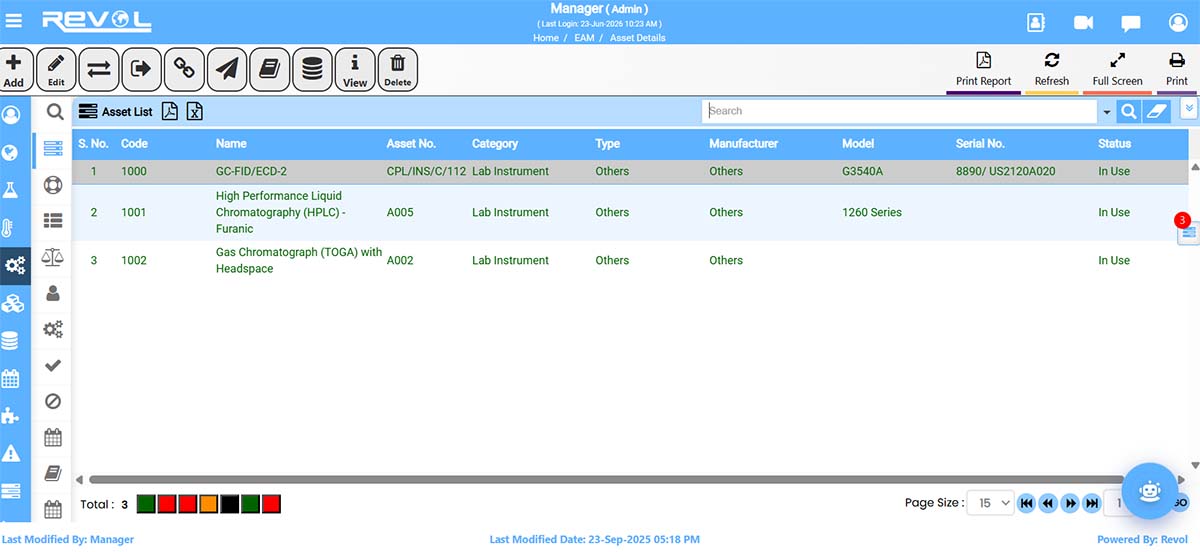
Schedule, execute, and document calibration and preventive maintenance for your full analytical instrument inventory — gas chromatographs, ICP-OES, viscometers, flash point testers, Karl Fischer titrators, and more — with automated reminders and a complete maintenance history that satisfies ISO 17025 equipment management requirements.
Document Management
Maintain version-controlled ASTM, IP, and in-house test methods, SOPs, and quality records with full revision history, electronic authorization, and controlled distribution — ensuring your documentation is always current, accessible during client or accreditation audits, and compliant with ISO 17025 clause 8.4 on control of documents.
Non-Conformance and CAPA Management
Log non-conformances immediately when identified — whether an out-of-specification fuel sample, a QC reference failure, or an instrument malfunction — and manage corrective and preventive actions through to verified closure within a single auditable record, fully satisfying ISO 17025 clause 8.7.
The Revol Difference: Why We Outpace Legacy Vendors
Feature
Revol LIMS
Legacy Vendors
CoA Generation
Automated — customer-specific templates generated directly from verified data in one click. No manual compilation, no transcription risk.
Hours of manual assembly per batch from instrument exports, spreadsheets, and multiple systems.
Batch Traceability
Full Genealogy — raw material lot to finished product CoA in a single, unbroken audit trail.
Partial traceability requiring manual cross-referencing across production records, spreadsheets, and ERP exports.
SPC/SQC Integration
Built-In — real-time control charts with automated OOS/OOT flagging and CAPA initiation at result entry.
External SPC tools or spreadsheets with no automatic integration to test results; patterns visible only retrospectively.
Customer Specification Management
Configurable — customer-specific spec limits, CoA templates, and reporting units maintained centrally with version control.
Managed in spreadsheets or binders; specification changes require manual updates across every relevant document.
Instrument Integration
Plug-and-Play — bi-directional APIs for GC, ICP, FTIR, Karl Fischer, viscometers, XRF, and more. No middleware required.
Third-party middleware or manual CSV uploads for most instrument types; per-instrument development often required.
Implementation Time
3–4 Months: Rapid deployment via proven methodology and domain expertise in chemical and petroleum lab environments.
9–12 Months: Protracted timelines with heavy custom configuration and onsite consulting requirements.
Keep Your Chemical or Petroleum Lab Compliant, Efficient, and Release-Ready
Revol LIMS gives chemical and petrochemical laboratories the infrastructure to deliver traceable results, generate customer-ready CoAs in seconds, control in-process quality in real time, and remain audit-ready across every applicable regulatory framework — without adding administrative burden to your team.
“Ready to modernise your chemical or petroleum laboratory operations? Book your FREE no-obligation demo today.”
Can Revol LIMS generate customer-specific Certificates of Analysis automatically?
Yes. Revol LIMS generates Certificates of Analysis directly from verified instrument data using configurable, customer-specific templates — covering format, analyte selection, reporting unit expressions, and specification limits per customer and product grade. The moment a batch is released, the CoA is produced without manual compilation. All CoAs are digitally delivered and permanently archived with a full audit trail, and customer specification sets are maintained centrally with version control, so every update is reflected consistently across all future releases.
Does Revol LIMS include SPC/SQC statistical process control?
Yes. Revol LIMS includes a real-time SPC/SQC module with configurable X-bar, R, individual moving-range, CUSUM, and EWMA control charts per product, process line, and parameter. Control and warning limits are configurable, and the system automatically flags Out-of-Specification (OOS) and Out-of-Trend (OOT) conditions at result entry, initiating mandatory CAPA investigation workflows. Long-term process capability metrics (Cp, Cpk, Pp, Ppk) are available by product and parameter for process optimisation reporting.
Which analytical instruments does Revol LIMS integrate with for chemical and petroleum testing?
Revol LIMS supports bi-directional integration with the full range of chemical and petroleum analytical instruments, including GC-FID and GC-MS for hydrocarbon and solvent analysis, ICP-MS and ICP-OES for trace metals and catalyst poisons, FTIR and NIR for polymer identification and raw material verification, Karl Fischer titrators for moisture content, viscometers and densitometers for physical property testing, XRF analysers, automated titrators, UV-Vis spectrophotometers, and ion chromatographs. Results transfer directly into Revol LIMS at completion, eliminating manual re-entry.
Is Revol LIMS compliant with REACH and environmental monitoring requirements?
Yes. Revol LIMS supports REACH compliance through SVHC substance tracking, restriction monitoring, and chemical safety report documentation management. Environmental monitoring workflows cover stack emissions, industrial wastewater, cooling water, and soil testing aligned to EPA methods, with regulatory reporting package generation for discharge permit compliance. SARA Title III threshold tracking with automated reporting alerts and SDS/GHS linkage to test methods and chemical inventory records are also included.
Can Revol LIMS handle multi-product, multi-customer specification management at scale?
Yes. Revol LIMS maintains a centralised customer specification library with configurable specification limit sets, CoA templates, reporting unit expressions, and delivery protocols per customer, product grade, and target market. Specification changes go through a configurable approval workflow with effective-date tracking, so every update is applied consistently from the right date forward — without manual updates to individual documents or templates. The system scales to support large product portfolios serving hundreds of customers across multiple geographies and regulatory markets.
Does Revol LIMS support end-to-end batch traceability from raw material to finished product?
Yes. Revol LIMS maintains a complete batch genealogy from the moment a raw material lot is received and tested through every intermediate production stage to the finished product release CoA. In the event of a raw material non-conformance, recall investigation, or customer quality dispute, the system enables retroactive impact analysis — identifying every finished product batch that incorporated a given raw material lot — in minutes rather than days.