.webp)
A Complete Guide to LIMS for ISO 17025 Accredited Testing & Calibration Labs
A NABL accreditation assessor has arrived at a third-party calibration laboratory for a scheduled reassessment visit. The laboratory's technical capability is beyond question.
The reference instruments are state-of-the-art, the calibration engineers boast decades of specialized experience, and the measurement uncertainty calculations are metrologically rigorous. To a casual observer, it is a world-class operation.
But within the first thirty minutes of the assessment, the assessor has uncovered three critical issues:
- An instrument whose calibration due date passed eleven days ago has been actively used for customer calibrations.
- A calibration certificate issued to a customer last month contains a measurement result that is fundamentally inconsistent with the raw data found in the internal calibration record.
- A corrective action raised during the previous year's assessment was marked as closed, but the objective evidence verifying its effectiveness cannot be located.
None of these issues reflect on the technical competence of the engineering team. Every single one is a documentation and data management failure.
Key Insight: In testing and calibration, technical excellence and documentary compliance are inseparable. A laboratory that cannot prove what it did is indistinguishable from a laboratory that did it wrong.
The data management system that connects technical performance to documentary evidence is not a mere administrative support function. In regulated environments, implementing a robust LIMS for testing and calibration is your absolute license to operate. A single expired calibration record or manually generated certificate with a transcription error can trigger a severe audit finding, suspend an accreditation, or invalidate months of test results.
This guide makes the case—from first operational principles to a practical evaluation framework—for what your data infrastructure must genuinely provide to protect your ISO 17025 accreditation.
Quick Answer: What is a Testing and Calibration LIMS?
A testing and calibration LIMS (Laboratory Information Management System) is a specialized digital platform designed to automate instrument tracking, metrological traceability, measurement uncertainty calculations, and ISO 17025-compliant certificate generation. Unlike generic laboratory software, a purpose-built calibration LIMS mathematically links test results to the exact reference standards and environmental conditions present at the time of execution, ensuring an unbroken audit trail for regulatory bodies like NABL.
What This Article Covers
- The Unique Calibration Challenge: The specific data management complexities that separate testing and calibration laboratories from standard analytical facilities.
- The 8 Critical Capability Domains: The precise architectural requirements every testing laboratory management system must address to satisfy ISO 17025.
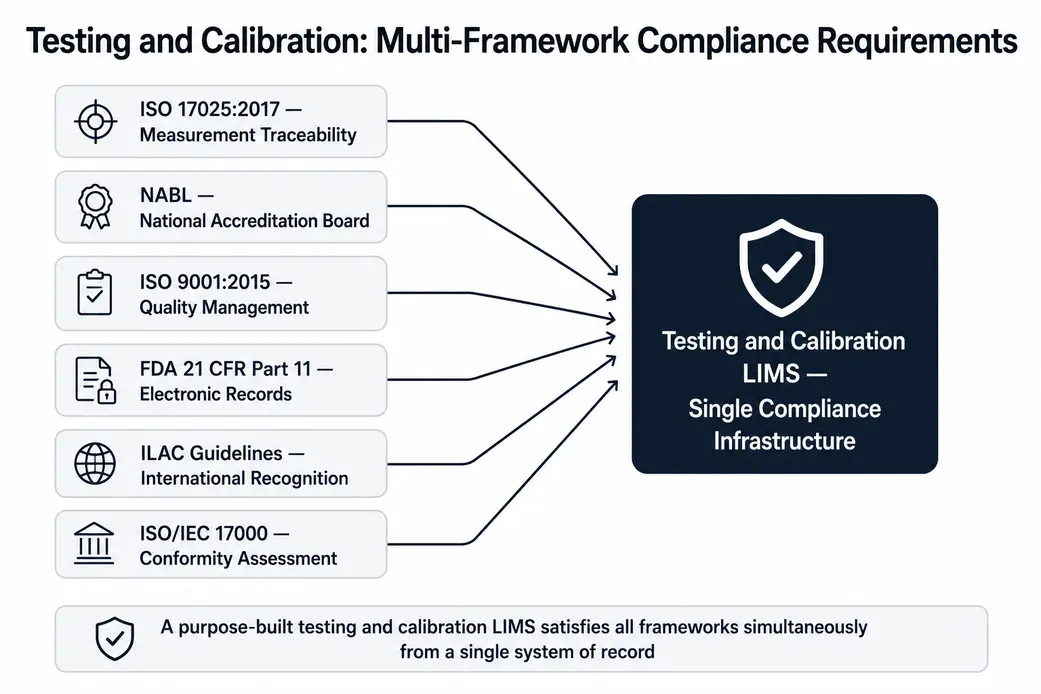
- Real Compliance Outcomes: How system capabilities map directly to actual ISO 17025, FDA 21 CFR Part 11, and NABL accreditation requirements.
- The True Cost of Manual Processes: The hidden financial risks of managing calibration schedules and certificates in spreadsheets.
- Scalability and Deployment: What zero-footprint web architecture and true mobile flexibility mean for field calibration teams.
- Advanced Analytics and AI: How modern Statistical Quality Control (SQC) shifts quality managers from reactive fire-fighting to proactive laboratory management.
- FAQs
1. The Testing and Calibration Data Challenge: Why This Industry Is Different
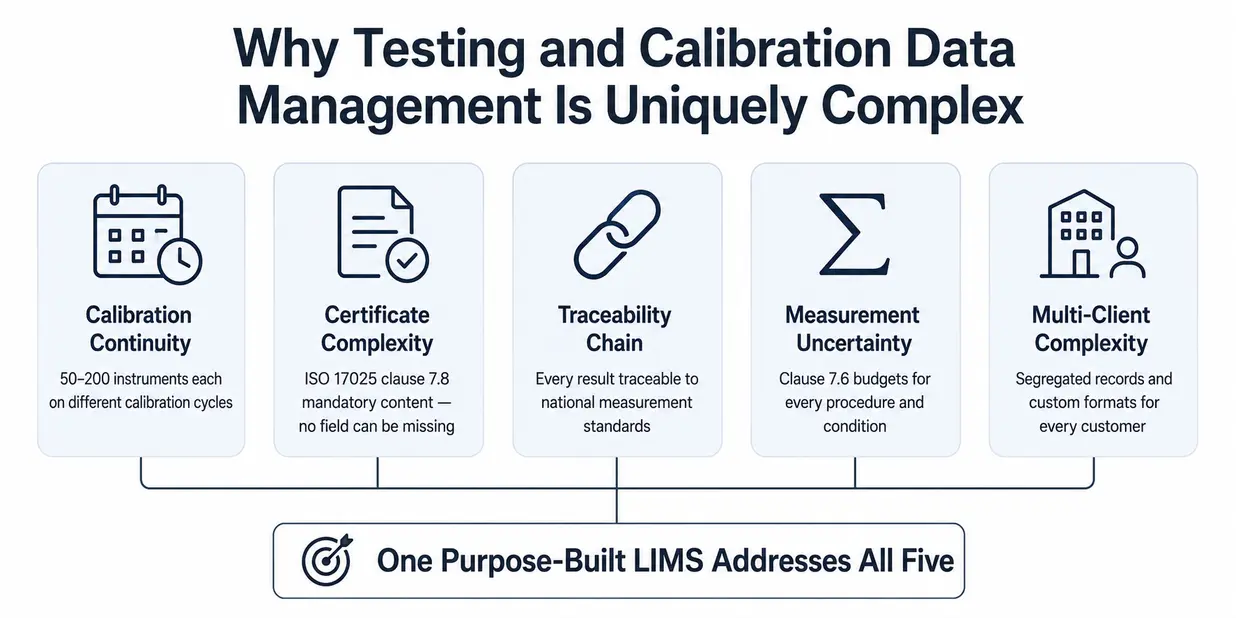
Testing and calibration laboratories face an entirely different data management reality than standard manufacturing QC laboratories. A standard testing laboratory tests a sample and reports a result. A calibration laboratory must report a result, express the measurement uncertainty of that specific result, prove the traceability of the standard used, and verify the environmental conditions.
The Calibration Continuity Challenge
Managing schedules across a large inventory is an operational tightrope. A mid-size laboratory may have 50 to 200 instruments under active calibration management, each demanding different uncertainty budgets. When tracking is managed in fragmented spreadsheets, the probability of an instrument being used outside its validity period approaches certainty. Under ISO 17025 clause 7.8, an out-of-calibration use event triggers a mandatory requirement to formally review and potentially retract all associated test results.
The Certificate Generation Complexity
Generating calibration certificates requires assembling vast arrays of mandatory data: unalterable measurement results, correctly formatted measurement uncertainty, explicit traceability statements, and environmental conditions. Manual calibration certificate generation using word processor templates creates severe systematic risk, leading to transcription errors and version control failures.
The Traceability Chain Complexity
Metrological traceability is the property of a measurement result whereby the result can be related to a reference through a documented, unbroken chain of calibrations. Managing this requires tracking the calibration certificates of external reference standards and monitoring internal working standards. Manual systems invariably lead to missing links, turning a routine NABL assessment into a highly stressful investigation.
The Measurement Uncertainty Documentation Challenge
ISO 17025 clause 7.6 mandates stringent measurement uncertainty estimation for all calibrations. Uncertainty budgets must be maintained for different procedures, environmental conditions, and instrument configurations. When calculated manually in Excel, the validity of all associated calibration certificates is fundamentally compromised by human error.
The Multi-Client Documentation Complexity
Third-party laboratories must maintain strictly segregated customer instrument records, generate certificates in customer-specific formats, and manage varying notification requirements. At volume, this completely overwhelms standard generic software.
2. Capability Domain 1: End-to-End Sample and Test Item Management
In a calibration laboratory, the "sample" is usually a high-value customer instrument. Handling it requires meticulous, documented care.
A robust testing laboratory management system must provide real-time tracking from the moment a customer instrument arrives. Modern platforms utilize barcode and RFID scanning to instantly log intake inspections, job card creation, physical execution, and safe return.
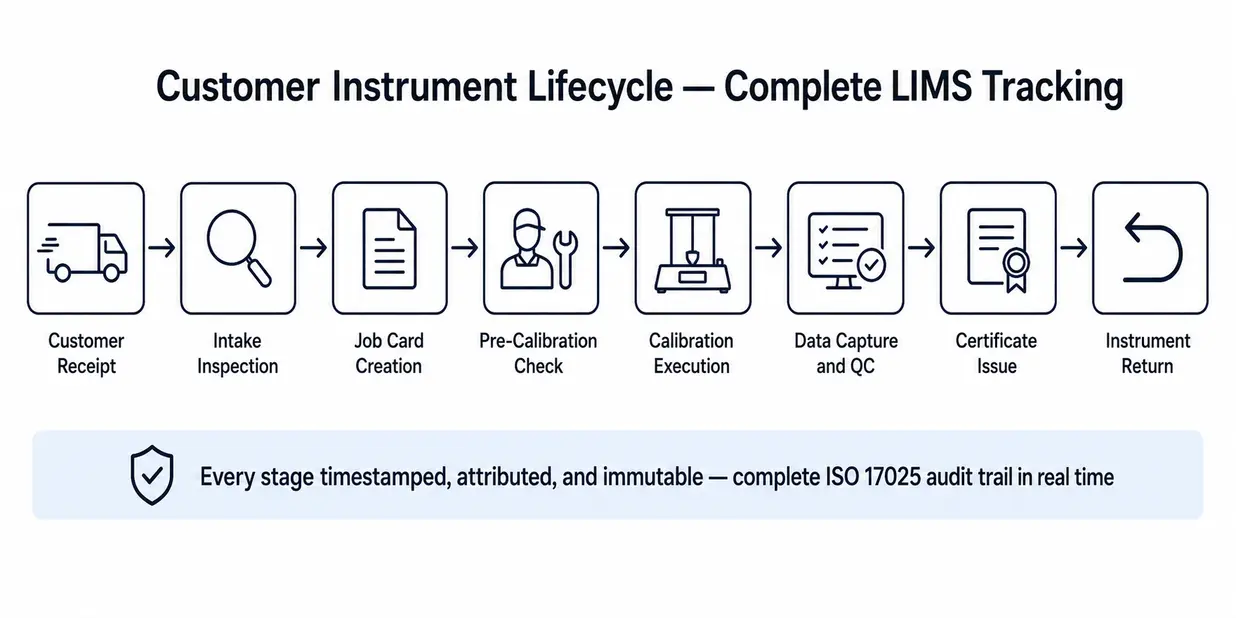
This lifecycle tracking is a strict necessity to satisfy ISO 17025 clause 8.4 preservation requirements. Advanced platforms allow users to attach photographic evidence (JPGs or PDFs) directly to the sample record during intake, serving as absolute liability protection if an instrument arrives damaged.
Furthermore, the LIMS must automatically route the instrument to the correct calibration procedure, reference standards, and appropriately qualified technician based on predefined competency matrices, eliminating manual routing bottlenecks.
3. Capability Domain 2: Advanced Calibration Management
The technical heart of any LIMS for testing and calibration is how it manages instrument lifecycles and standard validities.
Hard System-Enforced Lockouts
Genuine instrument calibration tracking requires a dynamic system that monitors status in real-time. It must trigger automated email alerts before due dates. More importantly, it must prevent the use of instruments with expired calibration status through hard, system-enforced lockouts.
A calendar reminder is merely a suggestion; a system-enforced control is a compliance guarantee. Only hard software lockouts truly protect a laboratory against out-of-calibration use events.
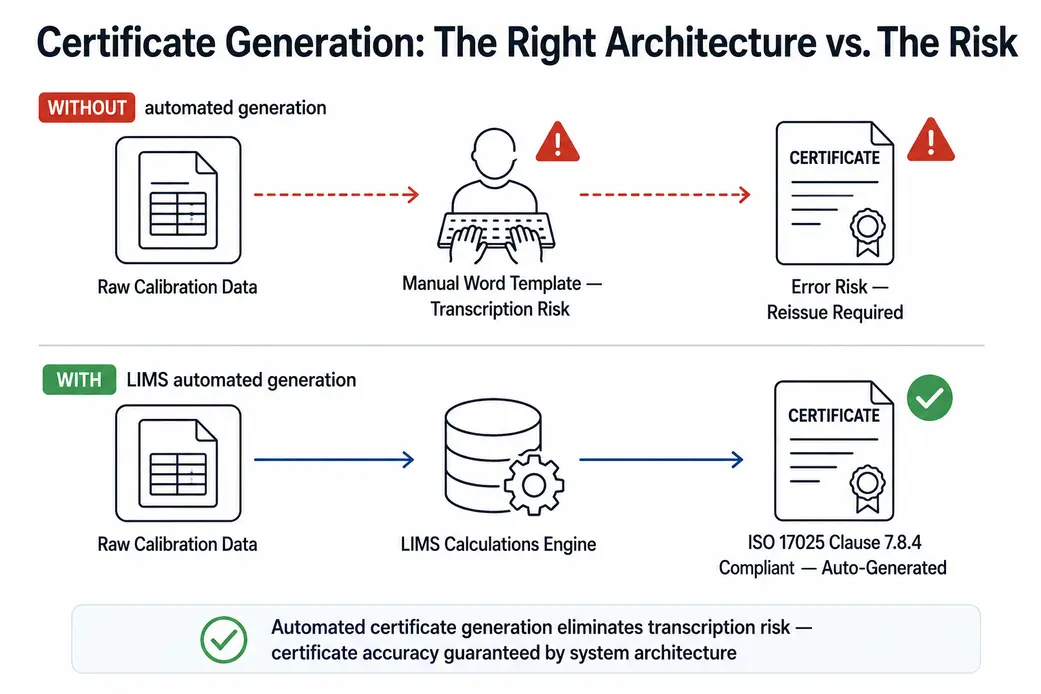
Automated Calibration Certificate Generation
The system must assemble certificate content directly from validated database records. It must automatically populate all mandatory ISO 17025 clause 7.8.4 fields without human intervention. The completed certificate must route through an electronic review workflow, culminating in a timestamped electronic signature and a unique certificate number. This completely eliminates manual certificate typing.
Comprehensive Calibration History
Every calibration event must be permanently recorded—including the complete measurement data, specific reference standards used, and exact environmental conditions. During audits, this enables the quality manager to produce a complete technical file for any instrument in minutes.
4. Capability Domain 3: Regulatory Compliance and Audit Trails
Testing and calibration laboratories exist within unforgiving regulatory frameworks. The data management system must natively speak the language of these standards.
Meeting ISO 17025, NABL, and FDA 21 CFR Part 11
An ISO 17025 LIMS must specifically address document control, records management, unbroken audit trails, and measurement traceability. Where applicable, it must support FDA 21 CFR Part 11 requirements for electronic signatures. In the Indian context, the system must function seamlessly as NABL accreditation software, capturing specific regional documentation nuances inherently.
True Audit Trail Calibration Laboratory Features
A compliant audit trail is a secure, computer-generated, timestamped electronic record. Every data entry, modification, deletion, and approval must be attributed to an authenticated user. These audit trails must be immutable and instantly reviewable on-screen without requiring IT department intervention.
5. Capability Domain 4: Data Integrity and Granular Security
Data integrity is the core of the laboratory's scientific credibility.
All test results, calibration records, certificates, and quality system documents must exist in a single system of record. The specific data integrity risks of distributed data management are catastrophic. When records are locked in separate instrument-specific software and Excel sheets, discrepancies are mathematically guaranteed.
Customer instrument data must be protected by enterprise-grade encryption. Role-Based Access Control (RBAC) requirements must be highly granular. A calibration technician executing a test, a senior reviewing engineer approving the data, and a customer service representative checking job status each require fundamentally different, system-enforced permissions.
6. Capability Domain 5: Real-Time Data Access and Client Portals
A laboratory operating blindly operates at high risk. Quality managers require immediate, unvarnished visibility.
Modern LIMS solutions provide advanced visual dashboards that aggregate data in real-time. Managers can instantly view all instruments approaching calibration due dates, certificates pending approval, and corrective actions currently overdue.
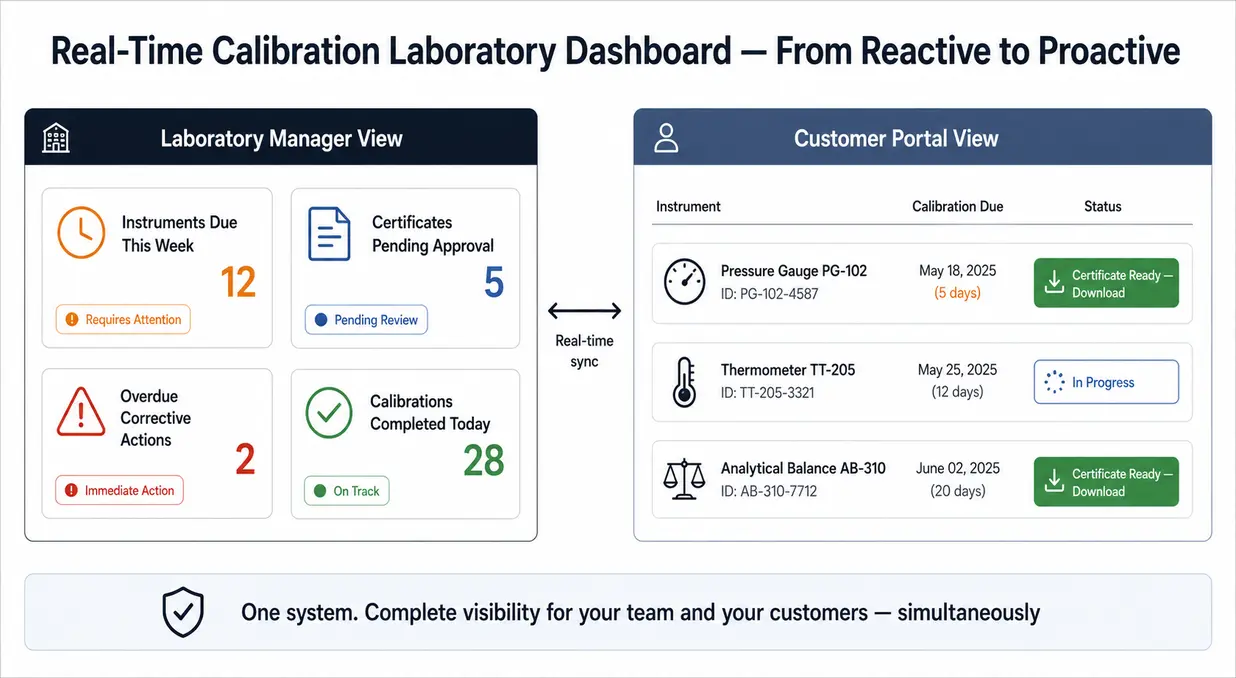
Top-tier systems shift the customer experience through secure Client Portals. Instead of your administrative team emailing PDFs, customers log in securely to view the live calibration status of their entire instrument fleet. They can download digitally signed certificates and request equipment pickups directly. Coupled with automated email and SMS alerts, this shifts the paradigm from reactive fire-fighting to proactive operational management.
7. Capability Domain 6: Workflow Automation and Instrument Integration
In a high-volume calibration laboratory, administrative friction is the primary barrier to profitability.
Automated Data Extraction
The most dangerous transcription point in a laboratory is a human manually typing a result from an instrument screen. Modern systems utilize specialized Instrument Integrators that automatically extract data. Whether the digital balance generates a PDF report, a CSV file, or connects directly via an RS232 or TCP/IP port, the system must parse and capture the precise reading values directly into the database in real-time.
Zero-Footprint Architecture
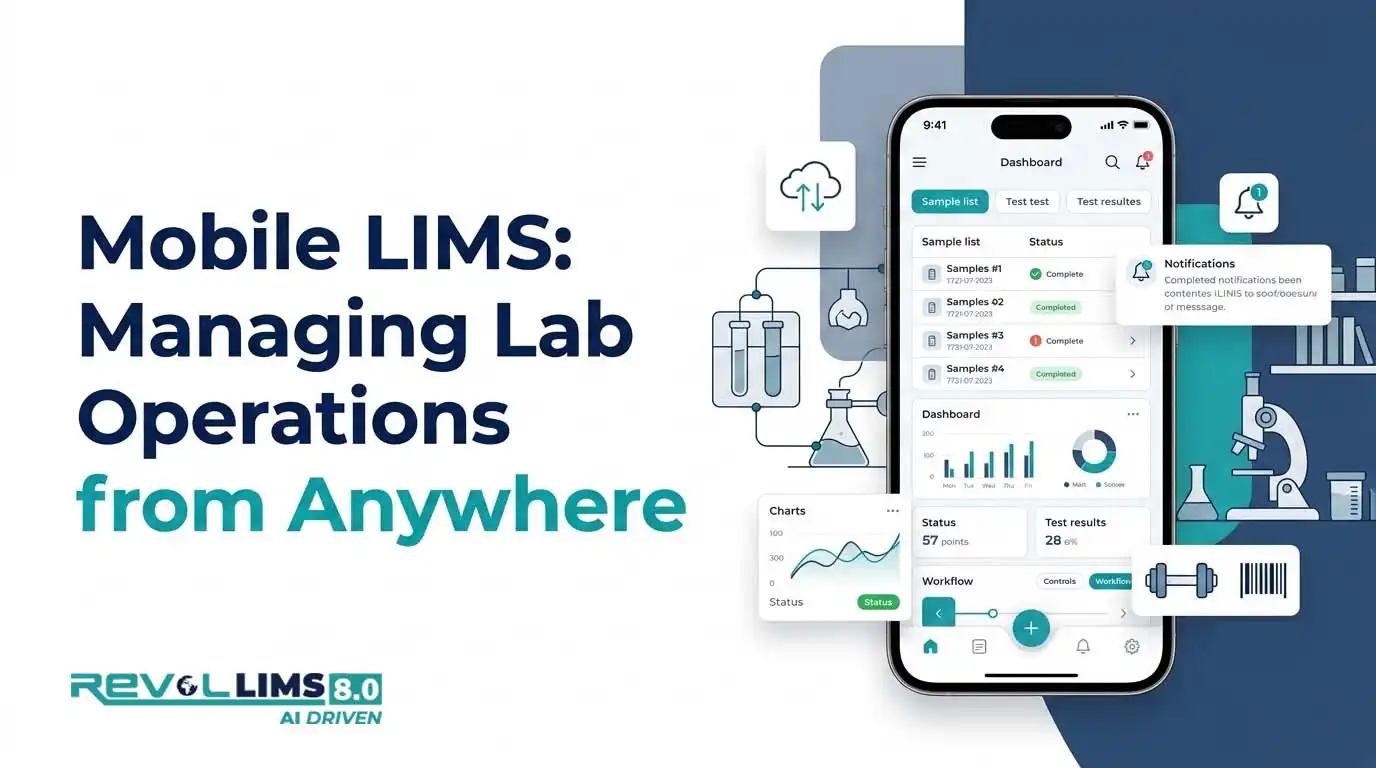
Scheduling calibration work must balance customer instrument availability, technician competency, standard availability, and environmental conditions. To facilitate this smoothly, the system must feature a true zero-footprint architecture. The LIMS must be 100% web-based and mobile-responsive. Technicians can access the system, scan barcodes, and enter data from any web browser on a tablet—whether at the laboratory bench or out in the field—without installing heavy local software.
8. Capability Domain 7: Analytics, Uncertainties, and Standards Management
Built-in Measurement Uncertainty and AI Analytics
A purpose-built LIMS moves uncertainty budgets out of Excel and into a centralized advanced calculations engine. It links specific uncertainty budgets to specific test methods. When a technician enters reading data, the system automatically applies the correct calculation based on environmental conditions.
Furthermore, built-in Statistical Quality Control (SQC) tools allow laboratories to monitor historical trends to identify systematic drift patterns. Advanced systems now integrate anomaly detection, flagging instruments with above-average failure rates that warrant metrological investigation.
Comprehensive Standards and Reagents Management
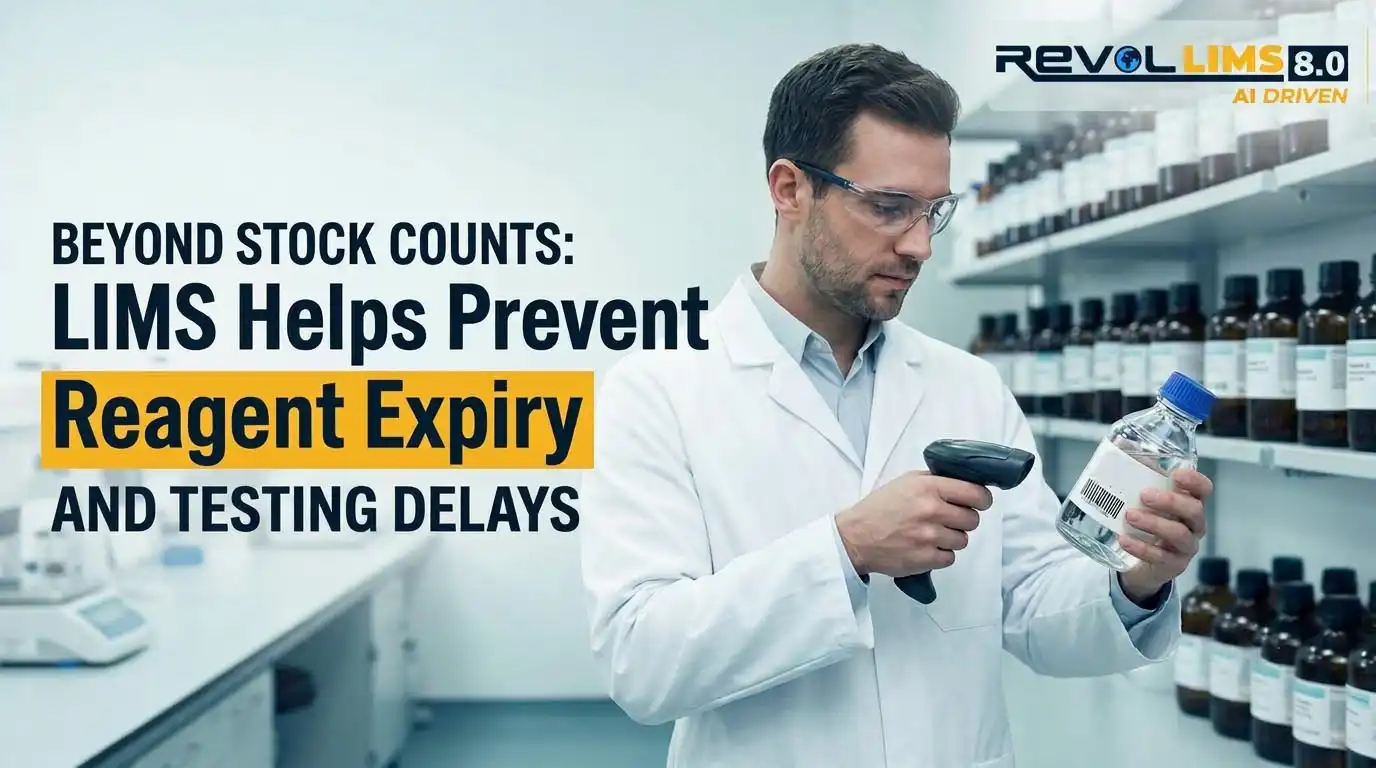
A LIMS must manage the laboratory's own internal tools. This includes tracking the usage and shelf-life of Volumetric Solutions and Reagents, monitoring Primary and Reference Standards for stability, and tracking the calibration cycles of critical laboratory Glassware.
9. Capability Domain 8: Scalability and True Deployment Flexibility
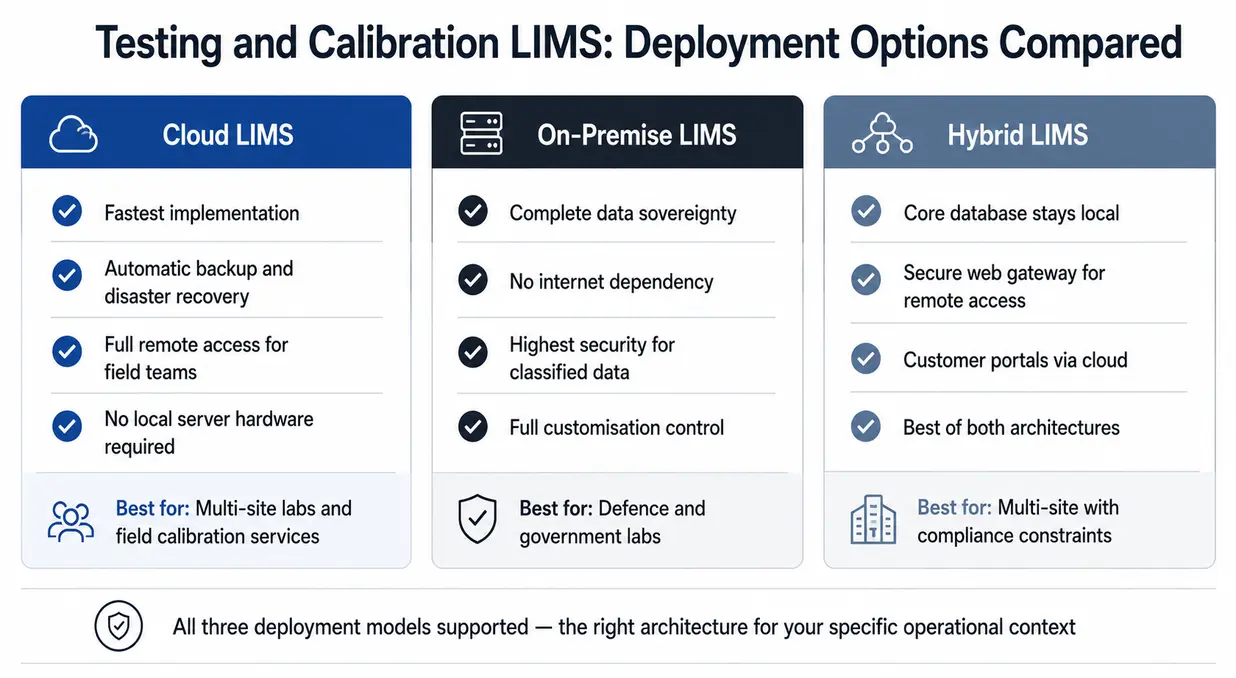
A LIMS is a decade-long investment that must accommodate new calibration disciplines without requiring a system replacement. This requires true deployment flexibility:
- Cloud LIMS: Pure cloud deployment offers the fastest implementation, automatic backups, and remote access for multi-site field teams.
- On-Premise Deployment: Required by facilities dealing with highly classified defense data or strict data sovereignty laws.
- Hybrid Deployment: Keeps sensitive core databases localized while allowing specific portal access via secure web gateways.
Regardless of deployment, the system must utilize an API-first architecture, allowing seamless integration with broader enterprise ERP and SAP systems.
10. The Real Cost of Manual Calibration Management
When evaluating calibration management software, laboratories frequently focus entirely on the license cost, ignoring the staggering hidden financial hemorrhage of manual processes.
- The Accreditation Risk Cost: A NABL suspension triggered by a documentation failure results in immediate revenue loss, reputational damage, and massive corrective action costs.
- The Certificate Error Cost: Manually generated certificate errors require costly investigations and reissues. If an incorrect certificate influences a safety-critical decision, the legal liability exposure is immense.
- The Administrative Labour Cost: In a laboratory managing 100 instruments, hours spent on schedule tracking and Word document preparation routinely represent 20% to 30% of total operating payroll.
- The Opportunity Cost: A laboratory suffocating under paperwork cannot expand into new calibration disciplines because its manual infrastructure cannot absorb additional complexity.
- The Customer Confidence Cost: Delayed certificate delivery puts the laboratory at a severe competitive disadvantage against competitors offering modern digital portals.
11. Generic LIMS vs. Testing and Calibration-Specific LIMS
One of the most expensive mistakes a facility can make is purchasing a generic analytical LIMS designed for water or clinical testing. Generic systems underperform because they are built around samples that are consumed, not instruments that require ongoing metrological traceability.
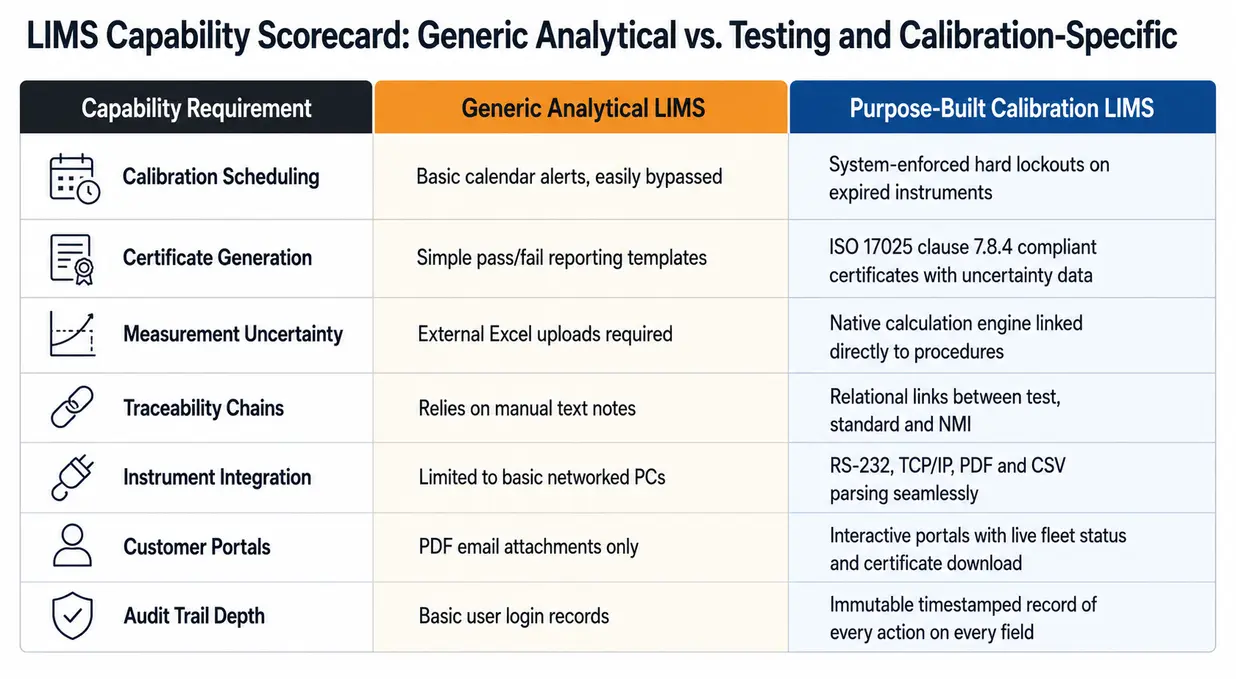
| Capability Requirement | Generic Analytical LIMS | Purpose-Built Calibration LIMS |
|---|---|---|
| Calibration Scheduling | Basic calendar alerts, easily bypassed. | Dynamic, strict system-enforced lockouts on expired tools. |
| Certificate Generation | Simple pass/fail reporting templates. | ISO 17025 clause 7.8 compliant certs with calculated uncertainty data. |
| Measurement Uncertainty | Usually requires external Excel uploads. | Native advanced calculation engines linked directly to procedures. |
| Traceability Chains | Non-existent; relies on text notes. | Unbroken relational links between test, standard, and NMI. |
| Instrument Integration | Limited to basic networked PCs. | Parses direct PDFs, CSVs, and connects via RS232/TCP/IP seamlessly. |
| Customer Portals | Basic PDF email attachments. | Interactive web portals for live equipment status tracking. |
12. Evaluating LIMS: The Questions That Actually Matter
When evaluating an accreditation management LIMS in India or globally, laboratory managers must look past standard software demonstrations.
- How does the system prevent the use of expired instruments? Demand to see the hard, system-enforced lockout in the execution screen, not just an email alert.
- Does the system generate compliant certificates natively? Verify it compiles ISO 17025 clause 7.8.4 mandatory data automatically without opening Microsoft Word.
- How are complex formulas handled? Ensure there is a built-in, native calculation platform for generating uncertainty budgets.
- What does the audit trail look like? Ask the vendor to modify a result and show you the immutable, on-screen audit trail.
- Does the system have a zero-footprint architecture? Ensure the system is 100% web-based and mobile-responsive so technicians can use tablets in the field without downloading local software clients.
You can also request a demonstration to see these capabilities in action before any procurement decision.
FAQ: Frequently Asked Questions about Calibration LIMS
Is a LIMS investment justified for a lab with only 80 instruments?
Yes, laboratories managing 50 to 100 instruments are in the most critical danger zone. You are large enough to have severe traceability chains and high audit exposure, but often lack the dedicated administrative staff of an enterprise. A LIMS shifts your engineers from administrative clerks back to revenue-generating technical experts.
How does LIMS certificate generation differ from Microsoft Word templates?
Word templates are static, unlinked documents highly vulnerable to transcription errors. A specialized calibration management software dynamically generates the certificate by pulling locked measurement data, standard traceability, and electronic signatures directly from the secure database.
How does a LIMS handle ISO 17025 clause 7.6 measurement uncertainty?
A purpose-built LIMS moves uncertainty budgets out of Excel and into a centralized calculations engine. When a technician enters reading data, the system automatically applies the correct mathematical calculation, ensuring consistent, error-free final results.
Can a single LIMS accommodate 12 different calibration disciplines?
Yes, a genuine testing and calibration LIMS uses highly configurable workflows, not hard-coded limits. Data capture screens are configured for specific disciplines (thermal, flow, mechanical), while underlying approval workflows remain consistently unified.
How does a LIMS work for field calibration with limited internet connectivity?
Modern LIMS platforms offer true mobility and offline capabilities. Technicians can use tablet-responsive pages to capture data offline in the field. Once internet connectivity is restored, the system automatically synchronizes securely with the central database.
Can a LIMS provide real-time visibility to our customers?
Yes, leading systems feature secure Client Portals. Customers can log in securely to view the live calibration status of their instrument fleet, download digitally signed certificates, and request pickups, dramatically reducing your administrative phone calls. Visit our key benefits page to learn more about what this visibility delivers operationally.
Key Takeaways
- A testing and calibration LIMS is your absolute license to operate — a single expired calibration record can trigger a NABL audit finding or invalidate months of test results
- Hard system-enforced lockouts, not calendar reminders, are the only genuine protection against out-of-calibration use events
- Automated certificate generation from validated database records eliminates transcription errors and version control failures inherent in Word templates
- Unbroken metrological traceability chains must be relational and system-managed — manual tracking invariably produces missing links
- A cloud, on-premise, or hybrid deployment must be evaluated against your connectivity, data sovereignty, and field team requirements
- Laboratories managing 50 to 100 instruments face the highest risk — large enough for complex traceability demands but often without dedicated administrative staff
- The hidden cost of manual calibration management includes accreditation risk, certificate error liability, administrative labour, and lost growth opportunity — not just software licence fees
- Built-in SQC analytics shift quality managers from reactive fire-fighting to proactive drift detection and metrological investigation
Final Thoughts
The calibration engineers and testing professionals in ISO 17025 accredited laboratories are among the most technically precise people in any industry. They work to measurement uncertainties measured in parts per million. They produce technical certificates that manufacturing companies, healthcare facilities, and government regulators rely upon daily to make safety-critical decisions.
Yet, far too often, these brilliant technical teams are forced to manage the documentation of this highly precise work using fragmented spreadsheets, legacy paper folders, and vulnerable word processor templates.
The system that manages the documentary evidence of your technical work should be unequivocally worthy of the work it documents.
Your laboratory's data management system is the critical infrastructure that either validates or undermines everything your technical team achieves. When an auditor sits down to review a technical file, they are evaluating your system's integrity. If your next NABL reassessment feels like a looming documentation crisis rather than a routine technical verification, it is time to upgrade your infrastructure to a modern, automated, zero-footprint solution.
Continue Reading
- How to Prepare Your LIMS for an FDA Audit: A Practical Checklist
- Achieving ISO/IEC 17025 Compliance: How a Modern LIMS Simplifies Accreditation
- Signs Your Legacy LIMS Is Costing You More Than You Think
- What Modern Mining Laboratories Must Demand From Their LIMS




 (1) (1).webp)