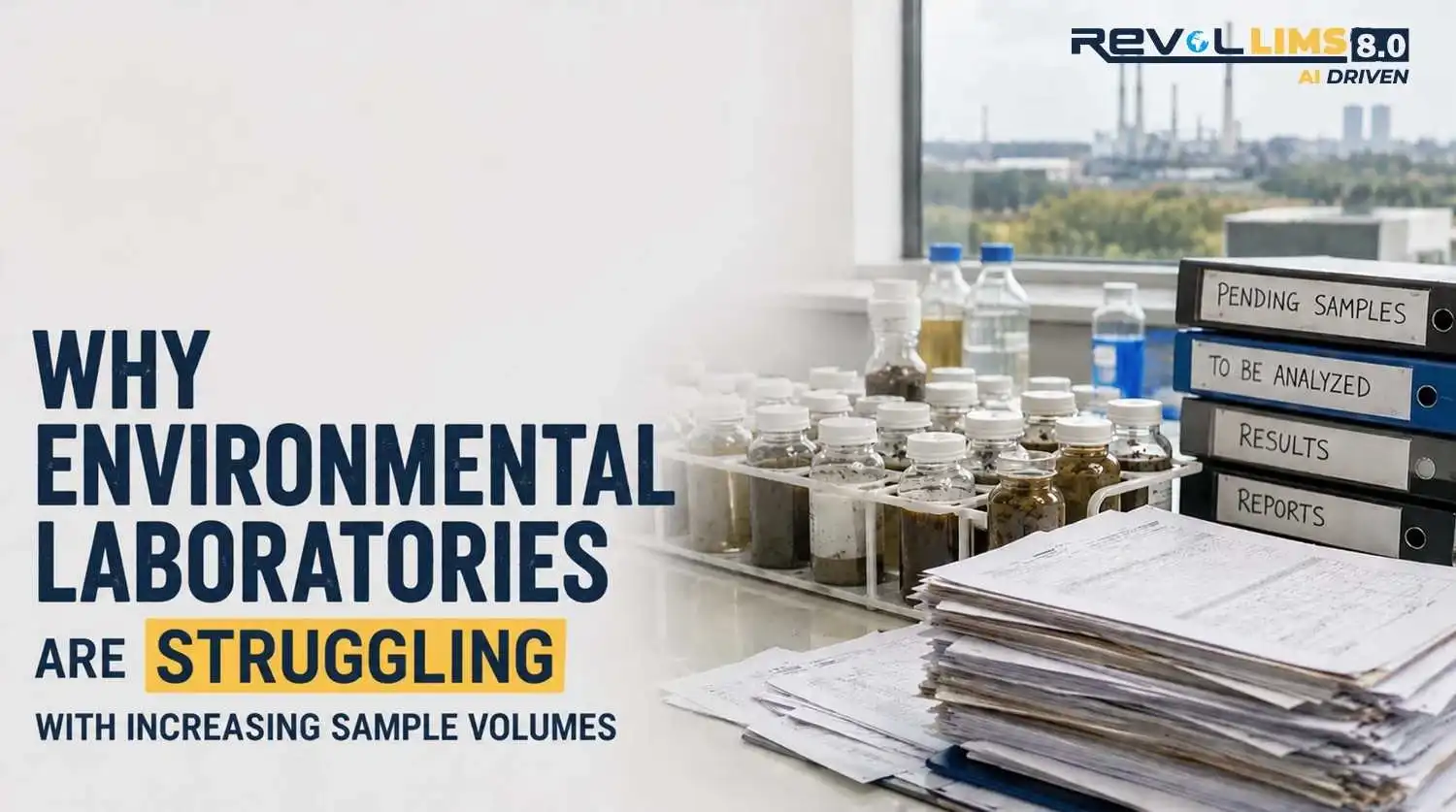
Why Environmental Laboratories Are Struggling with Increasing Sample Volumes
How PFAS, microplastics, and climate-driven monitoring are outpacing manual lab workflows — and the LIMS capabilities that restore throughput.
Environmental laboratories are being asked to test more, for more, in less time. Analyte lists have expanded well beyond the classic panel of metals, pesticides, and nutrients to include PFAS compounds, microplastics, and a growing set of trace-level contaminants — each one adding method complexity to a sample that used to require a single, simpler test. At the same time, monitoring obligations have widened: more sampling points, more frequent collection intervals, and surge testing after floods, wildfires, and other climate-driven events that regulators and clients now expect labs to absorb on short notice.
Key Takeaways
- Expanded analyte panels, tighter monitoring, and climate-driven surge testing are all raising sample volume at once.
- The strain hits first at accessioning, holding-time tracking, and instrument scheduling — not the final report.
- Manual, spreadsheet-driven workflows can't scale with volume without adding errors and missed deadlines.
- A modern LIMS absorbs volume through automated accessioning, dynamic scheduling, and instrument integration.
- This supports hold-time and custody requirements under TNI, NELAP, and ISO/IEC 17025.
1. Why Sample Volumes Are Climbing Faster Than Lab Capacity
Environmental labs are processing more samples because analyte scope, monitoring frequency, and event-driven testing demand are all expanding at once, while staffing and bench capacity expand far more slowly. No single driver explains the volume increase — it's the combination that outpaces a lab's ability to plan around it, which is exactly where purpose-built LIMS features start to matter.
Expanding Analyte Panels
PFAS, microplastics, and other trace-level emerging contaminants are increasingly required alongside traditional metals, nutrients, and pesticide panels. Each additional analyte group often means a separate extraction, a separate method, and a separate QC batch — so one physical sample can now generate several times the analytical workload it did a few years ago.
More Frequent and Broader Monitoring
Permit renewals, discharge monitoring programs, and public health surveillance increasingly call for more sampling points and shorter intervals between collections, expanding the routine sample count a lab has to absorb month over month — a pressure covered in more depth in this water testing lab guide.
Climate-Driven Surge Testing
Floods, wildfires, and other extreme weather events generate sudden, unplanned testing demand — stormwater runoff, ash contamination, or emergency drinking water checks — that has to be processed alongside a lab's existing routine workload, not instead of it.
Growth in Accredited Scope
Labs that expand their accredited methods and matrices to win more client work often do so faster than they scale staff or bench space, so the same team ends up managing a wider and larger workload with the same physical footprint.
2. Where the Volume Strain Actually Shows Up
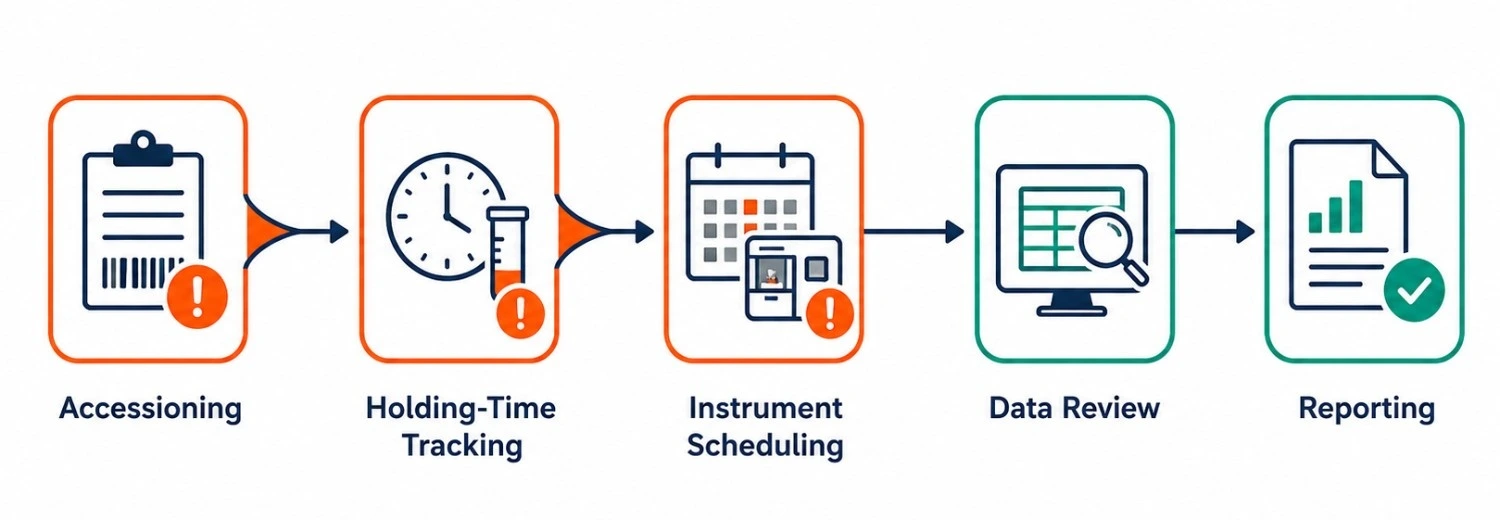
Rising sample volume doesn't strain a lab evenly — it concentrates at specific handoff points: accessioning, holding-time compliance, instrument scheduling, data review, and reporting. Each is a place where a manual, spreadsheet-based process that worked at lower volume starts to break down.
Accessioning Bottlenecks
Every sample has to be logged in, labeled, and assigned before testing can start. When intake is manual, a spike in incoming coolers creates an immediate backlog at the front door of the lab — samples wait to even begin their holding-time clock while staff work through paper chain-of-custody forms one at a time.
Holding-Time and Preservation Risk
Environmental samples are frequently perishable, with strict holding times and preservation requirements tied to each analyte. Under volume pressure, tracking dozens of different clocks across spreadsheets or paper logs makes it easy to miss a deadline — turning a data-quality issue into a re-sampling and cost problem.
Instrument and Bench Scheduling Conflicts
More samples mean more competing demand for the same GC-MS, ICP-MS, or LC-MS/MS instruments. Without a live view of instrument availability and queue priority, high-priority regulatory samples can sit behind routine work simply because no one had visibility into the full queue.
Manual Data Review and Reporting Delays
Assembling electronic data deliverables (EDDs) in state or program-specific formats by hand, and manually cross-checking QC batches before release, is manageable at low volume — but becomes the slowest step in the process once sample counts climb, delaying reports to regulators and clients alike.
3. Modern LIMS Key Features That Absorb Volume Growth
A modern LIMS handles rising sample volume by automating the specific points where manual workflows break — intake, scheduling, holding-time tracking, and reporting — rather than by simply asking staff to work through a longer queue faster. These capabilities draw on a few core LIMS modules working together, rather than standing alone as isolated tools.
Core Volume-Management Features
- Automated Sample Accessioning & Barcode Login — samples are logged and labeled electronically at intake, cutting manual data entry and reducing mismatched or duplicate sample IDs during high-volume periods.
- Dynamic Worklist & Bench Scheduling — the system builds and re-prioritizes analyst worklists automatically as new samples arrive, keeping regulatory-deadline samples visible instead of buried in a first-in queue.
- Holding-Time and Preservation Alerts — every sample's clock is tracked automatically, with alerts before a holding time lapses, rather than relying on staff to check dozens of deadlines manually.
- Digital Chain-of-Custody Tracking — custody transfers are captured electronically from collection through disposal, keeping the audit trail intact even as sample counts spike.
- Instrument and CDS Integration — results flow directly from analytical instruments into the sample record, removing transcription steps that slow down high-volume batches.
- Capacity and Workload Dashboards — lab managers see real-time bench, instrument, and staff load, so incoming volume can be redistributed before a bottleneck forms.
- Automated EDD Generation — electronic data deliverables are generated directly in the required state or program format, removing manual formatting work at the reporting stage.
- Batch QC and Auto-Flagging — out-of-control QC results are flagged automatically against method-specific limits, so reviewers focus only on batches that need attention.
- Mobile and Field Sample Login — field teams can register samples and capture custody data at the point of collection, so intake work is already done by the time coolers reach the lab.
- Elastic Cloud Scalability — cloud-based configuration lets a lab absorb seasonal or event-driven volume spikes without a corresponding jump in on-premise infrastructure.
- Client Self-Service Portal — clients and regulators can check sample status and pull results directly, reducing the status-update workload on lab staff during busy periods.
Individually, each feature removes friction at one step. Together, inside a single connected environmental LIMS, they let sample volume scale without a proportional increase in manual handling — which is the core problem most environmental labs are actually facing.
4. How Volume Moves Through a Connected Workflow
In a LIMS-managed workflow, a sample moves through five stages with its holding-time clock, custody record, and priority status intact at every step — instead of being re-tracked manually each time it changes hands.
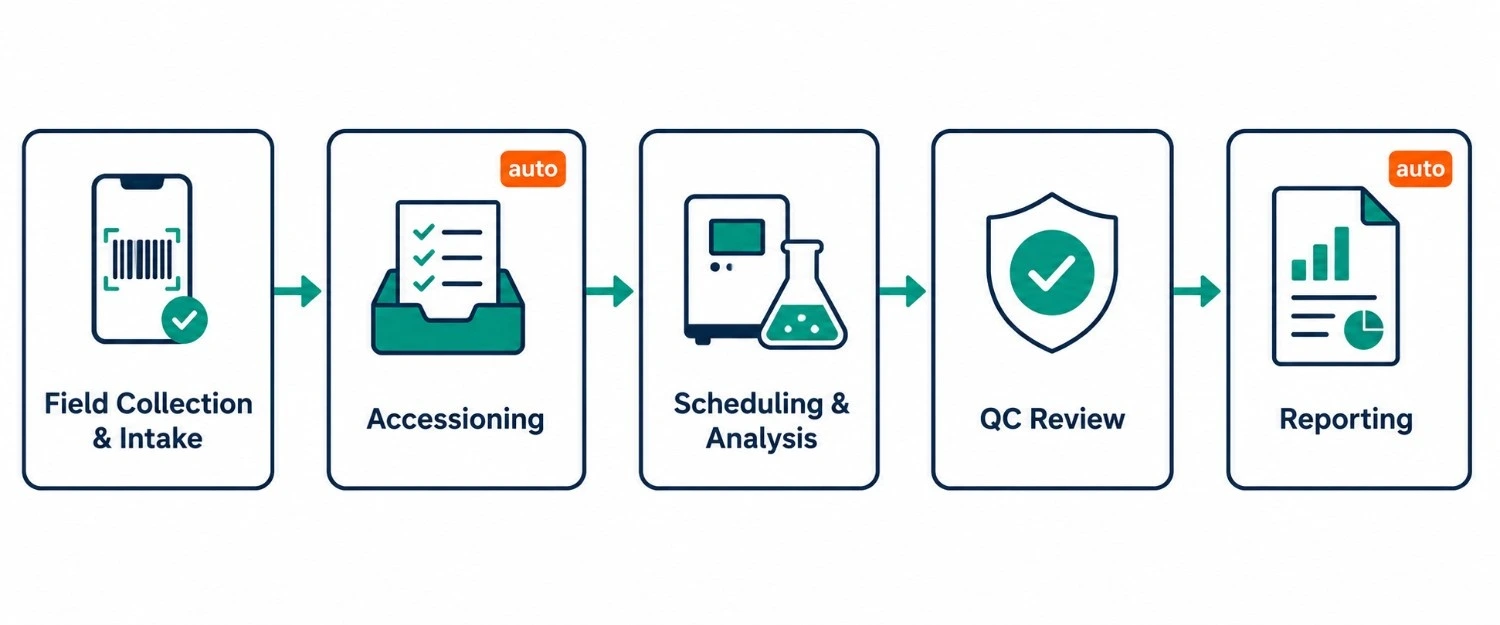
| Stage | Manual Workflow Risk | What a LIMS Changes |
|---|---|---|
| 1. Field Collection & Intake | Paper custody forms, delayed accessioning during volume spikes | Mobile login and barcode capture start the record at collection |
| 2. Accessioning | Manual data entry backlog, mismatched sample IDs | Automated login assigns IDs and starts holding-time clocks instantly |
| 3. Scheduling & Analysis | Instrument conflicts, no visibility into queue priority | Dynamic worklists rebalance queues as new samples arrive |
| 4. QC Review | Manual cross-checking delays release of high-volume batches | Auto-flagged QC exceptions focus reviewer attention |
| 5. Reporting | Manual EDD formatting slows delivery to regulators and clients | EDDs generate automatically in the required format |
The benefit isn't just speed at any one stage — it's that the whole chain stays traceable even when sample counts triple during a monitoring event or a post-storm surge, which is exactly when a lab can least afford to lose track of a holding time or a custody transfer.
5. Regulatory and Accreditation Alignment
Handling higher sample volumes without a system to manage it puts a lab's accreditation at risk, since the standards environmental labs operate under all assume documented, defensible sample handling regardless of workload.
TNI Standard & NELAP
The NELAC Institute's Environmental Laboratory Sector standard requires documented sample handling, calibration, and method validation
ISO/IEC 17025
General competence requirements for testing and calibration laboratories — traceable, method-validated results regardless of workload
EPA Monitoring Requirements
Discharge and drinking water monitoring programs set both testing frequency and reporting deadlines
6. Frequently Asked Questions
Why are environmental laboratories seeing higher sample volumes?
Because more testing demand is arriving from every direction at once — wider PFAS and microplastics panels, tighter monitoring schedules, and unplanned surge testing after storms or wildfires — while lab staffing and bench space haven't grown at the same pace.
Where does rising sample volume cause the most operational risk?
Accessioning, holding-time tracking, and instrument scheduling absorb the impact first. A backlog is usually visible on the bench long before it ever shows up in a delayed report.
Can a LIMS actually prevent missed holding times during high-volume periods?
Yes — accessioning starts each sample's holding-time countdown immediately, and the system raises an alert well before a deadline is at risk, which is the main safeguard once volume makes manual tracking unreliable.
Does adding a LIMS mean a lab needs fewer staff?
Not necessarily — the goal is to let existing staff absorb higher sample volume without a proportional rise in manual data entry, transcription, and status-checking work, rather than to replace analytical expertise.
How does a LIMS help with sudden, event-driven testing surges?
Cloud-based scalability and dynamic worklist scheduling let a lab reprioritize its queue and absorb an unplanned spike — such as post-storm or post-wildfire testing — without disrupting routine sample turnaround commitments.
7. Key Takeaway
Environmental laboratories aren't struggling with sample volume because any single test got harder — the real driver is panel complexity, monitoring frequency, and emergency testing demand converging faster than manual workflows were ever built to handle. The strain shows up first at the front door, in accessioning and holding-time tracking, long before it ever reaches a final report.
A modern LIMS addresses this by automating exactly those points — sample login, scheduling, holding-time alerts, and reporting — so volume can scale without a proportional rise in manual handling or compliance risk. That's the practical difference between a lab that treats every surge as a crisis, and one that treats it as a manageable, predictable workload shift. Labs comparing options can start with this LIMS buyer's guide, or explore the full set of LIMS benefits for environmental testing operations.
See How a Connected LIMS Handles Volume Growth
Explore how automated accessioning, scheduling, and reporting help environmental labs scale without losing control of holding times or custody records.
Request a Live DemoCONTINUE READING
Author: Revol Team · marketing@revollims.com · www.revollims.com





 (1) (1).webp)