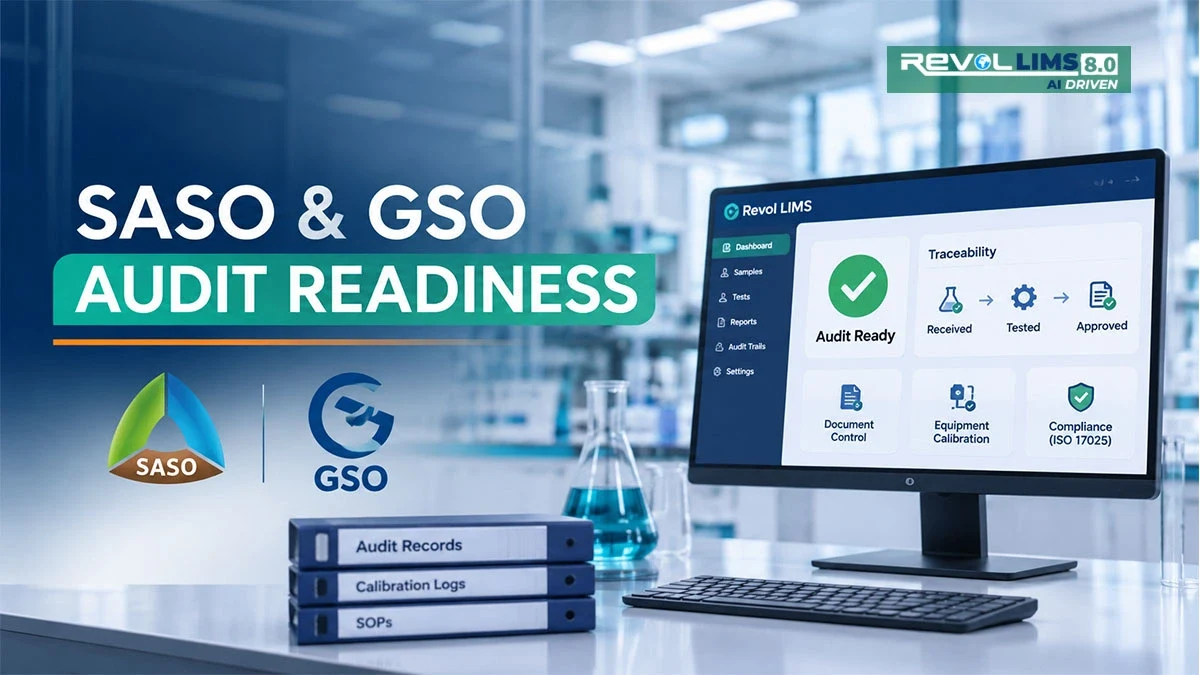
Preparing for SASO and GSO Audits: LIMS Features That Make Accreditation Assessments Smoother
Quick answer
A well-configured LIMS makes laboratory accreditation assessments in Saudi Arabia and the wider GCC smoother by keeping sample traceability, audit trails, method versions, equipment status and non-conformances linked in one searchable record, all aligned with ISO/IEC 17025.
Picture this: an assessor asks for the full history of a sample tested three months ago, including who handled it, which method version was used, the calibration status of the instrument, and any linked deviations. With spreadsheets and disconnected records, pulling that evidence together can take hours. With a LIMS that links these records, the same request is a search, not a reconstruction.
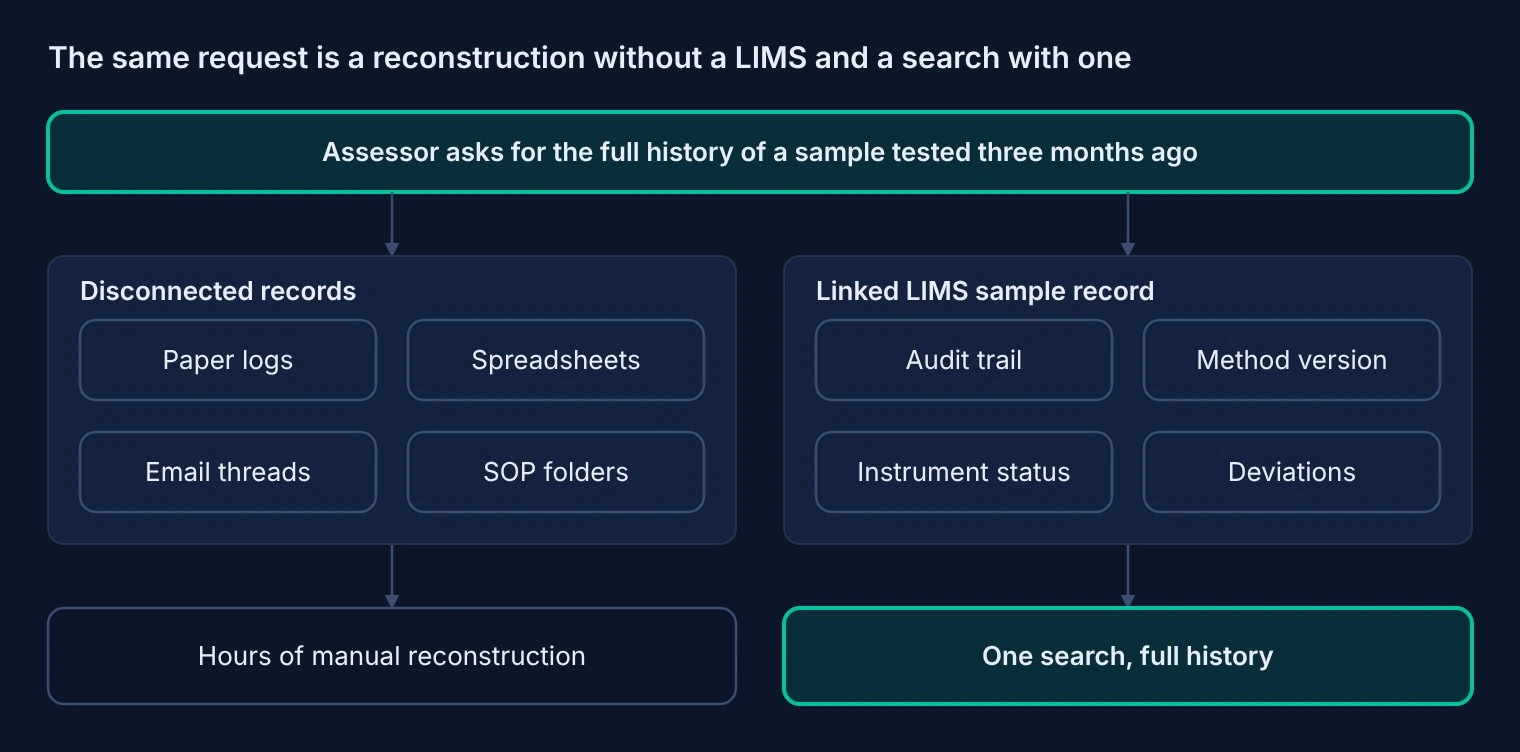 SASO and GSO set the standards and conformity framework, while accreditation itself is granted by SAC or GAC against ISO/IEC 17025. Laboratories that rely on manual systems often struggle to produce complete evidence under time pressure. A purpose-built LIMS keeps that evidence structured, searchable and ready when the assessor asks.
Key Takeaways
- Whichever body assesses your laboratory, the yardstick is ISO/IEC 17025, so one well-built evidence trail serves either SAC or GAC.
- Assessors focus on sample traceability, data integrity (ALCOA+), method version control, equipment status and non-conformance handling.
- The most valuable LIMS capabilities are immutable audit trails, chain of custody, role-based access with electronic signatures, version-controlled methods and linked deviation workflows.
Who Does What: SASO, SAC, GSO and GAC
Four organizations come up in most Saudi laboratory accreditation discussions:
- SASO (Saudi Standards, Metrology and Quality Organization) develops Saudi standards, issues conformity assessment regulations and applies the national metrology system (SASO responsibilities). It also accepts conformity assessment bodies (SASO acceptance program).
- SAC (Saudi Accreditation Center) provides accreditation services to conformity assessment bodies in Saudi Arabia, and is an ILAC MRA signatory for testing and calibration under ISO/IEC 17025 (ILAC).
- GSO (GCC Standardization Organization) is the regional standards body. Its Gulf Association for Laboratories encourages laboratories in member states to obtain GAC accreditation (GSO).
- GAC (GCC Accreditation Center) is a multi-economy accreditation body serving Saudi Arabia, Bahrain, Kuwait, Oman, Qatar, the UAE and Yemen, and is also an ILAC MRA signatory (ILAC).
What Assessors Typically Examine
Assessors work through the same eight areas in most ISO/IEC 17025 assessments. The features that follow show how a LIMS produces the evidence for each.
| Audit focus area | What assessors commonly request |
|---|---|
| Sample management | Unique identification, chain of custody, storage conditions, retention |
| Data integrity | Complete change history, attributable and contemporaneous records |
| Methods and procedures | Current approved version and proof it was used |
| Equipment and calibration | Status, due dates, intermediate checks, impact of failures |
| Personnel competence | Training records and authorization for specific tests |
| Non-conforming work | Impact assessment, root cause, corrective actions, effectiveness |
| Reporting | Reports that match original data and include required elements |
| Proficiency testing and QC | Participation records and actions on unsatisfactory results |
The Evidence Trail: From Sample Receipt to Report
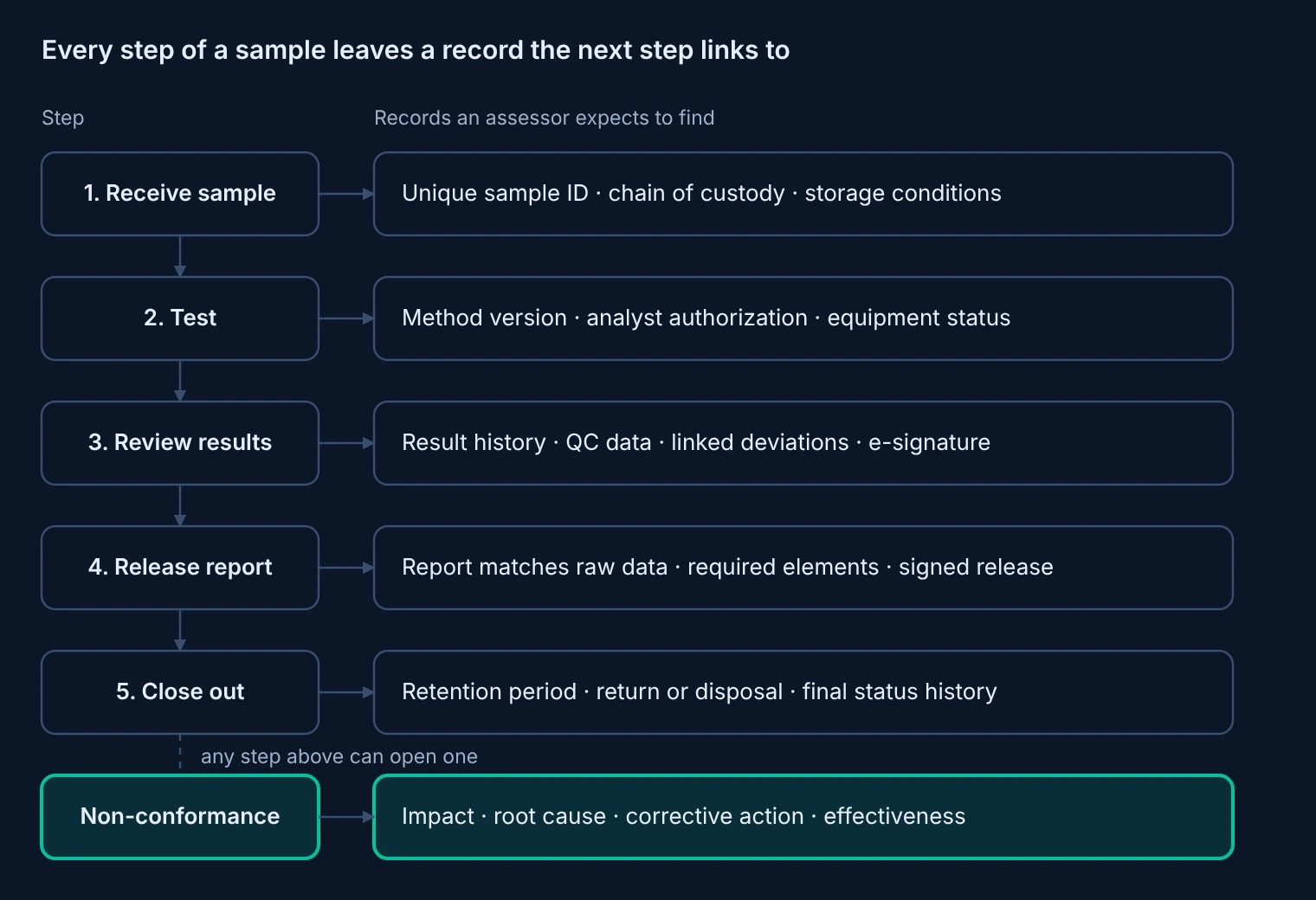
An assessor will usually follow one sample from the door to the final report. The diagram shows the records they expect to find at each step, and why each must link to the next.
LIMS Features That Make Assessments Smoother
1. Immutable audit trails
Every creation, modification, review and approval is recorded with user identity, timestamp, previous value, new value and reason for change. The history stays attached to the record instead of being rebuilt later.
2. Controlled sample lifecycle and chain of custody
Unique identifiers, barcodes, location tracking, aliquot management and full status history let you show correct handling from receipt to disposal or return.
3. Role-based access and electronic signatures
Access is limited by role, and critical actions such as result approval and report release require a signature linked to the individual. This supports segregation of duties and accountability.
4. Version-controlled methods and documents
Approved methods and SOPs are versioned, work can be restricted to the current approved version, and every revision keeps its approval record.
5. Equipment and calibration status control
Instruments and reference standards are linked to samples and tests. The LIMS can flag or block equipment that is out of calibration or past its maintenance interval, and it records intermediate checks.
6. Structured deviation and non-conformance workflows
When a deviation, out-of-specification result or equipment failure occurs, the system links the event to affected samples and captures impact assessment, root cause, corrective action and verification of effectiveness in one traceable record.
7. Review, approval and searchable reporting
Results move through defined review stages, and reviewers see the full history, QC data and linked deviations before signing off. Authorized users can then pull sample histories, audit-trail extracts, calibration status reports and training matrices on demand.
8. Support for LIMS validation
ISO/IEC 17025:2017 clause 7.11 covers control of data and information management, including validating the information system for its intended use before it is put into service. A mature LIMS supports documented configuration, change control and validation evidence (IQ/OQ/PQ or equivalent), which assessors frequently ask to see.
Preparation Roadmap
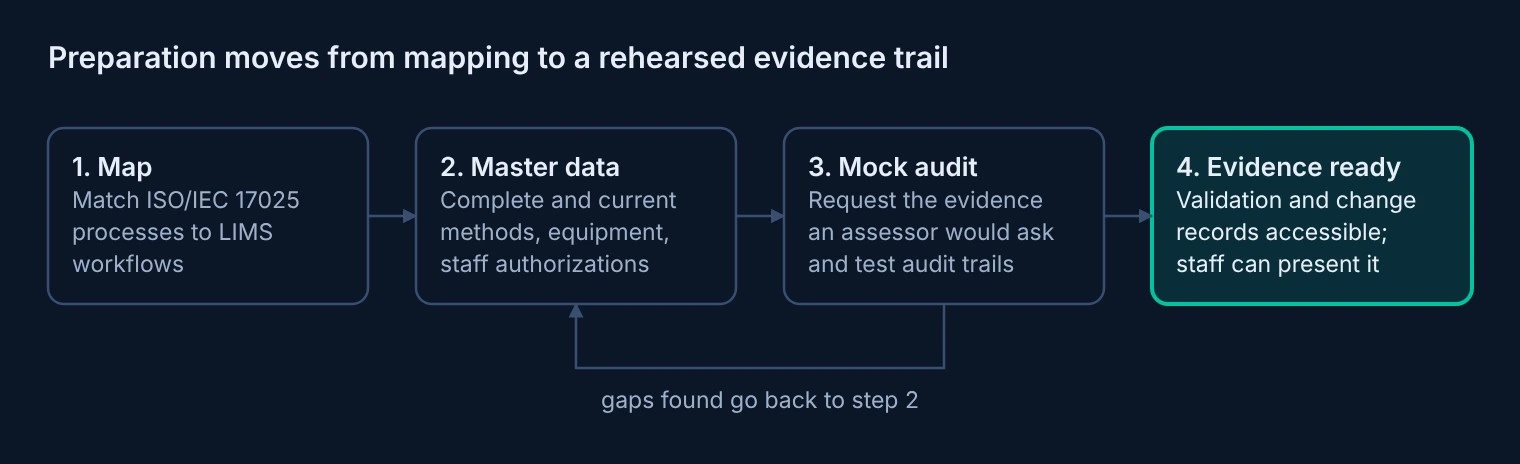
Preparation runs in four phases, looping back whenever a mock audit exposes a gap.
Use these five requests in your mock audit; if any takes more than a quick search, that is the gap to close:
- Every sample tested on one instrument since its last calibration.
- The method version behind all results released last month.
- Everything linked to a single deviation, from affected samples to corrective action.
- Who approved a specific report, and what they could see when they signed.
- Proof that an ordinary user cannot edit or disable the audit trail.
Frequently Asked Questions
Does a LIMS make a laboratory automatically compliant with accreditation requirements?
No. Compliance depends on the laboratory's quality management system, competent personnel, validated methods and consistent execution. A LIMS supports and documents these elements; it does not replace them.
Should my laboratory be accredited by SAC or GAC?
Both operate in Saudi Arabia, and some laboratories hold accreditation from each. Check which body your customers, regulators and any SASO conformity programs accept for your scope before choosing.
How long does it take to prepare a LIMS for an audit?
It varies. Laboratories that keep master data current and run periodic internal evidence checks usually need focused gap-closing in the weeks before the assessment rather than a full reconstruction of records.
Conclusion
Accreditation assessments test whether a laboratory can consistently produce reliable results and prove it. A LIMS that keeps samples, methods, equipment, deviations and approvals linked, and is treated as part of the quality system, makes that proof faster and far less stressful.
Want to see how a LIMS handles this in practice?
Request a demo or explore Revol LIMS solutions for your industry..
Book a DemoAuthor: Revol LIMS Team . marketing@revollims.com . www.revollims.com