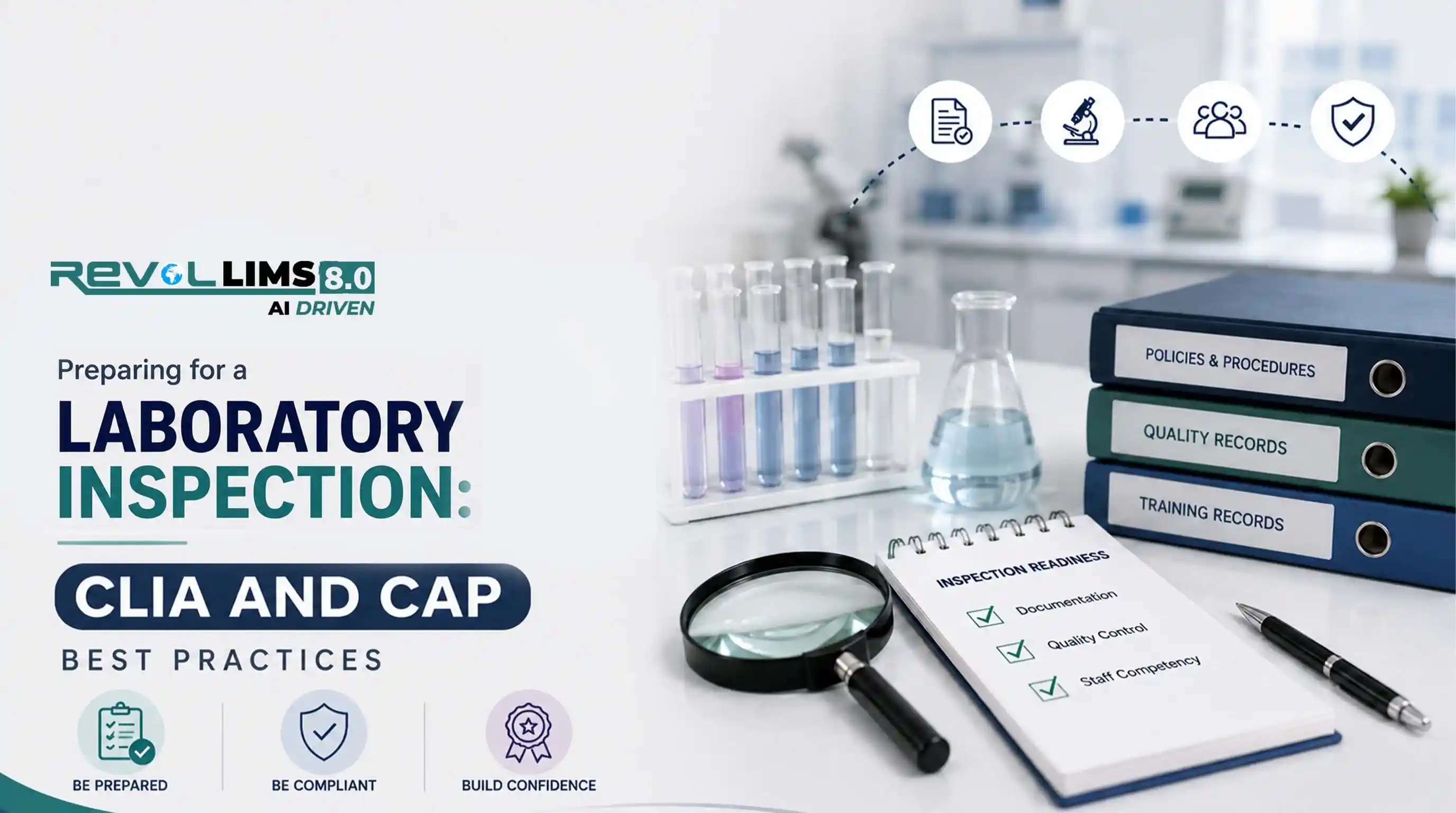
Preparing for a Laboratory Inspection: CLIA and CAP Best Practices
Key Takeaways
- CLIA sets the federal floor for laboratory quality; CAP accreditation is a deemed pathway that meets or exceeds it through peer-based, unannounced-cycle inspections.
- Most citations don't come from one major failure — they come from document control gaps, incomplete competency records, and QC data that can't be traced back to the sample.
- The 2026 CAP checklist cycle places new emphasis on digital workflows, remote data assessment, and patient self-collection documentation.
- A modern LIMS turns inspection prep from a weeks-long scramble into a continuously audit-ready state.
1. Why CLIA and CAP Inspections Carry So Much Weight
A laboratory inspection exists to answer one question: can this lab prove, on demand, that every result it reports is accurate, attributable, and produced by a qualified person using a validated method? The Clinical Laboratory Improvement Amendments (CLIA) set the federal baseline every laboratory testing human specimens must meet in the United States. The College of American Pathologists (CAP) Laboratory Accreditation Program is one of the accrediting bodies granted deemed status by CMS, meaning a successful CAP inspection satisfies CLIA requirements without a separate federal inspection.
What makes both frameworks demanding isn't the volume of paperwork — it's the requirement that policy, practice, and evidence all agree with each other on the day an inspector walks in. A procedure that exists on paper but isn't followed in the workflow, or a competency assessment that was completed late, is treated the same as if it never happened at all.
CAP inspections generally occur on a two-year cycle, with a laboratory-performed self-inspection required in the interim year. Laboratories outside the US receive advance notice of their inspection date, while domestic CAP inspections are typically unannounced within a defined window — which is exactly why "inspection readiness" has to be a standing operational state, not a pre-visit project.
2. Where Laboratories Actually Lose Points
Deficiencies rarely come from a single dramatic failure — they accumulate at predictable points where documentation, personnel records, and instrument data fail to connect. Four areas account for a disproportionate share of citations across CLIA and CAP inspections, a pattern also covered in this overview of LIMS benefits across pharma, food, and clinical labs.
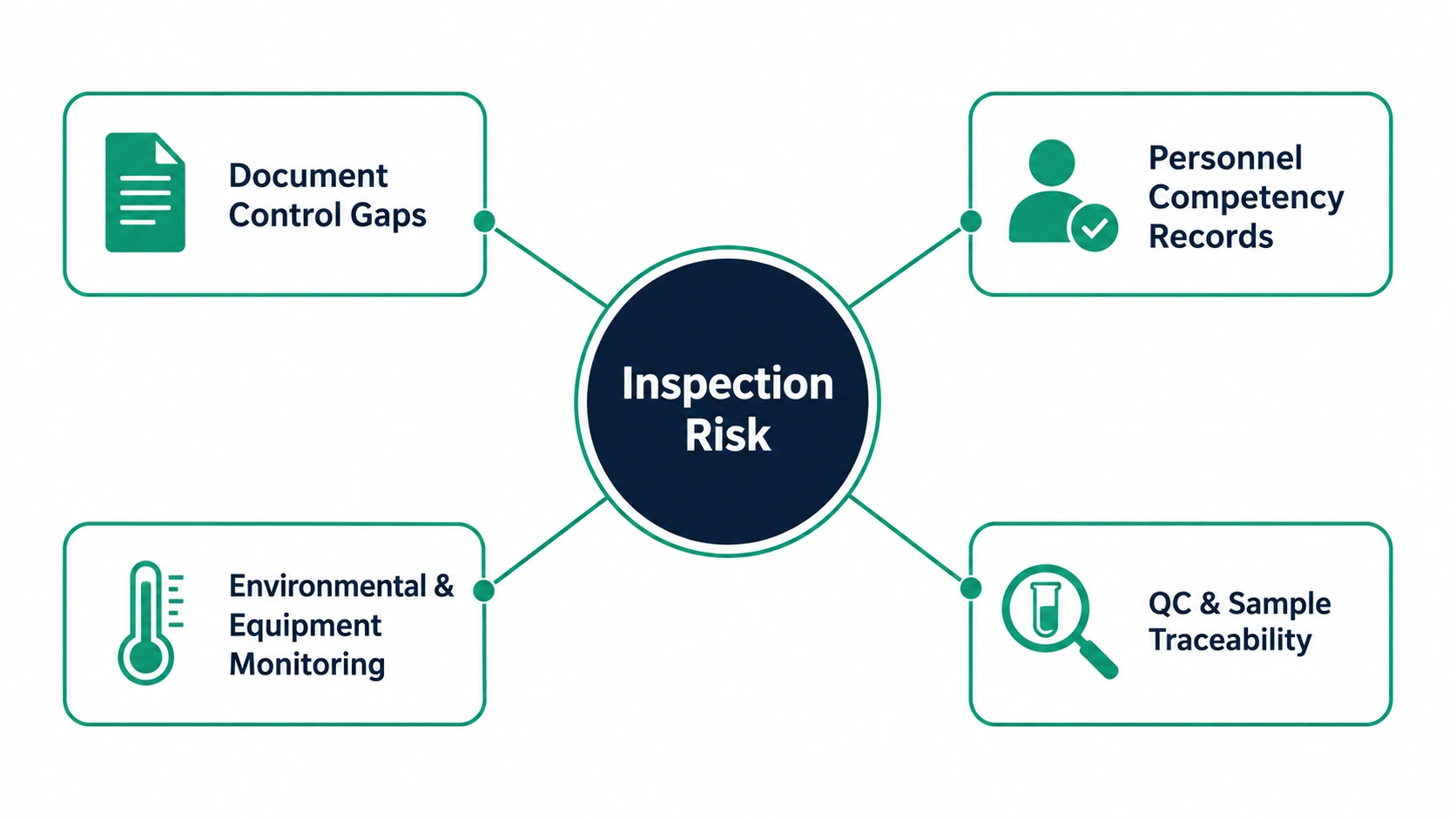
Document Control Gaps
Inspectors expect every active policy and procedure to be current, version-controlled, and readily available to the staff using it. A superseded SOP still sitting on a shared drive, or a procedure with no documented review date, is flagged even if staff are following the correct current version in practice.
Personnel Competency Records
CLIA and CAP both require documented competency assessment for testing personnel at defined intervals — commonly at six months and then annually. Missing, late, or incomplete competency files are among the most frequently cited deficiencies, because they're easy to fall behind on when tracked manually across dozens of staff and test methods.
Environmental and Equipment Monitoring
Temperature-dependent equipment — refrigerators, freezers, incubators, water baths — requires daily documented monitoring, typically with records retained for at least two years. Inspectors look for gaps in the log, missing corrective action for excursions, and calibration records that don't align with the equipment actually in use.
Quality Control and Sample Traceability
Every result needs a clear, unbroken path back to the sample, the method, the instrument, and the person who reviewed it. When QC data lives in spreadsheets or standalone instrument software instead of a governed system, reconstructing that chain during an inspection becomes a manual, time-pressured exercise.
3. Modern LIMS Key Features That Support Inspection Readiness
The deficiency patterns above share a common root: records that are individually correct but not connected to each other in real time. A modern LIMS closes that gap by linking documentation, personnel, equipment, and sample data as they're created rather than reassembling them after the fact. The features below map most directly to CLIA and CAP checklist requirements, and draw on the same core LIMS modules and LIMS features that support compliance more broadly.
Core Inspection-Readiness Features
- Controlled Document Management — SOPs and policies are version-locked, with superseded versions automatically archived and current versions the only ones visible to staff.
- Automated Competency Tracking — six-month and annual assessment schedules are tracked per analyst and per test method, with alerts before a record lapses.
- Continuous Environmental Monitoring Integration — temperature and equipment data feed in automatically from connected sensors, with excursions flagged and corrective actions logged in the same record.
- Full Sample-to-Result Traceability — every result is linked to its sample, method, instrument, reagent lot, and reviewer, so any result can be reconstructed on demand.
- Electronic QC Management — Westgard rules and control limits are applied automatically, with out-of-control events blocking result release until reviewed.
- Role-Based Access and E-Signatures — only qualified, currently competent personnel can perform or review a given test, enforced by the system rather than by policy alone.
- Audit Trail on Every Record — who created, modified, or approved a record, and when, is captured automatically and cannot be edited after the fact.
- Proficiency Testing (PT) Management — PT event schedules, submissions, and results are tracked against enrollment requirements, with gaps visible before they become findings.
- Self-Inspection and Checklist Workflows — internal self-inspections can be run against the same structure as the accrediting body's checklist, surfacing gaps before an external inspector does.
- Instrument Interfacing — results flow from the analyzer directly into the governed record, removing manual transcription as a source of error.
Individually, each feature closes one gap. Together, inside a single LIMS platform, they shift a laboratory from periodically preparing for inspection to being in a continuously inspection-ready state — a shift explored further in this clinical diagnostics LIMS overview.
4. A Practical Inspection-Readiness Timeline
Inspection preparation works best as an ongoing cycle rather than a pre-visit sprint — the table below outlines what a steady-state readiness rhythm typically looks like.
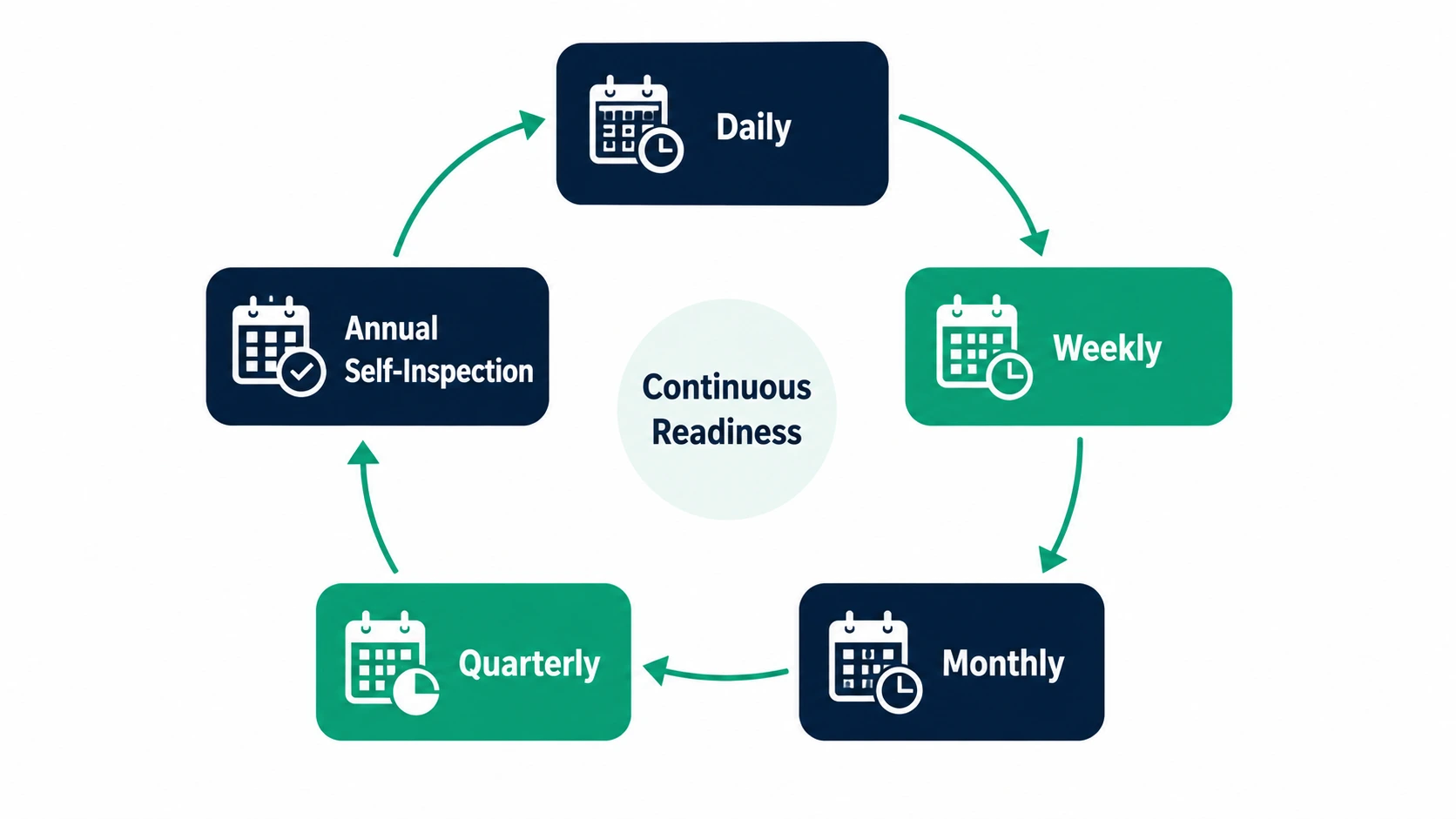
| Cadence | Focus Area | What to Verify |
|---|---|---|
| Daily | Environmental & QC | Temperature logs complete, QC run and reviewed, instrument flags addressed |
| Weekly | Document & Sample Records | Pending document reviews, sample chain-of-custody exceptions, open deviations |
| Monthly | Personnel & PT | Upcoming competency due dates, proficiency testing submission status |
| Quarterly | Internal Audit | Mock checklist walkthrough of a sample section, corrective action closure review |
| Annually / Self-Inspection Year | Full Checklist Review | Complete self-inspection against the customized accreditation checklist |
5. Regulatory Alignment: CLIA, CAP, and Related Standards
CLIA and CAP requirements overlap significantly with broader laboratory quality standards, which is why inspection readiness tends to strengthen a laboratory's standing across multiple frameworks at once.
CLIA (42 CFR Part 493)
Federal baseline for personnel qualifications, QC, PT, and record retention for laboratories testing human specimens.
CAP Accreditation Checklists
Discipline-specific, annually updated requirements; on-site peer inspection every two years with interim self-inspection.
ISO 15189
International standard for medical laboratory quality and competence, closely aligned with CLIA/CAP traceability and personnel requirements.
21 CFR Part 11
Applies where electronic records and signatures support test results — relevant wherever a LIMS or LIS is the system of record.
6. Frequently Asked Questions
How often does a CAP-accredited laboratory get inspected?
CAP-accredited laboratories generally undergo an on-site peer inspection every two years, with a required self-inspection using CAP materials in the interim year.
Is a CAP inspection the same as a CLIA inspection?
CAP holds deeming authority from CMS, which means a successful CAP inspection can satisfy CLIA inspection requirements in place of a separate CMS inspection, provided the laboratory maintains its accreditation.
What causes the most CLIA/CAP deficiency citations?
Most findings trace back to records that look correct in isolation but can't be verified against each other — a procedure updated without a logged review, a competency check completed a few weeks past its due date, or a result that can't be linked back to the instrument and analyst that produced it.
Do laboratories still need to submit a Self-Inspection Verification Form to CAP?
Recent process changes mean laboratories are generally no longer required to submit this form to CAP unless specifically requested, though the self-inspection itself must still be performed and the documentation retained for the next on-site inspection.
Can a LIMS reduce the time needed to prepare for an inspection?
A LIMS that keeps documents, competency records, environmental logs, and QC data continuously current reduces inspection prep to a verification step rather than a reconstruction project, since the underlying records are already audit-ready.
7. Key Takeaway
Laboratories rarely fail an inspection over one significant lapse. What accumulates against them is the gap between what a policy says, what a record shows, and what actually happened on the bench — and an inspector's entire process is built to find exactly that kind of mismatch.
Closing that gap isn't really about a sharper pre-inspection checklist. It's about the underlying records staying accurate as the work happens, so inspection day is a verification of what's already true rather than a race to prove it. A connected LIMS is one of the more measurable ways to get there, particularly for laboratories in clinical diagnostics, clinical research, and contract testing environments where inspection cycles are frequent and the cost of a finding is high. Labs weighing options can start with this LIMS buyer's guide, or review compliance-focused capabilities for clinical research laboratories and the full set of LIMS benefits.
See Inspection-Ready Workflows in Action
See how Revol LIMS keeps your lab's records connected — from sample login to signed result — so inspection day confirms what's already true instead of testing it for the first time.
Request a Live DemoCONTINUE READING
Author: Revol Team · marketing@revollims.com · www.revollims.com



 (1) (1).webp)
.webp)