(1) (1).webp)
From Reactive Testing to Predictive Intelligence: The AI-Powered Food Safety LIMS Guide
Every year, the United States Food and Drug Administration processes between 200 and 300 food and beverage product recalls. The European Union's Rapid Alert System for Food and Feed — RASFF — generates thousands of border rejection and market withdrawal notifications annually. In India, FSSAI enforcement actions on food products have increased measurably year over year as the regulatory body implements digital compliance infrastructure across the food supply chain.
What the data consistently reveals is that the majority of these events are not caused by failures in food manufacturing technology. They are caused by failures in food quality intelligence — specifically, the failure of a laboratory's quality monitoring system to detect a developing trend in product data before that product reached the consumer.
The Grocery Manufacturers Association estimates that a single food product recall costs a manufacturer an average of USD 10 million in direct costs alone. Indirect costs — brand damage, retail relationship impact, reformulation investment, regulatory remediation — consistently multiply that figure. The financial consequence is significant. The operational consequence is immediate. The reputational consequence is long-term.
What makes these numbers particularly important for food and beverage laboratories is what a 2022 analysis of FDA recall causation data showed: a substantial proportion of shelf-life and contamination-related recalls involved products that had passed all required testing at the time of release. The testing was conducted correctly. The results were within specification on the day they were generated. The problem was that nobody was watching what those results were trending toward.
This is the fundamental gap that reactive food safety testing cannot close — and that a modern AI food safety LIMS is specifically architected to address. A Laboratory Information Management System equipped with predictive trend analytics does not simply record whether a result passed or failed at a specific timepoint. It monitors the trajectory of every quality parameter across every stability study and every QC programme in real time — and alerts the quality team when a trend is developing that warrants intervention, before any result technically fails its specification.
The FSMA Food Traceability Rule, finalized under Section 204, requires covered facilities to produce complete traceability records within 24 hours of an FDA request. ISO 22000:2018 requires organizations to establish and maintain documented food safety programmes with measurable performance monitoring. GFSI scheme audits under BRC, SQF and FSSC 22000 consistently identify reactive quality monitoring as a finding area in reassessment cycles.
The regulatory direction is unambiguous. The commercial consequence of non-compliance is quantified. The technology that addresses both is available today. This guide makes the operational case — from evidence to implementation framework — for what a purpose-built AI-powered food safety LIMS must provide, and how it transforms a laboratory from a pass/fail reporting function into the early-warning system that food safety regulators and retail partners increasingly expect it to be.
TL;DR: Quick Summary
- The Paradigm Shift: AI-powered food safety LIMS transforms laboratories from reactive pass/fail reporting centers into proactive, predictive intelligence platforms.
- The 8 Capability Domains: This guide covers stability study automation, predictive analytics, SQC/SPC application, automated OOS flagging, instrument integration, CoA generation, and multi-site architecture.
- The Central Argument: Shelf-life intelligence and continuous trend monitoring prevent recalls rather than merely documenting them. AI analytics require no additional testing — only a system intelligent enough to continuously watch the data you already generate.
What Is an AI-Powered Food Safety LIMS?
An AI-powered food safety LIMS is a purpose-built laboratory data platform for food and beverage operations that goes beyond basic sample tracking and compliance reporting to actively analyze testing data. It automatically analyzes emerging trends, predicts shelf-life outcomes from stability study trajectories, and alerts quality teams to developing deviations before products reach consumers.
What This Article Covers
- The Flaws of Reactive Testing: Why waiting for a failed test result guarantees supply chain crises.
- Modern Stability Management: Automating complex, multi-parameter shelf-life studies.
- Predictive Analytics in Practice: How AI forecasting and anomaly detection operate on laboratory data.
- Proactive SQC/SPC: Applying clinical Westgard rules to food safety trend monitoring.
- Closed-Loop CAPA Integration: Turning automated early warnings into resolved quality events.
- Eradicating Data Noise: Why direct instrument integration is the prerequisite for AI forecasting.
- FAQs
1. Why Does Reactive Testing Keep Failing the Food Industry?
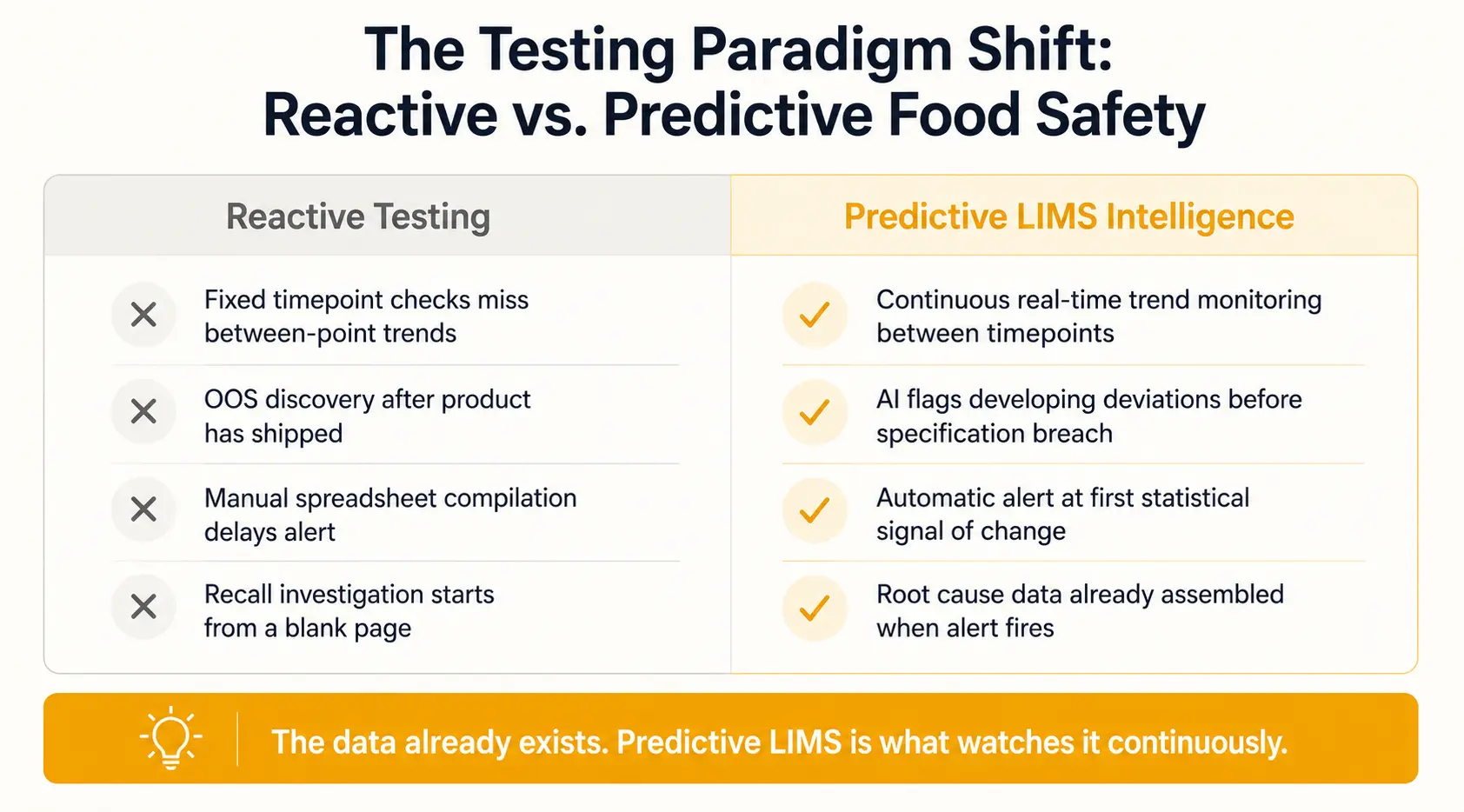
The traditional approach to food safety and quality testing is inherently flawed because it relies on static snapshots of dynamic biological and chemical systems.
The fundamental flaw of fixed-point stability testing is that testing a product at Day 0, Day 7, and Day 28 only tells you where the product was at three highly specific moments in time. It tells you absolutely nothing about the velocity or trajectory of the product's degradation between those points.
"A passing result today is not a guarantee of safety tomorrow. Reactive testing only confirms that a product hasn't failed yet; it cannot warn you that a failure is imminent."
The financial and operational cost of this intelligence gap is massive. A BRC survey found that the vast majority of food recalls involve products that passed all required testing before their initial release.
If products are passing their release testing but still failing in the market, the testing paradigm itself is broken.
Consider the specific failure modes of reactive testing in the F&B sector. A seasonal contamination pattern often shows up as a subtle, creeping elevation in environmental monitoring data six weeks before an actual pathogen outbreak occurs.
An allergen cross-contamination trend frequently appears as a gradually rising baseline in ELISA screening data long before any single batch technically breaches its maximum regulatory limit.
Manual, spreadsheet-based stability tracking simply cannot provide predictive intelligence. In these manual systems, the data exists, but nobody is watching it continuously. Quality professionals are too busy copying data from instrument readouts to Excel files to perform complex regression analysis on historical trends.
By the time a human analyst notices a problem in a spreadsheet, the product has already failed. This is the exact operational gap that a predictive food and beverage LIMS is designed to eliminate.
2. What Does a Modern Shelf-Life and Stability Study Management System Require?
Managing product stability in a food laboratory requires far more than a digital filing cabinet for timepoint results. It requires a dynamic, automated study framework.
Genuine shelf-life study management within a food stability study software context must begin with intelligent study design. Quality managers must be able to configure complex studies with variable timepoints, different storage conditions (ambient, chilled, accelerated), and highly specific testing parameters.
Once a study is initiated, the system must handle automated sample scheduling. It should automatically alert analysts when a timepoint is due, assign the correct testing protocols, and pull results directly from integrated instruments.
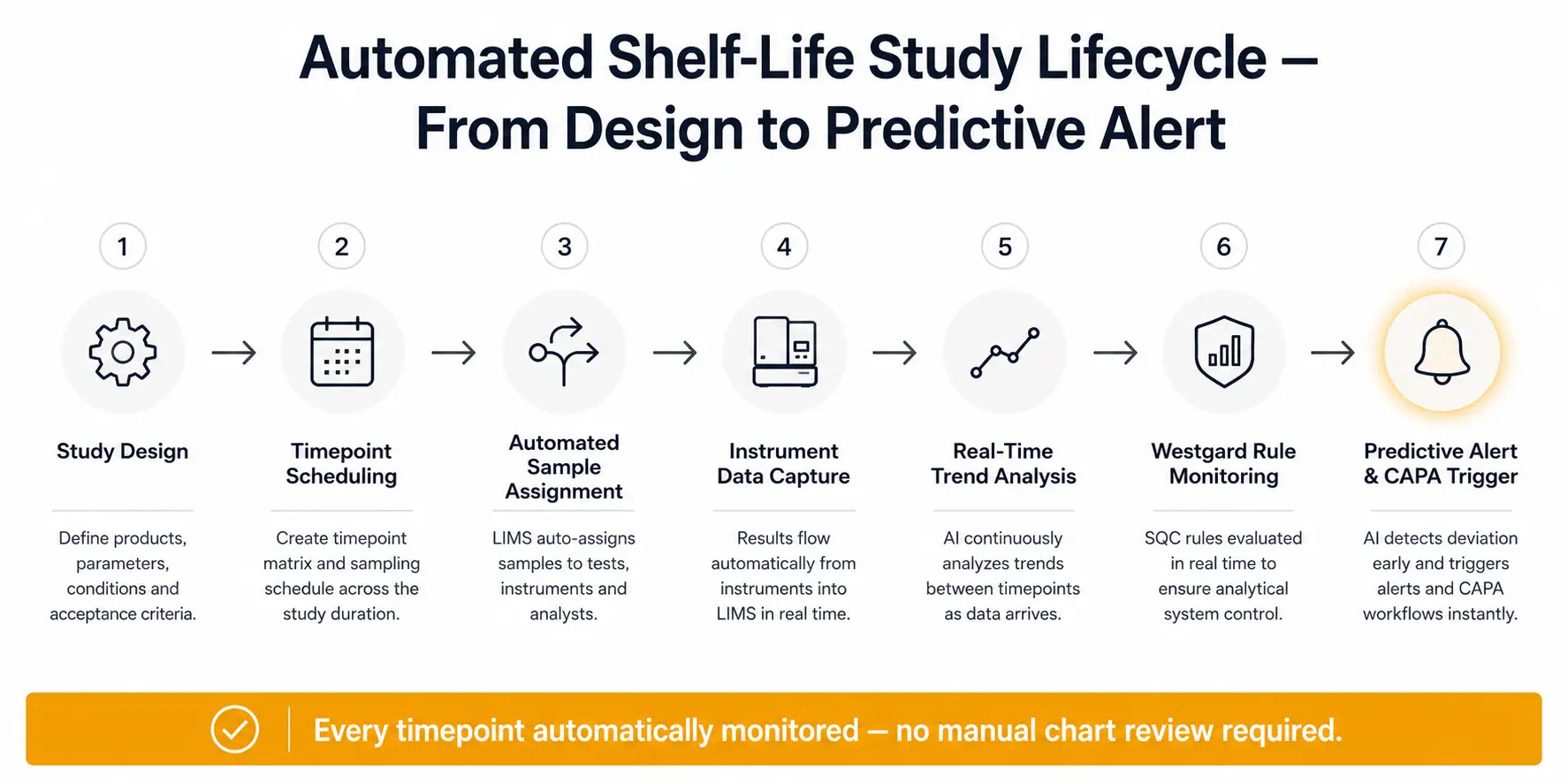
Real-time trend visualization is crucial. As each new timepoint result is added to the database, the system must automatically plot the data against historical batches and generate a visible trajectory curve.
Automated alert triggers must fire the moment a trend trajectory approaches a specification limit, not after it crosses it.
The stability parameters across different F&B product categories are incredibly diverse, and the system must handle all of them simultaneously.
Microbiological parameters (TVC, yeast, mold, specific pathogens) follow exponential growth curves. Physicochemical parameters (pH, viscosity, water activity, Brix) often follow linear or polynomial degradation curves.
Sensory, nutritional, and allergen residue stability all require different data types and tracking logic. Because these parameters behave differently, configurable Westgard-style rules are absolutely necessary. The mathematical logic that flags a dangerous microbiological spike is fundamentally different from the logic that flags a slow, creeping decline in pH.
3. How Does AI-Powered Predictive Analytics Actually Work in Food Safety Testing?
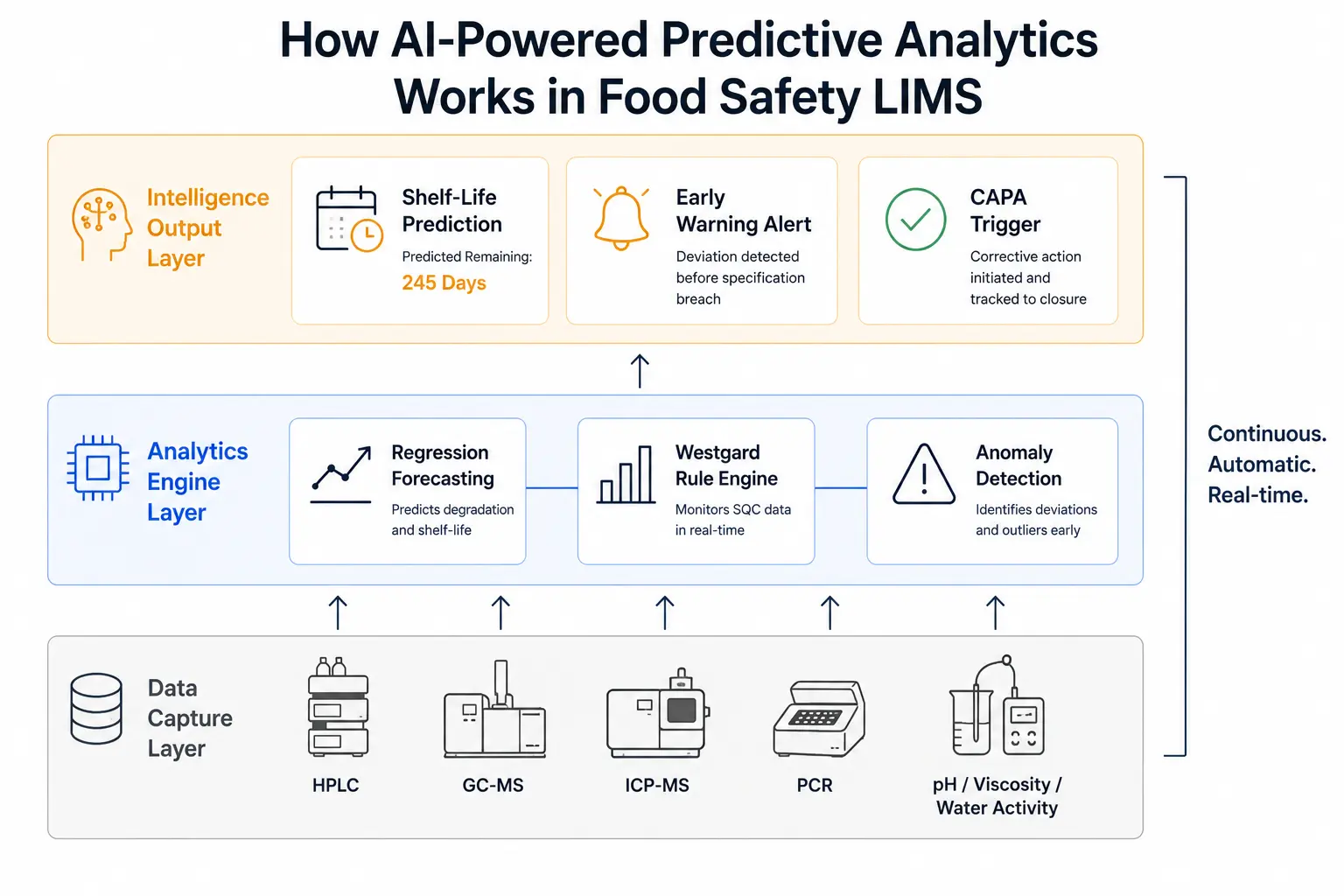
Artificial intelligence in laboratory informatics is often reduced to a marketing buzzword. In a world-class AI food safety LIMS, predictive analytics represents a set of highly specific, mathematically rigorous analytical functions.
The foundation is regression-based trajectory forecasting. The AI algorithms continuously analyze the results of an ongoing stability study and calculate the current velocity of degradation. It then predicts the exact date when a stability parameter will cross its specification limit.
Anomaly detection is equally critical. The system uses historical batch data to establish baseline product behavior. It then flags results that deviate from this established behavior, even if those results are still technically within specification.
This anomaly detection acts as the earliest possible signal before a failure occurs.
"AI does not replace the food scientist. It performs the impossible task of simultaneously monitoring tens of thousands of data points across every active product line, alerting the scientist only when their expertise is required."
Pattern recognition is applied powerfully across environmental monitoring data. The system can identify contamination risk zones by correlating microscopic shifts in swab data over time, identifying harborage points before colony counts ever reach action limits.
Correlation analysis links raw material lot characteristics to finished product shelf-life outcomes. The AI can identify that when a specific supplier's raw material possesses a certain moisture content, the finished product's shelf-life is consistently reduced by ten days, delivering proactive supplier quality intelligence.
However, one must be technically honest about what predictive food safety analytics requires as an input. It requires clean historical data, highly consistent testing protocols, and sufficient timepoint density.
A purpose-built food safety LIMS is the absolute prerequisite infrastructure for AI analytics. The AI cannot predict from data it does not have, and it will generate false predictions from data that is manually mistyped.
4. What Role Does SQC/SPC Play in Proactive Food Safety Quality Management?
Statistical Quality Control (SQC) and Statistical Process Control (SPC) are the methodologies that translate raw data into actionable intelligence.
While Westgard rules were originally developed for clinical laboratories to monitor analytical instrument quality, they apply powerfully to SQC SPC food testing and shelf-life trend monitoring.
A modern LIMS maps these statistical rules directly onto food safety parameters.
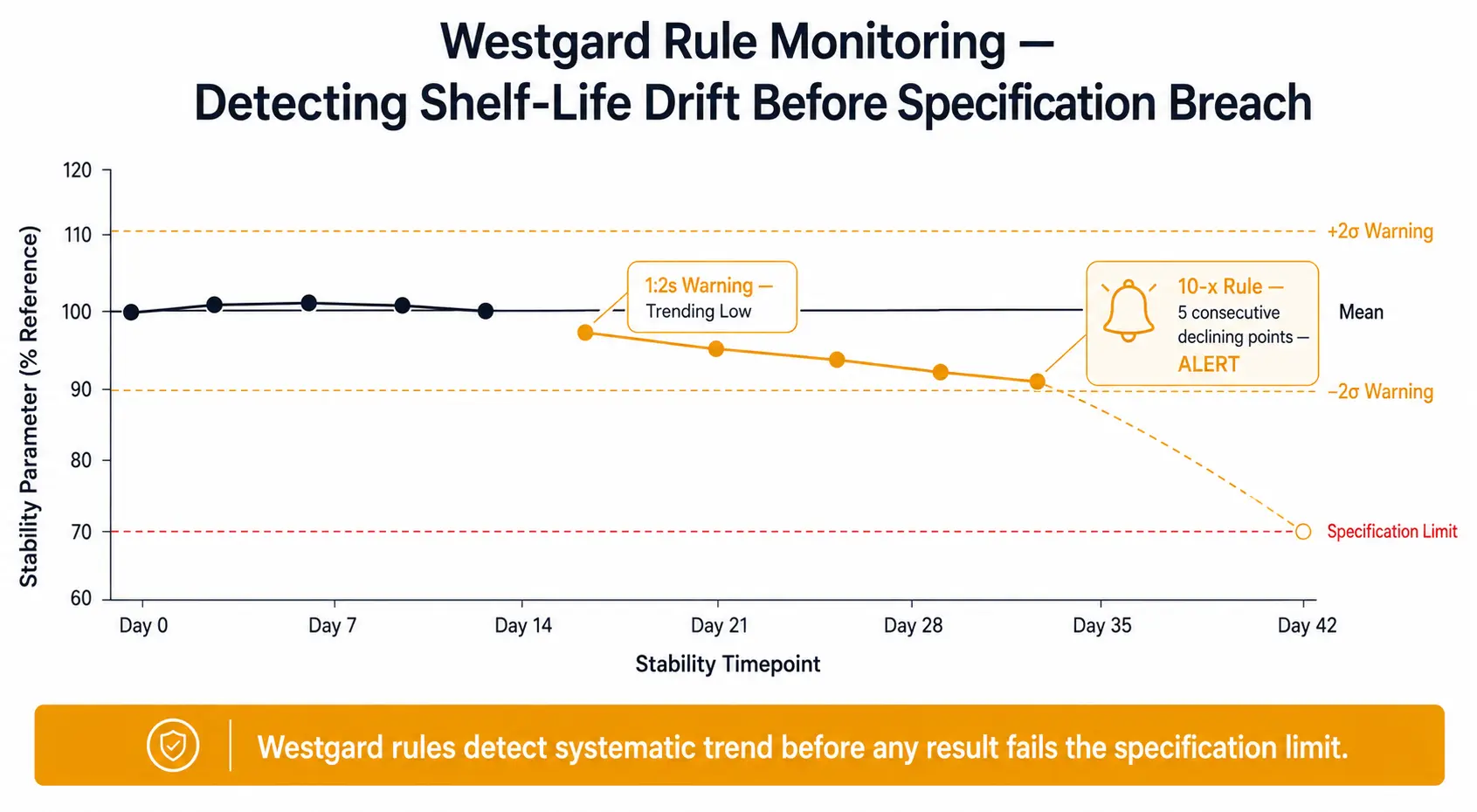
Consider the specific SQC failure signals most relevant to food and beverage. The "Two-of-Three" rule identifies early systematic drift. If two out of three consecutive microbiological tests fall more than two standard deviations from the historical mean, the system flags a developing contamination issue before a limit is breached.
The "Ten-x" rule identifies a sustained directional trend. If ten consecutive timepoint results for a physicochemical parameter (like viscosity) fall strictly on one side of the mean, it indicates a fundamental shift in the formulation's behavior, even if every result passes the static specification.
The "Warning Rule" flags an unusually high or low single result, prompting immediate re-testing before that anomaly becomes a confirmed Out of Specification (OOS) event.
⚠️ The Danger of Manual Control Charts: If your laboratory relies on a quality statistician to manually review printed control charts at the end of the week, your data is already obsolete. Real-time SQC monitoring eliminates this lag. The system reviews the charts continuously in the background and alerts the quality manager instantly when an action rule is triggered.
5. How Do Automated OOS Flagging and CAPA Integration Prevent Shelf-Life Failures?
Predictive intelligence is useless if it does not immediately trigger a corrective workflow. The LIMS must transform a detected trend deviation into a resolved, documented quality event.
This process begins with automated OOS flagging. The moment a stability result crosses a hard specification limit, or a predictive Westgard rule fires, the system must lock the sample record.
The system then initiates an automatic review workflow, routing the flagged result directly to the responsible quality manager. Crucially, the manager receives this alert with the complete trend context visible on their dashboard, not just the isolated failing number.
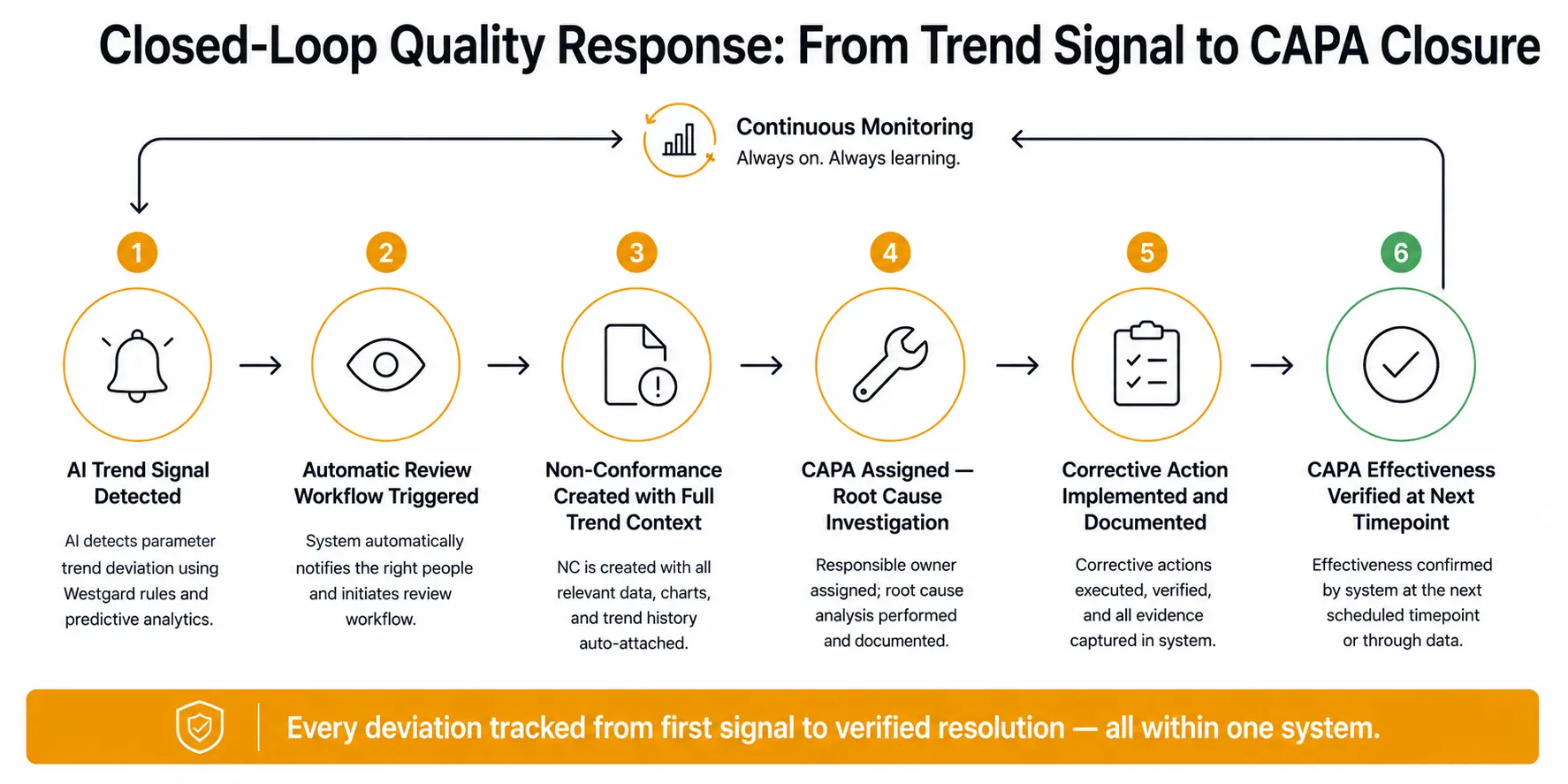
If the deviation is confirmed, the system automatically triggers non-conformance creation, embedding the trend data and charts directly into the quality record.
This seamlessly transitions into CAPA (Corrective and Preventive Action) assignment. The system routes the root cause investigation to the appropriate corrective action team, complete with the predictive intelligence that caught the issue.
Finally, the system demands CAPA effectiveness verification at the product's next stability timepoint.
"An early warning without a connected workflow is just noise. The system must not only detect the anomaly, but also force the organization to resolve it."
This closed-loop workflow — from initial signal to final resolution — is only possible when OOS detection, non-conformance management, and CAPA tracking all live within the exact same software ecosystem. External CAPA systems disconnected from the laboratory's stability data create the precise administrative gap that allows trends to mature into market failures.
6. What Instrument Integration Does AI-Powered Shelf-Life Intelligence Require?
AI algorithms are highly sensitive to data quality. Manual transcription introduces noise that fundamentally corrupts trend analysis.
A modern F&B laboratory relies on a fleet of analytical instruments to generate stability data. High-Performance Liquid Chromatography (HPLC) monitors active ingredients and preservative stability. Gas Chromatography-Mass Spectrometry (GC-MS) tracks volatile compounds and flavor profile degradation.
Inductively Coupled Plasma Mass Spectrometry (ICP-MS) is vital for tracking trace element migration studies in packaged products over long durations. PCR systems provide rapid pathogen detection for microbiological stability.
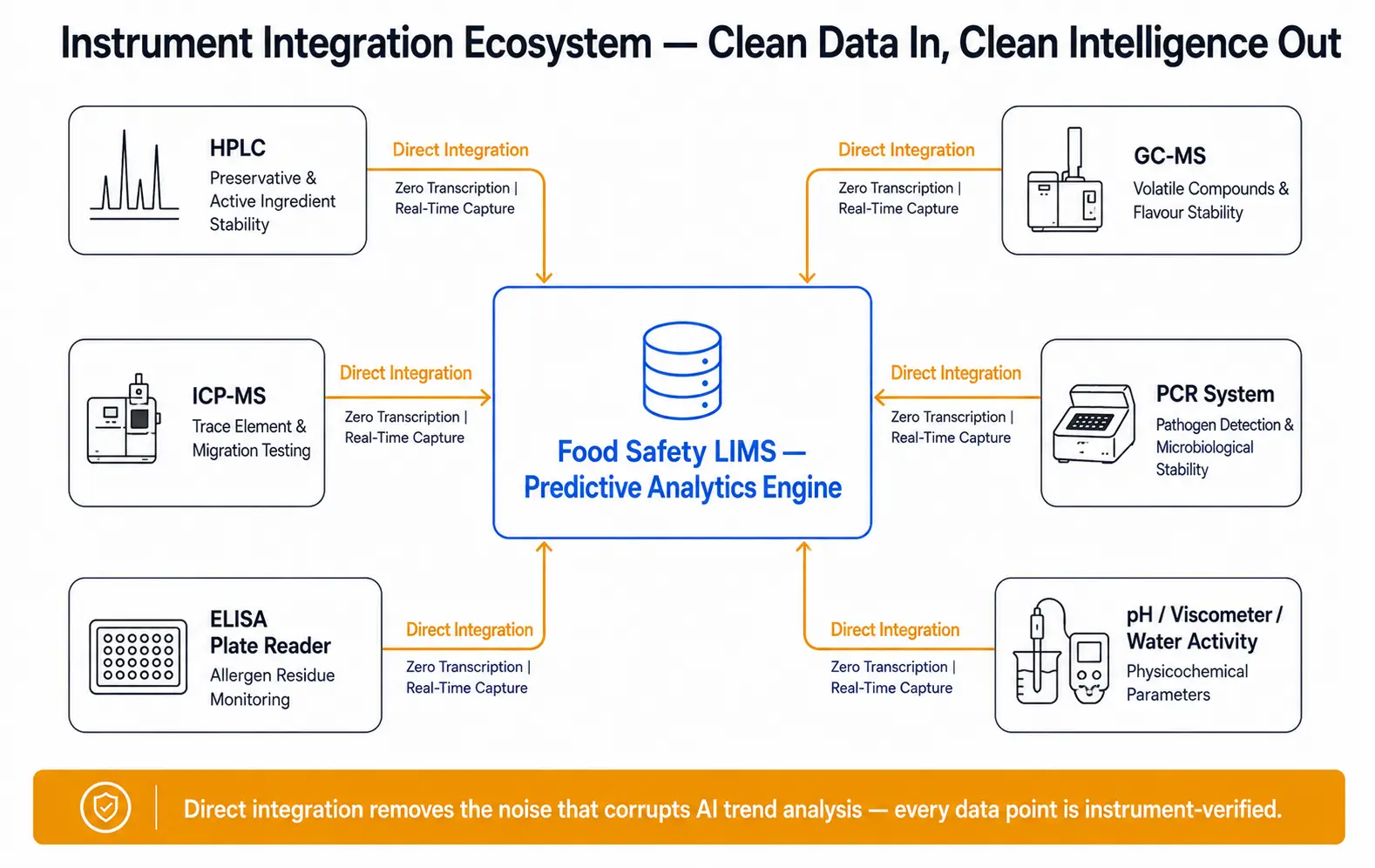
Bench instruments like pH meters, viscometers, and water activity meters generate the bulk of routine physicochemical stability data. ELISA plate readers are essential for allergen management LIMS tracking.
Direct, bi-directional instrument integration is a non-negotiable prerequisite for predictive analytics.
If an analyst slightly mistypes a pH reading of 4.52 as 4.25 into a spreadsheet, that manual error creates a false anomaly. The AI will interpret that mistyped number as a massive, sudden degradation in product stability, generating a false alert and wasting hours of investigation time.
Conversely, a mistyped number could artificially flatten a real degradation curve, masking a genuine trend. The AI is only as good as the cleanliness of its data, and direct API-level instrument integration guarantees absolute data cleanliness at the exact point of capture.
7. How Does Automated CoA Generation Accelerate Food Product Release?
The speed at which a laboratory can confidently release a product is a major competitive advantage, particularly in fresh and chilled food categories where extended documentation delays directly consume sellable shelf life.
Automated Certificate of Analysis (CoA) generation transforms the batch release process. As an automated CoA generation food solution, the LIMS automatically assembles the final stability study results at each required timepoint.
The system then performs an automatic specification verification. It checks the final aggregated results against the highly specific, configurable limits for that exact product category and target market.
If all parameters pass — and no predictive SQC rules have flagged an underlying trend — the CoA is generated instantly. It presents the complete stability study summary as a flawless, regulatory-grade document.
The LIMS must also support customer-specific CoA format mapping. Major retail chains and FMCG clients often demand testing data presented in highly specific, proprietary layouts. The system handles this mapping automatically behind the scenes.
For export-facing manufacturers, the compliance architecture is critical. The automated CoAs must be secured with 21 CFR Part 11 compliant electronic signatures, ensuring that the documentation meets FDA standards for non-repudiation and traceability.
8. What Deployment and Multi-Site Architecture Does a Food Safety LIMS Need?
The physical deployment of a FSMA LIMS software must align with the operational realities of modern food manufacturing networks.
Cloud, on-premise, and hybrid deployments each serve specific operational contexts. Cloud SaaS deployments offer rapid implementation and universal accessibility. On-premise solutions are often demanded by facilities operating under strict data sovereignty laws or dealing with unreliable rural internet connectivity.
Hybrid deployments offer the best of both, keeping heavy instrument data localized while pushing critical dashboards to the cloud.
Multi-site and multi-lab unified instance management is vital for enterprise manufacturers. If a company operates production facilities across multiple states or countries, maintaining disconnected siloed LIMS instances defeats the purpose of predictive analytics.
A unified architecture allows the corporate quality director to aggregate stability study data across all sites. This enables portfolio-level trend analysis, comparing the shelf-life performance of identical products manufactured in different geographical locations.
Furthermore, the system must support mobile field access. Plant-floor QC personnel and environmental monitoring teams require secure tablet access to log samples, record temperatures, and scan barcodes directly at the production line, feeding data into the central LIMS in real time.
9. The True Cost of Reactive Food Safety Management
When evaluating the transition to an AI-powered predictive LIMS, organizations must confront the staggering financial realities of their current, reactive workflows.
- The Retail Recall Cost: A shelf-life-driven product withdrawal from a major modern trade or export customer is financially devastating. The costs encompass reverse logistics, secure product destruction, and severe retailer penalty clauses. Following the withdrawal, the manufacturer must invest heavily in emergency reformulation. A predictive LIMS that catches a shelf-life deviation before dispatch pays for its entire multi-year license in a single prevented recall.
- The Regulatory Penalty Cost: Both FSMA in the United States and FSSAI in India mandate strict preventive controls. A documented failure to detect a preventable shelf-life or contamination trend — especially if the historical data shows the trend was present but ignored — invites severe regulatory consequences, including facility suspensions and intensive compliance audits.
- The Brand Equity Cost: The long-term commercial consequence of a shelf-life failure is immeasurable. When a product spoils prematurely on a consumer's shelf, the story spreads rapidly on social media. More critically, a documented quality failure becomes a permanent mark against the manufacturer during procurement reviews with major FMCG and retail customers.
- The R&D Acceleration Cost: When a product fails unexpectedly in the market, the R&D team must drop current innovation projects to investigate and reformulate the failed product. Months of new product development time are lost simply to regain the baseline stability the company thought it already had.
- The Hidden Analyst Time Cost: Calculate the hours consumed weekly by highly educated quality teams who are forced to manually compile stability spreadsheets, calculate standard deviations, and generate shelf-life reports. By forcing food scientists to act as data-entry clerks, the organization wastes the very talent that should be focused on predictive science and process improvement.
"You cannot build brand trust with a spreadsheet. Trust is built on the absolute, demonstrable certainty that you know exactly how your product will behave long after it leaves your loading dock."
10. Reactive Testing vs. Predictive LIMS Intelligence
One of the most consequential decisions a food and beverage manufacturer can make is moving away from reactive manual testing and toward an AI-powered predictive LIMS. The table below illustrates how these two approaches differ across every critical quality management dimension.
| Capability Domain | Reactive Manual Testing | AI-Powered Predictive LIMS |
|---|---|---|
| Stability Study Monitoring | Checked only at static, fixed timepoints. | Continuous trajectory forecasting between points. |
| OOS Detection Speed | Identified only after a limit is breached. | Trend anomaly flagged weeks before the limit is hit. |
| Contamination Patterns | Reacts to sudden colony count spikes. | Recognizes creeping baselines in environmental data. |
| Allergen Risk Tracking | Pass/fail reporting on final swabbing. | Predicts cross-contamination risks from historical lot data. |
| Regulatory Audit Readiness | Requires days of manual data compilation. | Instant, 24/7 access to immutable digital audit trails. |
| CoA Generation Time | Hours to days of manual assembly. | Instantaneous automated generation upon final approval. |
| Analyst Time Allocation | 40% testing, 60% data entry and reporting. | 90% testing and analysis, 10% review and approval. |
| Recall Prevention Rate | Low — relies on catching failures before the dock. | High — prevents deviations from maturing into failures. |
11. How Do You Evaluate an AI Food Safety LIMS for Predictive Shelf-Life Management?
Not all software marketed as "predictive" possesses genuine AI capabilities. Use these seven evaluation questions to interrogate vendors. You can also request a demonstration to validate these capabilities in a live environment.
- How does the system monitor stability study trajectories in real time? Does it merely draw a straight line between two fixed timepoints, or does it utilize regression algorithms to forecast nonlinear degradation curves continuously?
- What specific AI model underpins the trend forecasting? Demand transparency. Ask the vendor to explain whether their system uses basic linear regression or advanced machine learning models capable of multi-variant anomaly detection.
- Can Westgard rules be configured independently? Ensure the system allows you to configure different SQC rules per product category and per parameter. The rules for monitoring pathogen growth must be distinct from the rules monitoring pH drift.
- How does the system handle missing timepoint data? If a Day 14 test is skipped due to a weekend or instrument failure, does the AI gracefully adjust its forecasting curve, or does a missing data point crash the trend projection?
- What instrument integration is supported natively? Avoid systems that require third-party custom middleware to talk to your GC-MS or HPLC. Native, direct API integration is required for low-latency, error-free data capture.
- How does multi-site stability data aggregation work? Ask to see a demonstration of a corporate dashboard comparing the real-time shelf-life trajectory of the exact same SKU produced at two different manufacturing plants.
- What is a realistic implementation timeline? Implementing predictive AI requires training the system on your historical data. Ask for a realistic timeline for migrating existing stability study data to ensure the AI provides value immediately upon go-live.
FAQ: Frequently Asked Questions
Can AI-powered shelf-life prediction be trusted for regulatory compliance claims?
Yes, but the AI is an intelligence layer, not a replacement for analytical validation. The LIMS generates the predictive forecast to guide operational decisions and prevent failures. However, the final shelf-life claim submitted to regulatory bodies is still backed by the hard, validated analytical test results stored securely and immutably within the LIMS's 21 CFR Part 11 compliant database.
How much historical stability data does the AI require before predictions become reliable?
While the exact volume depends on the complexity of the product matrix, a general rule of thumb is that the AI requires three to five complete, historical batch life-cycles to establish a highly reliable baseline. However, even with a single complete study, the system's basic regression algorithms can immediately begin flagging gross anomalies and standard deviation drifts.
How does the system handle seasonal variation in microbiological stability baselines?
Advanced AI models are designed to recognize cyclical patterns. If historical data shows that environmental yeast and mold baselines naturally elevate during monsoon seasons, the system adjusts its predictive anomaly detection thresholds accordingly. It prevents "alert fatigue" by understanding that a slight seasonal elevation is normal, while still flagging a genuinely dangerous deviation.
Can a single LIMS manage both accelerated and real-time shelf-life studies simultaneously?
Absolutely. A robust food and beverage LIMS allows quality managers to link an accelerated stability protocol (e.g., elevated temperature and humidity) directly with its corresponding real-time study. The AI compares the trajectories of both studies simultaneously, validating whether the accelerated degradation accurately maps to the real-time product behavior on the shelf.
How does allergen stability tracking differ from microbiological and physicochemical stability monitoring?
Allergen tracking focuses heavily on residue limits and cross-contamination over time, rather than natural biological degradation. The AI monitors the historical efficacy of cleaning validations between product changeovers. If the system detects a slow but steady increase in baseline ELISA readings over several months, it alerts the team to a degrading sanitation process before a regulatory allergen limit is breached.
What does implementation look like for a facility currently tracking shelf-life studies in Excel?
Implementation begins with a structured data migration phase. LIMS engineers map your existing Excel-based stability protocols into the system's automated study framework. Historical data is cleansed and imported to train the initial SQC baselines. Instrument integration is established to phase out manual entry, followed by rigorous user training to transition the team from spreadsheet management to dashboard-driven intelligence.
Key Takeaways
- Fixed-Point Testing is Blind to Trends: Testing only at specific timepoints leaves laboratories completely unaware of the velocity of product degradation occurring between those tests.
- AI Needs Clean Data: Predictive forecasting is impossible without direct instrument integration to eradicate the noise and false anomalies caused by human transcription errors.
- Westgard Rules Apply to F&B: The same statistical rules used to monitor clinical instruments can be configured to detect early-stage drift in microbiological and physicochemical food parameters.
- Closed-Loop CAPA is Essential: A predictive alert is useless if it doesn't automatically trigger a non-conformance workflow, root cause investigation, and corrective action within the same system.
- Multi-Site Intelligence: A unified LIMS architecture allows enterprise manufacturers to analyze shelf-life trends at a portfolio level, comparing facility performance globally.
- Time is a Competitive Advantage: Automated CoA generation eliminates hours of manual administrative assembly, maximizing the sellable shelf life of fresh and perishable products.
- Recalls are Preventable: The vast majority of product withdrawals involve products that passed initial release testing. Continuous trajectory monitoring identifies these failures before they happen.
- Analysts Should Do Science: Automating data capture, SQC charting, and reporting frees highly educated food scientists to focus on predictive analysis and process optimization.
Final Thoughts
The food and beverage industry's regulatory trajectory is clear. FSMA's Food Traceability Rule, the EU's Farm-to-Fork Strategy, GFSI's increasing emphasis on food safety culture and proactive risk management, and FSSAI's ongoing digital compliance infrastructure development — every major regulatory framework is moving in the same direction. The minimum acceptable standard for food safety quality management is shifting from documentation of what happened to evidence of what was monitored and what was predicted.
Laboratories that operate reactive testing programmes — fixed timepoints, manual compilation, periodic review — are increasingly exposed to the compliance gap between what regulators now expect and what spreadsheet-based quality management can structurally deliver. The 24-hour traceability response requirement under FSMA Section 204 is not a target that most manual systems can meet consistently. The continuous monitoring expectation implicit in GFSI scheme audits is not a target that periodic fixed-point testing was designed to satisfy.
The commercial reality compounds the regulatory one. Major retail chains and FMCG manufacturers conducting supplier qualification audits increasingly evaluate laboratory data management capability as a criterion — not just quality results, but the infrastructure generating and monitoring those results. A contract testing laboratory or manufacturer's in-house lab operating on purpose-built AI-powered LIMS infrastructure has a demonstrable capability advantage in these evaluations over one operating on disconnected systems and manual workflows.
The operational investment in AI-powered food safety LIMS is not an IT expenditure. It is a risk management decision with a quantifiable return. When the average cost of a single food product recall exceeds USD 10 million in direct costs, and when the leading cause of recalls is not manufacturing failure but monitoring failure, the economic argument for predictive quality intelligence is straightforward.
The data your laboratory already generates from every stability study, every microbiological test, every allergen screen and every SQC chart contains the early-warning signals that prevent recalls. The question is whether your current infrastructure is intelligent enough to read them in real time — or whether you are waiting for a customer complaint to tell you what the data already knew.
If your laboratory is ready to evaluate what purpose-built AI-powered food safety LIMS infrastructure looks like in practice — for your specific product categories, your regulatory obligations and your current testing programme — we welcome the conversation. Request a demonstration to get started.
Continue Reading
- How to Prepare Your LIMS for an FDA Audit: A Practical Checklist
- Achieving ISO/IEC 17025 Compliance: How a Modern LIMS Simplifies Accreditation
- Signs Your Legacy LIMS Is Costing You More Than You Think
- A Complete Guide to LIMS for ISO 17025 Accredited Testing and Calibration Labs
- What Modern Mining Laboratories Must Demand From Their LIMS




.webp)