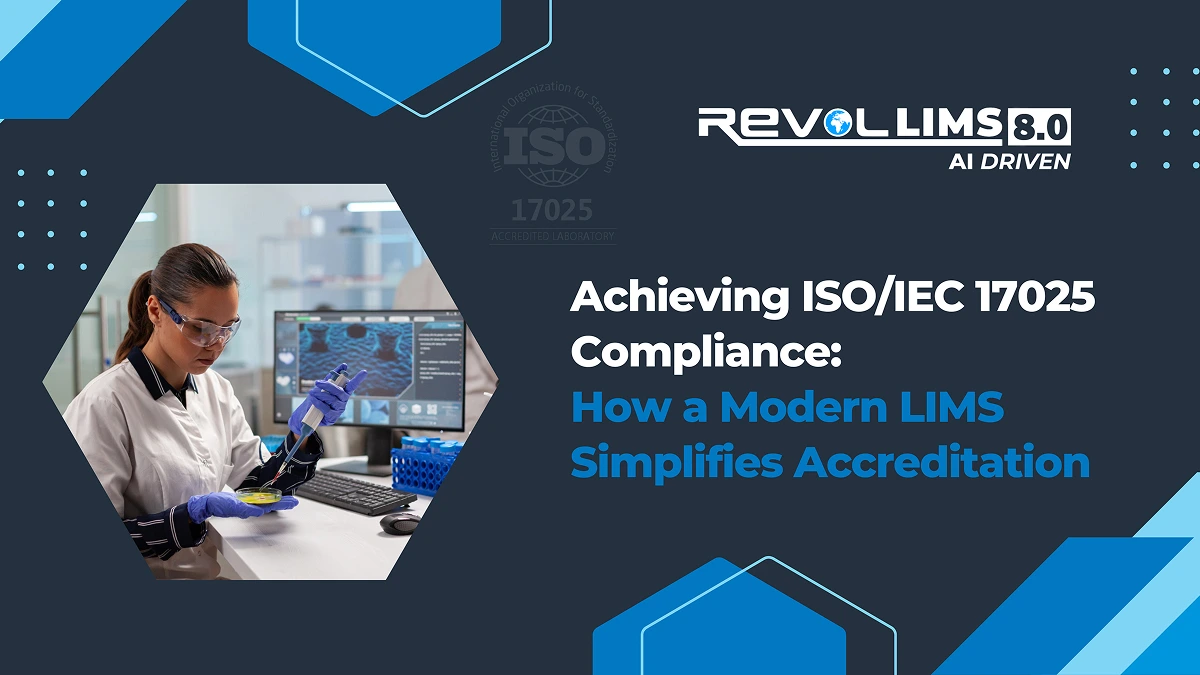
Introduction:The Gold Standard of Laboratory Technical Competence
In the global marketplace, data is only as valuable as the trust behind it. For testing and calibration laboratories, ISO/IEC 17025 accreditation represents the "Gold Standard" of technical competence. It is more than just a certificate on the wall; it is a rigorous demonstration that your facility operates with precision, produces valid results, and maintains an unwavering commitment to impartiality.
However, the journey to accreditation—and the daily effort required to maintain it—can be a logistical nightmare of manual record-keeping, spreadsheet management, and audit anxiety. In 2026, the standard has evolved to place a heavy emphasis on information technology and risk management. This guide explores how a Modern Laboratory Information Management System (LIMS) transforms ISO/IEC 17025 compliance from a burdensome administrative task into a seamless, automated byproduct of your lab's daily operations.
1. Understanding the Core Pillars of ISO/IEC 17025:2017
ISO/IEC 17025 is structured into five main requirement areas, each designed to ensure that every variable in the testing process is controlled and documented.
Clause 4 & 5: General and Structural Requirements
These clauses focus on the foundation of the lab—its impartiality, confidentiality, and organizational structure. A laboratory must prove that it is a legal entity and that its personnel are free from any commercial, financial, or other pressures that might compromise the quality of results.
Clause 6: Resource Requirements
This covers everything the lab needs to function: personnel, facilities, equipment, and metrological traceability. You must prove that your technicians are trained, your environment is controlled, and your equipment is calibrated.
Clause 7: Process Requirements
This is the technical heart of the standard. It covers the entire sample lifecycle—from the initial request and sampling to the evaluation of Measurement Uncertainty and the final reporting of results.
Clause 8: Management System Requirements
Similar to ISO 9001, this section ensures the lab has a system for document control, record management, corrective actions, and proactive Risk-Based Thinking.
2. Safeguarding Impartiality and Confidentiality (Clause 4)
In a modern lab, human error or bias is a constant risk. A LIMS safeguards impartiality through strict Role-Based Access Control (RBAC). By ensuring that only authorized personnel can approve results and that "Conflict of Interest" checks are baked into the system, the LIMS creates a digital barrier against bias.
Furthermore, Clause 4.2 mandates strict confidentiality. A LIMS secures sensitive client data through end-to-end encryption and partitioned databases, ensuring that data is only accessible to those with a "need to know." During an audit, you can instantly demonstrate your security protocols, a task that is nearly impossible with paper-based systems.
3. The Digital Fortress of Data Integrity (Clause 7.11)
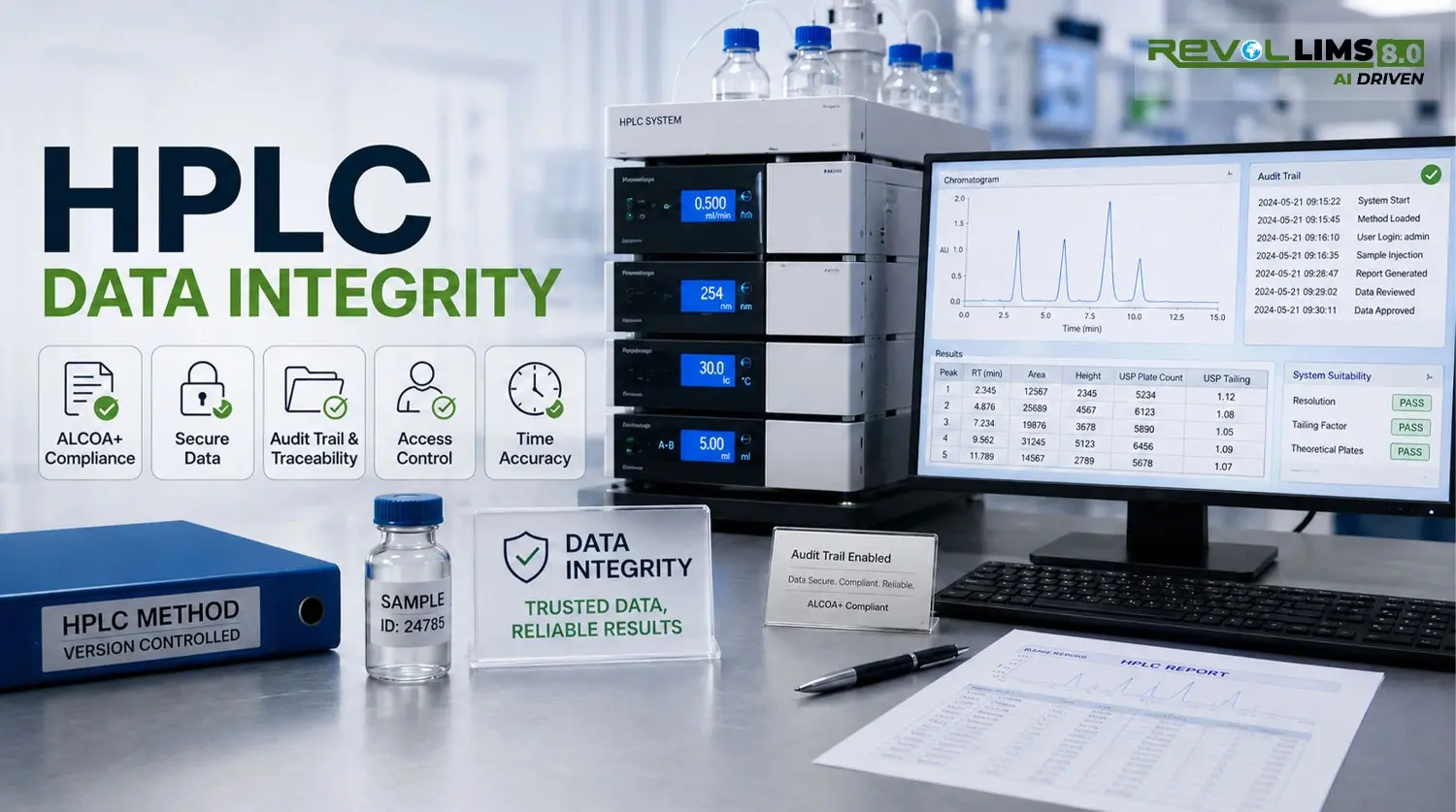
Often referred to as the "LIMS Clause," Clause 7.11: Control of Data and Information Management requires laboratories to ensure that any software used to collect, process, or report data is validated for functionality.
Automation of Data Integrity
Manual transcription is the leading cause of non-conformities during ISO audits. A modern LIMS eliminates this risk by:
4. Mastering Risk-Based Thinking (Clause 8.5)
The 2017 revision of ISO 17025 shifted the focus from purely reactive "Corrective Actions" to proactive Risk-Based Thinking. Labs must now identify potential threats to their quality system before they manifest as failed tests.
How LIMS Facilitates Proactive Risk Management:
- Direct Instrument Integration: Data flows directly from the instrument into the LIMS, removing the "human-in-the-middle" and the risk of "fat-finger" errors.
- Immutable Audit Trails: Every change to a technical record is captured with a timestamp, the user’s identity, and the reason for the change. This provides the "Who, What, When, and Why" that auditors demand under Clause 7.5 (Technical Records).
- Validation Protocols: Software like Revol LIMS arrives with pre-configured validation packages, helping you meet the strict "system validation" requirements of the standard with minimal effort.
5. Automating Measurement Uncertainty (Clause 7.6)
Measurement Uncertainty (MU) is frequently cited by lab managers as the most difficult aspect of ISO 17025. It requires a deep understanding of all sources of error and the complex statistical methods required to combine them.
The LIMS Solution:
- Real-Time Trend Analysis: By monitoring Quality Control (QC) charts in real-time, a LIMS can detect when a process is drifting toward a limit—even if it is still within the "pass" range. This allows for preventative maintenance before a failure occurs.
- Supplier and Reagent Risk: A LIMS tracks the performance of external providers (Clause 6.6). If a specific batch of reagent is consistently linked to failed blanks, the system flags the batch as high-risk, allowing the lab to quarantine it immediately.
- Automated Alerts: Instead of relying on a technician to check a calendar, the LIMS sends automated alerts for upcoming equipment calibrations or staff training renewals.
6. Ensuring the Validity of Results (Clause 7.7)
Accreditation requires that a laboratory has a procedure for monitoring the validity of its results. This typically includes the use of reference materials, internal quality control (QC) samples, and participation in Proficiency Testing (PT).
A LIMS simplifies this by:
7. Key LIMS Features for ISO 17025 Success (Comparison Table)
ISO 17025 Requirement Traditional Manual Method Modern LIMS Solution (e.g., Revol LIMS) Document Control Manual signing and physical folders Digital versioning and automated approval workflows Personnel Training Spreadsheet-based tracking Integrated competency matrices and auto-locks on testing Equipment Calibration Sticker-based reminders Automated lockout of out-of-calibration instruments Traceability Manual search through logbooks Instant "One-Click" traceability from sample to report Audit Trails Non-existent or manual notes Automatic, unalterable digital logs of all actions 8. The Roadmap: Transitioning from Manual to Digital
Transitioning to a digital system is often the most significant "Risk" a lab faces. However, a successful implementation serves as a "Quality Reset" for the entire organization.
Steps for a Successful Digital Transformation:
1. Gap Analysis: Use your LIMS implementation to identify where your manual processes fall short of the ISO 17025 requirements.
2. Workflow Mapping: Do not just digitize your paper mess. Use the LIMS to "lean out" your processes and build compliance directly into the digital workflow.
3. Validation of the System: Ensure you have a clear User Requirement Specification (URS) and that the LIMS is validated against it, as required by Clause 7.11.
4. Training & Culture: Adoption is key. Ensure your staff understands that the LIMS is there to protect their technical reputation by preventing errors before they happen.
Experience Highlight: Hindalco Case Study
When Hindalco’s Mouda plant (a major industrial leader) transitioned to Revol LIMS, they fully digitalized their laboratory processes. By integrating multiple instruments directly with the LIMS, they eliminated manual entry and achieved near-instant traceability, significantly reducing the time required for their ISO 17025 annual audits.
9.Frequently Asked Questions(FAQ Section)
1. Can a LIMS guarantee ISO/IEC 17025 accreditation?
While a LIMS provides the tools and framework necessary for compliance, accreditation is a result of how those tools are used. A LIMS like Revol ensures that your data is secure, traceable, and validated, which are the primary concerns of any ISO auditor.
2. How does a LIMS help with metrological traceability?
Metrological traceability requires that test results can be linked back to the International System of Units (SI) through an unbroken chain of calibrations. A LIMS maintains this chain by digitally linking every test result to the specific instrument used, its last calibration certificate, and the reference standards used during that calibration.
3. What is the role of the LIMS in nonconforming work (Clause 7.10)?
When a result falls out of spec or a QC sample fails, the LIMS can automatically trigger a "Non-Conformance Report" (NCR). It prevents the final report from being issued until a supervisor has reviewed the event and initiated a corrective action, ensuring the lab never releases invalid data.
4. Is Cloud-based LIMS secure enough for ISO 17025?
Yes. Modern SaaS LIMS platforms provide security measures—such as multi-factor authentication, data redundancy, and 24/7 monitoring—that far exceed what most laboratories can maintain on their own local servers.
5. Does the 2017 standard require a LIMS?
The standard is "technology-neutral," meaning it doesn't explicitly require a LIMS. However, meeting the 2017 requirements for data control, risk management, and electronic reporting without a LIMS is becoming increasingly difficult and risky for modern laboratories.
10. Glossary of Terms for ISO 17025
Impartiality: Presence of objectivity and freedom from conflicts of interest.
Metrological Traceability: Property of a measurement result whereby the result can be related to a reference through a documented unbroken chain of calibrations.
Measurement Uncertainty: A parameter associated with the result of a measurement that characterizes the dispersion of the values.
Proficiency Testing: Evaluation of participant performance against pre-established criteria by means of interlaboratory comparisons.
Conclusion: Compliance as a Competitive Advantage
ISO/IEC 17025 accreditation is not a one-time event; it is a continuous commitment to technical excellence. While the standard sets the "What," a modern LIMS provides the "How."
By automating the tedious aspects of compliance—from audit trails to measurement uncertainty—a LIMS allows your scientific team to focus on what they do best: producing the accurate, high-quality data that drives your business forward. In 2026, staying competitive means staying digital.
Ready to Simplify Your Accreditation Journey?
Revol LIMS is designed specifically to meet the rigorous demands of ISO/IEC 17025. From AI-driven risk insights to automated audit trails, we help you stay audit-ready 365 days a year.
[Schedule a Personalized Demo with the Revol LIMS Team Today]
- Built-in Uncertainty Budgets: Rather than managing disconnected Excel sheets, uncertainty templates are integrated directly into the test method.
- Seamless Calculations: As technicians enter raw data, the LIMS automatically pulls standard uncertainties from equipment records and applies the necessary coverage factors ($k=2$ for 95% confidence).
- Elimination of Silos: By keeping MU calculations within the same platform as the test data, you ensure a "Single Source of Truth," which is a major focus for modern auditors looking at data integrity.
- QC Sample Management: Automatically scheduling the insertion of "blanks" and "spikes" into every batch of samples.
- Automated PT Tracking: Logging PT results and comparing them against the "assigned value" to generate Z-scores instantly.
- Control Charts (Levey-Jennings): Generating real-time visual representations of lab performance to prove consistent technical competence to any visiting auditor.




 (1) (1).webp)