Introduction: The Evolution of Laboratory Data Access
Imagine a quality control manager rushing to respond to an FDA audit inquiry. They need to know which stability test batches failed in the last quarter and the root causes. In a traditional Laboratory Information Management System (LIMS), this simple question could take 15-20 minutes of navigating through multiple menus, applying filters, and exporting data to Excel.
Now imagine typing that exact question into your LIMS and receiving a comprehensive answer in 30 seconds.
This is the transformative power of Gen-AI chat assistants in modern LIMS platforms. As laboratory operations become increasingly data-intensive and regulatory requirements more stringent, the ability to access critical information quickly and intuitively has moved from a luxury to a necessity.
According to recent industry analysis, the global LIMS market is experiencing rapid growth, driven largely by the need for laboratory automation and improved data management. Gen-AI integration represents the next frontier in this evolution, making sophisticated data analysis accessible to every lab team member, regardless of their technical expertise.
Understanding Gen-AI Chat Assistants in LIMS
What Are Gen-AI Chat Assistants?
Generative AI chat assistants in LIMS are intelligent interfaces that understand natural language queries and translate them into complex database operations. Unlike traditional chatbots that rely on predefined scripts, Gen-AI assistants leverage advanced language models to comprehend context, interpret laboratory terminology, and generate meaningful responses.
These AI-powered assistants serve as a conversational layer between laboratory personnel and the underlying LIMS database, eliminating the need for users to understand database structures, query languages, or complex navigation paths.
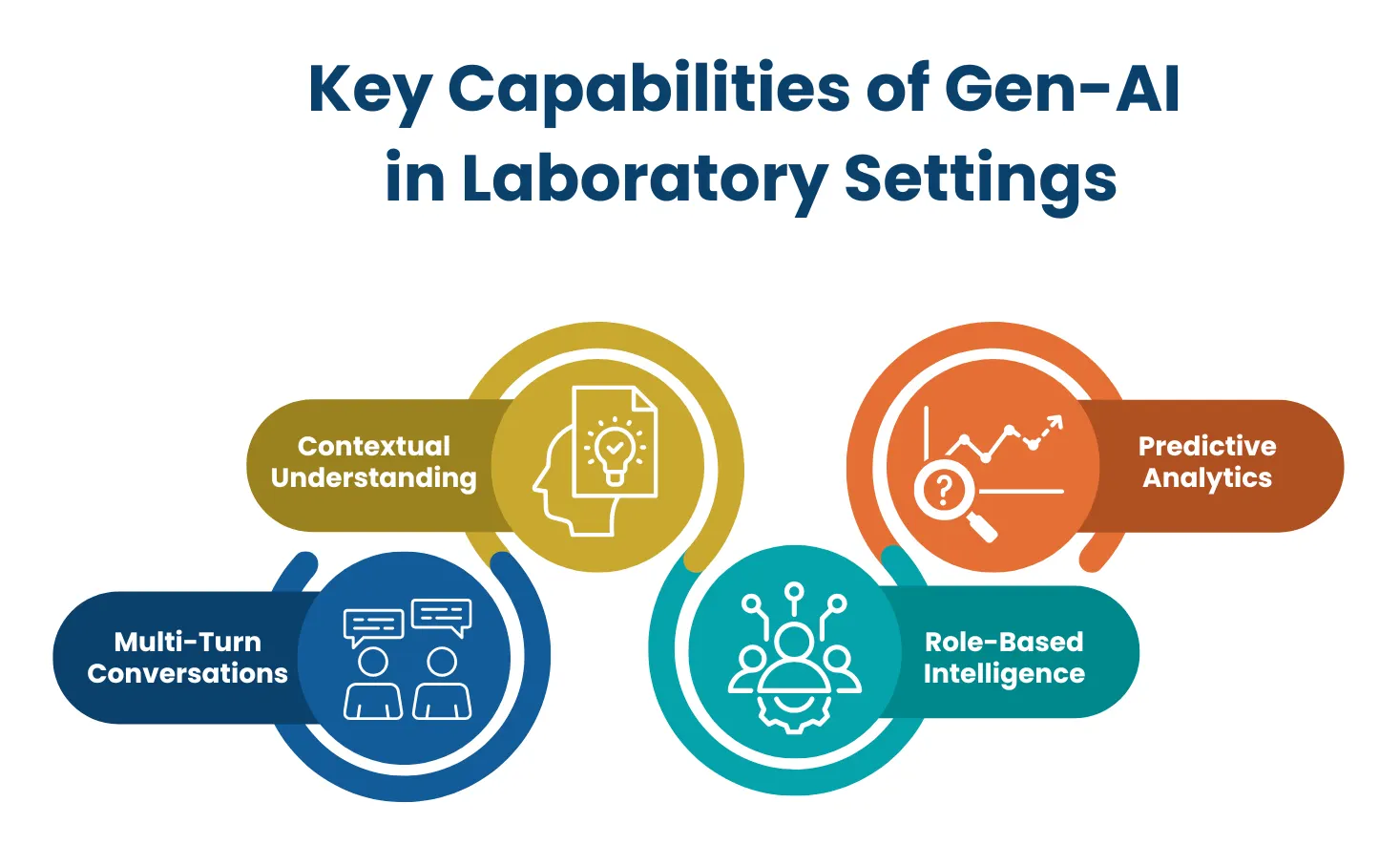
Contextual Understanding: Gen-AI assistants comprehend laboratory-specific terminology, acronyms, and workflows. They understand that "OOS" means out-of-specification, that "stability testing" refers to long-term product quality studies, and that "batch release" involves specific quality fcriteria.
Multi-Turn Conversations: Unlike simple search functions, Gen-AI chat assistants maintain conversation context, allowing users to ask follow-up questions and refine their queries naturally.
Predictive Analytics: Beyond retrieving historical data, these assistants can identify trends, predict potential issues, and suggest corrective actions based on patterns in laboratory data.
Role-Based Intelligence: AI assistants adapt responses based on user roles, providing detailed technical information to analysts while offering high-level summaries to management.
The Traditional LIMS Interface Challenge
The Complexity Problem
Traditional LIMS platforms, while powerful, often suffer from interface complexity. Built to handle diverse laboratory workflows across multiple industries, they typically feature:
- Hierarchical menu structures with dozens of options
- Multiple modules for different functions (sample management, testing, reporting, inventory)
- Query builders requiring knowledge of database fields and operators
- Report generation tools with extensive configuration options
- Complex filtering systems with cascading dependencies
For experienced LIMS administrators, these interfaces provide granular control. However, for the average laboratory technician, quality assurance specialist, or even lab manager, finding specific information often becomes a time-consuming task requiring either extensive training or assistance from IT personnel.
Real-World Impact of Interface Complexity
Training Burden: New laboratory staff typically require 2-4 weeks of LIMS training before achieving basic proficiency. Advanced features may take months to master.
Information Bottlenecks: When only a few trained individuals can extract complex data, laboratories develop information bottlenecks. Critical decisions get delayed waiting for the "LIMS expert" to generate the required reports.
Reduced Data Utilisation: Studies show that laboratories use only 30-40% of their LIMS capabilities, primarily because accessing advanced features requires technical expertise most staff don't possess.
Error Potential: Complex multi-step processes increase the likelihood of user errors, from selecting the wrong filters to misinterpreting report parameters.
The Traditional Data Retrieval Process
Consider a common scenario: A QA manager needs to identify all samples tested in the last month that showed pH values outside the acceptable range of 6.5-7.5.
Traditional LIMS Approach:
1. Log into LIMS and navigate to the Reports module
2. Select "Sample Testing Report" from a list of 50+ report types
3. Set date range parameters (start date, end date)
4. Navigate to filter settings
5. Add filter for test type: "pH Testing"
6. Add filter for result value: less than 6.5 OR greater than 7.5
7. Select output format (PDF, Excel, CSV)
8. Generate report
9. Export to Excel for additional analysis
10. Create charts or summaries as needed
Time Investment: 10-15 minutes (for experienced users)
Knowledge Required: Understanding of report types, filter logic, database fields, and Excel analysis
Error Risk: High (incorrect filters, wrong date formats, missing data)
Enter Gen-AI: The Conversational Revolution
How Natural Language Queries Transform LIMS
Gen-AI chat assistants fundamentally change the laboratory data access paradigm by allowing users to interact with LIMS as they would with a knowledgeable colleague.
The Same Scenario with Gen-AI:
User types or speaks: "Show me all samples from last month with pH results outside 6.5 to 7.5"
The AI assistant:
1. Understands the query intent
2. Identifies relevant data tables (samples, test results, pH measurements)
3. Applies appropriate filters (date range, pH values)
4. Retrieves and formats results
5. Presents data in an intuitive visual format
6. Offers follow-up options: "Would you like to see trends over time?" or "Should I identify the most common failure reasons?"
Time Investment: 30-60 seconds
Knowledge Required: Ability to describe what you need in plain language
Error Risk: Minimal (AI confirms interpretation if ambiguous)
Real-World Applications of Gen-AI Chat in Laboratories
Pharmaceutical Quality Control Laboratory
Scenario: Stability testing program management
Traditional Query Challenge: Generating comprehensive stability testing reports requires navigating multiple LIMS modules, understanding batch hierarchies, and correlating data across timepoints.
Gen-AI Solution:
- "Show me stability testing progress for Product X batches manufactured in Q4 2025"
- "Which stability samples are due for testing this week?"
- "Are any stability studies showing concerning trends?"
- "Compare current batch stability data with historical averages"
Impact: QA managers can expect 70% reduction in time spent on stability program monitoring, enabling more proactive quality management.
Environmental Testing Laboratory
Scenario: Multi-site water quality monitoring
Traditional Query Challenge: Consolidating data from multiple sampling locations, correlating with regulatory limits, and identifying compliance issues requires extensive manual data manipulation.
Gen-AI Solution:
- "Which sampling sites exceeded EPA limits for lead in the past quarter?"
- "Show me contamination trends for Site A over the past year"
- "Alert me to any sampling locations approaching regulatory action limits"
- "Generate a compliance summary for all sites monitored in January"
Impact: Environmental managers can identify potential compliance issues 5x faster, enabling rapid response to emerging contamination problems.
Cannabis Testing Facility
Scenario: Multi-analyte compliance testing coordination
Traditional Query Challenge: Cannabis testing requires tracking potency, pesticides, heavy metals, microbiology, and residual solvents across regulatory frameworks that vary by state.
Gen-AI Solution:
- "Which samples failed any compliance tests this week and why?"
- "Show me potency distribution for Strain X across all batches tested"
- "Are we seeing any patterns in pesticide failures by cultivator?"
- "Generate state compliance report for California samples tested in January"
Impact: Lab directors can expect 60% faster compliance reporting and improved ability to provide cultivator clients with actionable quality insights.
Demonstrating Revol LIMS Gen-AI Chat Features
Core Capabilities
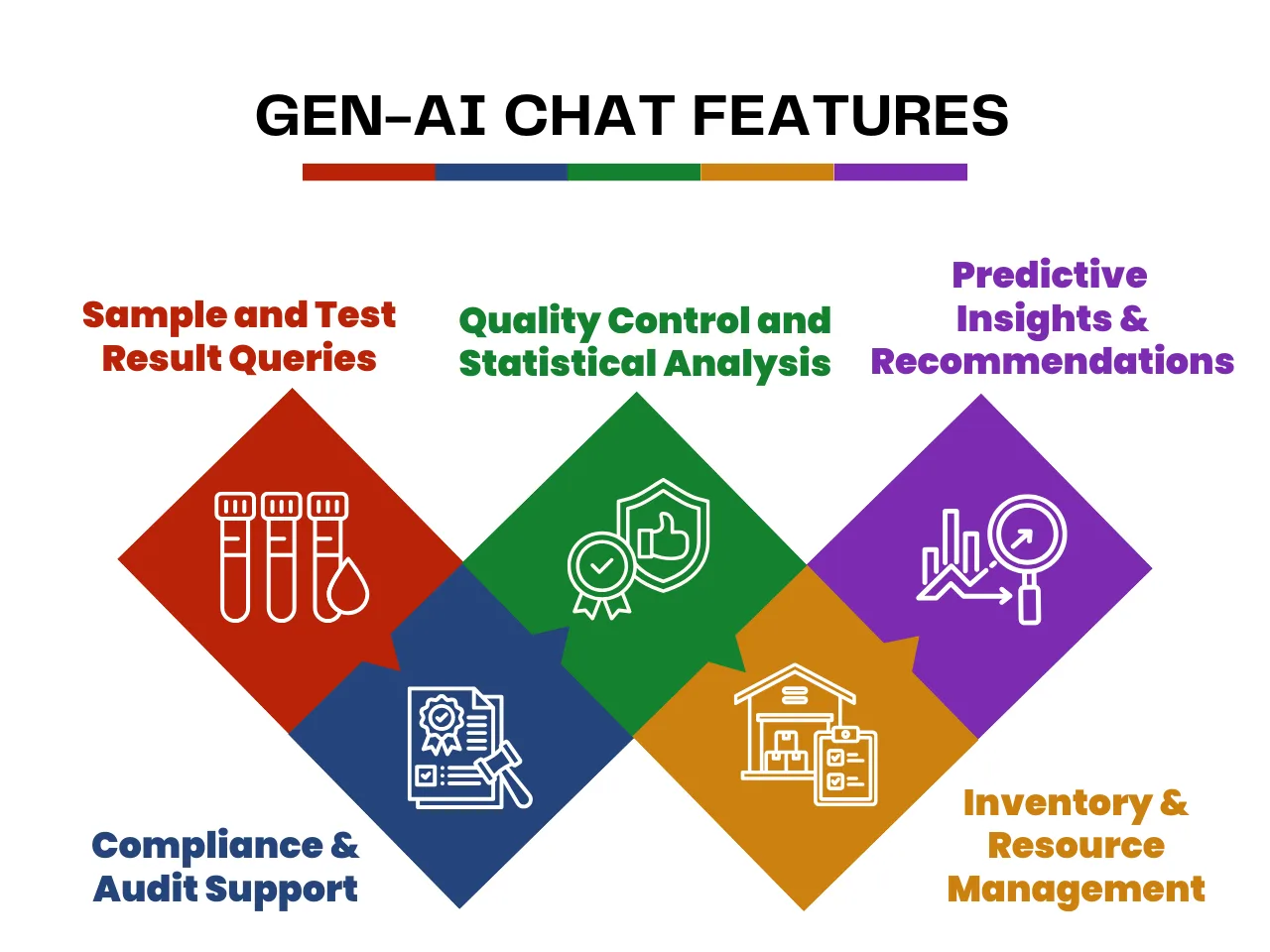
Revol LIMS integrates a sophisticated Gen-AI chat assistant specifically designed for laboratory operations. Our implementation goes beyond simple query retrieval to provide comprehensive laboratory intelligence.
1. Sample and Test Result Queries
The AI assistant understands laboratory workflows and can retrieve sample information across the entire testing lifecycle:
Example Queries:
- "Show me samples received today from Client ABC"
- "Which samples have been in the lab longer than our turnaround time commitment?"
- "Find all samples tested for heavy metals with results above action limits"
- "What's the average turnaround time for microbiological testing this month?"
The assistant presents results in intuitive formats, including tables, charts, and summary statistics, automatically choosing the most appropriate visualisation based on the data type and query intent.
2. Quality Control and Statistical Analysis
Quality control is central to laboratory operations. Revol's Gen-AI assistant provides intelligent QC monitoring:
Example Queries:
- "Show me the QC chart for instrument calibration over the past month"
- "Are any QC trends indicating instrument drift?"
- "Which analysts have the highest out-of-specification rates for pH testing?"
- "Generate Statistical Process Control charts for all critical tests"
The AI automatically applies appropriate statistical methods, identifies trends, and flags potential issues requiring attention.
3. Compliance and Audit Support
Regulatory compliance requires rapid access to documented evidence. The Gen-AI assistant serves as an intelligent audit preparation tool:
Example Queries:
- "Show me all test method deviations documented in Q4 2025"
- "Generate audit trail for Sample ID 12345"
- "Which batches failed initial testing but passed on retest?"
- "Provide documentation for all analyst training and qualifications"
The assistant ensures responses include all necessary documentation for regulatory review, including electronic signatures, timestamps, and change histories.
4. Inventory and Resource Management
Efficient laboratory operations require careful management of reagents, consumables, and equipment:
Example Queries:
- "Which reagents are expiring in the next 30 days?"
- "Show me current inventory levels for HPLC columns"
- "Which instruments are due for calibration this week?"
- "Alert me when any critical consumable drops below the minimum stock level"
The AI provides proactive inventory management, preventing testing delays due to stock-outs or expired materials.
5. Predictive Insights and Recommendations
Beyond retrieving historical data, Revol's Gen-AI assistant identifies patterns and provides actionable recommendations:
Example Queries:
- "What factors correlate with out-of-specification results in Product X?"
- "Predict instrument maintenance needs based on usage patterns"
- "Are there any emerging quality trends I should be aware of?"
- "Recommend optimal testing schedules based on sample volume forecasts"
This predictive capability transforms LIMS from a passive database into an active quality intelligence platform.
User Interface and Experience
The Revol Gen-AI chat interface is accessible throughout the LIMS platform via:
Persistent Chat Window: Always available in the corner of every screen, allowing users to ask questions without navigating away from their current task.
Voice Input Option: Users can speak queries rather than type, particularly useful in laboratory environments where hands may be occupied or gloved.
Mobile Access: Full Gen-AI functionality available through the Revol LIMS mobile app, enabling field sampling teams and remote staff to access laboratory data conversationally.
Contextual Awareness: The AI understands the user's current screen context. If viewing a specific sample, the assistant knows to interpret "show me test results" as referring to that sample.
Empowering Non-Technical Staff
Breaking Down Technical Barriers
One of the most significant advantages of Gen-AI chat assistants is democratizing data access across the entire laboratory team.
Laboratory Technicians
Traditional Challenge: Technicians typically receive minimal LIMS training focused on their immediate tasks (sample login, result entry). Accessing broader laboratory data requires assistance from supervisors or IT.
Gen-AI Empowerment:
- "Show me my assigned samples for today"
- "What's the priority order for these samples?"
- "Which samples am I waiting on results from QC?"
- "How does my productivity this month compare to my average?"
Technicians gain autonomy in managing their workload and can proactively identify bottlenecks without supervisor intervention.
Quality Assurance Specialists
Traditional Challenge: QA review requires correlating data across multiple LIMS modules, often necessitating complex report generation or database queries.
Gen-AI Empowerment:
- "Show me all pending batch release approvals"
- "Which batches have deviations requiring investigation?"
- "Generate trend analysis for out-of-specification results by product line"
- "Compare current month quality metrics to historical performance"
QA specialists spend less time extracting data and more time on critical analysis and decision-making.
Laboratory Managers
Traditional Challenge: Management oversight requires consolidating data from multiple sources, often requiring IT support for custom reporting.
Gen-AI Empowerment:
- "Dashboard view of laboratory performance metrics"
- "Which clients have samples exceeding turnaround time commitments?"
- "Show me resource utilisation by instrument and analyst"
- "Forecast testing capacity for next month based on current backlog"
Managers gain real-time visibility into operations, enabling data-driven decision-making without dependence on scheduled reports.
Client Service Representatives
Traditional Challenge: Client inquiries about sample status require looking up information in LIMS, often requiring training on multiple search functions.
Gen-AI Empowerment:
- "What's the status of all samples from Client XYZ?"
- "When will results be available for Sample ID 12345?"
- "Show me all completed reports for this client in the past week"
- "Has the client been notified of out-of-specification results?"
Client service teams provide immediate, accurate responses to client inquiries, improving customer satisfaction.
Training and Adoption
The learning curve for Gen-AI chat interfaces is dramatically shorter than traditional LIMS training:
Traditional LIMS Training: 2-4 weeks for basic proficiency, 3-6 months for advanced features
Gen-AI Interface Training: 1-2 days for basic proficiency, ongoing discovery of capabilities through natural exploration
New staff can begin asking questions immediately, learning the system's capabilities organically through interaction rather than structured training programs.
Traditional vs. Conversational Interfaces: A Detailed Comparison
Speed and Efficiency
Traditional Interface:
- Multi-step navigation: 5-15 clicks to reach desired information
- Filter configuration: 2-10 minutes for complex queries
- Report generation: 5-20 minutes depending on complexity
- Data export and manipulation: 5-30 minutes for analysis
- Total time for complex queries: 15-60 minutes
Conversational Interface:
- Single query input: 1 interaction
- AI processing: 5-30 seconds
- Results presentation: Immediate
- Follow-up refinement: 5-10 seconds per iteration
- Total time for complex queries: 30 seconds - 2 minutes
Efficiency Gain: 80-95% reduction in data retrieval time
Accuracy and Error Reduction
Traditional Interface Error Points:
- Selecting the wrong report type
- Incorrect filter logic (AND vs. OR operations)
- Date format errors
- Missing required fields
- Misinterpreting database field names
- Average error rate: 15-25% for complex queries (user correction required)
Conversational Interface Error Points:
- Ambiguous query phrasing (AI requests clarification)
- Average error rate: 2-5% (AI confirms interpretation before execution)
Accuracy Improvement: 80-90% reduction in query errors
Knowledge Requirements
Traditional Interface Requirements:
- Understanding of LIMS module architecture
- Knowledge of database schema and field relationships
- Familiarity with query builder logic
- Report configuration expertise
- Data export and manipulation skills
- Required training: 40-80 hours for proficiency
Conversational Interface Requirements:
- Ability to describe information needs in natural language
- Basic understanding of laboratory terminology (which staff already possess)
- Required training: 4-8 hours for proficiency
Training Reduction: 85-90% less time to achieve operational proficiency
Flexibility and Adaptability
Traditional Interface:
- Predefined report templates
- Fixed filter combinations
- Limited customisation without IT involvement
- New report types require formal requests and development time
- Adaptation time for new requirements: Days to weeks
Conversational Interface:
- Unlimited query variations
- Natural language allows novel question formulations
- Immediate adaptation to new information needs
- AI learns from user patterns and preferences
- Adaptation time for new requirements: Immediate
Flexibility Advantage: Real-time adaptability vs. scheduled development cycles
Data Accessibility
Traditional Interface:
- 20-30% of staff can independently access complex data
- 70-80% require assistance for advanced queries
- Information bottlenecks around trained "LIMS experts"
- Critical decisions delayed waiting for report generation
- Organisational data literacy: Low to moderate
Conversational Interface:
- 80-90% of staff can independently access complex data
- 10-20% require occasional assistance
- Distributed data access across the entire team
- Real-time information availability for decision-making
- Organisational data literacy: High
Accessibility Improvement: 3-4x increase in staff capable of independent data access
Technical Implementation and Compliance
Data Security and Access Control
A common concern with AI-powered systems is data security. Revol LIMS implements robust security measures, ensuring Gen-AI chat maintains the same strict access controls as traditional interfaces:
Role-Based Access: The AI assistant respects all configured user permissions. A laboratory technician asking "Show me all pending samples" receives only samples they have permission to view, while a QA manager sees the complete laboratory workload.
Audit Trail Integrity: Every Gen-AI query is logged with full audit trail documentation, including:
- User identification
- Timestamp
- Query text
- Data accessed
- Results returned
- Any actions taken based on query results
This ensures complete traceability for regulatory compliance and meets 21 CFR Part 11 requirements for electronic records.
Data Privacy: The AI assistant operates within the secure LIMS environment. No laboratory data is transmitted to external AI services, ensuring protection of confidential client information and proprietary formulations.
Regulatory Compliance
Gen-AI chat assistants in LIMS must maintain the same rigorous compliance standards as traditional interfaces:
ISO 17025 Compliance: The AI assistant provides documented traceability for all data queries supporting laboratory accreditation requirements.
21 CFR Part 11 Compliance: Electronic signatures, audit trails, and data integrity measures extend to AI-generated queries and reports.
GxP Compliance: For pharmaceutical laboratories, the AI assistant operates within validated systems, with all functionalities subject to the same qualification and validation protocols as traditional LIMS features.
Data Integrity (ALCOA+): AI-generated queries and results maintain data integrity principles:
- Attributable: All queries linked to specific users
- Legible: Results presented in clear, understandable formats
- Contemporaneous: Real-time timestamping of all interactions
- Original: Access to original data sources maintained
- Accurate: AI interpretations verified against source data
- Complete: Full context preserved in audit trail
- Consistent: Standardised query processing and result formatting
- Enduring: Permanent record retention
- Available: On-demand access to query history
Best Practices for Implementing Gen-AI in LIMS
1. Start with High-Value Use Cases
Identify queries that:
- Consume significant staff time currently
- Require specialised LIMS knowledge
- Are asked frequently across the organisation
- Support critical business processes
Begin with these use cases to demonstrate immediate value and build user confidence.
2. Provide Guided Discovery
While Gen-AI interfaces are intuitive, providing example queries helps users discover capabilities:
Sample Query Library:
- "Show me samples received today"
- "Which instruments need calibration this week?"
- "Generate QC trend chart for Test X"
- "What's our current testing backlog by test type?"
Users learn from examples and begin formulating their own variations.
3. Encourage Experimentation
Create a culture where staff feel comfortable asking questions and refining queries. The AI learns from interaction patterns, improving responses over time.
4. Monitor and Optimise
Review query logs to:
- Identify common information needs
- Discover queries that could be answered more effectively
- Refine AI training for laboratory-specific terminology
- Identify opportunities for process improvements
5. Combine with Traditional Interfaces
Gen-AI chat complements rather than replaces traditional LIMS interfaces. Complex data entry, configuration, and administration still benefit from structured interfaces. Use AI for data retrieval and analysis, and traditional interfaces for data management and system configuration.
The Future of AI in Laboratory Management
Emerging Capabilities
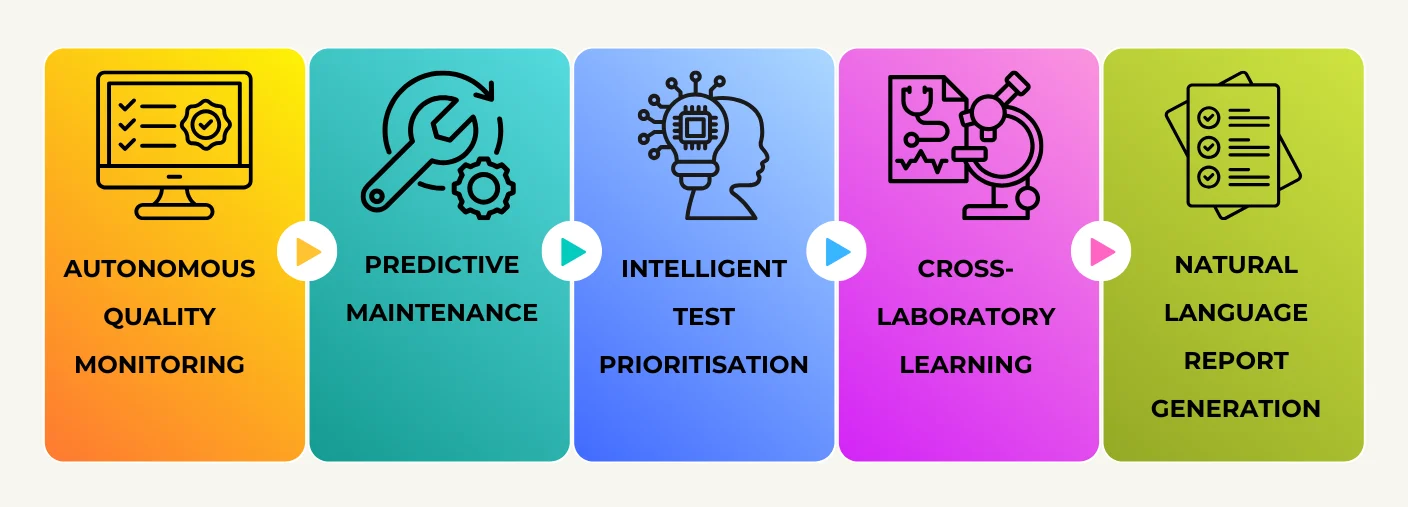
The evolution of Gen-AI in LIMS continues rapidly. Future developments include:
Autonomous Quality Monitoring: AI assistants that proactively alert staff to emerging quality trends, potential compliance issues, or equipment problems before they impact operations.
Predictive Maintenance: Analysis of instrument usage patterns, calibration histories, and performance trends to predict optimal maintenance schedules and prevent unexpected downtime.
Intelligent Test Prioritisation: Dynamic optimisation of testing sequences based on sample urgency, resource availability, analyst expertise, and regulatory requirements.
Cross-Laboratory Learning: AI systems that learn from patterns across multiple laboratory installations, identifying best practices and potential improvements applicable to your specific operations.
Natural Language Report Generation: AI-generated narrative reports that not only present data but also provide contextual analysis and recommendations in professional report formats suitable for client delivery or regulatory submission.
Integration with Laboratory Ecosystem
Gen-AI assistants will increasingly serve as the integration point between LIMS and the broader laboratory ecosystem:
ERP Integration: "What's the revenue impact of our current testing backlog?" (combining LIMS sample data with ERP pricing information)
Instrument Integration: "Why did Instrument 5 generate out-of-spec results yesterday?" (analysing LIMS results alongside instrument diagnostics and maintenance logs)
Supply Chain Integration: "Will we have sufficient reagents to complete this week's testing schedule?" (correlating testing forecasts with inventory and procurement systems)
Conclusion: The Conversational Future of Laboratory Operations
The integration of Gen-AI chat assistants into LIMS represents more than a technological upgrade; it fundamentally transforms how laboratories operate. By making complex data instantly accessible through natural language, AI breaks down barriers that have historically limited laboratory efficiency and decision-making.
The impact extends across every level of laboratory operations:
Laboratory staff gain autonomy and efficiency, spending less time searching for information and more time applying their scientific expertise.
Quality assurance teams achieve real-time visibility into laboratory performance, enabling proactive rather than reactive quality management.
Management obtains comprehensive operational insights without dependence on scheduled reports or IT resources, supporting data-driven strategic decisions.
Clients receive faster, more accurate responses to inquiries, improving satisfaction and retention.
As laboratory operations continue to grow in complexity and regulatory requirements intensify, the ability to access and analyse data conversationally will transition from a competitive advantage to an operational necessity.
Revol LIMS leads this transformation with Gen-AI chat capabilities designed specifically for laboratory workflows, compliance requirements, and the unique needs of quality-focused organisations. Our implementation ensures that cutting-edge AI technology serves your laboratory's mission: delivering accurate, reliable results that protect public health and safety.
The future of laboratory management is conversational. The question is not whether to adopt Gen-AI chat assistants, but how quickly you can leverage this transformative capability to enhance your laboratory's performance, compliance, and competitiveness.
Get Started with Revol LIMS
Ready to experience the power of conversational laboratory management?
Contact our team today to discover how Revol LIMS can transform your laboratory operations.
Request a Demo| Contact Sales | Learn More About Revol LIMS
Frequently Asked Questions
Q: How does Gen-AI chat maintain data security and comply with regulations like 21 CFR Part 11?
A: Revol's Gen-AI assistant operates entirely within your secure LIMS environment with full audit trail documentation. All queries are logged with user identification, timestamps, and accessed data. The AI respects role-based access controls, ensuring users only access data they're authorised to view. No laboratory data is transmitted to external AI services.
Q: What happens if the AI doesn't understand my query?
A: The AI assistant asks clarifying questions when queries are ambiguous. For example, if you ask "show me failures," the AI might respond, "Would you like to see test failures, instrument failures, or quality control failures?" This conversational refinement ensures accurate results.
Q: Can the AI assistant modify data or only retrieve information?
A: The current implementation focuses on data retrieval and analysis to maximise safety and compliance. Data modifications still require traditional LIMS workflows with appropriate approvals and electronic signatures. This separation ensures data integrity while providing powerful query capabilities.
Q: How long does AI implementation take?
A: Gen-AI chat is integrated into Revol LIMS core functionality, available immediately upon system deployment. Customisation for laboratory-specific terminology typically requires 1-2 weeks of AI training based on your workflows and data patterns.
Q: Does using AI require special technical skills?
A: No. If staff can describe what information they need in a normal conversation, they can use the AI assistant effectively. Basic training (4-8 hours) familiarises users with capabilities and best practices, but the interface is designed to be immediately intuitive.
Q: Will AI replace our LIMS administrators or reduce staff needs?
A: Gen-AI augments rather than replaces staff. LIMS administrators focus on system configuration, validation, and optimisation rather than repetitive data extraction. Laboratory staff redirect time from information searching to scientific analysis and decision-making. Organisations typically report improved efficiency and job satisfaction rather than staff reductions.
Published: January 2026 Author: Revol LIMS Team Category: Laboratory Technology, AI Innovation, LIMS Features
Related Articles:
- What is a LIMS? Complete Guide to Laboratory Information Management Systems
- LIMS Key Features: Essential Capabilities for Modern Laboratories
- ISO 17025 Compliance Made Easy with LIMS
About Revol LIMS
Revol LIMS is an AI-powered, industry-tailored Laboratory Information Management System providing global access with ISO 17025 and FDA 21 CFR Part 11 compliance. Available on-premise or in the cloud (PaaS/SaaS), Revol LIMS serves pharmaceutical, environmental, cannabis, forensic, and chemical testing laboratories worldwide with fast implementation (8-12 weeks), transparent pricing, and comprehensive support.
Learn more: www.revollims.com