HPLC Data Integrity Challenges and How LIMS Solves Them
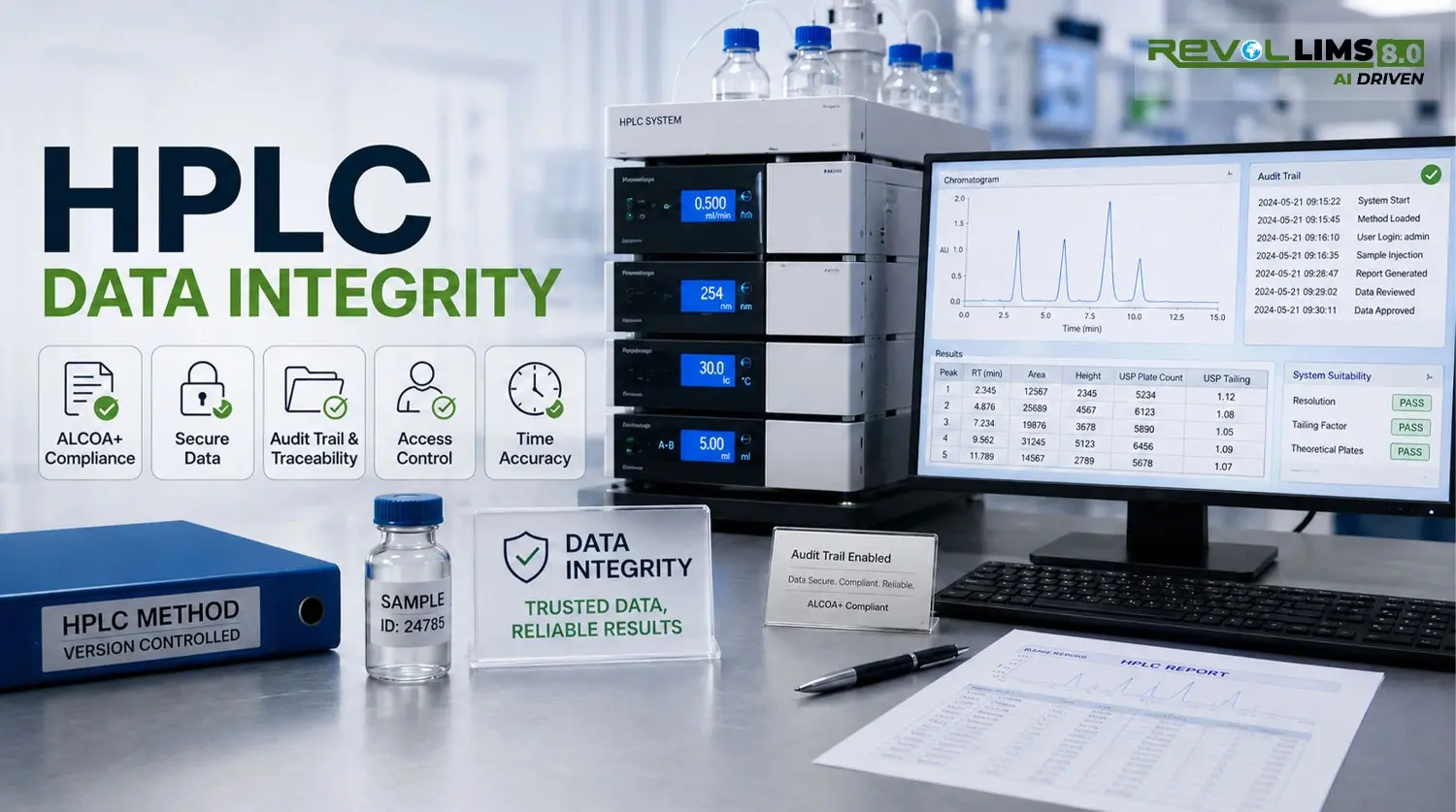
HPLC data integrity failures are one of the most frequent triggers of FDA warning letters and ISO 17025 non-conformances in analytical laboratories. They don't originate in instrument malfunctions — they come from missing controls: files that can be deleted, integrations that can be edited without a record, and audit trails that can be turned off.
A modern LIMS addresses each of these gaps directly by enforcing technical controls at the workflow level — controls that policy documents and SOPs alone cannot replicate. This post covers the four risk areas regulators consistently flag in HPLC environments and shows the specific mechanism each LIMS control uses to close them.
Key takeaways
- HPLC data integrity failures are among the most frequently cited drivers of FDA warning letters and ISO 17025 non-conformances.
- Four risk areas account for most findings: raw injection file deletion, undocumented manual peak integration, disabled or fragmented audit trails, and backdated system timestamps.
- A modern LIMS closes each gap through technical enforcement — making non-compliant actions impossible, not just prohibited.
- Compliance spans FDA 21 CFR Part 11, EU Annex 11, ISO/IEC 17025:2017, and the ALCOA+ framework simultaneously.
- QA review gates and automated OOS investigation workflows remove the possibility of releasing unreviewed or unresolved results.
What This Article Covers
- What is HPLC data integrity — and why is it regularly compromised?
- The four risk areas regulators flag most often
- How LIMS closes each HPLC data integrity gap
- Regulatory compliance coverage
- Frequently asked questions
- Key takeaway
1. What Is HPLC Data Integrity — and Why Is It Regularly Compromised?
HPLC data integrity means that every chromatographic record — raw injection files, integration parameters, peak tables, and method versions — is complete, unaltered, and traceable to the analyst, instrument, and moment it was created. The ALCOA+ framework (Attributable, Legible, Contemporaneous, Original, Accurate, plus Complete and Enduring) is the accepted standard against which regulators assess it.
In practice, integrity breaks down not because analysts intend fraud, but because systems are permissive where they should be restrictive. When a chromatography data system allows raw files to be renamed or deleted, when audit trails are an optional setting, and when QA review of chromatographic data is not built into the release workflow — the conditions for a data integrity finding are already in place.
2. The Four Risk Areas Regulators Flag Most Often
The table below represents the most frequently cited HPLC data integrity violations across FDA 483 observations and ISO audit reports.
| Risk Area | What Happens in Practice | Regulatory Consequence |
|---|---|---|
| Data Deletion | Failing injection files are discarded; only passing results are retained for reporting | FDA 483 / Warning Letter risk |
| Manual Integration | Peak baselines or windows adjusted post-run to shift OOS results into specification | GMP data integrity breach |
| Audit Trail Gaps | Trails disabled or incomplete — no user ID, timestamp, or justification for modifications | ISO 17025 accreditation loss |
| Back-Dated Records | System clock is altered to timestamp stability runs during equipment downtime or staffing shortfalls | 21 CFR Part 11 violation / legal |
1. Deletion of Raw Injection Files
Analysts working under result pressure sometimes run the same sample multiple times, retaining only the injection that produces a passing result. This practice — often called “cherry-picking” — is invisible in any system where raw files can be deleted or renamed after acquisition. The reported result looks clean; the discarded runs leave no footprint.
2. Undocumented Manual Peak Integration
Post-run integration edits — adjusting baselines, narrowing or widening peak windows, splitting merged peaks — directly affect reported peak areas and heights. When performed without a validated justification and without a change record, they convert a failing result into a passing one with no audit trail linking the two states. EU Annex 11 and FDA data integrity guidance both require that the original integration and any modification be preserved and attributable.
3. Disabled or Fragmented Audit Trails
An audit trail that omits the user ID, skips a timestamp, or requires a manual action to activate is not audit trail compliance — it is the appearance of it. Regulators look specifically for whether trails are system-enforced (always on, not optional) and whether they capture the reason for every change, not just the change itself.
4. Backdated System Timestamps
Altering the operating system clock before running or documenting a stability test to cover equipment downtime or staffing gaps is falsification of a regulated record. It is a direct violation of 21 CFR Part 11 — and one of the clearest grounds for a criminal referral in enforcement actions.
3. How LIMS Closes Each HPLC Data Integrity Gap
A LIMS resolves HPLC data integrity failures by replacing policy-level controls with technical enforcement — making non-compliant actions impossible rather than just prohibited. It does not compete with or replace chromatography data systems like Waters Empower or Agilent OpenLab CDS; it operates as the governance layer above them, controlling who can act on data, when, and under what authorisation.
The table below maps each gap to the specific LIMS mechanism that addresses it. The sections that follow explain how each works.
| HPLC Data Integrity Gap | LIMS Control That Closes It |
|---|---|
| Files deleted after failed runs | Immutable data lock — every injection registered and preserved; deletion blocked system-wide |
| Silent manual peak integration | CDS bridge enforces validated auto-integration; any override requires dual e-signature + documented scientific rationale |
| Fragmented or disabled audit trail | Always-on, server-side audit trail — user ID, timestamp, change type, and reason captured for every regulated record action |
| Backdated system timestamps | NTP-synced server clock — client-side time manipulation has zero effect on stored records |
| No independent QA data review | Configurable two-person review gate — QA sign-off mandatory before any result is released to reporting |
| OOS not formally investigated | Auto-flagging routes every out-of-specification result into a structured CAPA workflow with tracked closure |
Immutable Raw Data Lock
Once a sample is registered and an injection initiated, a modern LIMS preserves the associated raw data record in a locked state. Analysts cannot overwrite, rename, or remove injection files — passing or failing. Every run is retained in the sample record with its original server-side timestamp, making the full injection sequence visible to QA reviewers and auditors.
Controlled Peak Integration with Dual Authorisation
Integration modifications made inside the connected CDS are mirrored in the LIMS audit trail. Any manual override — adjusting a baseline, changing an integration window — triggers a mandatory dual e-signature step: the analyst justifies the change, and a second authorised reviewer approves or rejects it. The original and modified values, the reason code, and both electronic signatures are stored in the same record. No silent edits.
System-Wide, Always-On Audit Trail
The audit trail in a compliant LIMS cannot be toggled off by any user, including system administrators. Every create, modify, and delete action against a regulated record — results, methods, sample statuses — is captured with the user ID, server-synced timestamp, record type, and change description. QA teams can run a real-time trail review as a standing step in their data verification process, as recommended in FDA audit preparation guidance.
NTP-Synced Timestamps
All timestamps in a LIMS are issued by the server, synchronised to an NTP time source. Client-side clock changes — whether accidental or deliberate — have no effect on the record timestamps. A stability run documented at 14:32 on a given date was documented at exactly that time, and no client action can change that.
QA Review Gate Before Result Release
A LIMS enforces a configurable two-person review workflow. Results cannot be released to reporting until a designated QA reviewer has logged in, reviewed the chromatographic data and audit trail, and applied their electronic signature. This mirrors the second-person review requirement specified in both 21 CFR Part 11 / Annex 11 compliance guidance and ISO 17025 quality management requirements.
Automated OOS Investigation Workflow
When an HPLC result falls outside specification, the LIMS flags it immediately and withholds it from release. The OOS record automatically opens a CAPA workflow: root cause assignment, investigation steps, corrective action, and sign-off closure are all tracked in the same linked record. No out-of-specification result can be dismissed or overwritten without a completed investigation — and the investigation is fully auditable.
4. Regulatory Compliance Coverage
HPLC data integrity requirements span several overlapping frameworks. A modern LIMS is designed to meet all of them, across pharmaceutical, life science, and clinical research environments:
FDA 21 CFR PART 11
Electronic records & e-signatures — enforced through role-based access control, immutable records, and system-generated audit trails
EU ANNEX 11
GxP computerised systems — full system validation documentation, NTP-synced timestamps, backup and recovery controls
ISO/IEC 17025
Testing & calibration labs — method validation traceability, instrument calibration records, competency management
ALCOA+
Data integrity framework — Attributable, Legible, Contemporaneous, Original, Accurate, Complete, and Enduring records enforced by system design
5. Frequently Asked Questions
What are the main HPLC data integrity challenges in regulated labs?
The four most cited failures are: deletion of raw injection files after failed runs, undocumented manual changes to peak integration parameters, audit trails that are incomplete or disabled, and system timestamps altered to backdate stability records. Each is a technical gap — not a training issue — and each requires a system-level control to close it.
How does a LIMS prevent HPLC data manipulation?
By enforcing controls that make manipulation technically impossible or immediately visible: an immutable data lock prevents file deletion; dual e-signature requirements ensure every integration change is reviewed and documented; an always-on server-side audit trail captures every action; and NTP-synced timestamps cannot be altered by client-side clock changes.
Does a LIMS replace a CDS like Waters Empower or Agilent OpenLab?
No — the two systems serve different roles. A CDS governs instrument communication and raw data acquisition. A LIMS provides the sample management, workflow control, audit governance, and result release layer above it. LIMS and CDS are integrated so raw data flows automatically into governed records; neither replaces the other.
Which regulatory standards govern HPLC data integrity in pharma labs?
The primary frameworks are FDA 21 CFR Part 11 (electronic records and signatures), EU GMP Annex 11 (computerised systems in GxP environments), ISO/IEC 17025:2017 (testing and calibration lab competence), and the ALCOA+ data integrity principles. A compliant LIMS enforces all four simultaneously.
6. Key Takeaway
HPLC data integrity problems are persistent because the systems in most labs are permissive by default. Files can be deleted. Integrations can be changed silently. Audit trails can be disabled. These are architecture gaps — and architecture gaps require architecture fixes, not additional training or policy documents.
A LIMS shifts the compliance burden from individual behaviour to system enforcement. When analysts, QA reviewers, and instruments all operate within a single governed environment — one where every action is recorded, every deviation is flagged, and no data can be altered without a traceable authorisation — the probability of a data integrity finding drops to near zero. That is what LIMS is designed to deliver.
Secure your HPLC workflows with a modern LIMS
See how automated audit trails, role-based access, and validated integration protect every chromatographic result.
Request a Live DemoCONTINUE READING
- 21 CFR Part 11 & Annex 11 Compliance in LIMS
- FDA Audit Checklist for LIMS-Managed Labs
- Benefits of LIMS in Pharma, Food & Clinical Labs
Author: Revol LIMS Team · marketing@revollims.com · www.revollims.com



 (1) (1).webp)