Introduction
In a forensic laboratory , a single documentation gap can unravel an entire case.
It doesn’t take a catastrophic mistake. A missing signature on a transfer log. A timestamp that doesn’t match. A sample that was re-labeled without a recorded reason. These are the kinds of small, often human, errors that defense attorneys exploit — and that judges use to exclude evidence from court proceedings.
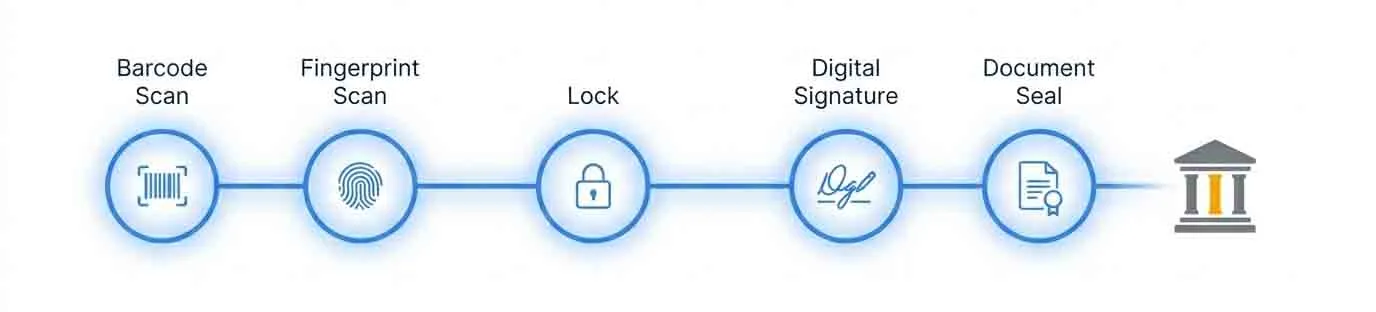
The chain of custody is the foundation of forensic science. It is the unbroken, documented record that proves evidence has been handled correctly from the moment it was collected to the moment it appears in a courtroom. When that record breaks — even slightly — the credibility of everything that lab produces is called into question.
The challenge is that for decades, most forensic labs have tried to maintain that record manually. Paper logs. Binders. Spreadsheets. Handwritten signatures passed from one technician to the next. And while these systems worked well enough in smaller, simpler times, they are no longer adequate for the scale and scrutiny that modern forensic laboratories face.
This is where a forensic Laboratory Information Management System (LIMS) changes everything.
What Is Chain of Custody in Forensic Labs?
In a forensic context, this documentation must be:
- Continuous — no gaps from evidence intake to final report
- Tamper-evident — any unauthorized change must be detectable
- Legally defensible — structured to meet court admissibility standards
- Auditable — reviewable at any point by accreditation bodies, attorneys, or investigators
A broken chain of custody doesn’t just mean a failed case. It can mean years of wrongful prosecution, destroyed reputations, and lost accreditation. For labs seeking ASCLD accreditation or ISO/IEC 17025 certification, chain of custody documentation is not optional — it is foundational.
The Real Problem: Where Manual Chain of Custody Breaks Down
Most forensic lab managers know their documentation processes aren’t perfect. The question is how often the gaps appear, and how serious they are when they do.
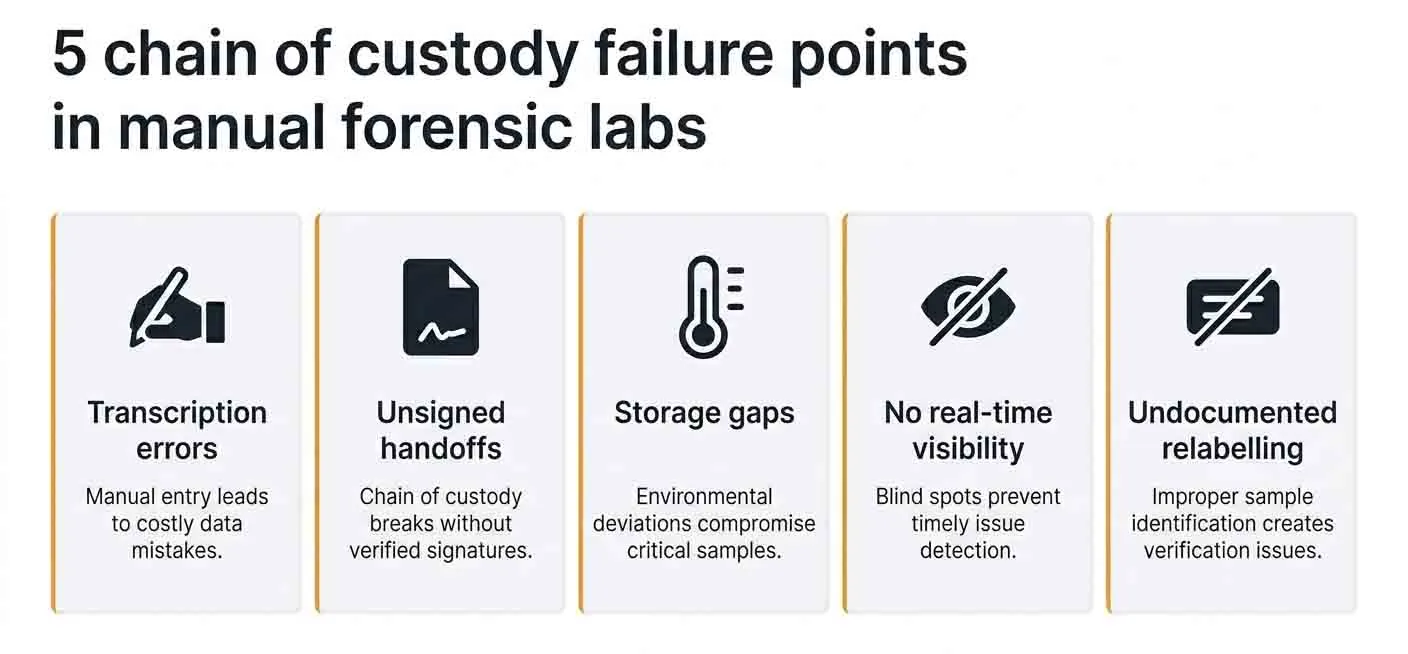
Here are the most common failure points in manual chain of custody management:
- 1. Handwriting and transcription errors When technicians manually log sample transfers, any illegible entry, incorrect date, or wrong sample ID number becomes a vulnerability. These errors are easy to make and hard to catch until it’s too late.
- 2. Unsigned or incomplete transfer logs In a busy lab, a technician receives a sample, sets it down to answer a question, and forgets to sign the log. Or a transfer happens verbally between shifts with no written record. These unsigned handoffs are among the most common chain of custody failures cited in court challenges.
- 3. Inconsistent storage documentation Evidence held in refrigerators, freezers, or secure vaults needs documented storage conditions and access records. Manual systems rely on refrigerator logs and lock-out sheets that are easy to miss, falsify, or simply lose.
- 4. No real-time visibility With a paper-based system, a supervisor cannot know at any given moment exactly where a sample is, who last handled it, or whether a required test has been completed. This lack of visibility makes it nearly impossible to catch problems before they become legal liabilities.
- 5. Re-labeling and re-assignment without audit records Samples sometimes need to be repackaged, re-labeled, or reassigned to a different analyst. In a manual system, these events are often underdocumented — a change gets made, but the reason, authorization, and timestamp don’t make it into the record.
How a Forensic LIMS Eliminates Documentation Gaps
A forensic laboratory is not simply a database for storing test results. It is a purpose-built workflow management system that enforces correct procedure at every step of the evidence lifecycle — making it structurally difficult to skip steps, mishandle samples, or lose documentation.
Here is how it works across the chain of custody workflow:
Evidence Intake and Registration
From the moment evidence arrives at the lab, a forensic LIMS captures every detail — case number, submitting agency, evidence type, condition on arrival, receiving officer, and date/time stamp — automatically logged without manual entry. Barcode or RFID scanning ties physical samples to digital records instantly, eliminating the risk of misidentification.
Automated Sample Tracking
Every movement of a sample through the lab — from intake to storage to analysis to archiving — is tracked in real time. The LIMS logs who moved it, when, and why. Transfers between analysts require a digital acknowledgment from both parties, creating a two-way verified handoff record that is far stronger than a paper signature.
Role-Based Access Control
Not everyone in a forensic lab should have access to every case or every sample. A forensic LIMS enforces role-based permissions, so only authorized personnel can access, modify, or transfer specific evidence. Every access attempt — successful or denied — is logged. This creates a complete access audit trail that documents not just what was done, but who tried to do what.
Electronic Signatures and Timestamps
A forensic LIMS captures legally compliant electronic signatures with timestamps at every required authorization point — sample receipt, test initiation, result verification, report approval, and sample disposal. These e-signatures carry the same legal weight as handwritten signatures and are far more reliable because they cannot be backdated, forged, or misplaced.
Storage Condition Monitoring
For evidence requiring temperature-controlled storage, a forensic LIMS can integrate with environmental monitoring systems to log conditions automatically. Every access to a storage location — vault, freezer, or secure cabinet — is recorded. This removes a major vulnerability from the chain of custody: unmonitored storage periods.
Immutable Audit Trails
Every action taken on a sample or case record in a forensic LIMS is written to an immutable audit log. If a result is amended, the original result is preserved alongside the change, the reason given, and the identity of the person who made it. Nothing is deleted. Nothing can be silently overwritten. This is the digital equivalent of writing in ink — and it is exactly what courts and accreditation auditors expect to see.
Use Case: How a Regional Forensic Lab Strengthened Its Chain of Custody with LIMS
Consider a mid-sized regional forensic lab handling approximately 800 cases per month across toxicology, DNA, and trace evidence units.
Before implementing a forensic LIMS, the lab used a combination of paper logs, an older spreadsheet-based tracking system, and manual signature sheets. Chain of custody challenges from defense attorneys were common. The lab was spending an average of three days per contested case reconstructing documentation from scattered paper records.
After deploying a purpose-built forensic LIMS:
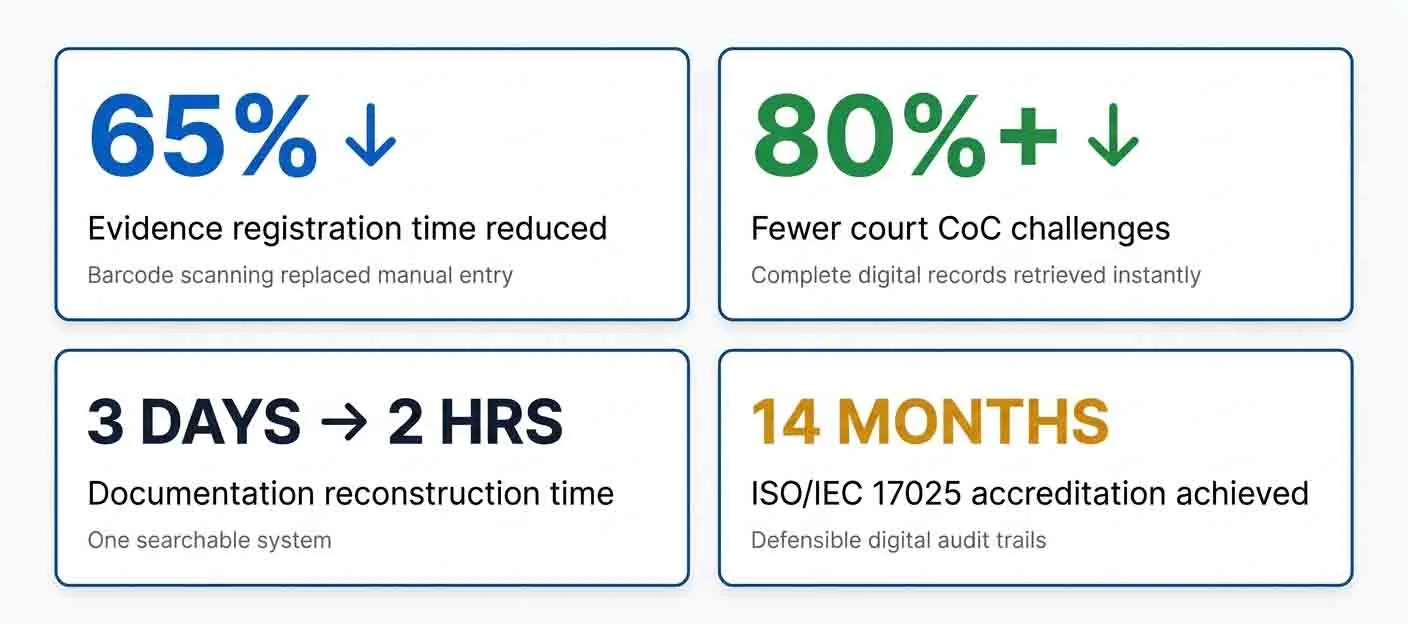
- Evidence registration time dropped by 65% — barcode scanning replaced manual data entry at intake
- Chain of custody challenges in court fell by over 80% .— complete digital records were immediately retrievable
- Documentation reconstruction for challenged cases went from 3 days to under 2 hours — everything was in one searchable system
- The lab achieved ISO/IEC 17025 accreditation within 14 months — in part due to the completeness and defensibility of its digital audit trails
These outcomes are not unusual. Labs that make the transition from manual documentation to forensic LIMS consistently report stronger accreditation outcomes, faster case turnaround, and substantially fewer legal challenges to their evidence handling.
Key Benefits of LIMS for Forensic Chain of Custody Management
Full compliance with ASCLD and ISO/IEC 17025 requirements Forensic LIMS is designed around the accreditation and compliance requirements that govern forensic labs. Chain of custody documentation meets or exceeds what ASCLD and ISO 17025 assessors expect to see.
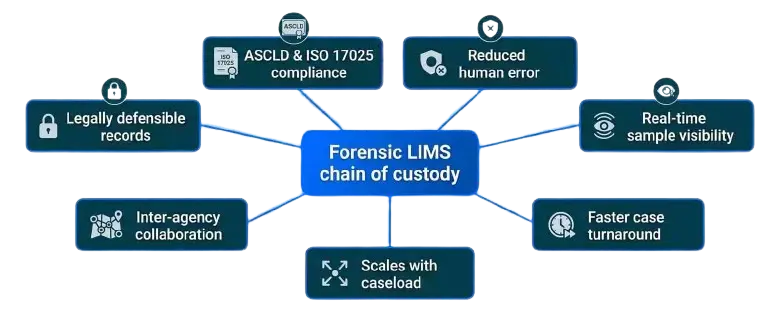
Reduced human error Automated logging, barcode scanning, and mandatory acknowledgment steps eliminate the transcription errors, unsigned handoffs, and forgotten entries that plague manual systems.
Real-time sample visibility Supervisors and case managers can see exactly where every piece of evidence is at any given moment — which analyst has it, what stage of testing it’s in, and what remains to be done.
Faster case turnaround When technicians spend less time on documentation and more time on analysis — and when supervisors spend less time chasing paper trails — the entire case cycle accelerates.
Scalability without complexity As case volumes grow, a forensic LIMS scales with the lab. Whether a lab processes 200 cases a month or 2,000, the chain of custody process stays consistent, controlled, and compliant.
Stronger inter-agency collaboration When multiple agencies are involved in a case, a forensic LIMS provides secure, role-controlled access so that relevant parties can view documentation without compromising evidence integrity.
What to Look for in a Forensic LIMS for Chain of Custody Management
Not every LIMS is built for forensic work. Here is what separates a purpose-built forensic LIMS from a generic system adapted for the job:
- Forensic-specific chain of custody workflows — not just sample tracking borrowed from a pharma or environmental module
- Court-admissible electronic signatures — compliant with legal evidentiary standards, not just internal sign-off tools
- Immutable, searchable audit logs — no edit history overwriting, no silent deletions
- Evidence disposition and archival tracking — managing samples from intake through long-term storage or court release
- Integration with instrument data systems — so test results flow directly from analytical equipment into case records without manual transcription
- Configurable role-based access — matching the actual organizational structure of a forensic lab
- Accreditation-ready documentation outputs — generating the reports and records that ASCLD and ISO/IEC 17025 assessors look for
Common Questions About Forensic LIMS and Chain of Custody
Can a LIMS completely replace paper chain of custody records? Yes — in most jurisdictions, electronic chain of custody records with compliant electronic signatures are fully acceptable in court. In fact, digital records are often considered more reliable than paper because they are timestamped, immutable, and cannot be lost. Labs should verify local evidentiary rules, but the trend across jurisdictions is clear: digital is the standard.
Does implementing a forensic LIMS require full lab shutdown for transition? No. A phased implementation — starting with intake and tracking, then adding reporting and instrument integration — allows labs to transition with minimal disruption to ongoing casework.
How long does it take to see measurable improvements in chain of custody documentation? Most labs report significant improvements within the first 60 to 90 days of going live — particularly in documentation completeness and the time required to retrieve records for audits or legal review.
The Bottom Line
The chain of custody is not just a procedural formality. It is the spine of forensic science. When it breaks — even once, even slightly — the consequences extend far beyond the lab. Cases collapse. Accreditations are jeopardized. Justice is delayed or denied.
Forensic labs that still rely on paper logs, spreadsheets, and manual signatures are carrying a risk that simply does not need to exist anymore. A purpose-built forensic LIMS eliminates the documentation gaps that those systems inevitably create — not by adding more paperwork, but by making correct documentation the default outcome of every step in the workflow.
The question is not whether forensic labs need digital chain of custody management. It is how long they can afford to operate without it.
Ready to Strengthen Your Forensic Lab’s Chain of Custody?
Revol LIMS is built for the specific demands of forensic laboratory work — from evidence intake to court-ready reporting. Our forensic LIMS gives your lab complete, legally defensible chain of custody documentation, real-time sample visibility, and the audit trail depth that accreditation bodies and courts expect.
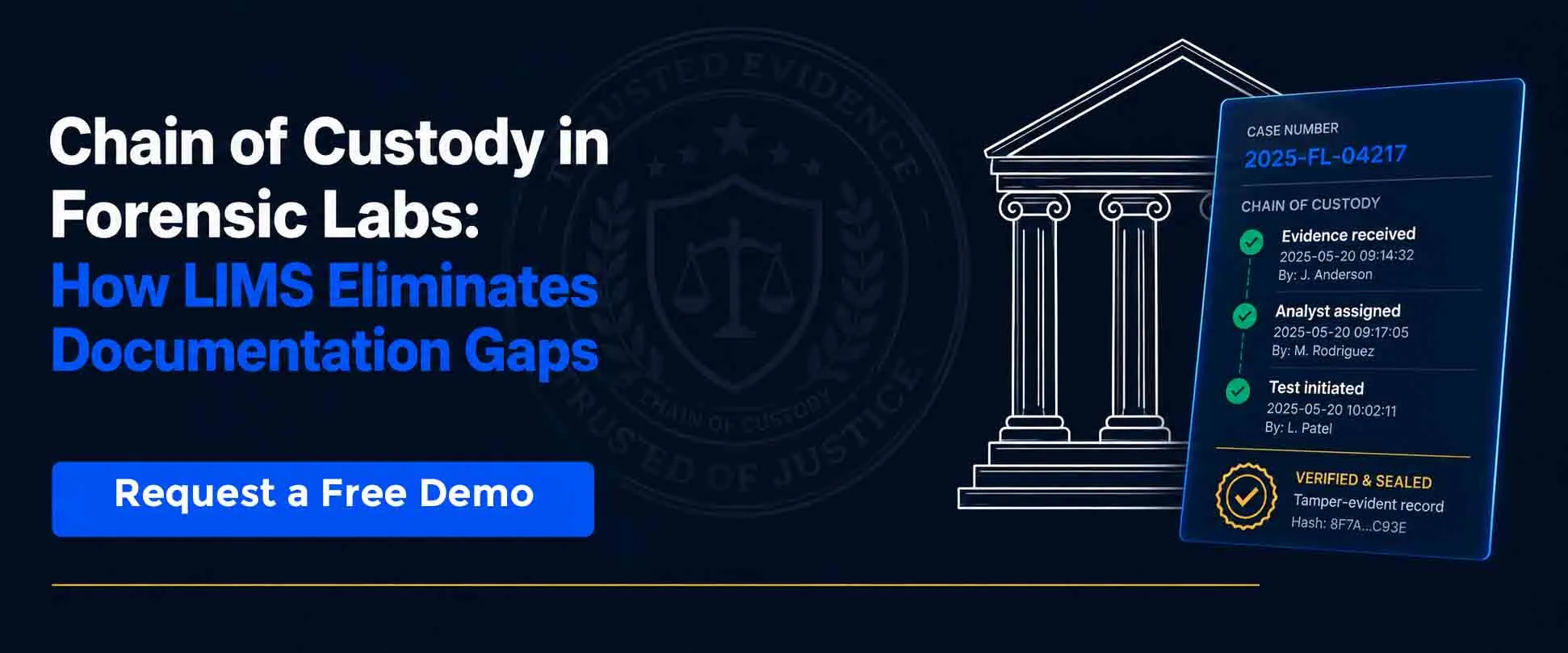
See exactly how our forensic LIMS handles chain of custody, sample tracking, and evidence management — tailored to your lab’s workflows and caseload.
Or explore our Forensic LIMS solution page to learn more about how Revol LIMS supports forensic laboratories at every scale.






 (1) (1).webp)

.webp)