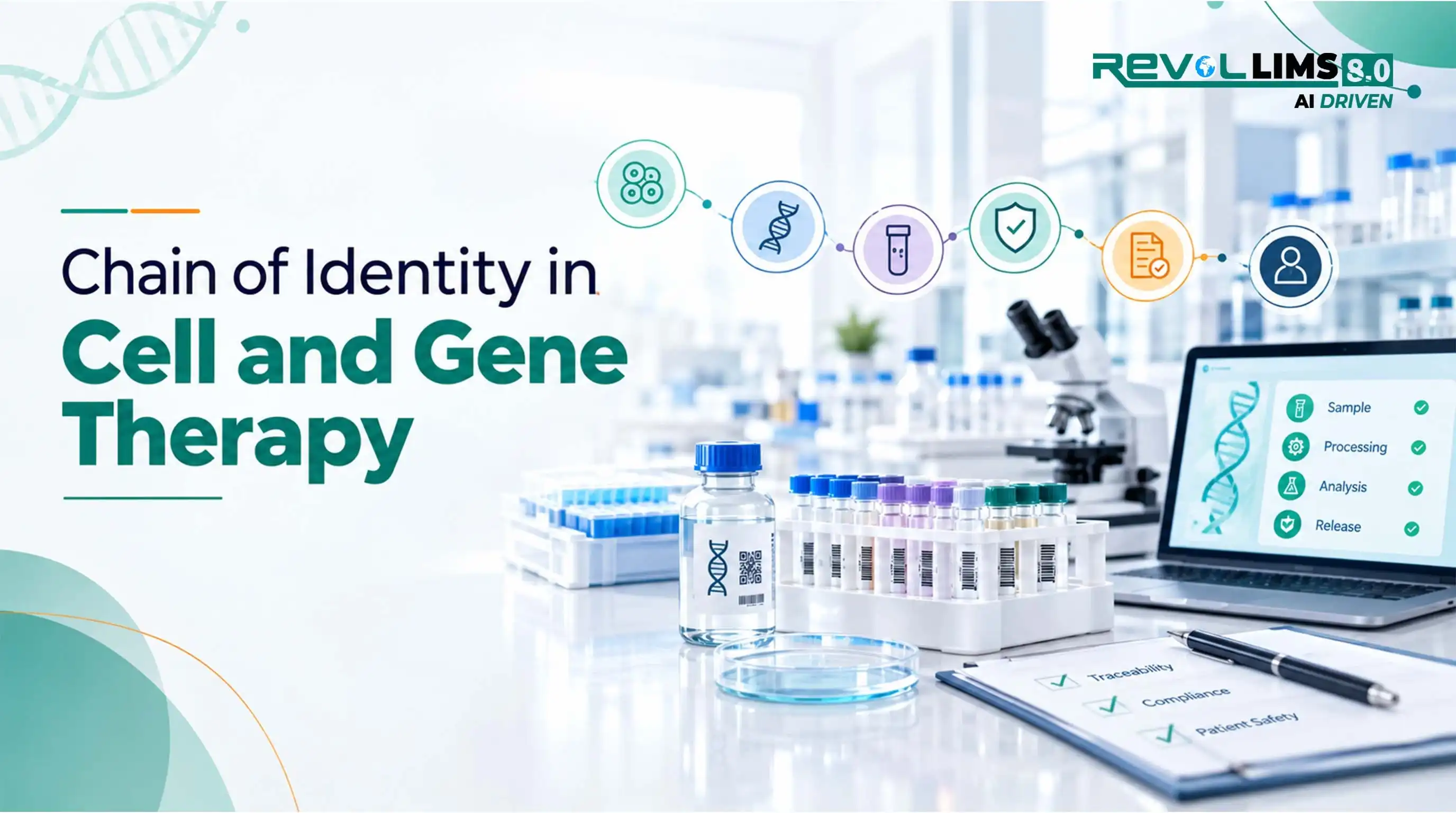
Chain of Identity in Cell & Gene Therapy: Traceability Guide
Key Takeaways
- COI links a patient or donor to their material and the final therapeutic product, end to end.
- COI confirms whose material it is; Chain of Custody confirms who handled it and when — most CGT workflows need both.
- Gaps usually trace back to manual entry, labeling issues, multiple handoffs, or disconnected records.
- A connected LIMS carries identity data forward automatically, so it's never manually reconciled.
1. Why Identity Matters in Cell and Gene Therapy
Cell and gene therapy (CGT) workflows are unlike almost any other manufacturing process in the life sciences. A single therapeutic product can begin as a small volume of blood, bone marrow, or tissue collected from one specific person, travel through collection sites, couriers, processing laboratories, testing facilities, and cryogenic storage, and eventually return to that same person as an infused or implanted treatment. In autologous therapies, this loop closes with one individual; in allogeneic or donor-derived therapies, the material moves from one person to another, but the same principle applies — the source must always be knowable.
At every stage of this journey, the biological material passes through multiple hands, systems, and sometimes multiple facilities. Samples are aliquoted, transformed, engineered, expanded, and repackaged. Each handoff introduces a point where a label could be misapplied, a record could be duplicated, or two similar-looking materials could be confused. In most laboratory contexts, a mix-up is a quality problem. In cell and gene therapy, where the product is often derived from — and returned to — a specific patient, a mix-up can mean the wrong therapy reaches the wrong person.
This is the problem that Chain of Identity is built to solve: maintaining a clear, verifiable connection between the original source and the final therapeutic material at every stage of the process, regardless of how many steps or facilities are involved.
2. What Is Chain of Identity?
Chain of Identity (COI) is the documented, continuous link that confirms a piece of biological material belongs to a specific, correctly identified source — and that this connection is preserved without ambiguity from the moment of collection to the moment of use.
In simple terms, it maps a relationship:
Chain of Identity confirms that the material collected from a specific patient or donor is the same material — through every processing step, transformation, and storage event — that is eventually released, tested, and delivered as the final therapeutic product.
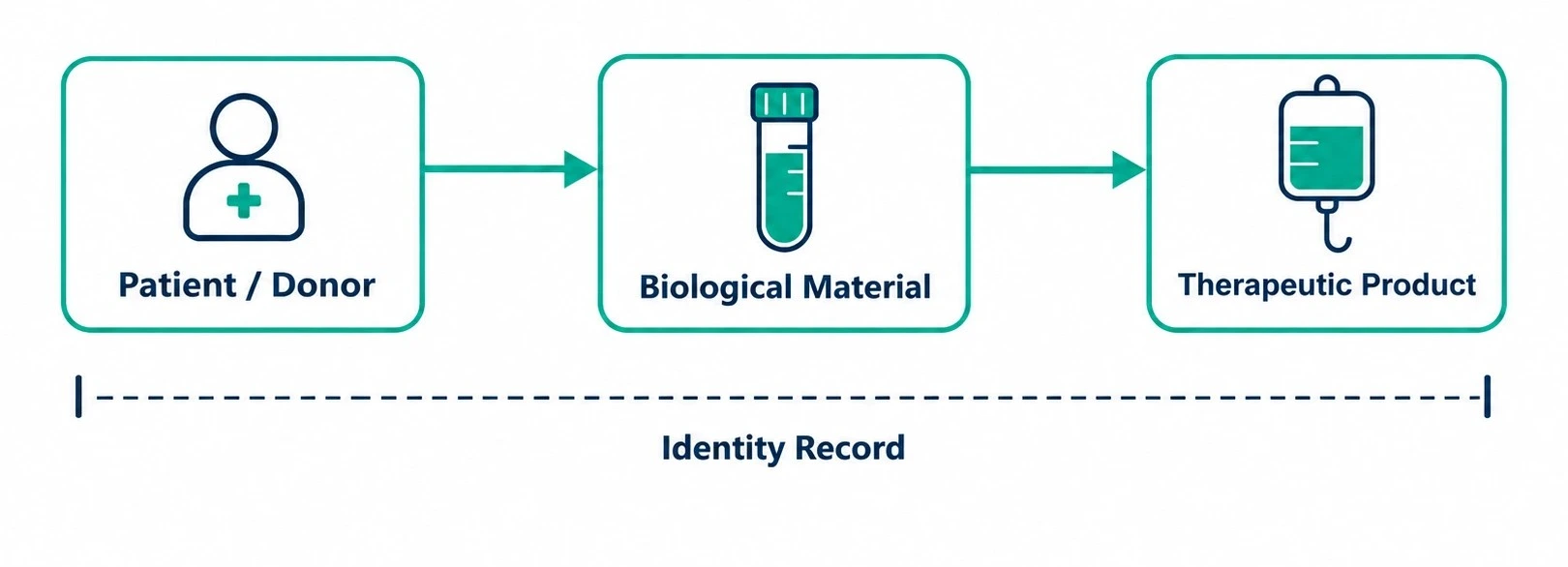
Here, "identity" does not refer only to a name or a label. It refers to a verifiable set of identifiers — patient or donor ID, unique sample or lot number, collection details, and cross-checks such as biometric or genetic confirmation where applicable — that stay consistently and correctly attached to the material as it changes form (from raw collection to processed cells, engineered vector, or final infusion bag).
This is what enables patient-to-product traceability: the ability to answer, at any point in the process, "whose material is this, and can I prove it?" That question sits at the center of nearly every regulatory framework covering clinical diagnostics laboratories and advanced therapy manufacturing.
3. How Does Chain of Identity Work?
Chain of Identity is maintained through a defined sequence of stages, each of which carries identity information forward to the next.
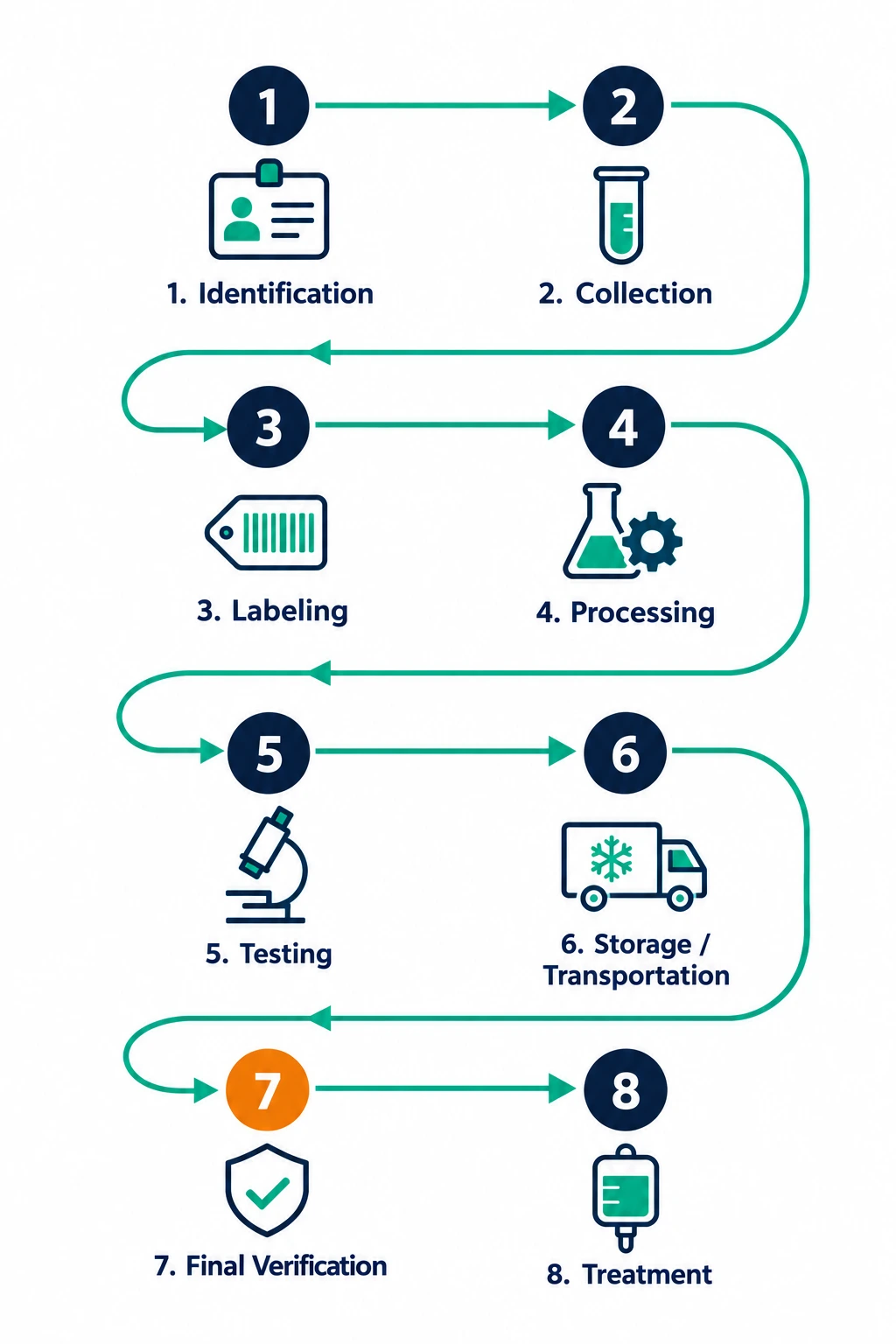
At each of these stages, what moves forward is not just the material itself, but the identity record attached to it. When any stage breaks that link — through a missed scan, an unrecorded transfer, or a manual entry error — traceability becomes harder to reconstruct after the fact.
4. Chain of Identity vs. Chain of Custody
These two terms are often used interchangeably, but they answer different questions. Chain of Identity confirms whose material this is. Chain of Custody confirms who has handled it and when.
| Aspect | Chain of Identity (COI) | Chain of Custody (COC) |
|---|---|---|
| Core question answered | What material belongs to which patient or donor? | Who handled or controlled the material, and when? |
| Primary focus | Source-to-product linkage | Handling, transfer, and custody events |
| Typical record | Patient/donor ID mapped to sample and product IDs | Handoff logs, timestamps, signatures, location changes |
| Risk if broken | Wrong material linked to wrong patient | Unaccounted handling gap or unverifiable transfer |
| Where it's checked | Identification, labeling, final verification, treatment | Every transfer, storage move, and handling event |
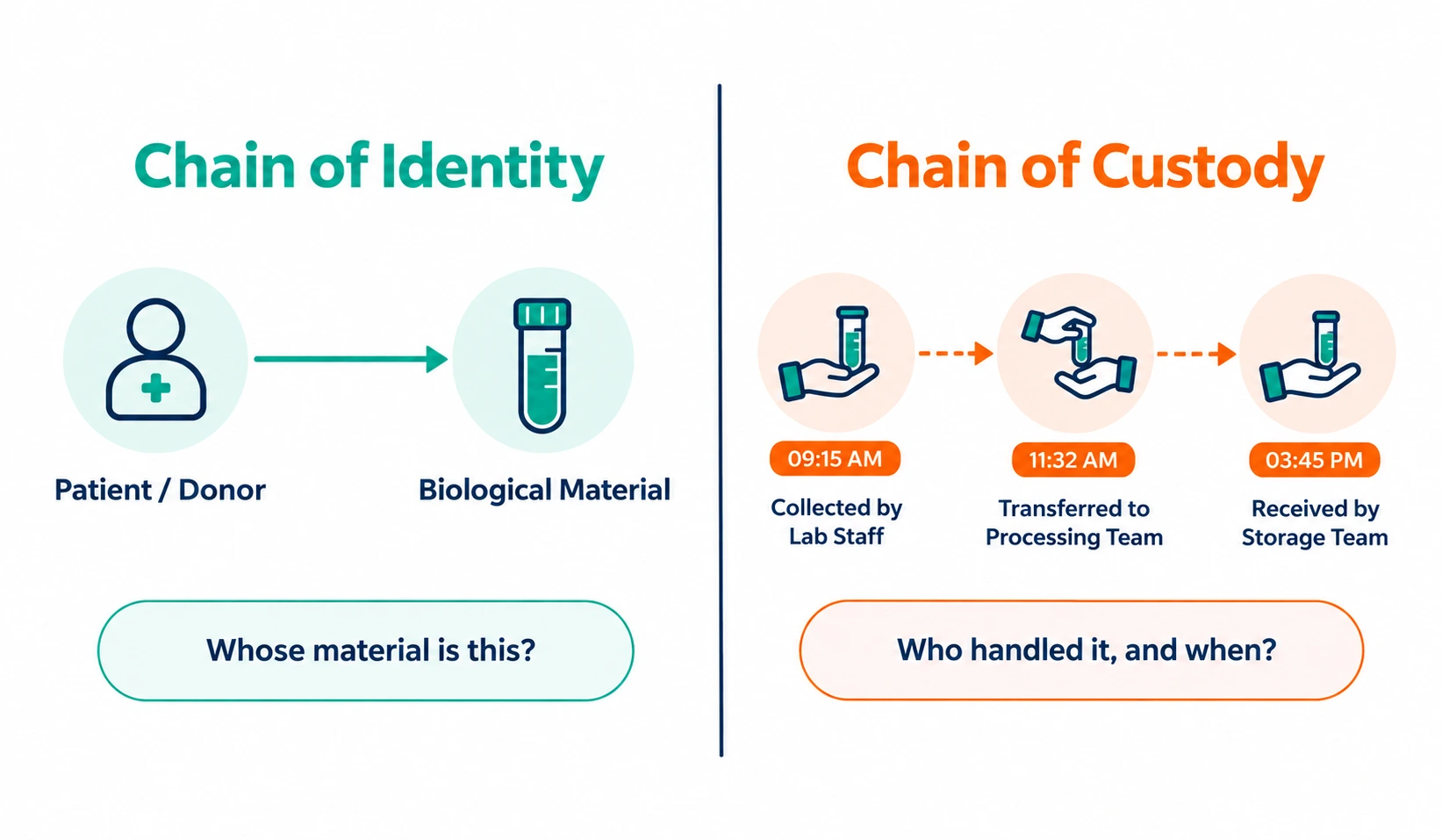
In practice, a robust CGT workflow needs both. Chain of Custody without Chain of Identity can prove a sample moved correctly between locations without confirming whose sample it actually is. Chain of Identity without Chain of Custody can confirm the source but leave gaps in accountability for who touched the material along the way.
5. What Can Affect Chain of Identity?
Because CGT material passes through so many hands and systems, several common operational issues can quietly introduce traceability gaps:
- Manual data entry — transcription errors when identity details are typed or re-typed between systems
- Identification or labeling inconsistencies — mismatched formats, duplicate IDs, or labels that degrade in cryogenic storage
- Multiple handoffs — each transfer between collection site, courier, processing lab, and treatment center is a potential break point
- Disconnected records — identity data captured in separate spreadsheets, paper logs, or systems that don't communicate, a gap that shows up just as often in long-term biorepository storage as it does in active CGT processing
- Missing information — incomplete collection or processing records that leave gaps in the identity trail
- Inconsistent tracking methods — mixing barcode-based, paper-based, and ad hoc tracking within the same workflow
6. How Can Laboratories Maintain Chain of Identity?
Laboratories working with CGT material generally rely on a combination of process discipline and consistent tooling to keep identity intact end to end:
- Consistent identification methods — a single identifier format used across every stage and every system
- Barcode-based tracking — scannable labels that remove manual re-entry at each handoff
- Verification at important stages — identity re-checks at collection, processing, release, and treatment, the same principle covered in our sample integrity guide for clinical diagnostics
- Electronic documentation — digital records that replace paper logs prone to transcription error, whether the material sits in active processing or long-term biorepository storage
- Complete audit trails — a timestamped record of every action taken on the material and by whom
- Controlled access — permissions that limit who can create, edit, or release identity-linked records
- Standardized workflows — the same defined sequence of steps followed for every patient or donor, every time
These practices apply just as directly to early-phase CGT trials run through a clinical research LIMS as they do to commercial-scale manufacturing, since a broken identity link at the trial stage is just as costly as one found after approval.
7. How Can Digital Systems Support Chain of Identity?
Manual practices reduce risk, but they still depend on people executing every step correctly, every time. Digitalization changes the equation by connecting the stages of the workflow so identity data moves with the material automatically, rather than being re-entered at each step.
A laboratory information management system (LIMS) is built to link these elements into one continuous, queryable record:
A connected LIMS ties the original identification event to every workflow step, test result, and record generated afterward, with a single audit trail running underneath the entire process — so identity never has to be manually reconciled between systems.
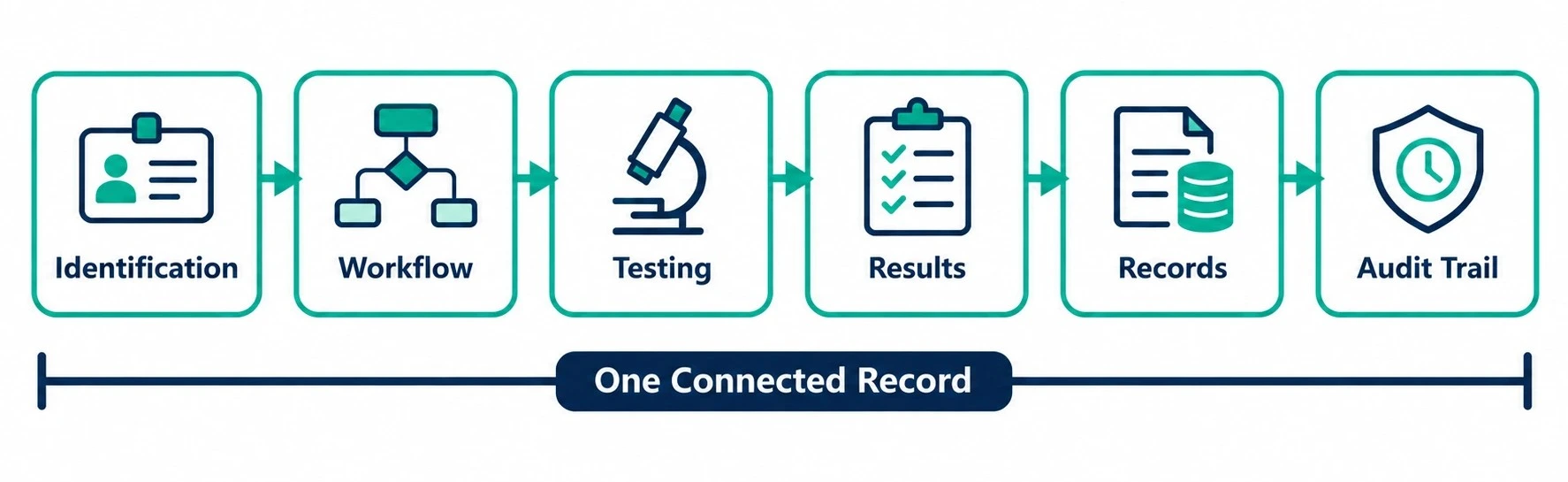
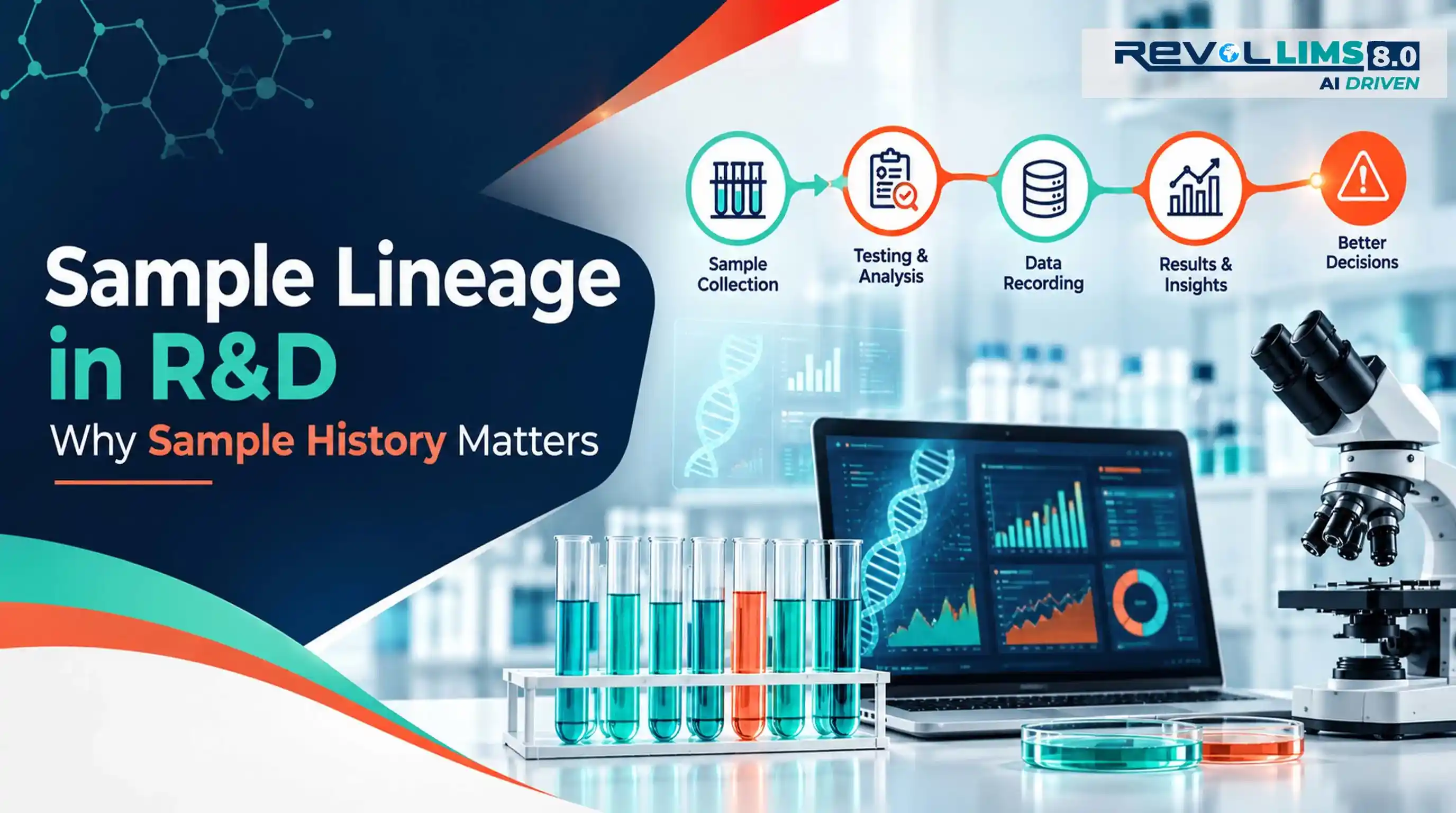
This kind of connected structure builds on the same principle covered in our piece on sample lineage in R&D: once a sample's history is captured digitally at the point of creation, every downstream step can reference it instead of re-establishing it. The same logic that supports a digital thread across manufacturing processes applies directly to identity-critical CGT workflows, and it mirrors the way precision medicine labs connect sequencing and biomarker data back to a single patient record.
Revol LIMS is one example of a system built to support these connected processes — linking patient or donor identification through collection, processing, testing, and storage, with barcode-driven tracking and a complete audit trail behind each record. It's designed to be part of the infrastructure that keeps identity intact, not a replacement for the process discipline described above.
This same discipline echoes the donor-eligibility and traceability expectations built into FDA's regulatory framework for human cells and tissues (21 CFR Part 1271), and it's central to how biorepositories manage long-term specimen integrity under ISO 20387, the international standard for biobanking.
8. Frequently Asked Questions
What is Chain of Identity in cell and gene therapy?
It's the traceable connection tying a specific patient or donor to the biological material collected from them, and ultimately to the therapeutic product made from that material — verified at every step in between.
Why is Chain of Identity important?
Because CGT products are often derived from and returned to a specific individual, a broken identity link can mean the wrong material is linked to the wrong patient, which is a far more serious risk than a standard sample mix-up.
How does Chain of Identity work?
It works through a connected sequence: identification, collection, labeling, processing, testing, storage and transportation, final verification, and treatment, with identity information carried forward and re-confirmed at each stage.
What is the difference between Chain of Identity and Chain of Custody?
Chain of Identity answers "whose material is this?" Chain of Custody answers "who has had control of it, and when?" Most CGT workflows need both tracked side by side.
How can laboratories maintain Chain of Identity?
By using consistent identification methods, barcode-based tracking, verification at key stages, electronic documentation, complete audit trails, controlled access, and standardized workflows applied the same way every time.
Can a LIMS support Chain of Identity?
Yes. A connected LIMS links identification, workflow steps, testing, results, and records under one audit trail, reducing the manual re-entry and disconnected systems that most commonly cause traceability gaps.
9. Conclusion
Chain of Identity is not a single checkpoint — it's a thread that has to run unbroken from the moment biological material is collected to the moment a therapy is administered. Every additional handoff, every manual entry, and every disconnected system is a chance for that thread to fray. What holds it together is a combination of consistent process design and connected digital records that carry identity forward automatically instead of relying on it being re-established at every step.
See How Connected Identity Tracking Works in Practice
Explore how Revol LIMS links identification, workflow, and audit trails across cell and gene therapy and clinical research workflows.
Request a Demo →Author: Revol Team · marketing@revollims.com · www.revollims.com






 (1) (1).webp)