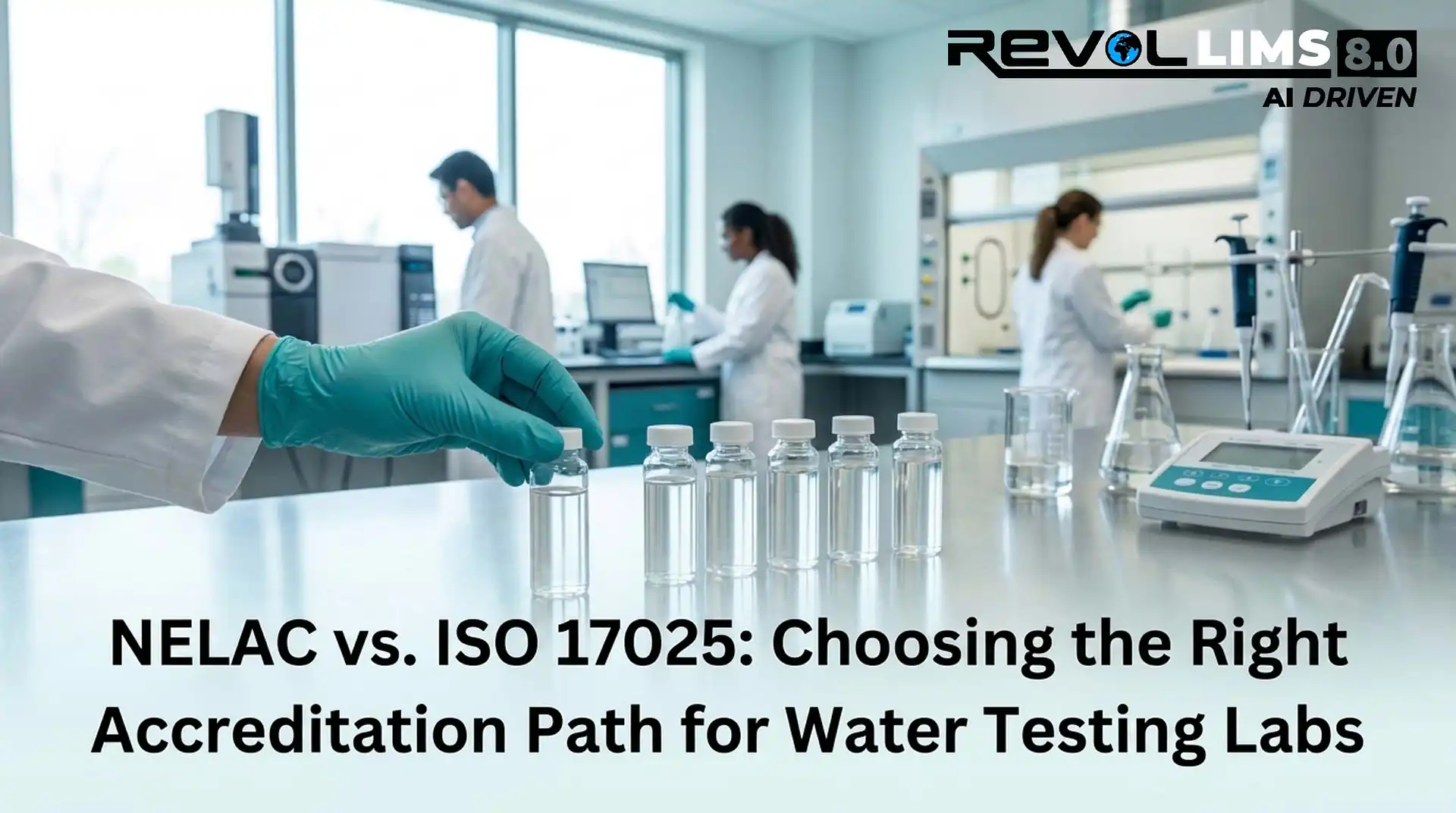
If you manage or work inside a water testing laboratory, you have probably run into this question more than once: should the lab pursue NELAC accreditation, ISO/IEC 17025 accreditation, or both? It is one of the most common — and most consequential — decisions a laboratory director will make. Get it right, and your lab can win new contracts, satisfy regulators, and build a reputation for reliable data. Get it wrong, and you risk wasted budget, audit fatigue, or worse, a lab that cannot legally report the results its clients need.
This guide breaks down NELAC accreditation and ISO/IEC 17025 accreditation in plain language: what each standard actually covers, how they differ, which use cases fit each one, and how to decide what is right for your laboratory. Whether you run a small municipal water lab or a multi-site environmental testing company, you will walk away with a clear framework for your next accreditation decision.
What Is NELAC Accreditation?
NELAC stands for the National Environmental Laboratory Accreditation Conference, the body that originally developed the standard now maintained by The NELAC Institute (TNI). Laboratories that meet the standard operate under the National Environmental Laboratory Accreditation Program, or NELAP, which is the accreditation program built on TNI's standard.
In simple terms, NELAC accreditation is a specialized, environment-focused accreditation designed specifically for laboratories that test drinking water, wastewater, groundwater, soil, air emissions, and hazardous waste. It exists because environmental data has direct public health and regulatory consequences — a false negative in a drinking water test is not just a quality issue, it is a public safety issue.
NELAC accreditation is administered at the state level in most cases, with several states also participating in NELAP through recognized accreditation bodies. Many state drinking water and wastewater programs will only accept results from a NELAC- or NELAP-accredited laboratory, which makes this accreditation a legal requirement rather than an optional quality credential for labs serving regulated clients in the United States.
What Is ISO/IEC 17025 Accreditation?
ISO/IEC 17025 is the international standard for the general competence of testing and calibration laboratories. It was developed jointly by the International Organization for Standardization (ISO) and the International Electrotechnical Commission (IEC), and it applies to laboratories in virtually every industry — environmental, pharmaceutical, food safety, manufacturing, forensics, calibration ,and more.
Where NELAC is environment-specific, ISO 17025 is a universal competence framework. It sets requirements for two broad areas: the laboratory's management system (similar in spirit to ISO 9001, but written specifically for testing organizations) and its technical competence — meaning staff qualifications, equipment, methods, sampling, and the validity of results.
Because ISO 17025 is recognized internationally, it is often the accreditation of choice for laboratories that want to demonstrate technical competence to clients anywhere in the world, not just to a single state regulator. Many private and commercial laboratories pursue ISO 17025 accreditation as their baseline quality credential, even before considering any industry-specific accreditation like NELAC.
NELAC vs. ISO 17025: Key Differences at a Glance
The truth is, NELAC and ISO 17025 are not entirely separate standards — NELAC's technical and management requirements are built on top of ISO/IEC 17025 and then add environmental-sector-specific requirements on top. Think of ISO 17025 as the foundation, and NELAC as a specialized structure built on that foundation for environmental laboratories. Here is a side-by-side comparison to make the distinction clear.
| Factor | NELAC / NELAP | ISO/IEC 17025 |
|---|---|---|
| Scope | Environmental testing only (drinking water, wastewater, air, soil, hazardous waste) | General-purpose standard for any testing or calibration laboratory, across every industry |
| Governed by | The NELAC Institute (TNI), implemented through state and federal accreditation bodies | International Organization for Standardization (ISO) and International Electrotechnical Commission (IEC) |
| Legal recognition | Often required by state and federal regulators for reporting drinking water and wastewater results | Recognized internationally; required for labs serving global clients or multiple industries |
| Technical basis | Built on ISO/IEC 17025 with added, environment-specific requirements | Foundational competence standard covering management systems and technical requirements |
| Method requirements | Prescriptive EPA-approved methods and detection limits for regulated analytes | Flexible; methods are chosen and validated based on client and application needs |
| Personnel requirements | Defined qualifications for the laboratory technical manager, plus mandatory orientation and annual training | General competence requirements; specifics are left to the laboratory's quality system |
| Proficiency testing | Mandatory, standardized PT program built into the accreditation module | Encouraged as part of ongoing method validation, but not uniformly mandated |
| Best suited for | Labs reporting regulated environmental data to state or federal agencies | Labs serving pharmaceutical, food, manufacturing, calibration, or multi-sector clients |
Use Cases: Which Laboratories Need Which Accreditation?
When NELAC Accreditation Is the Right Fit
- Municipal and public water systems: If your lab tests drinking water or wastewater on behalf of a public utility, NELAC or NELAP accreditation is very likely a non-negotiable regulatory requirement in your state.
- Environmental consulting labs: Labs that support site remediation, groundwater monitoring, or hazardous waste characterization typically need NELAC accreditation to have their data accepted by state or federal agencies.
- State-contracted testing programs: Any laboratory bidding on state or municipal contracts for regulated environmental testing should expect NELAC accreditation to be a contract requirement.
- Labs reporting under the Safe Drinking Water Act or Clean Water Act: Regulatory reporting obligations under these frameworks generally require NELAC-accredited data.
When ISO 17025 Accreditation Is the Right Fit
- Multi-sector laboratories: If your lab also tests food, pharmaceuticals, consumer products, or performs calibration work, ISO 17025 gives you one accreditation that covers competence across all of those service lines.
- Labs serving international or private-sector clients: Corporate clients, especially those outside the U.S. or in global supply chains, often require ISO 17025 as proof of technical competence.
- Commercial and private laboratories without direct regulatory reporting duties: If your lab is not submitting results directly to a state drinking water or wastewater program, ISO 17025 alone may satisfy your quality and competence needs.
- Labs building a broader quality reputation: ISO 17025 is widely recognized as a global benchmark for laboratory quality, which can be a strong differentiator in competitive bidding and client trust.
When You Need Both
Many environmental laboratories in the U.S. end up pursuing dual accreditation: NELAC/NELAP for regulated environmental reporting, and ISO/IEC 17025 for broader technical credibility and non-regulated work. Several accreditation bodies now offer a coordinated assessment process that evaluates a laboratory against both standards at once, reducing duplicate audits and paperwork. If your lab operates in multiple states, serves both regulated and private clients, or plans to expand service lines beyond environmental testing, dual accreditation is usually the most future-proof strategy.
Benefits of NELAC Accreditation
- Regulatory compliance: It satisfies state and federal requirements for reporting drinking water, wastewater, and other environmental data, keeping your lab and your clients on the right side of the law.
- Access to public-sector contracts: Many municipal and state contracts explicitly require a NELAC- or NELAP-accredited lab, so accreditation directly expands your addressable market.
- Standardized proficiency testing: The built-in PT program gives your lab (and your clients) an added layer of confidence that your results are consistently accurate over time.
- Public trust: Because NELAC accreditation is tied to public health outcomes, holding it signals to communities and regulators that your data can be trusted for decisions that matter.
Benefits of ISO 17025 Accreditation
- Global recognition: ISO 17025 is understood and respected by clients, regulators, and partners around the world, which matters if your lab works across borders or industries.
- Broader market access: One accreditation can support multiple service lines — environmental, food, pharmaceutical, or calibration — instead of pursuing a separate accreditation for each.
- Stronger quality culture: The standard's emphasis on measurement traceability, method validation, and continual improvement tends to raise the overall rigor of a lab's operations.
- Competitive differentiation: In competitive bidding situations, ISO 17025 accreditation is often treated as a baseline mark of credibility, especially with private-sector and international clients.
How to Decide: A Simple Decision Framework
Ask your laboratory leadership team these four questions:
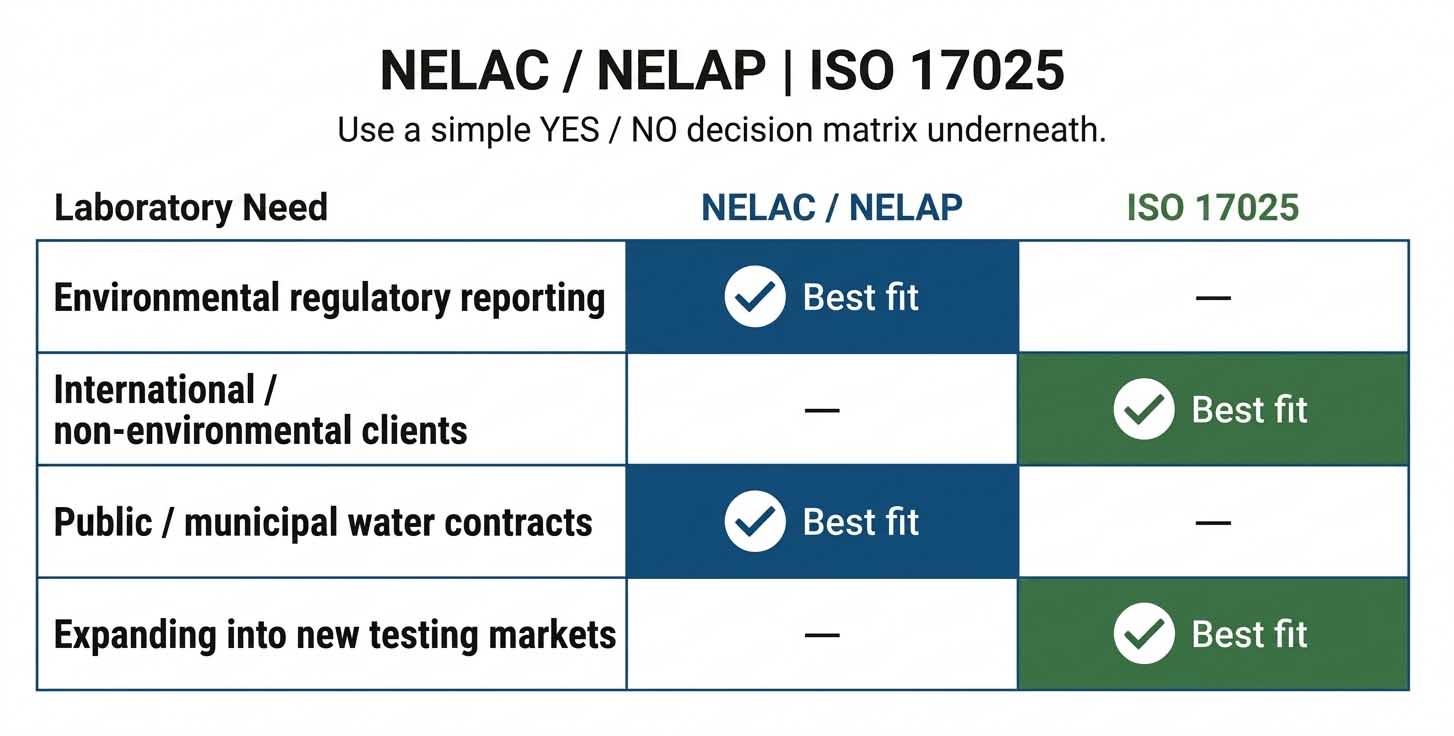
- Do we report results directly to a state or federal environmental regulator? If yes, NELAC or NELAP accreditation is likely required, not optional.
- Do we serve clients outside the environmental sector, or outside the U.S.? If yes, ISO 17025 will help you compete for that business.
- Are we bidding on public-sector or municipal water contracts? These almost always specify NELAC/NELAP accreditation as a bid requirement.
- Do we want to expand into new testing markets in the next 2–3 years? If growth plans include pharmaceutical, food, or calibration testing, building on an ISO 17025 foundation now will save time later.
If your answers point toward regulated environmental work only, start with NELAC/NELAP. If your lab's ambitions extend beyond environmental testing, or you already need international recognition, ISO 17025 should be your foundation — with NELAC layered on top if regulatory water testing is part of your service mix.
Real-World Use Case: Choosing an Accreditation Path
As the lab grew, it began receiving requests from private industrial clients who needed calibration verification and material testing outside the environmental space, along with a handful of manufacturing clients based in Europe who required ISO/IEC 17025 as a condition of doing business. Without ISO 17025 accreditation, the lab had to turn down that revenue or subcontract it to a competitor.
The lab's leadership eventually pursued a coordinated ISO 17025 and NELAP assessment, allowing them to keep their existing municipal contracts while opening the door to new industrial and international clients. Within a year, non-environmental testing accounted for a meaningful share of new revenue — work that would have been impossible under NELAC accreditation alone.
This scenario is increasingly common. Laboratories that start with a narrow, regulation-driven accreditation strategy often find that market opportunities outgrow that scope within a few years. Planning for dual accreditation earlier, even if it is implemented in phases, tends to be more cost-effective than adding it later under client pressure or a tight bid deadline.
Cost and Timeline Considerations
Budget and timeline are often the deciding factors in accreditation planning, so it helps to know what to expect from each path.
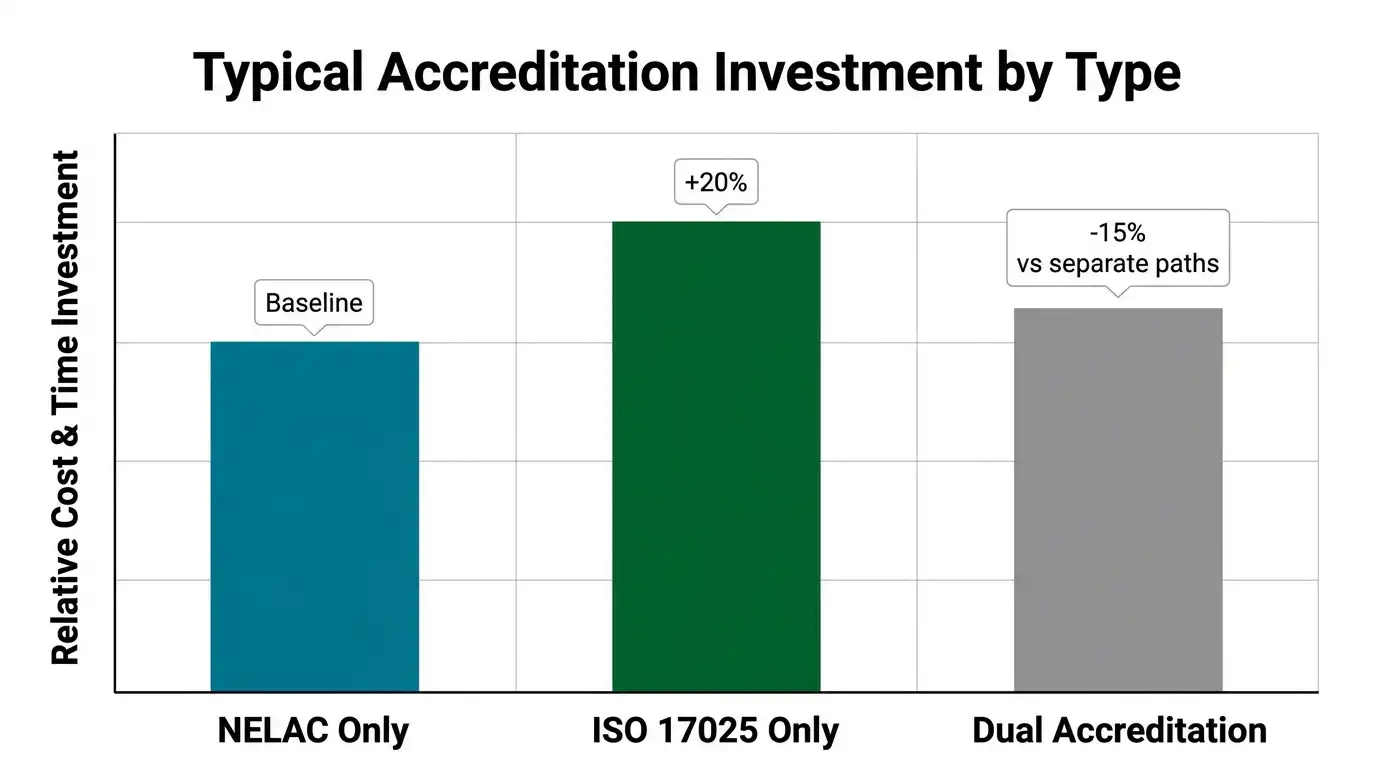
- NELAC/NELAP accreditation costs: Fees vary by state and by the number of analytes and methods in your scope of accreditation. Costs typically include application fees, annual accreditation fees, and the cost of required proficiency testing samples for each analyte group.
- ISO 17025 accreditation costs: Fees depend on the accreditation body, the size of your scope, and the number of testing locations. Initial assessments generally cost more than renewal or surveillance assessments, and consulting or gap-analysis support can add to the upfront investment.
- Dual accreditation costs: Coordinated assessments that cover both standards in a single audit cycle are usually less expensive than pursuing each accreditation separately and on different timelines, since travel, staff time, and document review overlap significantly.
- Typical timeline: Most laboratories should budget six to twelve months from the start of a gap analysis to a successful on-site assessment, with additional time if new equipment, staff, or proficiency testing cycles are required.
Because both standards require ongoing surveillance assessments and annual fees, accreditation should be treated as a recurring line item in the laboratory's operating budget, not a one-time capital expense.
Steps to Achieve Accreditation
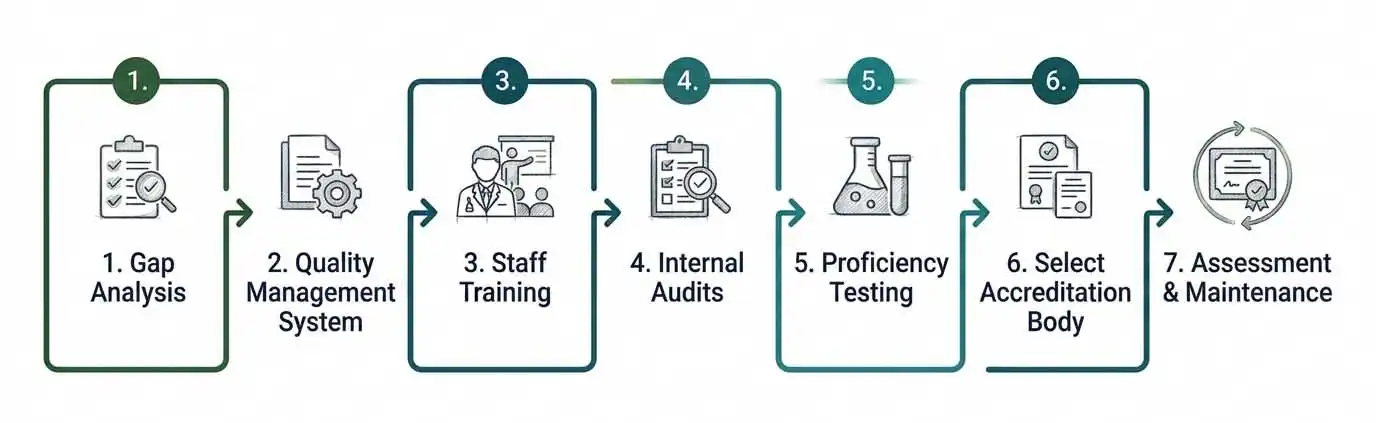
- Gap analysis: Compare your current quality management system against the requirements of the standard(s) you are pursuing to identify missing documentation, procedures, or training.
- Build or update your quality management system: Document policies for method validation, equipment calibration, personnel competence, sample handling, and data integrity.
- Staff training: Ensure your technical manager and analysts meet the qualification and training requirements specific to the standard, including any mandatory orientation for NELAC.
- Internal audits and corrective actions: Run internal audits to catch nonconformities before your external assessment, and document how each issue was resolved.
- Proficiency testing: Enroll in and successfully complete the required PT programs, especially for NELAC, well ahead of your assessment date.
- Select an accreditation body: Choose an accreditation body recognized for the standard you need — many now offer combined ISO 17025 and NELAP assessments in a single visit.
- On-site assessment and continual maintenance: After the initial assessment and any corrective actions, maintain compliance through ongoing internal audits, proficiency testing, and scheduled surveillance assessments.
Common Challenges Labs Face — and How to Avoid Them
- Underestimating documentation requirements: Both standards demand detailed, traceable records. Start your document control system early, not right before your assessment. Treating accreditation as a one-time project: Accreditation is a continuous quality commitment, not a certificate you earn once and forget. Build ongoing internal audits into your annual calendar.
- Choosing the wrong scope: Applying for a broader scope of accreditation than your lab actually needs adds cost and audit complexity without added business value. Scope your application to your real client and regulatory needs.
- Delaying proficiency testing enrollment: PT samples often have registration deadlines and limited testing windows. Build your PT schedule into your project timeline from day one.
Why This Decision Matters for Your Business
Accreditation is not just a compliance checkbox — it is a business strategy. NELAC accreditation opens the door to regulated environmental contracts and public trust. ISO 17025 accreditation opens the door to broader markets, international clients, and multi-sector growth. Laboratories that align their accreditation strategy with their actual client base and growth plans avoid wasted spend and position themselves for sustainable, long-term growth.
Frequently Asked Questions
Is ISO 17025 required for NELAC accreditation?
Yes, in effect. NELAC's technical and management requirements are built directly on the ISO/IEC 17025 framework, with additional environmental-sector requirements layered on top. A NELAC-accredited lab is already meeting the core of ISO 17025.
Can a laboratory hold both NELAC and ISO 17025 accreditation at the same time?
Yes. Many environmental laboratories hold both, and several accreditation bodies offer coordinated assessments that evaluate a lab against both standards in a single audit cycle, reducing cost and disruption.
How long does it take to become accredited?
Timelines vary by lab readiness, but most laboratories should plan for six months to a year from the start of a gap analysis to a successful on-site assessment, particularly if new staff training, equipment, or proficiency testing cycles are involved.
Does every state require NELAC accreditation for drinking water testing?
Most states require NELAC or NELAP accreditation, or an equivalent state-specific certification, for laboratories reporting drinking water and wastewater results. Requirements vary by state, so laboratory directors should confirm specific requirements with their state drinking water or environmental agency.
Final Thoughts: Building an Accreditation Strategy That Works for Your Lab
Choosing between NELAC and ISO 17025 accreditation does not have to be an either-or decision. Understanding what each standard covers, who requires it, and how they work together allows laboratory managers, QA/QC professionals, and lab directors to build an accreditation roadmap that supports both regulatory compliance and long-term business growth. Start with a clear picture of your client base and regulatory obligations, and let that picture guide your investment in NELAC, ISO 17025, or both.
Ready to Strengthen Your Laboratory's Accreditation Strategy?
Whether your lab is preparing for its first NELAC assessment, adding ISO/IEC 17025 to your credentials, or planning a dual-accreditation roadmap, the right preparation makes all the difference. Connect with an accreditation specialist today to map out a gap analysis, build your timeline, and get your laboratory audit-ready — with confidence.
Author: Revol Team




 (1) (1).webp)

.webp)