Sample Lineage in R&D: Why Sample History Matters
In any active R&D lab, a single sample rarely stays in one form for long. It gets split into aliquots, processed through different steps, tested under multiple protocols, and sometimes re-tested weeks later when a question comes up about the original result. By the time a final number lands in a report, that sample may have passed through half a dozen stages and just as many hands.
Knowing where a sample sits right now — its current status, its current location — is useful, but it isn't the full picture. What matters just as much is where that sample came from, what happened to it along the way, and which results trace back to which processing step. That connected record is what's known as sample lineage, and it's becoming one of the more overlooked gaps in R&D sample data management.
1. What Is Sample Lineage in R&D?
Sample lineage is the complete, connected history of a sample — every transformation, every derived aliquot, every test, and every result linked back to where it originated. Instead of treating a sample as a single static record, sample lineage treats it as a chain: each step is recorded and connected to the step before it, so nothing exists in isolation.
A simple example makes this easier to picture:
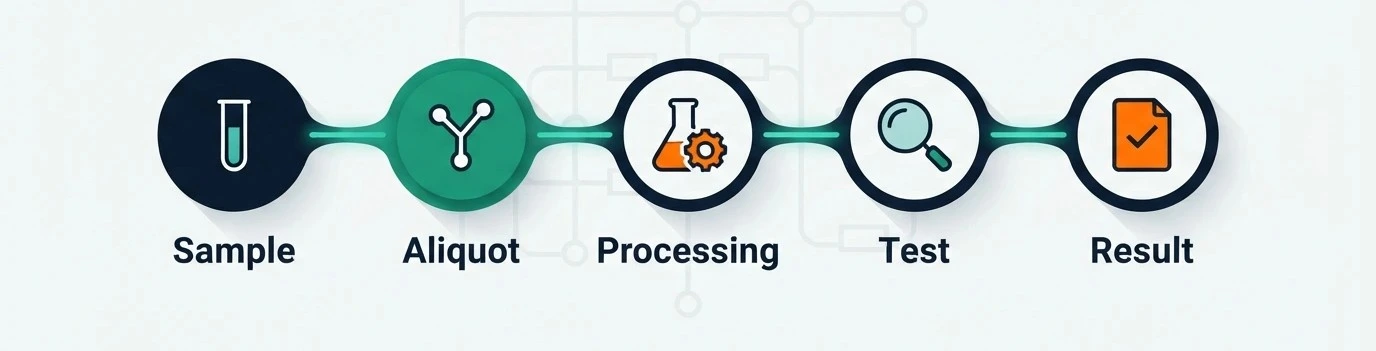
Sample lineage is what preserves those relationships, so a result can always be traced back through processing to the original sample it came from — a concept that mirrors the broader idea of a digital thread connecting a product's full lifecycle, applied here at the level of an individual sample.
2. Why Is Sample Lineage Important in R&D?
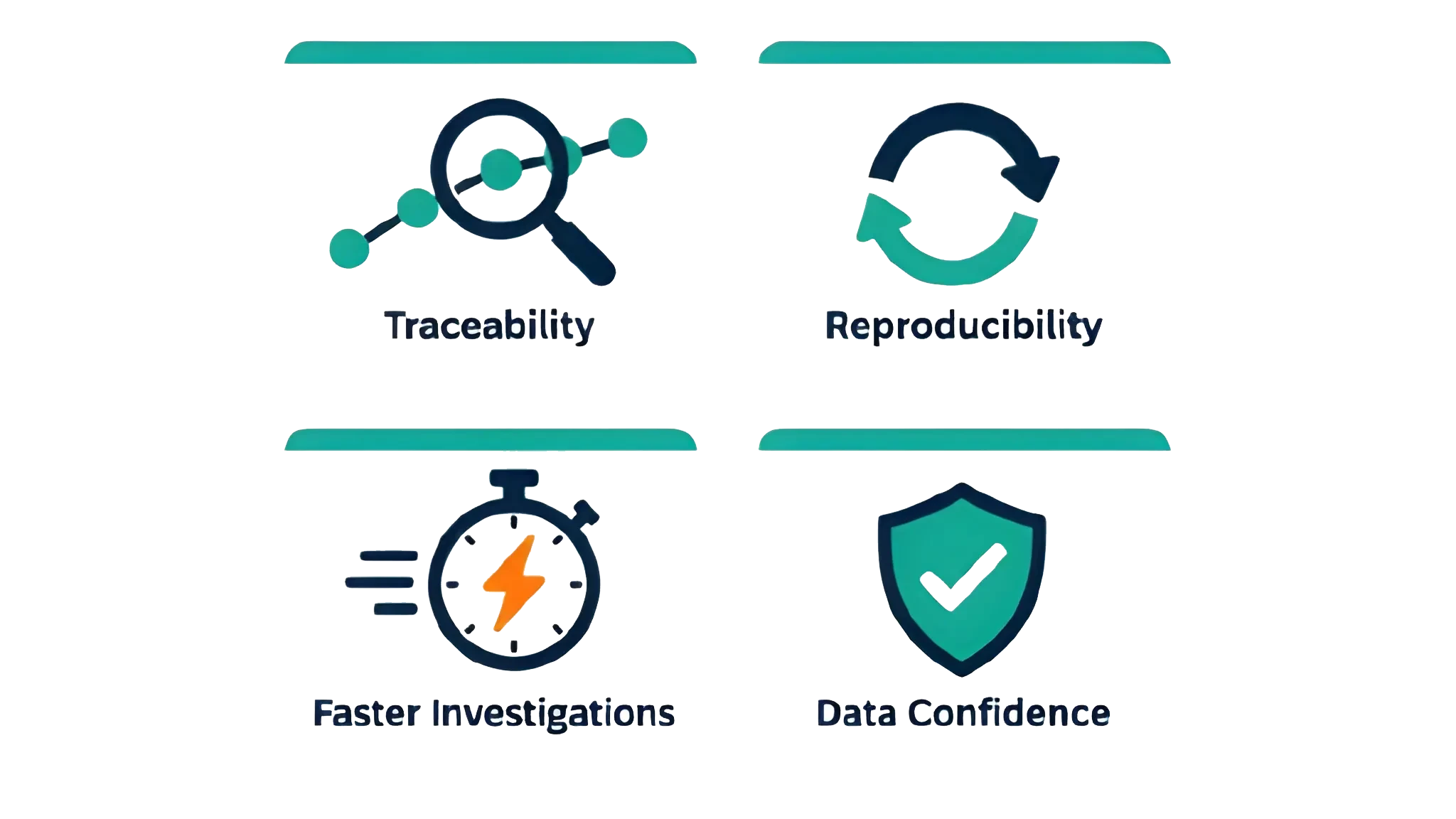
R&D generates a high volume of derived samples and iterative results, which makes lineage more than a record-keeping detail — it directly affects how much a lab can trust and act on its own data. Four areas stand out.
- Traceability — Every result can be traced back to its exact source sample, processing step, and parent aliquot, with no gaps in the chain.
- Reproducibility — When the full processing history is captured, other researchers can understand and repeat exactly how a result was produced.
- Faster Investigations — When a result looks off, teams can trace it back through the lineage chain instead of manually reconstructing what happened.
- Data Confidence — Connected, verifiable sample history gives researchers and reviewers confidence that a result reflects what it claims to.
The reproducibility point isn't just good lab practice — it's now a formal research expectation. NIH's strategy for strengthening replication and reproducibility treats the ability to trace exactly how a result was produced as core scientific infrastructure, not an afterthought.
That last point echoes a principle behind the broader push for FAIR research data: metadata is only trustworthy when it carries clear provenance — a documented record of where it came from and how it was derived. Sample lineage is that provenance record applied to physical samples rather than datasets.
3. What Information Should a Sample's History Include?
A complete sample history doesn't need to be complicated — it needs to be connected. At minimum, it should capture:
- Sample source — where the original sample came from and under what conditions it was collected.
- Processing history — every step the sample went through, in order.
- Parent/child relationships — which aliquots or derivatives came from which original sample.
- Tests performed — what was run, on which version of the sample.
- Results — outcomes tied back to the exact sample and the test run that generated them.
- Storage/location — where each sample or aliquot currently sits, and where it has been.
When these six elements are consistently connected, a researcher can answer "how did we get this result?" in minutes rather than piecing it together from memory or scattered notes.
4. What Challenges Make Sample Lineage Difficult to Manage?
Most labs don't lose sample history on purpose — it happens because the systems and habits around sample tracking weren't built to preserve it. Common problems include:
- Missing information — A processing step or aliquot goes unrecorded, breaking the chain between a result and its source.
- Manual records — Handwritten logs and notebooks depend on individual diligence and are easy to forget or misplace.
- Disconnected spreadsheets — Different stages tracked in separate files with no shared identifiers, so nothing links back automatically.
- Difficulty finding the source of a result — When lineage is incomplete, tracing a result back to its original sample becomes a manual search across systems and people.
- Repeated testing — Without a clear history, teams sometimes re-test simply because they can't confirm what was already done, wasting samples, time, and reagents.
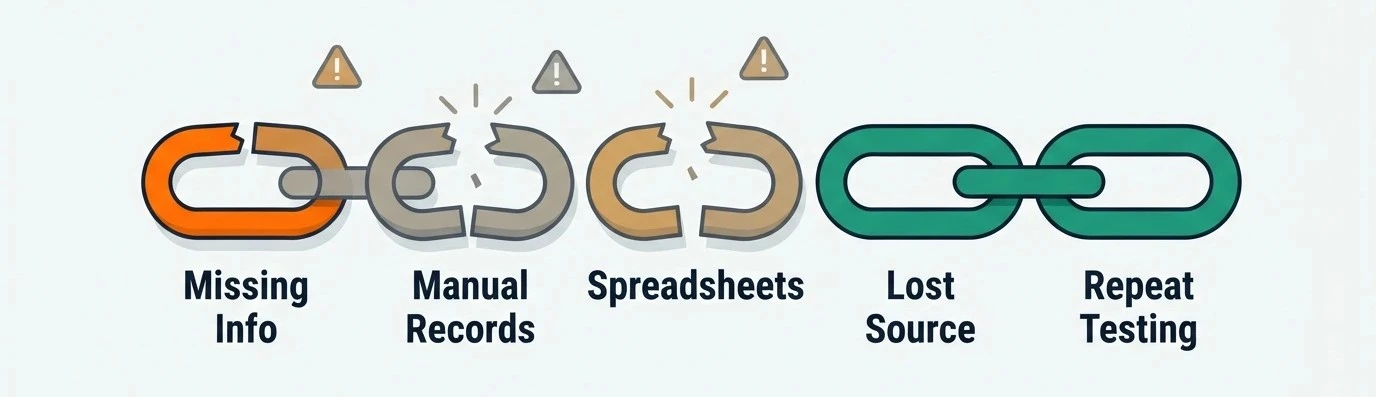
Each of these gaps compounds the next. A missing aliquot record makes an investigation slower; a slower investigation makes repeated testing more likely; repeated testing eats into limited sample volume that R&D often can't easily replace.
5. How Does a LIMS Improve Sample Lineage?
A laboratory information management system addresses sample lineage at the point where most of these gaps start — sample tracking in R&D itself. Rather than relying on separate logs for each stage, a LIMS keeps every sample event connected in one system of record.
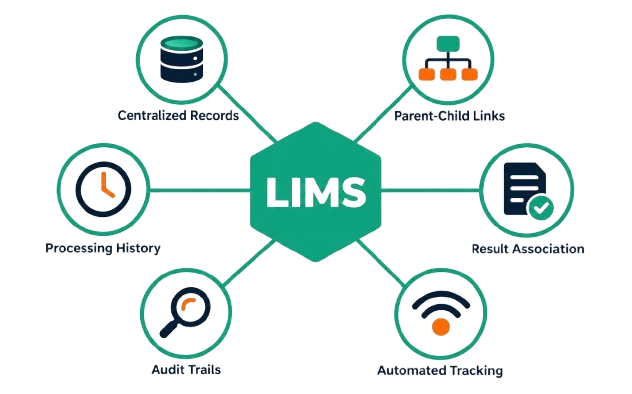
Modern LIMS Key Features for Sample Lineage
- Centralized sample records — every sample, aliquot, and derivative lives in one system instead of scattered files.
- Automated sample tracking — status, location, and stage updates are captured as they happen, not entered after the fact.
- Parent-child sample relationships — aliquots and derived samples are automatically linked back to their originating sample.
- Complete processing history — each step a sample goes through is logged in sequence and tied to the sample record.
- Result association — test results are connected directly to the specific sample and processing step that produced them.
- Audit trails — a time-stamped record of who did what, and when, supports both investigations and regulatory review.
This is the same principle behind connected sample tracking in genomic research workflows and chain-of-custody tracking in biobank sample management — a concept formalized in ISO 20387's biobanking requirements, which define chain of custody as responsibility for materials and data as they move through each step of a process. The audit-trail side of this has its own regulatory backing too: FDA's data integrity guidance expects records to stay attributable and traceable throughout their lifecycle — the same standard a LIMS audit trail is built to meet. For R&D specifically, this kind of structured, LIMS-driven approach to R&D sample management replaces guesswork with a record that's there when it's needed.
6. What Are the Benefits of Better Sample Traceability?
When sample lineage is consistently captured, the benefits show up throughout the research process rather than in one isolated step:
- Investigations into unexpected results take hours instead of days.
- Reviewers and collaborators can verify how a result was reached without asking around.
- Fewer samples are re-tested unnecessarily, preserving limited sample volume.
- Data submitted for regulatory or publication review holds up to scrutiny.
- Teams spend more time interpreting results and less time reconstructing history.
None of this requires an overhaul of how research is done — it requires the connections between samples, steps, and results to be captured as work happens, rather than reconstructed afterward. Reducing unnecessary re-testing is also a recognized quality outcome in accredited lab environments: ISO/IEC 17025 itself points to traceable, well-documented results as a way to cut down on repeat work and strengthen confidence in a lab's output. This is a natural extension of good core LIMS capabilities already in use in many R&D, clinical diagnostics, and pharma laboratory settings.
7. Frequently Asked Questions About Sample Lineage
What is sample lineage?
It's the full, connected chain behind a sample — where it originated, what it was derived from, every processing step it went through, and every test and result tied to it. Rather than a single snapshot in time, sample lineage records the whole journey, stage by stage, so nothing about a sample's past is left disconnected from its present.
Why is sample traceability important in R&D?
R&D relies on results that others can trust, question, and repeat. Sample traceability makes it possible to confirm exactly how a result was produced, investigate anomalies quickly, and avoid unnecessary re-testing — all of which support reproducibility and confident, defensible research data.
What is the difference between sample tracking and sample lineage?
Sample tracking typically shows where a sample is right now — its current status or location. Sample lineage goes further, capturing the full history behind that current state: where the sample originated, what processing it went through, and which results connect back to it.
How does LIMS support sample lineage?
A LIMS centralizes sample records, automatically logs processing steps, links parent and child samples, and connects test results directly to their source sample. This removes the need for manual, disconnected records and keeps a complete, searchable history available whenever it's needed.
How are parent and child samples connected in a LIMS?
When an aliquot or derivative is created from an original sample, a LIMS automatically records that relationship, tagging the new sample as a "child" linked to its "parent." This connection is preserved through every further processing step, so the full chain remains traceable at any point.
See Connected Sample Lineage in Action
Explore how centralized sample tracking, parent-child relationships, and full audit trails come together in a modern LIMS built for R&D.
Request a Demo →Author: Revol Team · marketing@revollims.com · www.revollims.com




 (1) (1).webp)

.webp)