Introduction: The Hidden Cost of Reagent Expiry
Reagents are the lifeblood of every testing lab. From pharmaceutical QC and food testing to clinical diagnostics and environmental analysis, reliable results depend on having the right reagent, in date, at the right time.
Yet reagent management is often treated as a simple stock-keeping task. Labs count what is on the shelf and assume all is well. In reality, a reagent that is expired, close to expiry or simply missing can disrupt testing, delay reports and put compliance at risk.
The problem is rarely carelessness. It happens because most labs count their stock, but do not truly track it.
A stock count tells you how much you have. It does not tell you:
- When each lot expires
- Which lot should be used first
- How fast you are really using each item
- Whether you will run out before the next delivery arrives
That gap is where the hidden costs live.
The Costs You Don't See on the Balance Sheet
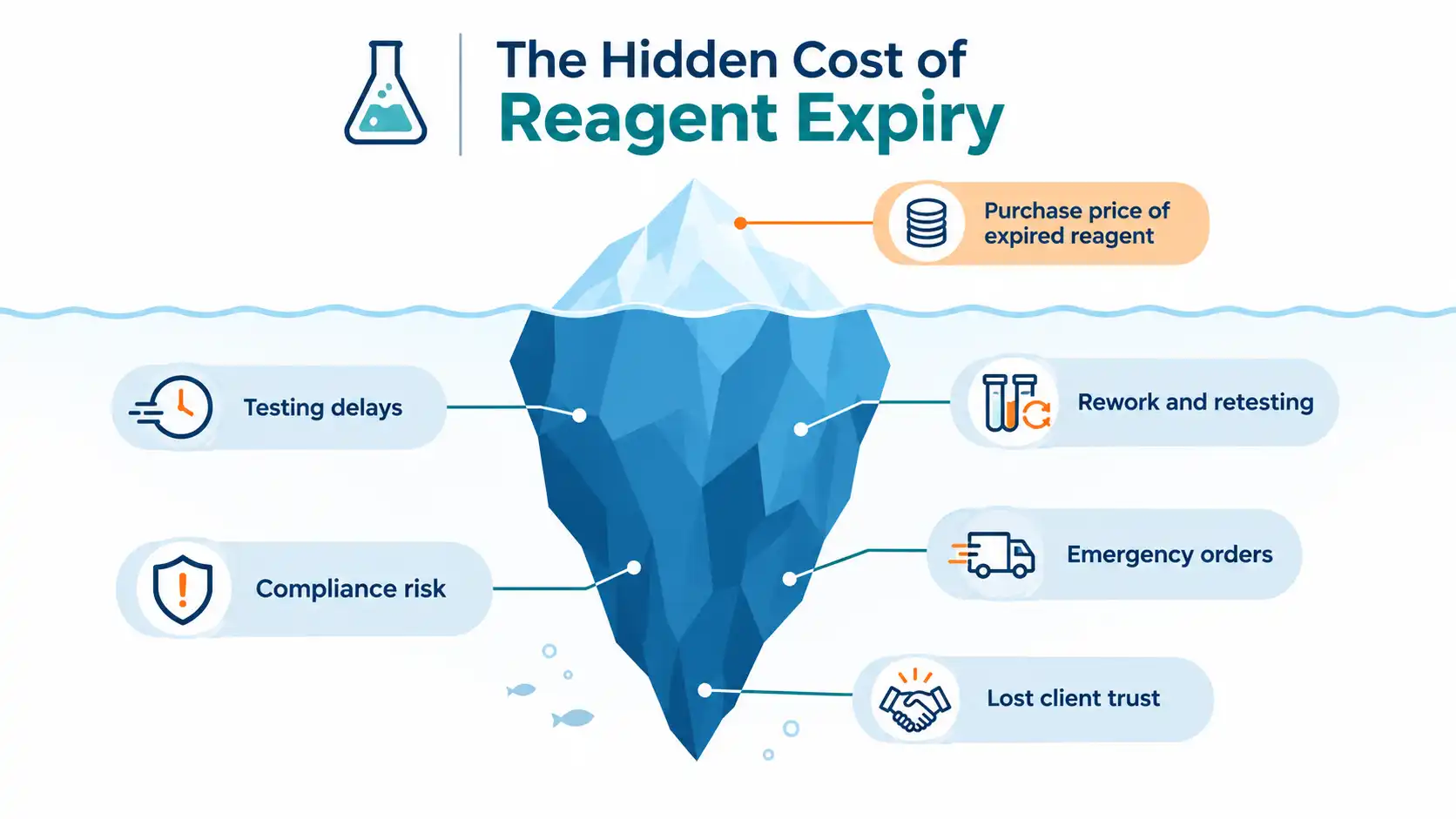
When a reagent expires on the shelf, the visible loss is the purchase price. But the real cost is bigger:
- Wasted money: Many reagents, standards and reference materials are expensive. Throwing them away unused is pure loss.
- Testing delays: An unexpected stock-out can halt a whole test method until new supply arrives.
- Rework and retesting: If an expired reagent slips into use, results may need to be repeated or, worse, recalled.
- Compliance risk: Auditors under ISO/IEC 17025 , GLP, GMP and similar frameworks expect labs to prove that materials were in date and traceable at the time of use.
- Lost trust: Late reports and questionable results damage client confidence.
Spreadsheets, paper logs and whiteboards can only go so far. They depend on people remembering to check, update and act. In a fast-moving lab, that is a lot to ask.
This is where a Laboratory Information Management System (LIMS) changes the game. A modern LIMS does not just count what is in the cupboard. It connects reagents to expiry dates, lots, methods, tests and usage, so the lab can act before a problem appears.
In this blog, we look at how reagent expiry and stock issues cause testing delays, how a LIMS improves reagent tracking, how features like expiry alerts and FEFO keep stock fresh, and what benefits labs can expect in operations, finances and quality.
Inventory Challenges and Testing Delays
Most labs do not set out to waste reagents. The problem grows quietly, from small gaps in daily routines. Let's look at the most common ones.
1. Manual Tracking Breaks Down
Many labs still rely on Excel sheets, handwritten registers or separate files kept by different people. These tools work when volumes are small. As the lab grows, they start to fail:
- Entries are missed or typed incorrectly
- Different team members keep different versions
- Nobody sees the full picture in real time
- Expiry dates are buried in columns no one checks
A single missed update can mean a reagent is reordered when it was not needed, or not reordered when it was.
2. Stock Counts Hide the Real Story
Say your lab has 10 bottles of a buffer solution. That sounds safe. But what if 6 of them expire next week? Your usable stock is only 4, and your count has given you a false sense of security.
A simple quantity does not show:
- Which lots are close to expiry
- Which lots are already open, and for how long
- Whether a reagent has a shorter shelf life after opening
- How much is reserved for upcoming tests
3. Poor Visibility Across Storage Locations
Reagents live in many places: refrigerators, freezers, flammable cabinets, different rooms, even different sites. When there is no single view, teams often:
- Order duplicates because they cannot find existing stock
- Hoard extra units "just in case"
- Leave older lots at the back while newer ones get used first
The result is overstock on some items and shortages on others, at the same time.
4. Weak Link Between Reagents and Tests
In many labs, the inventory list and the testing workflow live in separate worlds. The store team knows what is on the shelf. The analysts know what they need. But nothing connects the two.
So a method may be scheduled without checking whether the required reagent is in date and in stock. Analysts find out only when they reach the bench.
5. Reactive Ordering
When reordering depends on someone noticing that stock is low, purchasing becomes a last-minute rush. Add supplier lead times, import delays or limited-shelf-life items, and the risk grows quickly.
How These Gaps Turn into Testing Delays
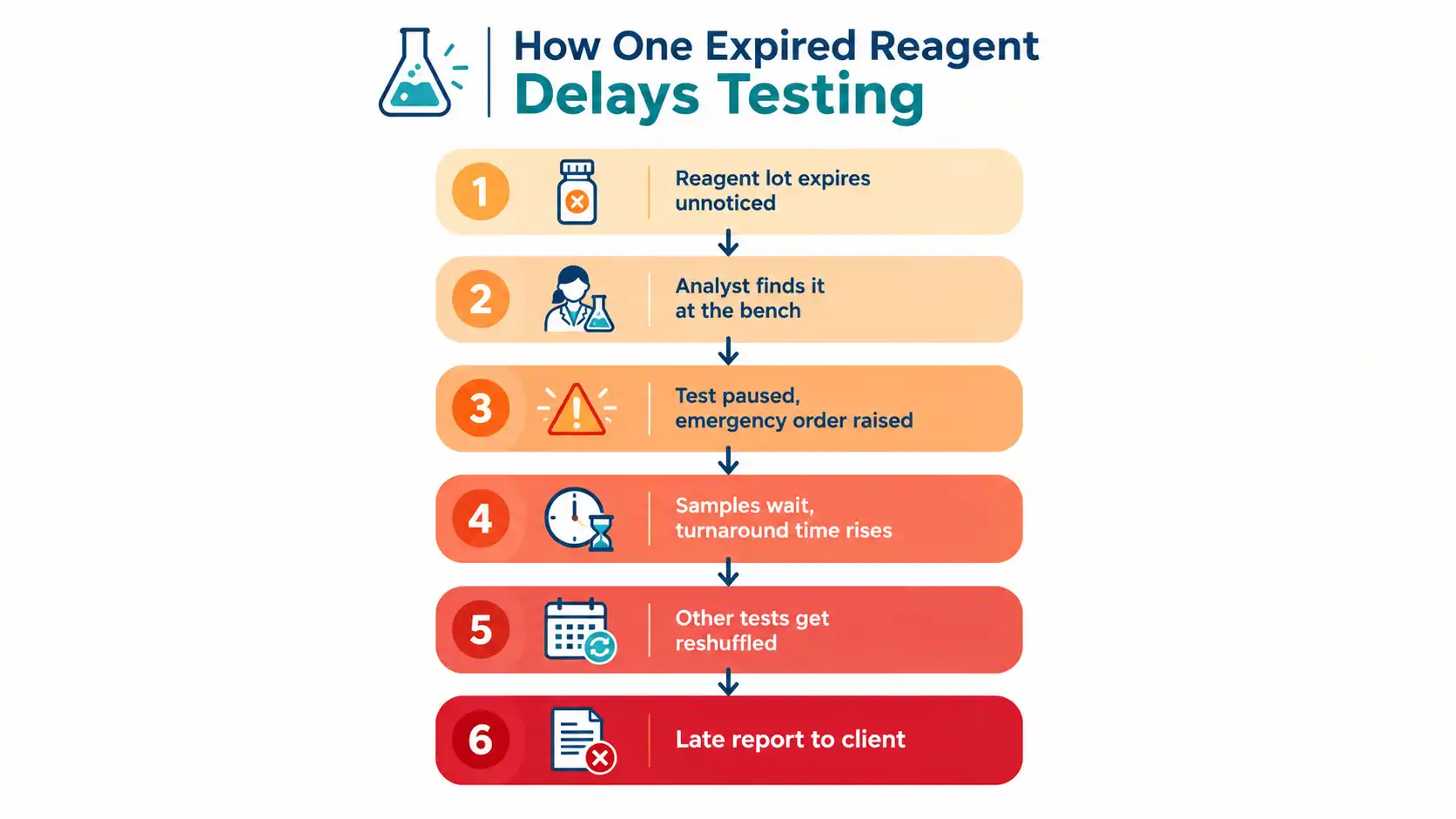
Here is how a small inventory slip can snowball:
- A reagent lot expires unnoticed.
- The analyst discovers it when preparing a batch.
- The test is paused while the team searches for stock or raises an emergency order.
- Samples wait, and turnaround time (TAT) goes up.
- Other tests get reshuffled to make up for lost time.
- The client receives a late report, or the lab pays for express shipping to catch up.
In regulated labs, there is an even bigger risk. If an expired reagent is used by mistake, the results may be invalid. That can trigger investigations, out-of-specification (OOS) reviews, retesting and corrective actions. Each one takes time, effort and money.
The lesson is simple: reagent management is not a back-office task. It directly shapes how fast and how reliably the lab delivers results.
How LIMS Improves Reagent Tracking
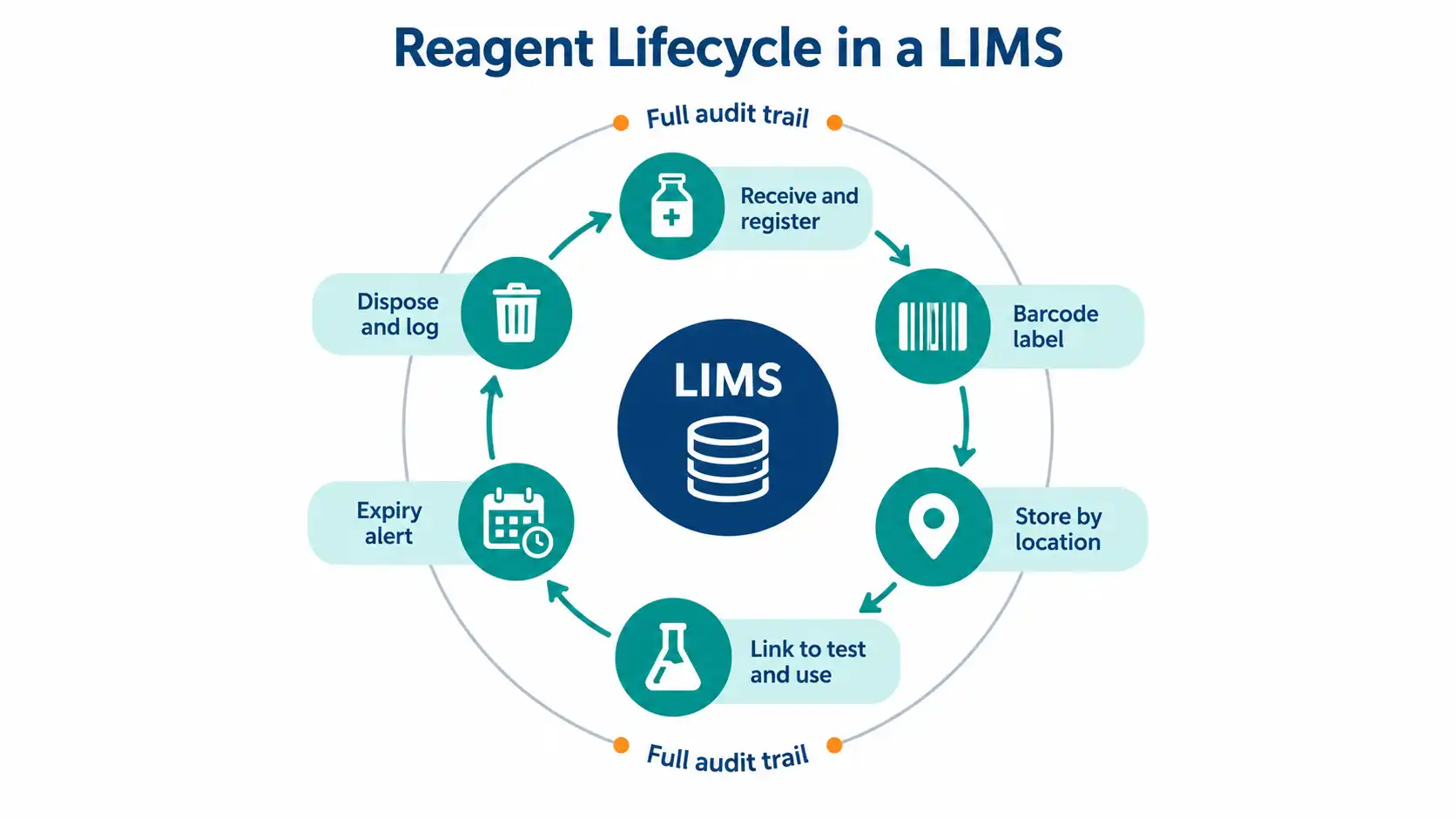
A LIMS brings reagents, lots, methods and results into one connected system. Instead of a list of quantities, the lab gets a living record of every item, from the day it arrives to the day it is used up or disposed of.
Here are the key ways a LIMS makes tracking smarter.
Lot-Level and Batch-Level Records
Every reagent is recorded with the details that matter:
- Supplier and catalog number
- Lot or batch number
- Date received and date opened
- Expiry date and in-use expiry (after opening)
- Storage condition and location
- Certificate of Analysis (CoA) or supporting documents
- Quantity received, used and remaining
This means the lab no longer asks, "Do we have this reagent?" It can ask a better question: "Do we have a valid, in-date lot of this reagent, and where is it?"
Barcodes and Labels for Fast, Accurate Entry
Most modern LIMS platforms support barcode or QR code labels. When a new delivery arrives, staff scan or register it, and the system assigns a unique ID. Later, anyone can scan the container to see its lot, expiry and status in seconds.
This cuts down on manual typing, reduces errors and speeds up daily work.
Real-Time Stock Updates
When an analyst uses a reagent, the LIMS records the quantity used and updates the balance. No second spreadsheet. No end-of-week catch-up.
The store team, the lab manager and the purchasing team all see the same live numbers. That removes confusion and builds a single version of the truth.
Linking Reagents to Methods and Tests
This is where a LIMS goes beyond ordinary inventory software. It can link each test method to the reagents, standards and consumables it needs.
That unlocks powerful checks:
- Before a test starts, the system can confirm that the required reagent is available and in date.
- During the test, the analyst records which lot was used, creating a clear audit trail.
- After the test, if a lot is later found to be faulty, the lab can quickly see every result that used it.
That last point is vital for quality investigations. Instead of searching through notebooks, the lab can trace affected samples in minutes.
Status Control and Quarantine
A LIMS lets labs assign a status to each lot, such as:
- Received / awaiting QC
- Approved for use
- In use
- Quarantined
- Expired
- Disposed
An expired or quarantined lot can be blocked from selection in a test. That simple control stops human error before it reaches the bench.
Multi-Location and Multi-Site Visibility
For labs with several rooms, storerooms or sites, a LIMS provides one consolidated view. Teams can see where each item is stored, how much is available at each location, and whether stock can be transferred rather than bought again.
Full Traceability and Audit Trails
Every receipt, transfer, use and disposal is logged with a date, time and user. For labs working under ISO/IEC 17025, GLP, GMP, NABL or similar requirements, this built-in traceability makes audits far smoother. Instead of scrambling to find records, the lab can pull them up on demand.
Expiry Alerts, FEFO and Stock Planning
Tracking is the foundation. The real value comes from what the LIMS does with that data. Three features work together to keep reagents fresh and tests on schedule: expiry alerts, FEFO and smart stock planning.
Expiry Alerts: Know Before It's Too Late
A good LIMS watches expiry dates for you, around the clock. Instead of relying on someone to remember, the system sends automatic alerts at set points, for example:
| Alert stage | Typical timing | What it prompts |
|---|---|---|
| Early notice | 90 days before expiry | Plan usage, avoid reordering that lot |
| Warning | 30 days before expiry | Prioritize use, consider transfer to another site |
| Urgent | 7 days before expiry | Use immediately or prepare disposal |
| Expired | On expiry date | Block from use, quarantine, document disposal |
These timings are only examples. Each lab can set its own thresholds by reagent type. A short-life biological reagent needs a much tighter window than a stable chemical.
Alerts can appear on a dashboard, arrive by email or be sent to specific roles such as the lab manager, store in-charge or quality head.
Good systems also handle in-use expiry. Once a bottle is opened, its life may drop from two years to a few weeks. The LIMS can calculate and track that new date automatically from the moment of opening.
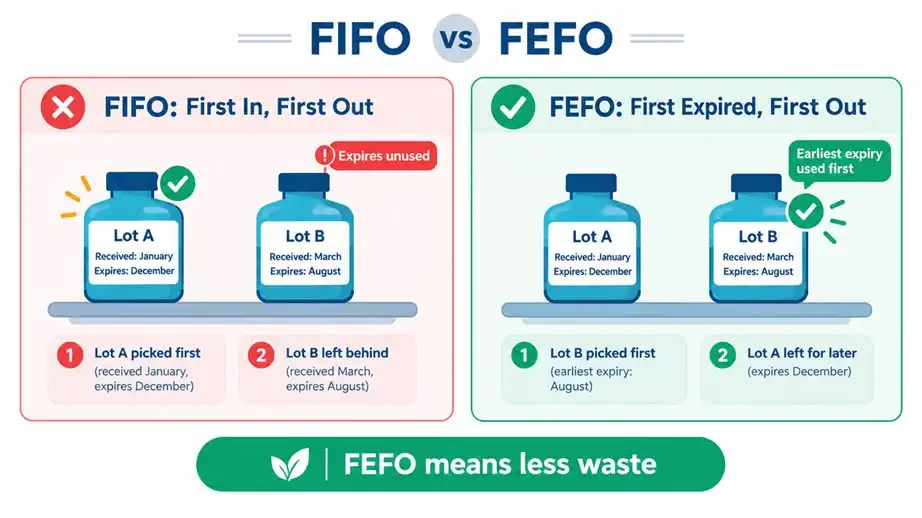
FEFO: First Expired, First Out
You may know FIFO, or First In, First Out. It works well for items with similar shelf lives. But in a lab, a lot received later can sometimes expire earlier than one received before it.
That is why many labs prefer FEFO: First Expired, First Out.
Here is a simple example:
- Lot A arrived in January and expires in December.
- Lot B arrived in March and expires in August.
Under FIFO, staff would pick Lot A. Lot B would then sit and expire. Under FEFO, the LIMS suggests Lot B first, because it will expire sooner.
A LIMS supports FEFO by:
- Sorting available lots by expiry date when an analyst selects a reagent
- Recommending the earliest-expiring valid lot by default
- Flagging or warning when someone picks a later-expiry lot without reason
- Blocking any expired lot from being used
The result is less waste, and fewer "mystery bottles" at the back of the fridge.
Smart Stock Planning: From Reactive to Proactive
Avoiding expiry is only half the job. The lab also needs to avoid running out. A LIMS helps strike that balance with data-driven planning.
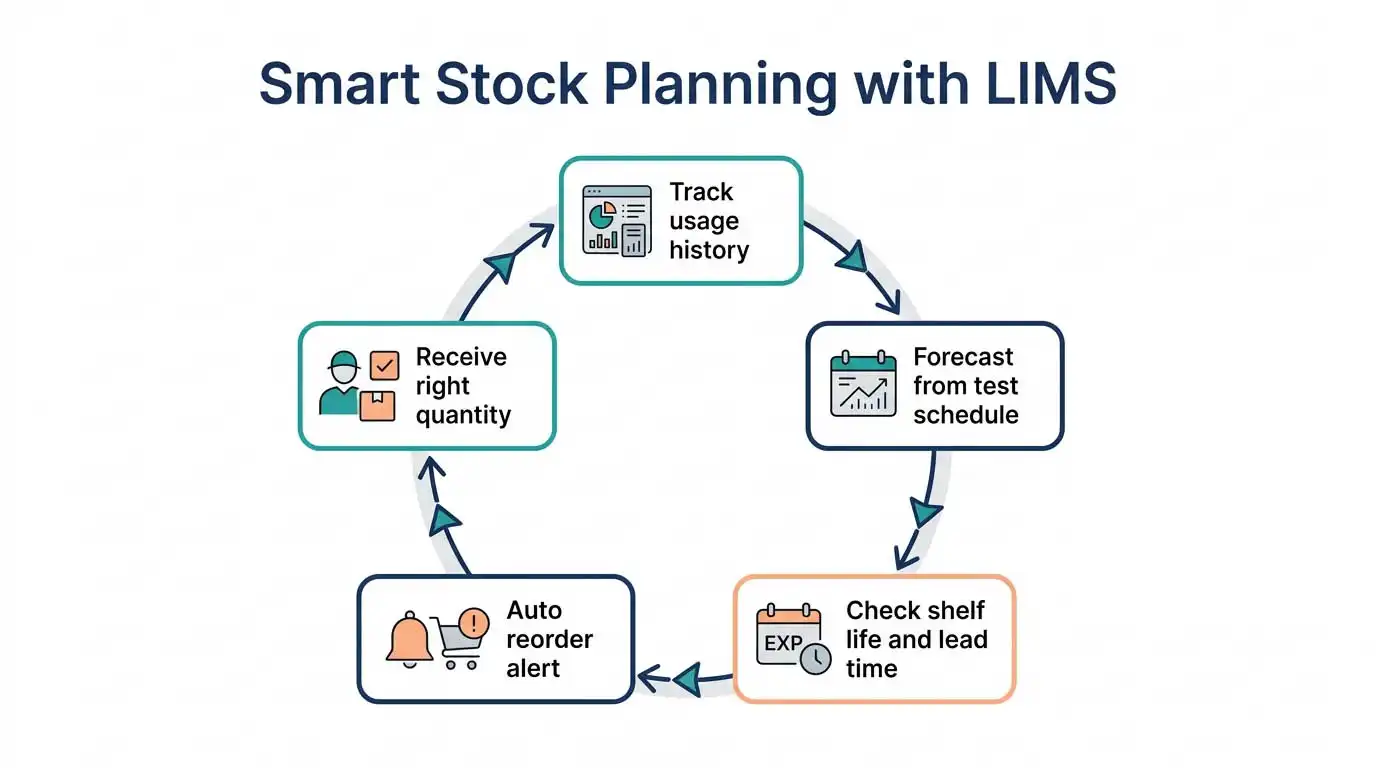
- Usage history. The system records how much of each reagent is consumed over time. This shows real demand, not guesswork.
- Minimum and reorder levels. Labs can set a minimum stock level and a reorder point for each item. When stock falls to that point, the LIMS raises a reorder alert or prompts a purchase request.
- Lead-time awareness. Some reagents arrive in two days. Others take eight weeks. The LIMS can factor in supplier lead times so that reorder alerts come early enough.
- Forecasting from the test schedule. Because reagents are linked to methods, the system can estimate upcoming needs from the planned workload. If a large batch of samples is expected next month, the lab can see the reagent requirement in advance and order accordingly.
- Shelf-life-aware ordering. Ordering in bulk may look cheaper, but not if half the stock expires unused. The LIMS helps the lab buy the right quantity by comparing expected use against shelf life.
- Avoiding duplicate purchases. Before a new order is placed, the team can check stock across all locations, including lots nearing expiry that could be used up first.
Together, these tools shift the lab from "we'll order when we notice" to "the system tells us what to do, and when."
Operational, Financial and Quality Benefits
When reagent tracking improves, the effects spread across the whole lab. Here is what teams can expect.
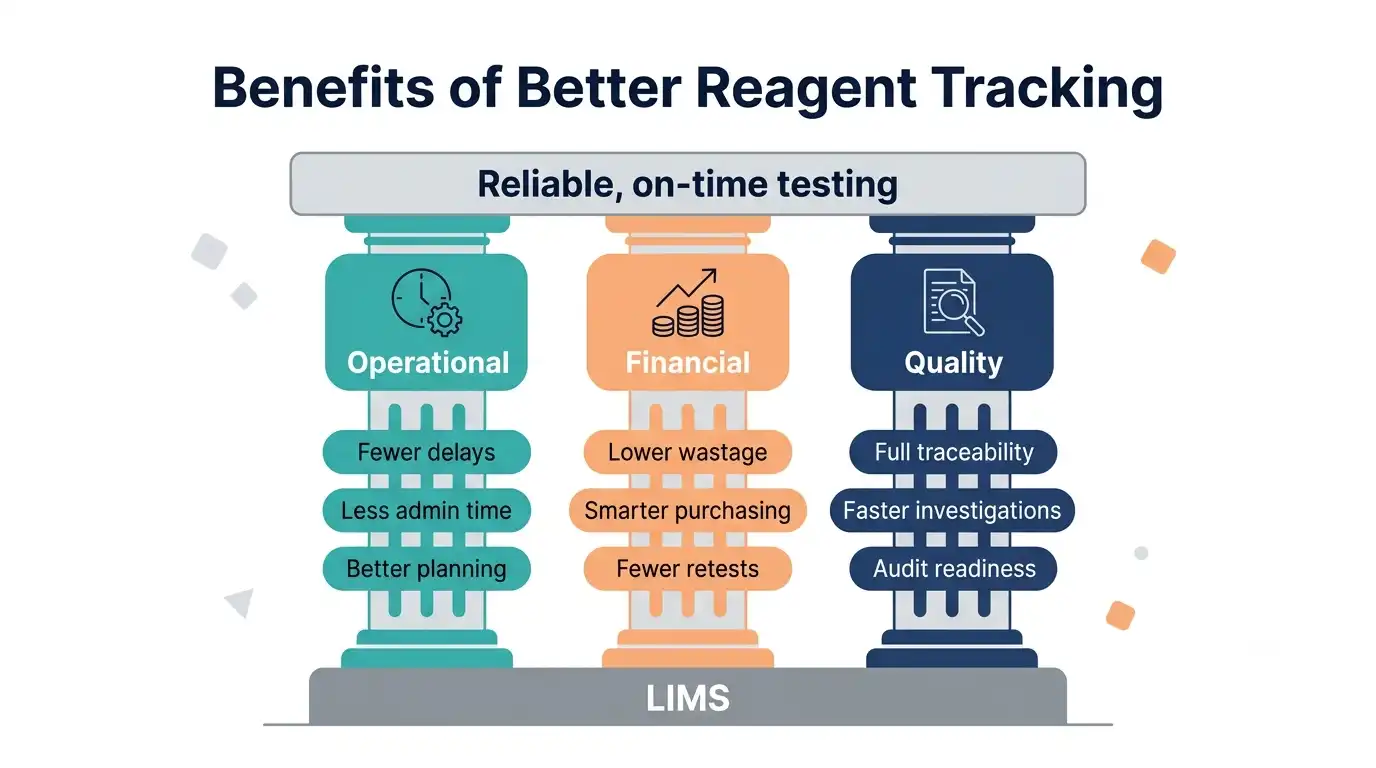
Operational Benefits
- Fewer testing delays. With early warnings and reorder alerts, stock-outs become rare. Methods can run as scheduled, and turnaround times stay predictable.
- Less time spent on admin. Analysts no longer hunt for reagents or check expiry dates by hand. Store teams skip manual stock-taking and reconciliation. Time goes back to actual testing.
- Smoother workflows. Because reagents are linked to tests, analysts can see at a glance whether everything needed is ready before they start.
- Better planning. Lab managers get a clear view of what is coming: which lots expire soon, which items are running low and what the upcoming workload will need.
- Cleaner storage. FEFO and status control keep fridges and shelves organized. Expired items are removed on time instead of piling up.
Financial Benefits
- Lower wastage. Using the earliest-expiring lots first, and buying only what can be used, cuts the volume of reagents thrown away.
- Smarter purchasing. Usage data supports better order quantities, fewer emergency orders and stronger negotiating positions with suppliers.
- Reduced rush costs. Last-minute orders often mean express shipping and premium prices. Planning ahead avoids both.
- Fewer retests. If expired or unsuitable reagents never reach the bench, the lab saves the cost of repeating work.
- Lower inventory holding costs. The lab carries less idle stock, which frees up cash and storage space.
- Better cost visibility. Because consumption is linked to tests, labs can see the true reagent cost per test or per project. That helps with pricing, budgeting and profitability analysis.
Quality and Compliance Benefits
- Fewer errors. Blocking expired or quarantined lots stops mistakes at the source.
- Full traceability. The lab can show exactly which reagent lot was used for each result, and prove it was in date at the time of use.
- Faster investigations. If a supplier recalls a lot or a quality issue appears, the lab can trace all affected tests within minutes and act quickly.
- Audit readiness. Complete records, time-stamped activity logs and documented approvals make audits less stressful. Evidence is already in the system.
- Stronger data integrity. Results backed by verified, in-date materials are more defensible, whether the audience is a regulator, a client or an internal quality team.
- Consistent practice. Standard rules for receiving, storing, using and disposing of reagents apply to every analyst and shift, reducing variation.
A Quick Before-and-After View
| Area | Without a LIMS | With a LIMS |
|---|---|---|
| Expiry tracking | Manual checks, easily missed | Automatic alerts and blocking |
| Lot selection | Based on habit or convenience | FEFO-guided |
| Stock visibility | Scattered across files and people | One live view across locations |
| Reordering | Reactive, often urgent | Planned using usage and lead times |
| Traceability | Hard to reconstruct | Instant lot-to-result linkage |
| Audit prep | Time-consuming and stressful | Records ready on demand |
The impact is not limited to one department. Operations run smoother, finance sees lower costs, and quality teams gain confidence in every result.
Conclusion
Reagent expiry is rarely dramatic. It is a slow leak: a bottle here, a lot there, a delayed test now and then. But over a year, those small losses add up to real money, real delays and real risk.
Stock counts alone cannot solve this. They show quantity, not quality, timing or readiness. To truly protect testing schedules, labs need to know what they have, when it expires, where it is, how fast it is used and which tests depend on it.
A LIMS brings all of this together. With lot-level tracking, automatic expiry alerts, FEFO-guided usage and smarter stock planning, it helps labs:
- Prevent costly reagent waste
- Avoid last-minute stock-outs and testing delays
- Keep every result backed by valid, traceable materials
- Stay audit-ready without extra effort
If your lab still relies on spreadsheets and memory to manage reagents, now is a good time to ask a few simple questions:
- How many reagents did we discard as expired in the last 12 months?
- How many times did a test wait because a reagent was missing?
- Could we prove, today, which lot was used for any result from last year?
If the answers are uncomfortable, a LIMS can help. Moving beyond stock counts is not just an IT upgrade. It is a step toward a lab that runs on time, controls its costs and earns trust with every report.
Ready to stop reagent expiry from slowing your lab down?
Explore how a modern LIMS can bring visibility, control and confidence to your inventory and your testing.
Author: Revol Team











 (1) (1).webp)