LIMS for Pharmaceutical Stability Studies: From Protocol Design to Real-Time Shelf-Life Reporting
Introduction
It is 2 a.m. on a Saturday and a stability chamber alarms: humidity has drifted outside its set range. By Monday, the QA team needs to know which batches were inside, which pulls fall due this week, and whether any results already in review are affected. In many laboratories, answering that means opening spreadsheets, scanning chamber logs and chasing emails.
That scenario (illustrative, but familiar to most stability teams) is the real argument for a purpose-built stability LIMS. Stability studies determine whether a product keeps its quality, safety and efficacy through its intended shelf life. They run for years, across many batches, storage conditions, time points, analysts and sometimes sites, and every result must be traceable and defensible.
This guide explains what a stability LIMS does, where manual programs break down, how a structured workflow leads to shelf-life decisions, and how to implement one without disrupting studies already in progress.
Key Takeaways
- A stability LIMS turns an approved protocol into scheduled, assigned and traceable work, instead of a calendar someone has to maintain.
- Its biggest value is linkage: results, samples, chambers, deviations and approvals live in one connected record.
- Shelf-life decisions rely on statistical trending (ICH Q1E), so the system should support trend analysis and early out-of-trend (OOT) detection, not just result storage.
- Compliance depends on controls (audit trails, access control, e-signatures, validation) aligned with 21 CFR Part 11, EU Annex 11 and ALCOA+ principles.
- Start with the controls that protect sample integrity and scheduling, then add integrations and analytics.
What a Stability LIMS Actually Does
A stability LIMS is a laboratory information management system configured for stability-specific workflows. It is more than a sample tracker: it links the scientific design of a study to its execution, so any result can be traced to a specific sample, batch, storage condition, protocol version, analyst, instrument and approval decision.
| Capability | What it covers |
|---|---|
| Protocol management | Study design by product, batch, strength, packaging, condition, time point, test panel and acceptance criteria, with approval and version control |
| Sample management | Unique IDs, barcodes, aliquots, location tracking and chain of custody |
| Chamber and inventory | Chamber allocation, capacity visibility and links to monitored storage locations |
| Scheduling | Pull calendars generated from the approved protocol, reminders and analyst worklists |
| Analytical workflow | Worksheets, instruments, calculations, specification checks and result review |
| Exception handling | Deviation, OOS and OOT workflows linked to affected records |
| Data integrity | Role-based access, audit trails, electronic signatures and validated records |
| Reporting | Study status, pending actions, excursions, trends and shelf-life reports |
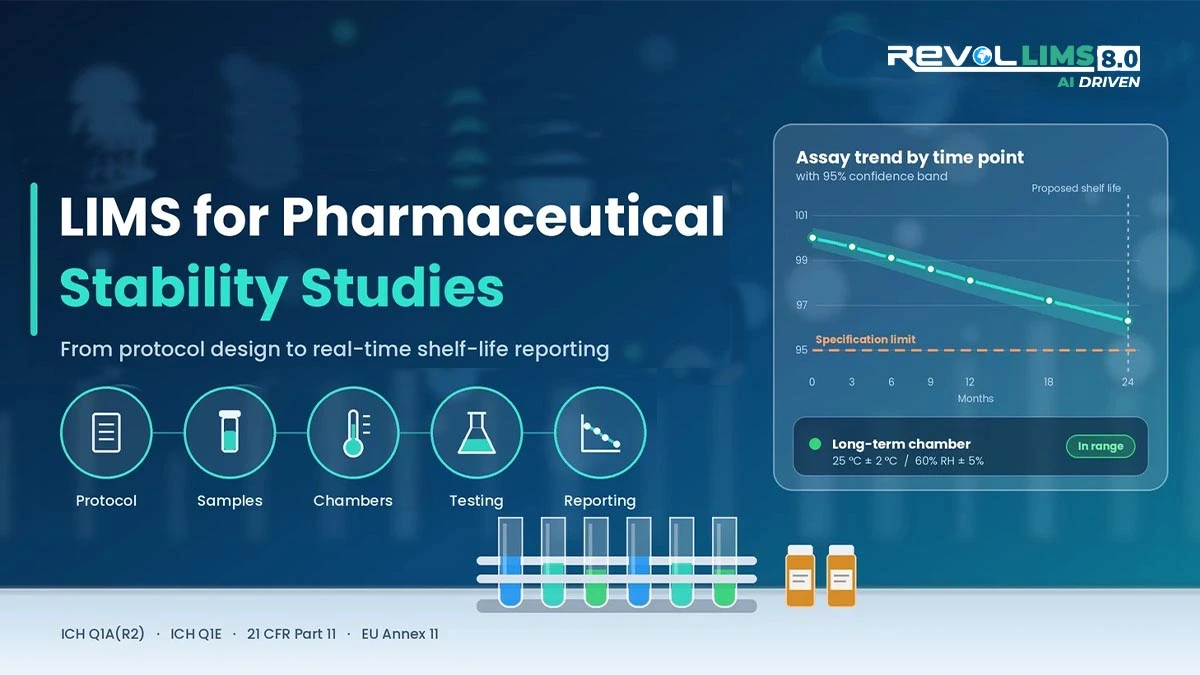
The testing schedule itself comes from the protocol. Under ICH Q1A(R2), long-term studies for products with a proposed shelf life of at least 12 months are generally tested every three months in the first year, every six months in the second year, and annually thereafter. Accelerated studies run for a minimum of six months with at least three time points (for example, 0, 3 and 6 months). A LIMS builds these schedules automatically and keeps them tied to the protocol version.
Where Stability Programs Break Down
Most stability problems are not caused by a lack of scientific expertise. They arise when critical information is spread across protocols, spreadsheets, chamber logs, instruments, email and paper forms. Spreadsheets can record data, but they cannot enforce workflow, preserve relationships between records or provide controlled auditability at scale.
| Common gap | Operational impact | LIMS capability needed |
|---|---|---|
| Protocol changes managed manually | Outdated schedules and inconsistent execution | Controlled versioning and change management |
| Samples tracked in spreadsheets | Lost samples, missed pulls, weak traceability | Unique IDs, barcodes and chain of custody |
| Chamber data stored separately | Late excursion detection, unclear sample impact | Monitoring integration and excursion alerts |
| Pull schedules maintained by hand | Overdue tests, last-minute planning | Automated calendars, reminders and worklists |
| Results reviewed on paper | Slow approvals, difficult audits | Electronic review, signatures and audit trails |
| Shelf-life analysis assembled manually | Delayed, inconsistent reports | Configurable trend charts and dashboards |
The excursion problem
A chamber excursion is not only an equipment event. It can affect every sample stored during the excursion period. Without integration, teams must manually identify affected samples, notify QA, document an impact assessment and decide whether testing continues.
With chamber monitoring linked to the LIMS, the alarm, its duration, the temperature or humidity deviation, the affected samples and the QA decision sit in one traceable record. In the 2 a.m. scenario above, the Monday question (“what was inside, and what is due?”) becomes a single query rather than an investigation.
From Protocol to Shelf-Life Decision: The Workflow
A structured workflow turns an approved protocol into a measurable process in which every result stays linked to its supporting evidence.
- Design the protocol. Define products, batches, packaging, storage conditions, time points, tests, specifications and duration.
- Approve and version it. QA and stakeholders approve a controlled protocol version.
- Generate samples and schedules. The LIMS creates sample records, unique identifiers and time-point schedules.
- Store under controlled conditions. Samples are allocated to chambers and linked to monitoring data.
- Schedule and execute pulls. Due tasks are assigned, and withdrawal and testing progress are tracked.
- Capture and review results. Analysts record results; reviewers compare them to specifications and approve electronically.
- Manage exceptions. OOS results, OOT signals, deviations, excursions and protocol amendments are documented and linked to the study.
- Report the conclusion. Dashboards and reports show completed and pending time points, trends and the evidence behind the shelf-life decision.
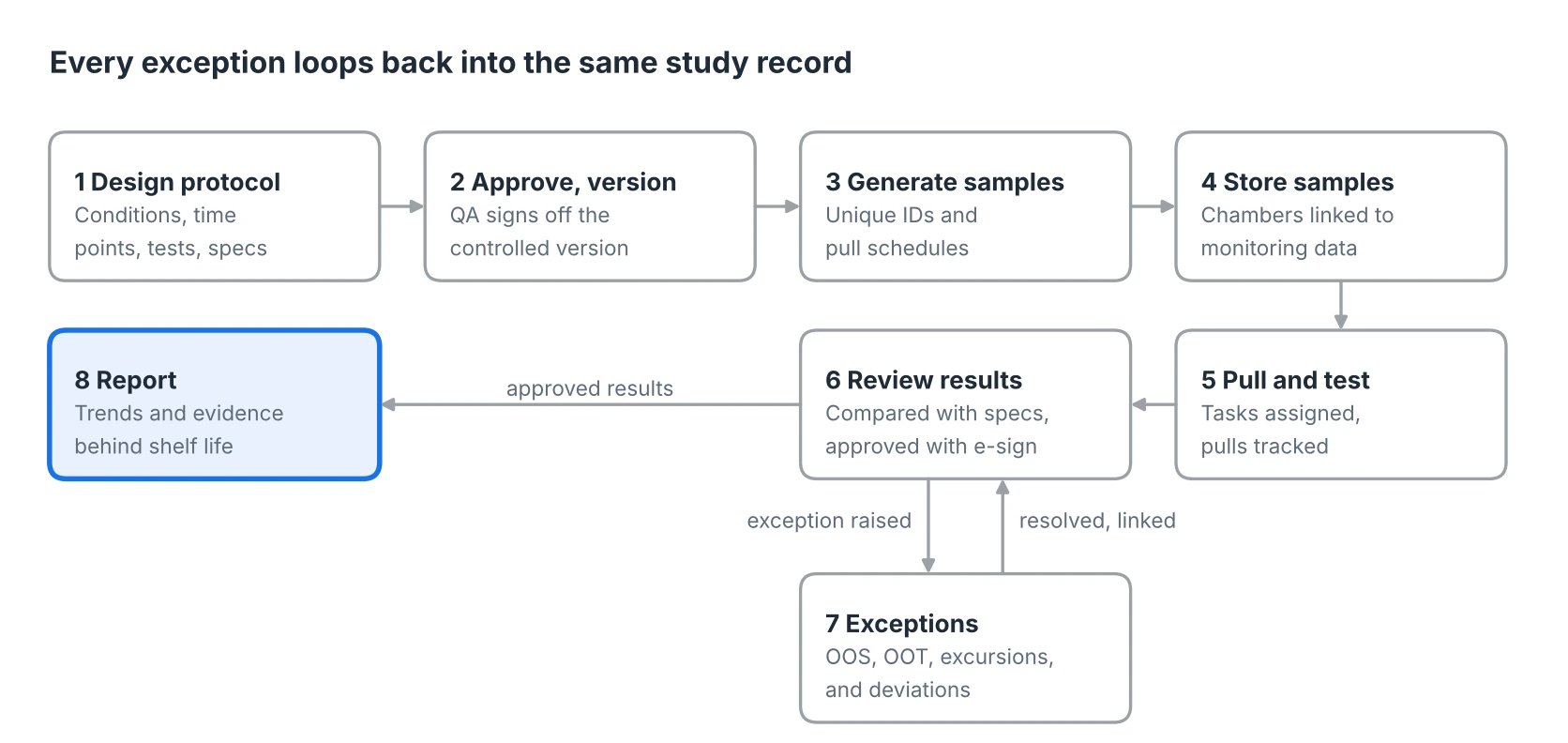 Steps 1 to 5 run in a line; at review, results either flow into the report or raise an exception that is resolved inside the same record and returns to review.
Because the evidence stays linked throughout, shelf-life reporting becomes a view of existing records rather than a reconstruction from separate systems.
Turning Results into Shelf-Life Decisions
Storing results is only half the job. Shelf life is proposed and justified by evaluating how quality attributes change over time, and ICH Q1E sets out the principles for that evaluation.
In practice, the evaluation typically involves:
- Trend analysis of attributes such as assay, degradation products, dissolution and water content, per batch and condition.
- Statistical modelling, commonly regression analysis, to estimate where the attribute is expected to cross its acceptance limit, using appropriate confidence limits.
- Judgement on extrapolation, which ICH Q1E permits only in limited, justified cases and not as a substitute for data.
- Early signals such as out-of-trend results, which fall within specification but depart from the expected pattern and deserve investigation before they become OOS failures.
A stability LIMS supports this by holding clean, structured data for every batch and time point, flagging OOT results against defined rules, and presenting trend charts alongside the supporting investigations. Many laboratories pair the LIMS with validated statistical tools or use built-in analytics. Either way, the key is that the data feeding the analysis is complete, traceable and reviewed.
What “real-time” really means
Real-time shelf-life reporting does not mean results appear instantly. It means authorized users can see current study status, completed and pending time points, results, trends, deviations and chamber events at any moment, without manually assembling data from separate systems.
Compliance and Data Integrity
A LIMS does not make an organization compliant on its own, but it provides the technical controls that regulations expect.
- FDA 21 CFR Part 11. Under Part 11, electronic records and signatures must be trustworthy, reliable and generally equivalent to paper records and handwritten signatures. Signatures must be unique to one individual and linked to their records.
- EU Annex 11. For laboratories supplying the European market, Annex 11 sets expectations for computerised systems, including validation, audit trails, access control and data integrity.
- ALCOA+. Data should be attributable, legible, contemporaneous, original and accurate, as well as complete, consistent, enduring and available. A well-configured LIMS makes these attributes the default rather than a manual effort.
Validation matters as much as features. Workflows, calculations, access controls and reports must be confirmed as fit for intended use before they support GxP decisions.
Beyond the Standard Small-Molecule Study
Stability programs rarely stay simple. A capable LIMS should also handle:
- Photostability testing per ICH Q1B, tracked as a distinct condition within the study.
- Reduced designs such as bracketing and matrixing (ICH Q1D), which change which samples are tested at which time points.
- Biotechnological and biological products, where ICH Q5C applies and attributes such as potency and aggregation are monitored.
- Multi-site programs, where consistent protocols, terminology and review standards are essential.
If these apply to your portfolio, confirm during selection that the system can model them without custom workarounds.
How to Get Started
A phased approach improves stability operations without disrupting ongoing studies.
- Map the current process. Document how protocols, samples, chambers, pulls, tests, deviations and reports are handled today.
- Prioritize critical controls. Sample traceability, pull scheduling, chamber linkage, result review and audit trails come first.
- Standardize your data. Align terminology for products, batches, conditions, tests, specifications and deviations.
- Configure core workflows. Start with protocol management, sample allocation, scheduling and result capture.
- Integrate monitoring and instruments. Connect chamber monitoring and analytical systems where technically feasible.
- Validate and train. Confirm that workflows and records meet intended-use and compliance requirements, and train every role.
- Measure improvement. Track overdue pulls, documentation completeness, investigation cycle time and report turnaround against your baseline.
Treat advanced analytics and wider integrations as a second phase, once the core controls are reliable.
FAQs
Does a LIMS replace the stability protocol?
No. The protocol remains the scientific and regulatory basis for the study. The LIMS operationalizes the approved protocol, controls its versions and helps ensure execution follows the plan.
Can a LIMS help with ICH Q1A(R2) compliance?
It can support compliance by controlling protocol execution, storage conditions, testing intervals, data capture and review. It does not make an organization compliant by itself.
Is stability chamber monitoring part of a LIMS?
Sometimes. Some laboratories use a separate monitoring system, others integrate it with the LIMS. What matters is that conditions, alarms, excursions and affected samples can be traced together.
Can a LIMS perform shelf-life statistics?
Some systems include trending and regression tools; others export clean data to validated statistical software. Either approach works if the data is complete, traceable and the method is justified under ICH Q1E.
What should we evaluate first when choosing a system?
Sample traceability, automated pull scheduling, chamber linkage, result review, deviation management, audit trails and reporting. Also check validation support, fit with your regulatory markets, and how well it handles your product types.
Conclusion
A stability LIMS moves a laboratory from fragmented records to a connected, controlled program. By linking protocols, samples, chambers, testing, trending and deviations, it gives QC and QA teams the traceability and visibility needed for confident, audit-ready shelf-life decisions.
Ready to see how this works for your studies?
Request a demo or explore Revol LIMS for pharmaceutical laboratories.
Book a DemoAuthor: Revol LIMS Team · marketing@revollims.com · www.revollims.com