From Quote to Final Report: How a LIMS Supports the Entire CRO Study Lifecycle
Introduction
A Contract Research Organization (CRO) is judged on the quality of its results and how quickly it delivers them. Both depend on how smoothly a study moves from one stage to the next. When teams work from separate spreadsheets, logbooks and email threads, every hand-off adds waiting time.
A Laboratory Information Management System (LIMS) keeps the study in one connected record, from the first quotation to the final report. This article follows a study through each stage of the CRO study lifecycle. For compliance, data segregation and audit trails in multi-sponsor laboratories, see our guide to LIMS for Contract Research Organizations.
What Is the CRO Study Lifecycle?
Quick answer
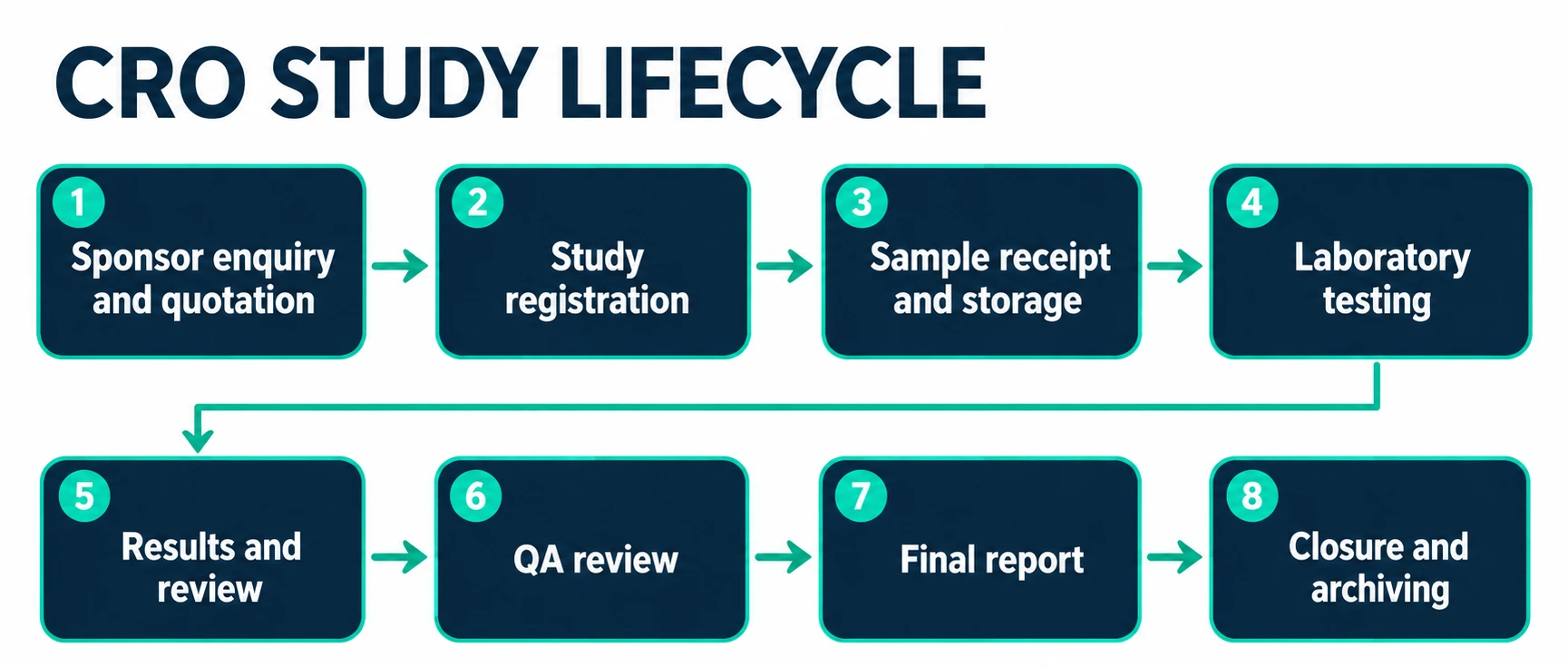
A CRO study lifecycle is the complete process of managing a contract research project, beginning with sponsor enquiry and quotation and continuing through study registration, sample receipt, laboratory testing, data review, quality assurance, final reporting and record archiving. A LIMS helps connect and manage these activities through centralized laboratory workflows and records.
We will follow one hypothetical example: a pharmaceutical sponsor requests an analytical chemistry study on a new drug product. Each stage below shows what the CRO does and where a LIMS helps.
Sponsor Enquiry and Quotation Management
A LIMS records each sponsor enquiry, the tests requested and the resulting quotation in one place, so scope, pricing and turnaround time are consistent and easy to retrieve.
In our example, the sponsor asks for assay, impurity and stability testing. In the LIMS, the team can:
- Link the quotation to the sponsor record and the requested test methods
- Reuse approved test packages and price lists
- Track quotation status, from draft to accepted
- Convert the accepted quotation into a study without re-entering details
That last step carries the agreed scope straight into the study, so nothing requested is missed.
Study Registration and Planning
A LIMS gives each accepted project a unique study record that carries the agreed scope, team, timeline and resources, so testing can start without re-entering details.
The study record holds:
- The accepted scope and test list from the quotation
- The Study Director and the assigned analysts
- The planned start date, milestones and report date
- The instruments and storage space the study needs
With every active study on one schedule, managers can check laboratory capacity before they promise a start date.
Sample Receipt and Storage
A LIMS manages sample receipt by checking arriving samples against the study, giving each one a unique ID and barcode label, and recording where it is stored, so any sample can be found quickly.
When the drug product samples arrive, staff can:
- Pre-register expected samples against the study
- Record the quantity and condition of each sample on arrival
- Print unique sample IDs and barcode labels at the receiving bench
- Assign storage locations that can be searched by sample ID or study
Laboratory Testing and Study Execution
A LIMS organizes testing by assigning tests to qualified analysts, scheduling instruments and tracking reagents and reference standards, so work flows without gaps or double booking.
Once testing begins, the LIMS can:
- Create worklists and assign tests to qualified analysts
- Flag instruments that are due for calibration or maintenance
- Record reagent and reference standard lot numbers and expiry dates
- Give supervisors a live view of workload and pending tests
This is CRO laboratory management in practice: the right test, by the right person, on the right equipment.
Results and Data Management
A LIMS captures results once at the source, routes them through peer review and approval in a defined order, and consolidates them by study, so the full dataset is ready when the report is written.
Copying values between files slows a study and invites errors. Instead, a LIMS:
- Records or imports each result once, so nothing is retyped
- Applies standard formulas, so every analyst gets the same answer
- Shows review queues: what is waiting, with whom, and for how long
- Consolidates all results in one view for the Study Director
Quality Assurance and GLP Within the Study Workflow
A LIMS supports Good Laboratory Practice (GLP) by placing QA inspections and report reviews on the study schedule, tracking each review and sign-off, and giving the QA unit timely access to study records.
GLP is a quality system for how nonclinical laboratory studies are planned, performed, monitored, recorded, reported and archived. In the United States it is set out by the Food and Drug Administration (FDA) in 21 CFR Part 58 and, for studies under its programs, by the Environmental Protection Agency (EPA) in its GLP standards. The OECD Principles of GLP underpin mutual acceptance of study data between countries.
Under 21 CFR 58.35, the QA unit works alongside the study from start to finish. A LIMS helps by:
- Keeping a master schedule of active studies and planned inspections
- Recording in-process inspections and alerting the Study Director to findings
- Attaching the QA statement and sign-off to the report record
Final Report Generation and Sponsor Delivery
A LIMS speeds up final reporting by assembling approved results into the draft report, tracking review comments and sign-offs, and recording when the finished report is issued to the sponsor.
For the sponsor's report, the LIMS can:
- Pull approved results, methods and sample information into the draft
- Route the draft to the Study Director and QA, tracking each comment and version until sign-off
- Log the issue date and delivery to the sponsor
Because the report is built from approved data, it matches the study records.
Study Closure and Record Archiving
A LIMS supports study closure by confirming that samples, data and approvals are complete, then moving the study's records into controlled archives where they stay retrievable for the required retention period.
GLP expects raw data, protocols, reports and related records to remain retrievable, with retention periods set by the regulation and the sponsor. Closing the study in the LIMS means:
- Confirming every test is complete and every result approved
- Recording the final disposition of remaining samples
- Locking the study record against further changes
- Indexing records by study, sponsor, date or sample ID
Years later, a sponsor's question can be answered in minutes rather than days.
How Revol LIMS Supports the Complete CRO Lifecycle
Revol LIMS is a Laboratory Information Management System that brings the stages above into one platform, so a study moves from quotation to final report without leaving the system. For a CRO, that means one record per study, one schedule for the whole laboratory, and one place to see where every sample and every report stands.
The table compares a manual approach with Revol LIMS at each stage.
| Lifecycle stage | Manual approach | With Revol LIMS |
|---|---|---|
| Enquiry and quotation | Emails and spreadsheets, scope re-typed | Enquiry, quotation and scope in one record that becomes the study |
| Study planning | Separate calendars and whiteboards | One view of timeline, team and instruments |
| Sample receipt | Paper logs and handwritten labels | Pre-registered samples, barcode labels, searchable storage |
| Testing | Verbal assignments and paper worklists | Assigned worklists with instrument and reagent status |
| Results and review | Values copied between files | Results captured once, review queues visible |
| Final report | Assembled by hand from many files | Draft built from approved results |
| Closure and archiving | Paper boxes and shared-drive folders | Study closed in the system, records indexed |
Explore Revol LIMS for CRO laboratories or the full list of Revol LIMS modules. For multi-sponsor data segregation, 21 CFR Part 11 audit trails, chain of custody and out-of-specification investigations, read our guide to LIMS for Contract Research Organizations.
Conclusion
A LIMS connects every stage of the CRO study lifecycle, so quotations become studies, samples become results and results become reports. For CROs running many studies at once, that connection is what allows growth without losing control of turnaround time.
Want to talk through your laboratory's workflow?
Request a demo, explore Revol LIMS for CRO laboratories, or write to marketing@revollims.com
Book a DemoFrequently Asked Questions
What is the role of a LIMS in a CRO?
A LIMS is the central system a CRO uses to run studies from quotation to final report, keeping enquiries, samples, results and reports in one connected record.
How does a LIMS support the CRO study lifecycle?
It supports each stage: quotations, study planning, sample receipt and storage, testing, results review, QA, reporting and archiving.
How does a LIMS help with quotations and study scheduling?
It links each quotation to the sponsor and requested tests, carries the accepted scope into the study record, and shows capacity before a start date is committed.
How are samples stored and found during a study?
Each sample gets a unique ID and barcode label at receipt and a recorded storage location, so staff can search by sample ID or study.
How does a LIMS help produce the final study report?
It pulls approved results and sample information into the draft, tracks review comments and sign-offs, and logs the issue date.
What happens to study records when a study closes?
Records are locked, indexed and kept for the required retention period, so they can be retrieved quickly if a sponsor asks questions later.
What are the benefits of using a LIMS in contract research laboratories?
Typical benefits are fewer re-entry errors, faster turnaround, clearer workload visibility, quicker reporting and easier retrieval of old records.