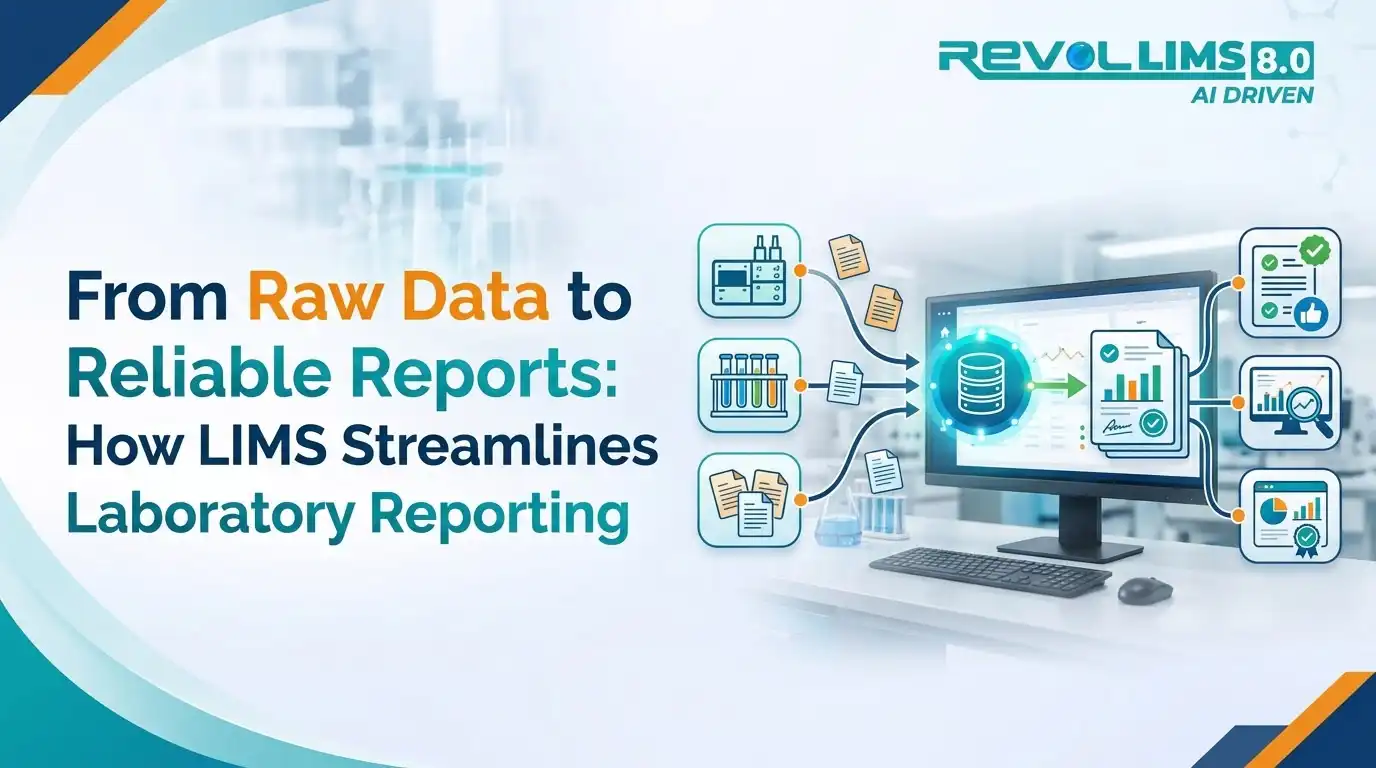
A laboratory information management system (LIMS) streamlines reporting by capturing results at the source, applying defined checks and review steps, and generating reports from approved data instead of retyped copies. The outcome is faster, more consistent reports with a traceable record of who produced, reviewed, and changed each result.
In practice, the path from a raw instrument reading to a signed report crosses many hands and tools. A result may move from an instrument to a spreadsheet, to a second reviewer, to a template, and to a customer's inbox. Every handoff is a place where a number can be mistyped, a version mixed up, or a change left unrecorded.
For laboratories that work under accreditation or regulation, the report is the final product. ISO/IEC 17025, the international standard for testing and calibration laboratories, expects results to be reported accurately, clearly, unambiguously, and objectively. Data integrity guidance from regulators adds that the underlying data must be complete, consistent, and accurate.
This article is written for laboratory professionals, QA/QC managers, lab directors, IT teams, and decision-makers. It explains what reporting really involves, where gaps typically appear, what a laboratory needs to close them, how a structured LIMS workflow supports reliable reporting, and how to get started.
Note on requirements: Standards and regulations differ by sector, region, and accreditation scope. Treat this article as general education.
Key Takeaways
Reliable laboratory reports depend on controlled data, not just good formatting. A LIMS helps by standardizing how results are captured, reviewed, approved, and issued. It supports, but does not replace, a sound quality system, validated methods, trained staff, and clear procedures that determine whether a report can be trusted.
- Reporting is a process, not a document. It spans calculation, review, interpretation, release, and amendment.
- Most gaps come from handoffs. Manual copying, offline reviews, and untracked edits create most of the risk.
- Requirements are consistent across frameworks. Accurate and traceable records, controlled changes, and validated systems appear in ISO/IEC 17025, FDA guidance, EU GMP Annex 11, and OECD GLP guidance.
- Structure beats speed alone. Faster reporting is a by-product of fewer errors and fewer rework loops.
- A LIMS is a tool, not a guarantee. Regulators describe risk-based, well-governed approaches rather than a single technology answer.
- Start small. Map one report type, set requirements, validate in stages, and measure results.
What Does Laboratory Reporting Actually Mean?
Laboratory reporting is the controlled process of turning raw observations and instrument output into a verified, approved, and traceable result that a customer or regulator can rely on. It covers calculation, review, interpretation, formatting, release, and any later amendment, not only the final document.
 Many teams think of "the report" as the PDF that leaves the building. ISO/IEC 17025treats reporting as one stage in a chain that includes technical records, evaluation of measurement uncertainty, validity of results, and control of data and information management. The report is only as sound as the links before it.
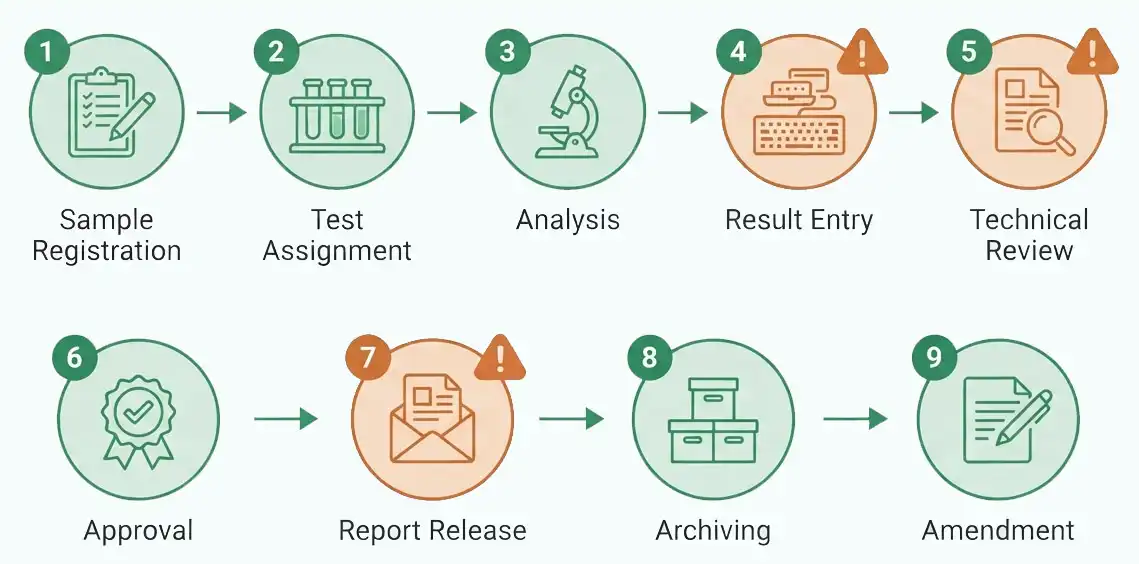
What are the stages between raw data and a report?
Although every laboratory differs, most follow a similar path. A simplified view:
- Request and sample registration. The laboratory receives a request, assigns unique identifiers, and records sample details.
- Test assignment and scheduling. Methods, analysts, and instruments are allocated.
- Analysis and raw data generation. Instruments and analysts produce observations, readings, and chromatograms.
- Result entry and calculation. Raw data are processed, calculated, and compared to limits or specifications.
- Technical review. A second qualified person checks the data, calculations, and method compliance.
- Approval and authorization. An authorized person confirms the result is ready for release.
- Report generation and release. A report is produced in the required format and sent to the customer.
- Archiving and retrieval. Records are retained and can be retrieved later.
- Amendment, if needed. Corrections to an issued report follow a controlled procedure.
What makes a report "reliable"?
A reliable report is one a reader can trust and an auditor can reconstruct. The table below summarizes common attributes and where the expectation comes from.
| Attribute | Plain-language meaning | Where the expectation appears |
|---|---|---|
| Accurate, clear, unambiguous, objective | The reader cannot misinterpret what was tested or found | ISO/IEC 17025, clause 7.8 |
| Complete, consistent, accurate data | No missing runs, no conflicting versions, no unexplained changes | FDA data integrity guidance |
| Attributable and original or true copy | Each entry can be tied to a person, time, and source | FDA data integrity guidance (ALCOA) |
| Traceable change history | Changes to records are recorded with who, when, and reason | 21 CFR Part 11; EU GMP Annex 11 |
| Stated decision rule | If a pass/fail statement is given, the rule behind it is described | ISO/IEC 17025, clause 7.8.6, as interpreted by UKAS |
| Controlled amendments | Corrections to issued reports follow a defined process | ISO/IEC 17025, clause 7.8.8 |
A short note on terminology. FDA's 2018 guidance describes data integrity using the ALCOA attributes: attributable, legible, contemporaneously recorded, original or a true copy, and accurate. Industry and some regulators commonly extend this to "ALCOA+" by adding complete, consistent, enduring, and available. The expanded version is widely used in practice and referenced in recent European drafts, but the FDA guidance itself uses the five-attribute form.
Where does a LIMS fit in?
A LIMS is software that manages samples, tests, results, workflows, and records in one controlled environment. In a reporting context, its main job is to keep the data-to-report path inside a single, governed system, so that results flow from entry to review to release without being retyped. It does not decide whether a method is valid or a result is correct. People and procedures still do that. The LIMS enforces the process and records what happened.
Where Do Laboratories Face Reporting Gaps?
Most reporting gaps come from disconnected steps: results copied between instruments, spreadsheets, and documents; reviews that happen outside the system of record; and changes that leave no clear trail. These gaps raise the risk of transcription errors, delays, inconsistent formats, and findings during audits or inspections.
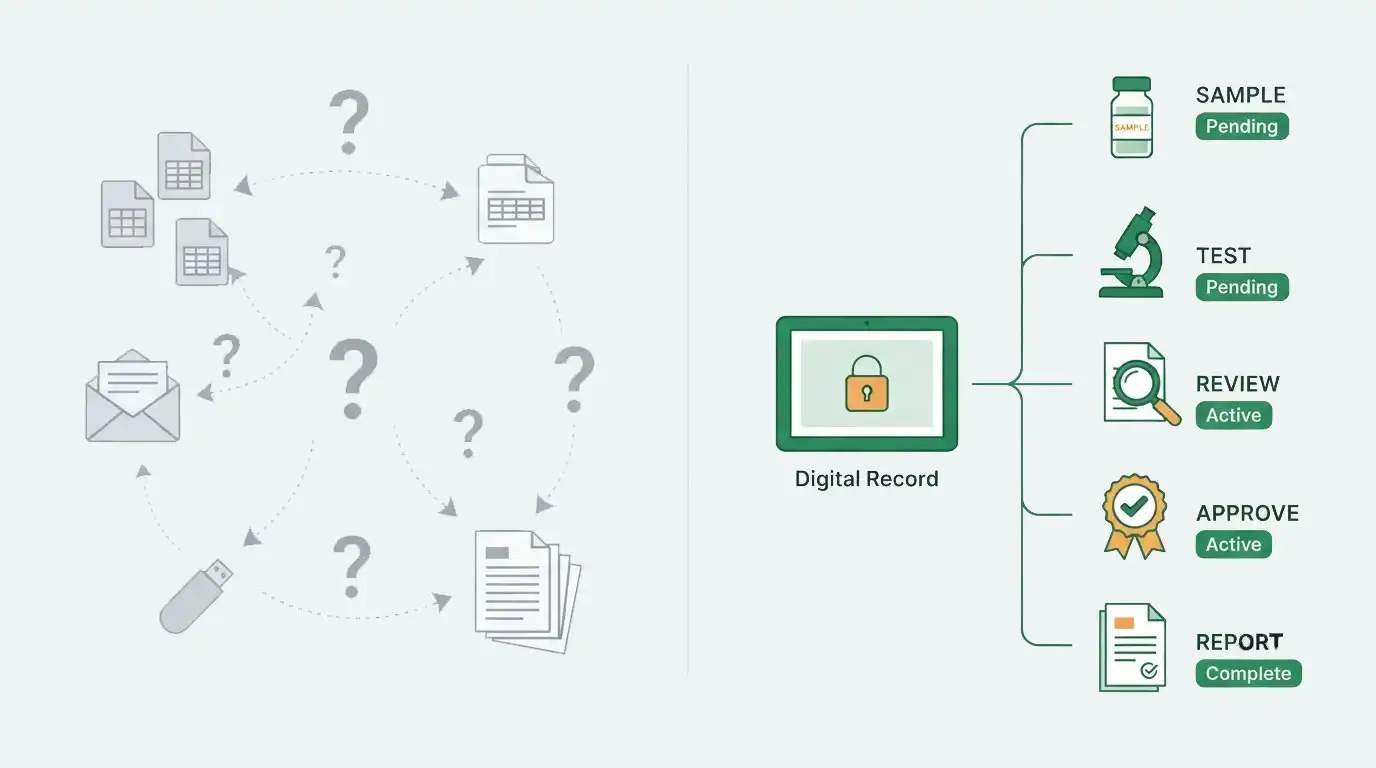
These gaps rarely mean a laboratory is careless. They usually grow out of habits that worked at smaller volumes.
What are the most common gaps?
| Gap | How it shows up | Why it matters |
|---|---|---|
| Manual transcription | Values typed from instruments or worksheets into spreadsheets or templates | Transcription errors; second-person checks become slow and repetitive |
| Spreadsheet-based calculations | Formulas stored in personal files, edited without control | Version confusion; hard to show the calculation was validated |
| Offline or informal review | Review by email, chat, or marked-up printouts | The approval exists, but not in a retrievable, attributable record |
| Inconsistent report formats | Different analysts use different templates and wording | Customer confusion; missed required report content |
| Untracked corrections | Values overwritten or reports replaced without a recorded reason | Weak traceability; difficulty reconstructing what changed |
| Disconnected instruments and systems | Data move by USB drive, file copy, or manual export | Risk of missing, duplicated, or mismatched data |
| Unclear status of records | Staff cannot easily tell whether a result is draft, reviewed, or approved | Premature release; rework |
| Slow retrieval | Finding old results requires searching folders, emails, and paper | Delays during customer queries, audits, and investigations |
Why do these gaps matter for compliance?
Regulators have said this plainly. FDA has stated that it has increasingly observed data integrity-related violations during inspections of drug manufacturers, and it describes data integrity as an important part of ensuring product safety, efficacy, and quality. The guidance also stresses that the complete life cycle of data needs to be protected. OECD's advisory document on GLP data integrity takes a similar life-cycle view and asks facilities to understand their data flows, from generation to archiving.
ISO/IEC 17025 approaches the same issue from the quality side. Laboratories are expected to monitor the validity of results and to record data in a way that lets trends be detected, using statistical techniques where practicable. That is hard to do when data live in scattered files.
What do the gaps cost in practice?
The costs are rarely one dramatic event. They are small, repeated losses: reviewer time spent re-checking copied values, reports delayed while approvals are chased, customer queries that need manual reconstruction, and audit preparation that depends on a few people who know where things are. These costs differ in every laboratory and are best measured locally, using the baseline study described in "How Can a Laboratory Get Started?"
What Do Laboratories Need for Reliable Reporting?
Laboratories need controlled data capture, defined review and approval rules, secure and traceable records, validated systems, and report templates that reflect applicable requirements. These needs come from quality and data integrity expectations in standards such as ISO/IEC 17025 and, where relevant, FDA, EU GMP, and OECD GLP guidance.
The following requirements apply to most laboratories, whatever tools they use. They are framed as capabilities to look for in any system or process, not as product features.
What capabilities support reliable reporting?

- Controlled data capture. Results enter the system at or near the point of generation, ideally by direct instrument interface or structured entry with validation checks. EU GMP Annex 11 expects computerized systems that exchange data electronically to include appropriate built-in checks for the correct and secure entry and processing of data.
- Defined workflows with status control. Each sample and result has a visible status, such as in progress, under review, approved, or released. Rules decide who can move a record to the next status.
- Role-based access and segregation of duties. Only authorized people can enter, review, approve, or change data. ISO/IEC 17025 expects information management systems to be protected from unauthorized access and safeguarded against tampering and loss.
- Audit trails. The system keeps a secure, time-stamped record of changes. Annex 11 states that, based on risk assessment, systems should record GMP-relevant changes and deletions, document the reason for changes, make audit trails available in an intelligible form, and review them regularly. 21 CFR Part 11 sets related expectations for electronic records and signatures used in FDA-regulated contexts.
- Electronic signatures and record linking, where applicable. Part 11 requires that signatures be linked to their records so they cannot be excised, copied, or transferred to falsify a record.
- Validated and controlled systems. ISO/IEC 17025 expects information management systems used for results and records to be validated for functionality, including interfaces. Annex 11 expects risk-based validation, controlled change and configuration management, and periodic evaluation to confirm the system remains in a validated state.
- Supplier and hosting oversight. If the system is maintained by an external provider, the laboratory remains responsible for ensuring that the provider meets applicable requirements. This is addressed in clause 7.11.4 of ISO/IEC 17025.
- Standardized report templates. Templates should include the content the applicable standard or customer requires, and should state the decision rule when a statement of conformity is given.
- Controlled amendments. Corrections to issued reports should follow a defined procedure and be recorded.
- Retention and retrieval. Records should be retained for the required period and retrievable on request.
How do the major frameworks line up?
| Need | ISO/IEC 17025 | FDA (21 CFR Part 11 and data integrity guidance) | EU GMP Annex 11 | OECD GLP No. 22 |
|---|---|---|---|---|
| Accurate, unambiguous reporting | Clause 7.8 | Data should be reliable and accurate | Accuracy checks on data entry and exchange | Data integrity across the life cycle |
| Traceable change history | Technical records and information management | Audit trails under Part 11 | Audit trails, regularly reviewed | Reconstruction of activities and data |
| Validated systems | Validation of information systems | Risk-based approach described in FDA's Part 11 scope guidance | Validation, change control, periodic evaluation | Risk-based, governed approach to data |
| Access control | Protection from unauthorized access | Part 11 access and authority controls | Controls to restrict access | Defined roles and responsibilities |
The frameworks are not identical. A testing laboratory seeking ISO/IEC 17025 accreditation faces different obligations from a pharmaceutical quality control laboratory under cGMP, and a GLP test facility differs again. FDA's own scope guidance also describes a narrower, risk-based reading of Part 11 for validation, audit trails, record retention, and record copying. Read the guidance that applies to you.
What is changing in the regulatory landscape?
The European Commission opened a stakeholder consultation in July 2025 on a revised EU GMP Annex 11 on computerised systems, alongside a revised Chapter 4 on documentation and a new Annex 22 on artificial intelligence. The consultation has closed. The current Annex 11 text dates from 2011. Laboratories working under EU GMP should check the European Commission's EudraLex Volume 4 page for the current status of the revision before finalizing system requirements.
How Does a Structured Workflow Support Reliable, Faster Reporting?
A structured LIMS workflow moves each sample through defined stages: registration, testing, result entry, review, approval, and report release. Each stage applies rules and records who acted and when, so reports are generated from approved data and discrepancies are caught earlier rather than at final review.
The value comes from design, not software alone. When a laboratory defines its workflow and then configures a system to enforce it, data move once instead of many times, review happens inside the record, and reports are built from approved results.
How does the workflow run, step by step?
- Register the sample once. A unique identifier is assigned at receipt. Customer, method, and specification details attach to that identifier, so they do not have to be re-entered later.
- Assign tests by rule. Test lists follow product, matrix, or method rules. This reduces missed or surplus tests.
- Capture results at the source. Where possible, instruments send results directly into the record. Where manual entry is unavoidable, field-level checks (units, ranges, required fields) catch many errors at the moment of entry.
- Apply calculations in controlled form. Calculations live in a managed, validated configuration instead of in personal spreadsheets.
- Flag exceptions automatically. Results outside limits, missing data, or expired reference materials trigger visible flags for review.
- Route to technical review. A qualified second person reviews data, calculations, and flags in the same record, with a prompt to document comments.
- Authorize release. An authorized person approves. The record status changes, and the approval is attributed and time-stamped.
- Generate the report from approved data. The template pulls results, units, methods, and statements directly from the approved record. Retyping is not needed.
- Archive and retrieve. The report, supporting data, and audit trail remain linked and retrievable.
- Amend under control. If an issued report must change, the change follows the defined amendment procedure and is recorded.
What changes compared with a manual process?
| Step | Typical manual approach | Structured, system-supported approach |
|---|---|---|
| Result entry | Typed into spreadsheet or worksheet | Captured from instrument or entered once with validation checks |
| Calculation | Personal or shared spreadsheet | Controlled, validated calculation configuration |
| Review | Email, printout markup, verbal sign-off | In-record review with attributed approval |
| Report creation | Copy and paste into a document template | Generated from approved data using a standard template |
| Corrections | Overwrite file, replace PDF | Recorded change with reason; controlled amendment of reports |
| Status visibility | Ask the analyst | Visible status for every sample and result |
| Audit readiness | Assemble evidence manually | Retrieve linked records and audit trail |
How does this support data integrity and audit readiness?
A structured workflow supports the ALCOA attributes in practical ways:
- Attributable: actions are tied to named users with defined roles.
- Contemporaneous: time stamps are generated by the system, not typed in later.
- Original or true copy: results come from the source or a verified copy, not retyped values.
- Accurate: entry checks, controlled calculations, and review steps reduce errors.
- Complete and consistent: required fields, status control, and linked records reduce gaps and version conflicts.
Annex 11's expectation that audit trails be regularly reviewed is worth noting here. A system can generate audit trails, but only people can review them. Build audit trail review into your procedures, for example as part of the data review step, rather than treating it as an afterthought.
What are the limits of a LIMS?
Being honest about limits improves decisions. A LIMS does not:
- Validate your methods. Method validation and verification remain laboratory responsibilities.
- Fix unclear procedures. Automating a confusing process makes the confusion faster. Clarify first, then configure.
- Replace competent review. The system can prompt and record a review, but a qualified person must perform it.
- Remove the need for system validation. Under the frameworks above, the laboratory must show the system is fit for purpose and remains so after changes.
- Guarantee compliance. FDA describes risk-based strategies for managing data integrity risks, and no single tool covers every control.
How Can a Laboratory Get Started?
Start by mapping your current data-to-report process, ranking the biggest risks, and defining requirements before looking at any system. Then validate in stages, train users, and measure results. A small, well-scoped pilot usually teaches more than a full-scale rollout attempted at once.
 The steps below suit laboratories that are replacing spreadsheets, upgrading an older system, or reviewing an existing setup. They are intentionally product-neutral.
What are the practical steps?
- Form a small cross-functional team. Include a lab supervisor, an analyst, QA, IT, and a decision-maker. Reporting problems cross all these groups.
- Map one report type end to end. Choose a high-volume or high-risk report. Walk from sample receipt to release, and mark every manual copy, offline review, and unrecorded change.
- Measure a baseline. Record, for a representative period, the time from result entry to report release, the number of corrections after review, and the number of reports amended after release. Use your own numbers. They are more persuasive than any external benchmark.
- Rank the risks. Use a simple scoring approach (likelihood, impact, detectability) to decide which gaps to close first. This reflects the risk-based thinking in the guidance discussed above.
- Define requirements in plain language. Write them as needs, not features. For example: "Results from instrument X must reach the record without manual retyping" or "Every change to an approved result must record who, when, and why."
- Map requirements to your obligations. Note which come from ISO/IEC 17025, accreditation body rules, customer contracts, or regulations.
- Evaluate options against your requirements. Use a consistent scoring sheet. Ask about validation support, audit trail behavior, access controls, interface methods, data export, and exit options. If an external provider hosts or maintains the system, confirm how you will meet your oversight responsibility.
- Plan validation early. Decide what evidence you need, who will produce it, and how change control will work after go-live. ISO/IEC 17025 and Annex 11 both expect validation and controlled change.
- Pilot with one workflow. Run the pilot in parallel with the existing process where practical, compare results, and adjust configuration.
- Train, then go live in phases. Train users on both the system and the procedures that surround it. Expand to additional report types once the first is stable.
- Review after go-live. Re-measure the baseline, review audit trails, and collect user feedback. Feed findings into your quality system's improvement process.
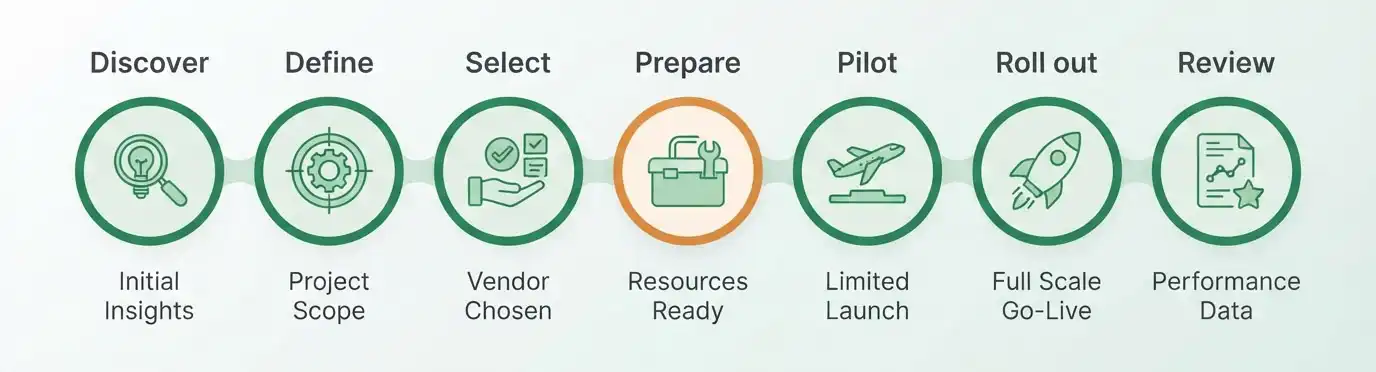
What might a realistic roadmap look like?
The timeline below is an illustration, not a benchmark. Actual durations vary widely with laboratory size, regulation, and system complexity.
| Phase | Focus | Typical outputs |
|---|---|---|
| Discover | Process mapping, baseline, risk ranking | Process map, baseline measures, risk register |
| Define | Requirements and obligations | Requirements list, regulatory mapping |
| Select | Evaluation and supplier review | Scoring sheet, supplier assessment records |
| Prepare | Validation planning, configuration, procedures | Validation plan, draft SOPs, training plan |
| Pilot | One workflow in controlled use | Pilot report, deviations, lessons learned |
| Roll out | Phased expansion and training | Release records, training records |
| Review | Post-go-live assessment | Updated baseline, audit trail review, improvement actions |
What questions should IT teams ask?
IT teams often carry the validation and security workload. Useful questions include:
- How are user accounts, roles, and permissions managed and reviewed?
- How are audit trails protected from alteration, and how can they be exported for review?
- How are backups and restores tested, and how are updates handled under change control?
- Where is data stored, and what happens to it if the laboratory leaves the system?
- How do instrument interfaces handle errors and missing data?
These questions line up with the lifecycle, security, and change-management themes in Annex 11 and the information-management clauses of ISO/IEC 17025.
FAQs
These answers address common questions from laboratory managers and IT teams evaluating reporting workflows. Each one is brief and points to the relevant standard or guidance where a requirement is involved. Always confirm requirements against the current version of the standard or regulation that applies to your laboratory and accreditation scope.
What is a LIMS in the context of laboratory reporting?
A LIMS is a software system that manages samples, tests, results, workflows, and records in a controlled environment. For reporting, it keeps data entry, calculation, review, approval, and report generation in one governed place, so reports draw on approved data and each action leaves a record of who did what and when.
Does using a LIMS make a laboratory ISO/IEC 17025 compliant?
No. ISO/IEC 17025 sets requirements for competence, impartiality, and consistent operation of laboratories. A LIMS can support clauses on technical records, information management, and reporting, but accreditation depends on the whole management system, including validated methods, trained personnel, and demonstrated results. A system helps; it does not certify the laboratory.
What is an audit trail, and why does it matter for reports?
An audit trail is a secure, time-stamped record of who created, changed, or deleted data, and why. It lets reviewers and auditors reconstruct what happened to a result. Annex 11 and 21 CFR Part 11 both address audit trails, and Annex 11 expects them to be available in an intelligible form and regularly reviewed
Do we need a validated system, and how much validation is enough?
ISO/IEC 17025 expects information management systems used for laboratory data to be validated for functionality, including interfaces. Annex 11 expects the extent of validation to follow a documented risk assessment. The right amount depends on system complexity, intended use, and regulatory context, so document your reasoning and keep evidence.
Can a cloud-hosted or externally managed system be used?
Yes, but responsibility stays with the laboratory. ISO/IEC 17025 clause 7.11.4 states that when the information management system is maintained by an external provider, the laboratory must ensure the provider meets the applicable requirements. In practice, this means supplier assessment, clear agreements, and documented oversight rather than assuming the provider handles compliance.
What is the difference between ALCOA and ALCOA+?
FDA's 2018 guidance describes ALCOA: attributable, legible, contemporaneously recorded, original or a true copy, and accurate. ALCOA+ is a widely used extension that adds complete, consistent, enduring, and available. If you are asked which to follow, check the guidance your regulator or accreditation body actually cites for your sector.
Should we fix our paper or spreadsheet process before buying software?
Usually, at least partly. Mapping and clarifying the current process reveals which steps are necessary, which are workarounds, and which risks matter most. Automating a poorly defined process tends to preserve its problems. A short process review, as described above, gives better requirements and a clearer view of what any system must support.
Conclusion
Reliable reports come from reliable data handling. A LIMS streamlines reporting when it enforces consistent capture, review, and release steps on validated, traceable records. Success still depends on clear procedures, trained people, and ongoing review, so the best starting point is an honest look at where your current process loses time or trust.
The recurring theme across ISO/IEC 17025, FDA guidance, EU GMP Annex 11, and OECD GLP guidance is the same: know your data flows, control them according to risk, keep records that can be reconstructed, and keep systems in a validated state. A well-implemented LIMS can make those principles part of everyday work instead of an audit-season project.
Your Next Step: Map One Report from Sample to Release
Use this article as a working checklist. Gather your QA, lab operations, and IT leads for 45 minutes, map one report type from sample to release, and mark every manual copy or unrecorded review. That one-page map gives you an evidence-based starting point for any process improvement or system evaluation.
Ready to simplify your lab reporting?
See how a structured workflow can work in your lab.
Book a Demo
Author: Revol LIMS Team . marketing@revollims.com . www.revollims.com